Hyphen Chart (Rules And Usage With Examples)
What Is a Hyphen?
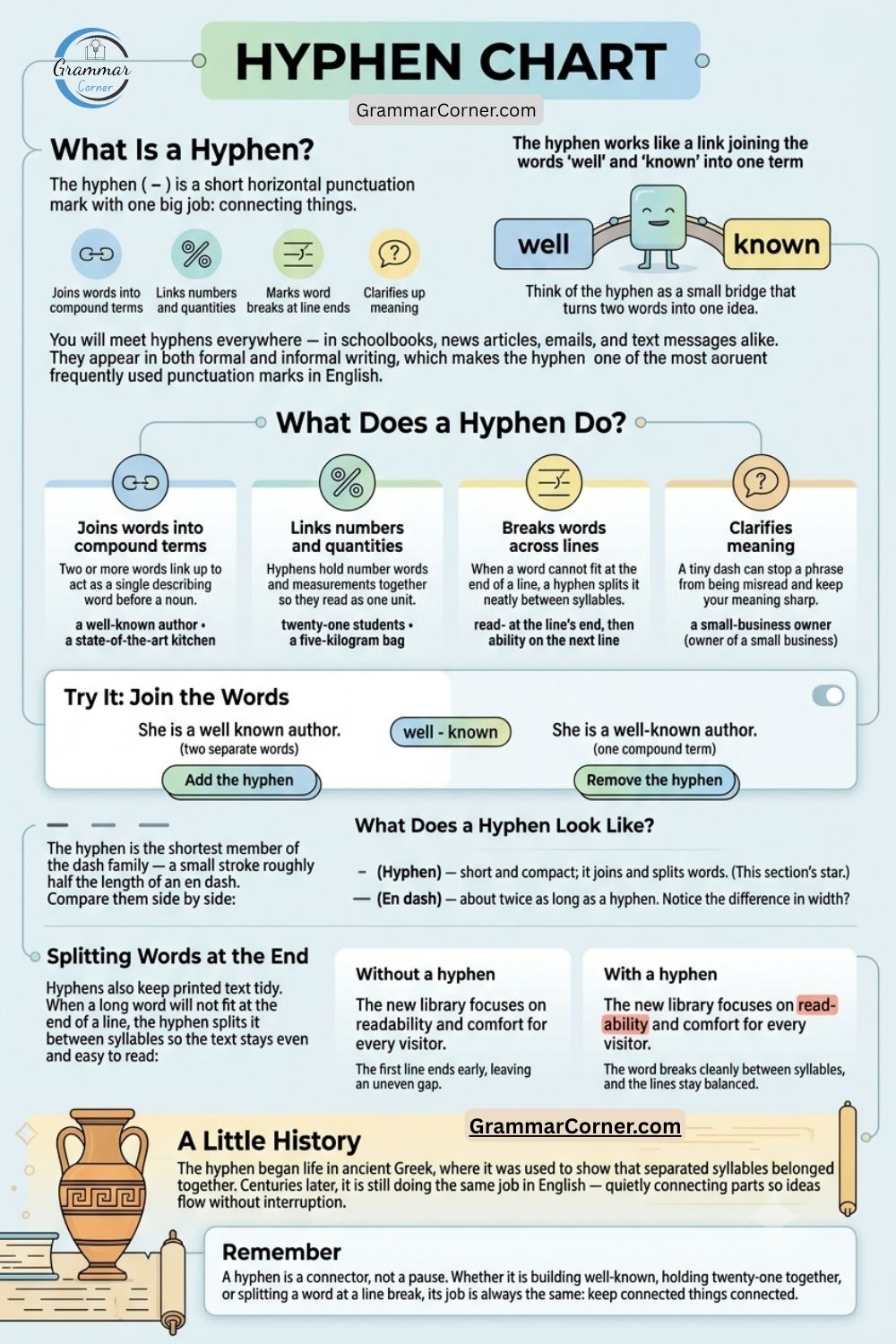
The hyphen (‑) is a short horizontal punctuation mark with one big job: connecting things. It joins words to build compound terms, links numbers and quantities, marks the break in a word that runs out of room at the end of a line, and clears up meaning when words could be read the wrong way.
You will meet hyphens everywhere — in schoolbooks, news articles, emails, and text messages alike. They appear in both formal and informal writing, which makes the hyphen one of the most frequently used punctuation marks in English.
What Does a Hyphen Do?
Two or more words link up to act as a single describing word before a noun.
a well-known author • a state-of-the-art kitchenHyphens hold number words and measurements together so they read as one unit.
twenty-one students • a five-kilogram bagWhen a word cannot fit at the end of a line, a hyphen splits it neatly between syllables.
read– at the line’s end, then ability on the next lineA tiny dash can stop a phrase from being misread and keep your meaning sharp.
a small-business owner (owner of a small business)Try It: Join the Words
She is a well known author. (two separate words)
What Does a Hyphen Look Like?
The hyphen is the shortest member of the dash family — a small stroke roughly half the length of an en dash. Compare them side by side:
Splitting Words at the End of a Line
Hyphens also keep printed text tidy. When a long word will not fit at the end of a line, the hyphen splits it between syllables so the text stays even and easy to read:
readability and comfort for
every visitor.
The first line ends early, leaving an uneven gap.
ability and comfort for every
visitor.
The word breaks cleanly between syllables, and the lines stay balanced.
A Little History The hyphen began life in ancient Greek, where it was used to show that separated syllables belonged together. Centuries later, it is still doing the same job in English — quietly connecting parts so ideas flow without interruption.
Remember A hyphen is a connector, not a pause. Whether it is building well-known, holding twenty-one together, or splitting a word at a line break, its job is always the same: keep connected things connected.
How to Use a Hyphen?
A hyphen’s main job is simple: it joins words together. When two or more words team up to act as a single adjective, verb, or noun, the hyphen is the glue that holds them in place.
That little line does more than connect words, though. It also prevents confusion. Without a hyphen, a reader might pause and wonder which words belong together. And when a long word reaches the end of a line, a hyphen lets it break neatly onto the next one.
Let’s look at how hyphenated compounds work in each role.
Compound Adjectives
The joined words describe a noun as one unit.
- The quick-thinking student rapidly solved the problem.
- The well-known professor gave an insightful lecture.
Compound Verbs
The joined words act together as a single action.
- The political parties have co-sponsored the new bill.
- The professor has co-authored a new research paper.
Compound Nouns
The joined words name one person, thing, or idea.
- The actor signed a major movie-production deal.
- The non-profit organized a successful fundraising gala.
Try It: Join the Words
Tap the hyphen button to see the two words snap together into one compound word.
Remember
A hyphenated compound carries one meaning. “Well-known” isn’t “well” plus “known” — it’s a single adjective meaning famous.
Using Hyphens to Refer to Physical Quantities
Hyphens are also a handy shortcut for writing number ranges and measurements. Instead of writing “two to three inches,” you can simply write “2-3 inches” — shorter, cleaner, and instantly clear.
Thickness, length, width, or height
- The package is 2-3 inches thick.
- The board is 12-15 feet long.
Scores and results
- The final score was 10-7.
- The election results were 52-48.
Distances and travel times
- The trail we hiked was 6-7 miles long.
- The commute is 15-20 minutes by car.
Speeds and weights
- The athlete can run 100-200 meters in under 25 seconds.
- The baby’s weight at birth was 6-7 pounds.
Style note
In everyday writing, the hyphen handles ranges perfectly well. Formal style guides, however, often reserve the slightly longer en dash (–) for number ranges and scores (e.g., 2–3 inches). Follow whichever convention your school, publisher, or workplace prefers — just be consistent.
Using Hyphens to Represent Time Frames
Hyphens help you package time words — hours, minutes, shifts, and contract lengths — into neat, single descriptions. The trick is knowing where the hyphen belongs. Use a hyphen when the time expression sits before a noun and describes it. When the same words come after the noun, leave the hyphen out.
We booked a one-hyphen-hour meeting.
“One-hour” describes the noun “meeting,” so the hyphen glues the two words into one description.
Where hyphenated time frames appear
-
Length of events
- We scheduled a one-hour meeting.
- She hosted a 30-minute webinar.
-
Employment arrangements
- She has a full-time job.
- He works on a part-time basis.
-
Contract and commitment terms
- This is a short-term contract.
- We agreed to a month-to-month lease.
-
Work shifts
- The night-shift workers arrive at 11 p.m.
- She covers the day shift on weekdays. (no hyphen — “day shift” is the noun itself)
Many writers add a hyphen wherever a number meets a time word. Drop the hyphen when the phrase follows the noun or verb:
The meeting will last one-hour. The meeting will last one hour. The webinar runs for 30-minutes. The webinar runs for 30 minutes.For a span of clock times, such as a shift running from 11 p.m. to 7 a.m., formal style guides call for an en dash (11 p.m.–7 a.m.), not a hyphen. In quick, informal writing you will often see a plain hyphen (11pm-7am), and readers understand it — but in polished work, reach for the en dash.
Using Hyphens to Refer to Ages
Hyphens also connect age-related words when they work together as one description. Here are the three patterns you will meet most often:
-
Age ranges
- The discount applies to children ages 5–12.
- The study focused on adults ages 30–45.
-
Life stages
- The woman is in her mid-thirties.
- My cousin is a high-schooler.
-
Tenure lengths
- She is a 10-year veteran of the company.
- He signed a five-year contract.
Strictly speaking, ranges of numbers — like ages 5–12 — take an en dash (–) in formal and published writing. A hyphen (5-12) is extremely common in everyday writing and on the web, so you will see both. If you are writing for school, print, or a style guide, choose the en dash.
The hyphen belongs in 10-year veteran because “10-year” describes the noun “veteran.” When the years simply follow a verb, no hyphen is needed:
He has worked there for 5-years. He has worked there for 5 years. He is a 5-year employee of the firm.Using Hyphens to Indicate Fractions and Compound Numbers
When numbers are written out in words, hyphens bind them into single grammatical units, which makes them faster to read and impossible to misgroup.
-
Fractions written as words
- A two-thirds majority was needed.
- The recipe calls for one-fourth teaspoon of salt.
-
Compound numbers (21–99)
- Twenty-five people attended.
- Thirty-one students enrolled in the course.
-
Percentages written as words
- Fifty-five percent agreed.
- Sixty-eight percent of voters showed up.
Hyphenate every spelled-out number from twenty-one to ninety-nine. In a percentage like fifty-five percent, the hyphen joins the two number words — the word percent itself is never attached with a hyphen.
Using Hyphens in Prefixes and Suffixes
Sometimes a hyphen after a prefix is the only thing standing between two completely different meanings. Compare these real pairs — each one changes meaning the moment the hyphen disappears:
| With Hyphen | Without Hyphen |
|---|---|
| Re-sign — to sign again (She re-signed her contract.) | Resign — to quit a job (She resigned from her post.) |
| Re-cover — to cover again (We re-covered the old sofa.) | Recover — to get better (He recovered from the flu.) |
| Re-creation — the act of creating again (a re-creation of the battle) | Recreation — leisure activity (a park built for recreation) |
| Re-sent — sent again (I re-sent the email.) | Resent — to feel bitter about (He resented the remark.) |
| Re-press — to press again (Re-press the shirt collar.) | Repress — to hold back (She repressed a laugh.) |
Most everyday prefixed words — undo, misplace, overlook, redo — are written as one word with no hyphen. Add the hyphen only when leaving it out would create a different word (as in the pairs above) or make the word genuinely hard to read.
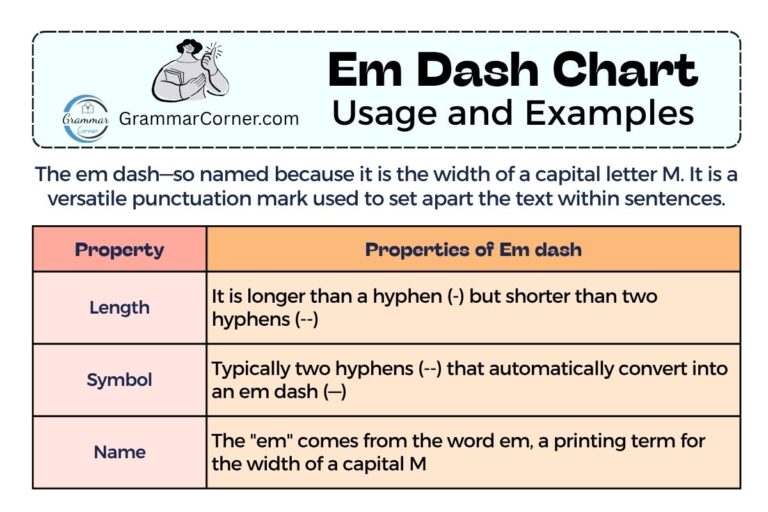
Comparing Hyphens, En Dashes, and Em Dashes
These three horizontal marks look like siblings, but each one has its own job. The easiest way to tell them apart is by length:
| Feature | Hyphen | En Dash | Em Dash |
|---|---|---|---|
| Symbol | – | – | — |
| Main job | Joins words in compound terms | Marks number and date ranges | Sets off parenthetical phrases |
| How common | Very common | Less common | Increasingly common |
| Typical register | Informal and everyday writing | Formal writing | Both formal and informal writing |
Frequently Asked Questions About Hyphen
See also:
- Punctuation Comprehensive Guide
- Apostrophe Rules and Examples
- Exclamation Mark Chart
- Question Mark Rules and Examples
- Quotation Marks Rules and Examples
Q: When is the hyphen used in a compound word?
A: Use hyphens in compound words functioning as adjectives preceding a noun.
Q: Should all compound words be hyphenated?
A: No, only hyphenate compounds when it improves readability.
Q: What’s the difference between a hyphen and en dash?
A: Hyphens join words while en dashes indicate ranges.
Q: Do hyphens change word meaning?
A: Yes, hyphens distinguish meaning in prefixes like re-sign versus resign.
Q: Can words ending in -ly be hyphenated?
A: Avoid hyphenating compounds ending in -ly adverbs like locally owned.
Q: Is there a hyphen in email or ebook?
A: No, words like email and ebook are considered closed compounds and should not be hyphenated.
Q: How long are hyphens?
A: Hyphens are the shortest dash, shorter than both en dashes and em dashes.
Q: Are hyphens informal?
A: Hyphens are appropriate for both formal and informal writing contexts.