Subject-Verb Agreement Chart: A Complete Guide
What Is Subject-Verb Agreement?
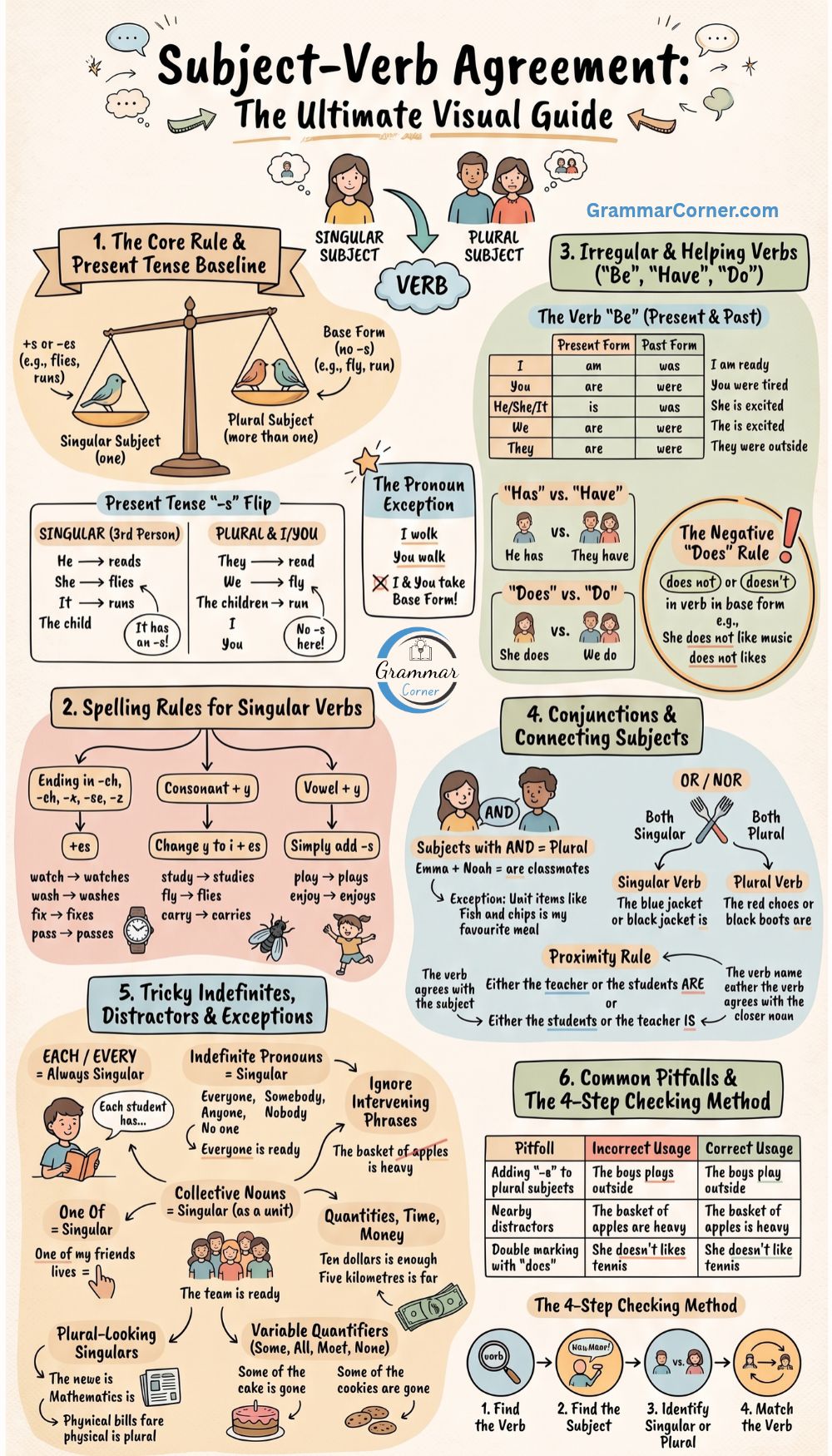
Subject-verb agreement means that the subject of a sentence and its verb must match in number. A singular subject takes a singular verb, while a plural subject takes a plural verb.
Examining Singular vs. Plural Forms
Consider this core comparison:
In the first sentence, bird refers to one bird (singular), so we use the singular verb flies. In the second sentence, birds refers to more than one bird (plural), so we use the plural verb fly.
More Examples of Subject-Verb Agreement
Observe how verbs change form based on whether the subject is singular or plural:
| Singular Subject (Singular Verb) | Plural Subject (Plural Verb) |
|---|---|
| The child runs fast. | The children run fast. |
| Emma reads every evening. | Emma and Noah read every evening. |
| The dog barks loudly. | The dogs bark loudly. |
| My friend likes chess. | My friends like chess. |
✨ Quick Challenge
Which of the following sentences correctly applies standard subject-verb agreement in the present tense? Tap your answer.
See the full answer
Answer: “Emma and Noah read books together every evening.”
Subject-verb agreement breakdown:
- Plural Compound Subject: Emma and Noah = plural (two people) ➔ requires plural verb read (no -s).
- Singular vs. Plural Rule: Singular third-person subjects take verbs ending in -s (“The child runs”, “The dog barks”), while plural subjects take base forms without -s (“The children run”, “My friends like”).
First, Find the Subject
Before choosing a verb, you need to know who or what the sentence is about. That word or group of words is the subject.
Consider how changing the subject from singular to plural changes the required verb:
For example, in “The students practise for the school concert” ➔ Who practises? The students. Because students is plural, practise is the correct verb form.
Singular and Plural Subjects
A singular subject denotes one person, animal, place, thing, or idea, while a plural subject denotes more than one:
Side-by-Side Sentence Comparisons
| Singular Subject (Verb + s) | Plural Subject (Base Verb) |
|---|---|
| The teacher explains the lesson. | The teachers explain the lesson. |
| A cat sleeps on the sofa. | Two cats sleep on the sofa. |
| The computer works well. | The computers work well. |
• More than One (Plural): They walk | They play | They look
What Happens with “I” and “You”?
Important Exception: Do not add -s simply because a subject refers to one person!
The pronouns I and you (even when referring to a single individual) take the base form of the verb in the simple present tense:
• -s Form: He plays football | She plays football | It plays music
❌ Incorrect: I walks to school.
The -s verb form is reserved specifically for he, she, it, and other singular third-person nouns.
✨ Quick Challenge
Apply the “Who or what is doing the action?” test: Which of the following sentences correctly applies present tense subject-verb agreement? Tap your answer.
See the full answer
Answer: “The new computer works perfectly with our design software.”
Subject identification and agreement check:
- Step 1 (Find the Subject): Ask What works? ➔ The new computer (Singular noun = it).
- Step 2 (Select the Verb): A singular third-person subject takes the present tense verb with -s (works).
- Pronoun Reminder: The pronouns I and you take base verbs (“I walk”, “You play”), while plural nouns also take base verbs (“The teachers explain”, “Two cats sleep”).
The Verb “Be”
The verb be changes more than most English verbs across different subjects and tenses. Matching its present and past forms correctly with the subject is fundamental to clear English.
Forms of “Be” in the Present and Past
| Subject | Present Form | Past Form |
|---|---|---|
| I | am (I am ready.) | was (I was tired.) |
| You | are (You are early.) | were (You were tired.) |
| He / She / It | is (She is excited. / It is cold.) | was (He was tired. / She was tired.) |
| We | are (We are classmates.) | were (We were tired.) |
| They | are (They are outside.) | were (They were tired.) |
Subject-Verb Agreement in the Present Tense
The simple present tense is where subject-verb agreement patterns are most evident:
- He writes.
- She runs.
- The boy jumps.
- My sister cooks.
- They write.
- We run.
- The boys jump.
- My sisters cook.
Spelling Rules for Singular Verbs
- watch ➔ watches (The teacher watches the students.)
- wash ➔ washes (My brother washes the dishes.)
- fix ➔ fixes (The machine fixes the problem.)
- pass ➔ passes | teach ➔ teaches | buzz ➔ buzzes
Consonant + y ➔ change y to i and add -es:
- study ➔ studies (Maya studies every evening.)
- fly ➔ flies | carry ➔ carries | try ➔ tries
Vowel + y ➔ simply add -s:
- play ➔ plays (Liam plays tennis.)
- enjoy ➔ enjoys | stay ➔ stays
“Have” vs. “Has” and “Do” vs. “Does”
• Has (Singular 3rd person: he, she, it, singular noun):
- He has a bicycle.
- The school has a large library.
• Have (I, you, we, they, plural nouns):
- I have a question.
- They have three dogs.
• Does (Singular 3rd person):
- She does her homework.
- He does not like spinach.
• Do (I, you, we, they):
- They do their homework.
- We do not play tennis.
Once the helping verb does or doesn’t carries the third-person inflection, the main verb must return to its base form:
❌ Incorrect: She does not likes music. / He doesn’t walks to school.
Subject-Verb Agreement in Questions
In questions, the auxiliary verb moves before the subject. Agreement is determined by the subject that follows:
| Singular Subject (Does / Is / Has) | Plural Subject (Do / Are / Have) |
|---|---|
| Does Mia like science? | Do Mia’s friends like science? |
| Does your brother play chess? | Do your brothers play chess? |
| Is your teacher here? | Are your teachers here? |
| Has Anna finished her project? | Have Anna and Jack finished their projects? |
✨ Quick Challenge
Which of the following sentences correctly applies subject-verb agreement across auxiliary verbs, questions, and negative structures? Tap your answer.
See the full answer
Answer: “Does your sister study biology every afternoon?”
Agreement breakdown:
- Question Agreement: your sister is singular (she) ➔ requires Does. The main verb study remains in its base form.
- Common Pitfalls:
• Double-marking the verb: “does not carries” ➔ should be “does not carry”.
• Compound plural subjects: “Anna and Jack” ➔ requires Have, not Has.
• Past tense plural with “Be”: “The puppies” ➔ requires were, not was.
Compound Subjects Joined by “And”
When two or more individual subjects are connected by “and”, they join together to form a plural subject. As a result, they require a plural verb.
Think of “and” as an addition sign combining elements:
- Emma and Noah (Emma + Noah = 2 people) ➔ are classmates.
- The cat and the dog ➔ play together.
- My brother and sister ➔ enjoy swimming.
Occasionally, two nouns joined by “and” refer to a single combined dish, object, or concept. In these cases, use a singular verb:
• “Fish and chips is my favourite meal.” (Treated as one complete dish).
Subjects Joined by “Or” or “Nor”
When subjects are connected using “or” or “nor”, agreement is determined by the components:
Use a singular verb:
“The blue jacket or the black jacket is in the closet.”
Use a plural verb:
“The red shoes or the black boots are in the closet.”
The Proximity Rule (Singular + Plural Mixed)
When one subject is singular and the other is plural, the verb agrees with the subject closest to it:
(Closest subject is students [plural] ➔ are)
(Closest subject is teacher [singular] ➔ is)
“Each” and “Every” Are Always Singular
Words like each and every distribute focus onto individual items one at a time. They always take a singular verb:
| Pattern | Example Sentence |
|---|---|
| Each + singular noun | Each student has a notebook. |
| Every + singular noun | Every child needs a pencil. |
| Each + of the + plural noun | Each of the students has a book. |
| Every + room | Every room has a window. |
Note: In phrases like “Each of the students has…”, do not be distracted by the plural word “students”—the true grammatical subject remains the singular pronoun Each.
Singular Indefinite Pronouns
Indefinite pronouns refer to unspecified people or things. In standard English grammar, these pronouns are treated as singular and take singular verbs:
- Everyone is ready.
- Someone has left a backpack here.
- Nobody knows the answer.
- Each needs a ticket.
- ✔ Everyone is (not everyone are)
- ✔ Someone has (not someone have)
- ✔ Nobody knows (not nobody know)
Don’t Be Tricked by Extra Intervening Words
Words that come between the subject and the verb (such as prepositional phrases) do not change the number of the subject.
In “The box of crayons is on the desk,” the true subject is box (singular), not crayons.
• “The teacher,
More Examples of Prepositional Filtering:
- The students in the classroom are quiet.
- The collection of stamps is valuable.
- The books on the table are mine.
“One of” Is Always Singular
The phrase “one of” is another frequent agreement trap. The noun following “one of” is plural, but the grammatical subject is strictly one (singular):
Quick Concept Review
Keep these five core principles in mind when selecting verbs:
- One of the students ➔ is (Subject is One).
- The box of pencils ➔ is (Subject is box).
- Everyone ➔ has (Indefinite pronouns are singular).
- My friends ➔ like (Plural subject takes base verb).
- Either the coach or the players ➔ are (Agrees with nearest subject players).
Collective Nouns
A collective noun names a group of people, animals, or things. When the entire group acts together as a single unit, it takes a singular verb in standard American English.
- The team is ready for the match.
- The class works quietly.
- The family lives in Toronto.
Uncountable Nouns Usually Take Singular Verbs
Some nouns cannot be counted as separate, individual items. Because they cannot be pluralized in standard usage, they always take singular verbs:
- The information is useful.
- The furniture looks new.
- The music sounds beautiful.
- My homework is finished.
Even when describing large amounts, the verb remains singular:
❌ Incorrect: The water are cold.
Amounts of Money
Determining the verb depends on whether you are referring to a total financial value or physical currency:
“Ten dollars is enough for lunch.”
“Fifty dollars is a lot to spend on a notebook.”
“Ten-dollar bills are scattered across the table.”
Time, Distance, and Measurement
When a period of time, distance, weight, or quantity is considered as a single continuous measurement or unit, use a singular verb:
| Measurement Type | Example Sentence |
|---|---|
| Time Period | Five years is a long time. / Two hours is enough time for the film. |
| Distance | Ten kilometres is too far to walk today. |
| Weight / Mass | Twenty kilograms is the maximum baggage weight. |
“There Is” vs. “There Are”
In sentences introduced by there, the real grammatical subject follows the verb. Agreement depends directly on the noun that comes after:
- There is a book on the desk.
- There is a problem with the computer.
- There are three books on the desk.
- There are several problems with the computer.
Plural-Looking Words That Are Singular
Several nouns end in -s but refer to a single subject, field of study, or concept, and therefore require a singular verb:
- The news is surprising. (news = singular concept)
- Mathematics is my favourite subject.
- Physics is difficult for some students.
✨ Quick Challenge
Which of the following sentences correctly applies subject-verb agreement with measurements, uncountable nouns, or inverted structures? Tap your answer.
See the full answer
Answer: “Three weeks is a long holiday for our team.”
Breakdown of key agreement principles:
- Measurement Units as One Whole: Quantities of time (three weeks), money (fifty dollars), and distance (ten kilometres) function as single units of measurement ➔ takes singular verb is.
- Uncountable Nouns: Words like information, furniture, water, and advice are non-count ➔ takes singular verb is / looks.
- Academic Subjects Ending in -s: Mathematics, physics, civics, and economics are singular disciplines ➔ takes is.
- Inverted There-sentences: There are five birds… matches the following plural noun birds.
Words That Usually Take Plural Verbs
Certain nouns refer to items that consist of two connected parts. These words are treated as plural and take plural verbs.
- The scissors are on the desk.
- My trousers are wet.
- These glasses are new.
If you add the phrase a pair of, the word pair becomes the actual singular subject:
• This pair of trousers is too large.
“Some,” “All,” “Most,” and “None”
Indefinite quantity words like some, all, most, and none can take either singular or plural verbs based on the noun that follows in the prepositional phrase:
| Singular / Uncountable Reference | Plural Countable Reference |
|---|---|
| Some of the cake is gone. | Some of the cookies are gone. |
| All of the water is cold. | All of the students are ready. |
| Most of the book is interesting. | Most of the books are interesting. |
• If the noun is uncountable/singular (e.g., cake, water, book) ➔ use a singular verb.
• If the noun is plural countable (e.g., cookies, students, books) ➔ use a plural verb.
Subject-Verb Agreement Across Tenses
1. Simple Past Tense
For most regular and irregular verbs in the simple past tense, the verb form remains identical for both singular and plural subjects:
Exception with “Be”: The verb be changes in the past tense (was for singular subjects; were for plural subjects and you):
• He was late. vs. They were late.
2. Future Tense
In the simple future tense, the modal auxiliary will stays identical for singular and plural subjects, followed by the bare base verb:
- She will travel tomorrow. / They will travel tomorrow.
- The dog will sleep outside. / The dogs will sleep outside.
3. Present Perfect Tense
In the present perfect tense, the auxiliary verb must match the subject in number:
- Daniel has finished his homework.
- The girl has arrived.
- The students have finished their homework.
- The girls have arrived.
Why Does Subject-Verb Agreement Matter?
Subject-verb agreement ensures sentences sound natural and convey ideas clearly without jarring structural errors:
Applying accurate subject-verb agreement sharpens your communication across every writing and speaking format:
Common Mistakes to Avoid
Here are seven of the most frequent subject-verb agreement pitfalls and how to correct them:
✅ Correct: The boys play outside.
✅ Correct: The girl walks to school.
✅ Correct: The basket of apples is heavy.
✅ Correct: Everyone is ready.
✅ Correct: They have a new teacher.
✅ Correct: She doesn’t like tennis.
✅ Correct: There are three books on the table.
A Simple Method for Checking Your Sentences
Whenever you are uncertain about choosing the right verb form, follow this reliable 4-step checking method:
Ask: What is the action or state?
In “The little birds sing every morning” ➔ Verb = sing.
Ask: Who or what is performing the action?
Who sings? ➔ Subject = birds.
Determine the number: birds refers to more than one ➔ plural.
Plural subject ➔ takes the base verb sing.
➔ The little birds sing every morning.
A Quick Subject-Verb Agreement Checklist
Before completing any piece of writing, run through this quick checklist to catch hidden agreement errors:
- ✔ What is the true subject of the clause?
- ✔ What is the main verb?
- ✔ Is the subject singular or plural?
- ✔ Does the verb form properly match the subject’s number?
- ✔ Are there intervening prepositional phrases (e.g., of, with, in) that might distract from the real subject?
- ✔ Are helping verbs (is/are, was/were, has/have, do/does) correctly paired?
- ✔ If the sentence begins with “there is” or “there are”, does the verb match the noun that follows?
Practice: Can You Fix the Sentences?
Test your agreement skills on these ten practice questions before reviewing the answers below.
- The dog (bark / barks) at strangers.
- The dogs (bark / barks) at strangers.
- My sister (enjoy / enjoys) painting.
- My friends (enjoy / enjoys) painting.
- Everyone (is / are) invited.
- The books on the shelf (is / are) dusty.
- The book on the shelves (is / are) dusty.
- Sarah and Mia (plays / play) volleyball.
- The teacher (has / have) a question.
- The teachers (has / have) a meeting.
Answer Key & Explanations
| # | Correct Verb | Grammatical Reason |
|---|---|---|
| 1 | barks | The dog is singular (requires -s verb). |
| 2 | bark | The dogs is plural (requires base verb). |
| 3 | enjoys | My sister is a singular third-person subject. |
| 4 | enjoy | My friends is plural. |
| 5 | is | Everyone is a singular indefinite pronoun. |
| 6 | are | The true subject is plural: The books (ignore on the shelf). |
| 7 | is | The true subject is singular: The book (ignore on the shelves). |
| 8 | play | Sarah and Mia form a compound plural subject joined by and. |
| 9 | has | The teacher is a singular subject. |
| 10 | have | The teachers is a plural subject. |
Practice: Find the Subject
Sometimes the hardest part of subject-verb agreement is not choosing the verb—it is locating the true subject amid prepositional phrases and modifying clauses.
Identify the true subject in each of the following sentences:
- The group of children is waiting outside.
- One of the players has scored a goal.
- The books on the wooden table are mine.
- Everyone in the classroom is excited.
- The basket of fresh oranges looks delicious.
Answers & Subject Analysis
| # | True Subject | Intervening Phrase (Ignore) | Why It Agrees |
|---|---|---|---|
| 1 | group (Singular) | of children | Singular subject takes is. |
| 2 | one (Singular) | of the players | Singular subject takes has. |
| 3 | books (Plural) | on the wooden table | Plural subject takes are. |
| 4 | everyone (Singular) | in the classroom | Singular indefinite pronoun takes is. |
| 5 | basket (Singular) | of fresh oranges | Singular subject takes looks. |
Subject-Verb Agreement: The Big Picture
The Core Principle: The verb must always match its subject in number and person.
Here is a comprehensive summary of all major subject-verb agreement patterns:
| Grammatical Situation | Example Sentence |
|---|---|
| Singular subject | The child plays. |
| Plural subject | The children play. |
| He / She / It (Third person) | She writes. |
| I / You / We / They | They write. |
| Singular “be” | He is happy. / He was happy. |
| Plural “be” | They are happy. / They were happy. |
| Singular “have” | She has a book. |
| Plural “have” | They have books. |
| Two subjects joined with “and” | Tom and Lily are here. |
| “Each” or “every” | Every student has a pencil. |
| “Everyone” / Indefinite pronouns | Everyone is ready. |
| “There is” | There is one answer. |
| “There are” | There are many answers. |
| Amount as one whole unit | Ten minutes is enough. |
| Subject with an extra phrase | The box of toys is heavy. |
Final Challenge: Put It All Together
Test your comprehensive mastery of subject-verb agreement across all rules by choosing the correct verb in each sentence:
- The group of students (is / are) ready for the trip.
- My brother (play / plays) the guitar.
- The children (enjoy / enjoys) the science museum.
- Everyone (want / wants) to participate.
- There (is / are) several books on the desk.
- One of the players (has / have) forgotten the ball.
- Emma and Oliver (is / are) visiting the library.
- Five kilometres (is / are) a long walk for a young child.
- Neither the teacher nor the students (was / were) late.
- She (doesn’t like / doesn’t likes) rainy weather.
Answer Key & Explanations
| # | Correct Option | Grammatical Reason |
|---|---|---|
| 1 | is | The singular subject is group (ignore of students). |
| 2 | plays | My brother is a singular third-person subject. |
| 3 | enjoy | The children is an irregular plural subject. |
| 4 | wants | Everyone is a singular indefinite pronoun. |
| 5 | are | Inverted structure agrees with following plural noun: several books. |
| 6 | has | The singular subject is One (ignore of the players). |
| 7 | are | Emma and Oliver form a plural compound subject joined by and. |
| 8 | is | Five kilometres is treated as a single unit of distance measurement. |
| 9 | were | With neither… nor, the verb agrees with the closest subject (students). |
| 10 | doesn’t like | After auxiliary doesn’t, the main verb reverts to base form (like). |