Periods | Full Stop Chart (Rules and Examples)
Punctuation made simple
The Period (Full Stop). A Small Dot with a Big Job
The period is usually the first punctuation mark we ever learn, and it stays with us for life. On the page it looks like almost nothing — a single dot resting on the line. Yet that tiny dot carries real responsibility. A period tells the reader, “This sentence is finished. Take a breath, then move on.”
Without periods, writing would turn into one endless stream of words. The reader would never know where one idea stops and the next one begins.
See What Happens When the Periods Disappear
The fastest way to understand why the period matters is to read a few lines without it. Try the demo below, then bring the periods back and feel the difference.
the rain stopped just after lunch amir grabbed his kite and ran to the park the wind was perfect his kite climbed higher than the trees
Hard to follow, isn’t it? Your eyes have nowhere to rest, so every idea blurs into the next.
How to Use This Guide
Understanding the period is easiest when you take it one step at a time, and that’s exactly how this guide is arranged. Here’s the path we’ll follow:
-
What a period is
A clear, beginner-friendly definition of the mark and its main job.
-
Why it matters
How this one dot keeps writing readable, calm, and easy to follow.
-
The essential rules
The uses that matter most in everyday writing, with plenty of examples.
-
Common mistakes
The errors writers make most often — and simple ways to avoid them.
By the end, you’ll know exactly when to use a period, and you’ll use it with confidence.
One Mark, Two Names
Before we go further, let’s clear up a question that confuses many learners: is a “period” different from a “full stop”? Not at all. They’re two names for exactly the same mark.
American English
period
This is the everyday name in the United States. American teachers, style guides, and dictionaries all use it.
British English
full stop
This is the usual name in the UK and in many countries that follow British usage, such as India, Australia, and Pakistan.
Same dot · same job · almost the same rules
The two traditions follow nearly identical rules. The few small differences — mostly in how abbreviations are punctuated — are easy to learn, and I’ll point them out as we reach them. In this article, I’ll mainly say period, but everything applies equally to the full stop.
Remember
A period marks the end of a complete thought. If your sentence makes a statement and finishes an idea, close it with a period — nothing more is needed.
Quick Check: Did That Sink In?
Warm-up quiz
Three quick questions before we move on. Tap an answer to see instant feedback.
1. What does a period tell the reader?
2. In British English, the period is usually called the…
3. Which statement is true?
The Small Mark With a Big Job
Why Is the Period Important?
The period may be tiny, but it does some of the heaviest lifting in English writing. Here are four reasons it matters so much.
It creates clear boundaries
Every sentence needs an ending. The period gives your reader a clean stopping point, so one idea never blurs into the next.
It controls the rhythm of your writing
Periods create natural pauses. Short sentences with frequent periods feel quick and punchy. Longer sentences feel slower and more thoughtful. Good writers use this on purpose.
It prevents confusion
Missing periods lead to run-on sentences, which are hard to follow. A well-placed period keeps your meaning sharp.
It signals professionalism
In emails, reports, and essays, correct punctuation shows care and attention. Sloppy punctuation can make even good ideas look careless.
Hear the Rhythm for Yourself
Notice how the placement of periods changes the pace of these two lines.
The door opened. Nobody spoke. We waited.
Frequent periods make the writing feel fast, tense, and direct.
The door opened slowly while we sat in silence, waiting to see who would step inside.
One long sentence with a single period feels calmer and more reflective.
Try It: Fix the Run-On
This sentence is missing its periods, so the ideas run together. Tap each dashed box to add a period and watch the sentence become readable.
I finished the report I sent it to my boss she was happy
If your reader has to go back and reread a sentence to work out where one idea ends and the next begins, a missing period is usually the reason.
Quick Check
1. What happens when periods are missing from writing?
2. How do short sentences with frequent periods usually feel to a reader?
3. Why does correct punctuation matter in emails, reports, and essays?
Appearance and Structure
Let’s look at the mark itself.
How It Looks
A period is a single, small dot that sits right on the baseline of your text — the invisible line your letters rest on. It’s actually the exact same dot you already see at the bottom of a lowercase i or j.
The period, the dot over an i, and the dot over a j are all the same mark — only their position changes their job.
Where It Appears
A period goes at the end of a sentence, with no space before it and exactly one space after it, before the next sentence begins.
We won the game. Everyone cheered.
We won the game .Everyone cheered.
Keyboard Symbol
On almost every keyboard, the period shares a key with the “greater than” symbol (>), usually just to the right of the comma. You press it directly — no need to hold Shift.
The comma and period usually sit side by side. The small character in the corner (>) only appears when you hold Shift — the period itself needs no Shift key at all.
Unicode and Technical Detail
In computing, the standard period has its own official code: U+002E, named FULL STOP in the Unicode standard. It’s the very same character used to end sentences, and also to structure file names and web addresses.
Typing Tip
Remember
For decades, typists were taught to leave two spaces after a period — a habit left over from old typewriters. Today, nearly every style guide recommends just one space after a period. Stick with one.
Main Functions of the Period
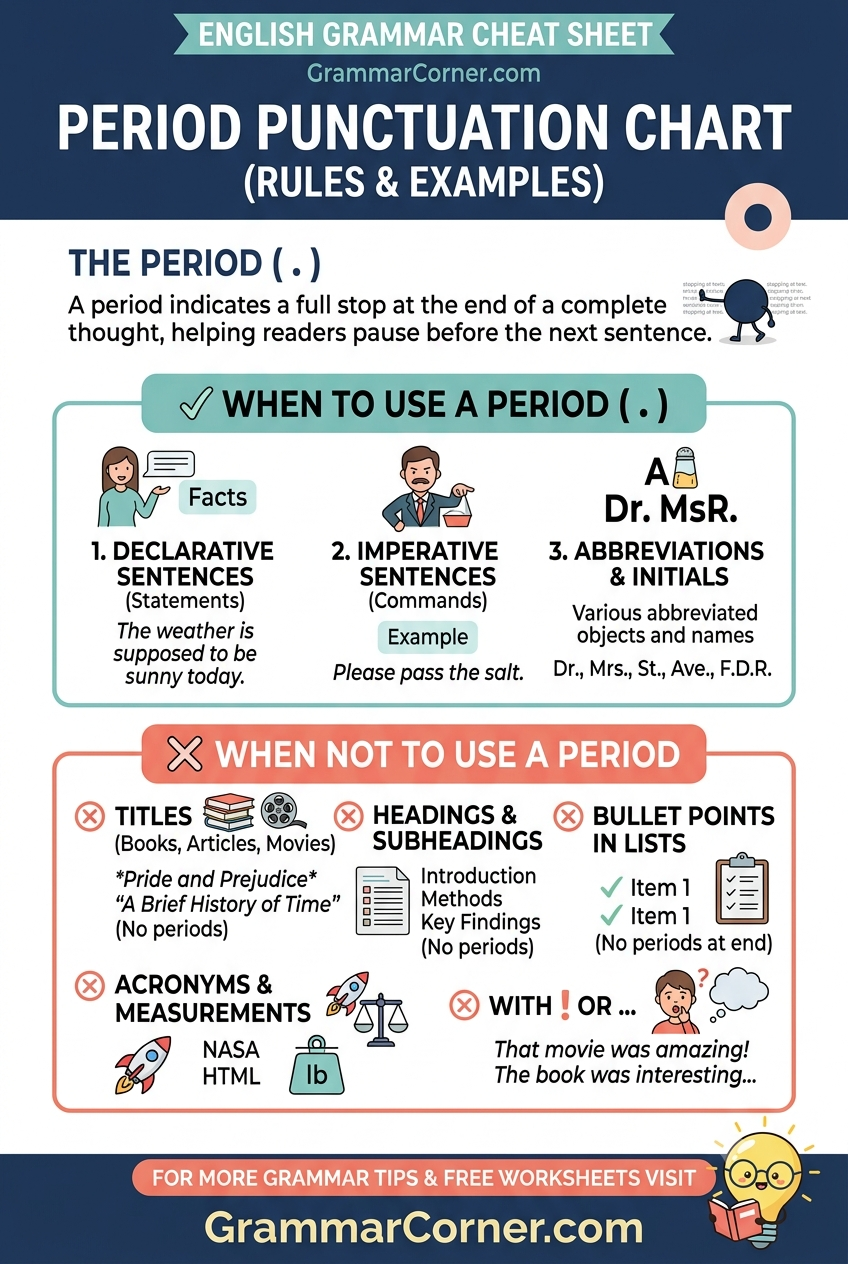
The period has three main jobs. Let’s take them one at a time.
-
1
Ending a Statement
(a Declarative Sentence)
This is the period’s most common job. A statement simply tells the reader something.
- The library closes at nine.
- My sister lives in Toronto.
- Water boils at 100 degrees Celsius.
Each of these sentences shares information, so each one ends with a period.
Quick trick
Ask yourself: “Does this sentence just tell me something?” If yes, it ends with a period.
-
2
Ending a Command or Request
(a Mild Imperative)
When you tell someone to do something in a calm, ordinary way, you end it with a period — not an exclamation mark.
- Please close the door.
- Turn left at the second light.
- Remember to bring your ID.
Remember: if the command is shouted or shows strong emotion, use an exclamation mark instead — Stop right there! For normal instructions, though, the period is correct.
Quick trick
Say the sentence out loud in your head. Calm voice? Use a period. Shouting? Use an exclamation mark.
-
3
Marking Abbreviations
Periods often appear inside or after shortened words. This tells the reader that letters have been left out.
- Dr. Ahmed will see you now.Dr. = Doctor
- The meeting starts at 10 a.m.
- She has a Ph.D. in chemistry.
Quick trick
Whenever letters are missing from a word, expect a period marking the cut.
Note that not every abbreviation uses periods — and this is one of the biggest differences between American and British English, explained in the rules below.
Rules for Using Periods
Here are the practical rules that will cover almost everything you write.
End every complete statement with a period.
If your sentence makes a statement and isn’t a question or an exclamation, it ends with a period.
End calm commands with a period.
A normal, everyday instruction — not a shout — ends the same way a statement does.
Use one space after a period, never before it.
A period sits right against the last letter of the sentence, then a single space introduces the next one.
Handle abbreviations by style — and know the British/American split.
American English tends to use periods in titles and abbreviations. British English often drops them, especially when the abbreviation ends with the same letter as the full word.
- Mister Mr. Mr
- Doctor Dr. Dr
- et cetera etc. etc.
- United States U.S. / US US
Pick one system and stay consistent throughout a document.
Rules for Using Periods
Here are the practical rules that will cover almost everything you write.
End every complete statement with a period.
If your sentence makes a statement and isn’t a question or an exclamation, it ends with a period.
✅The train was late again.
End calm commands with a period.
An instruction given in a level, everyday tone gets a period too, not an exclamation mark.
✅Please sign at the bottom.
Use one space after a period, never before it.
The period sits right against the last word of the sentence, then a single space begins the next one.
✅I agree. Let’s begin.
❌I agree .Let’s begin.
Handle abbreviations by style — and know the British/American split.
American English tends to keep periods in titles and abbreviations. British English often drops them, especially when the short form ends in the same letter as the full word.
Quick reference: American vs. British abbreviations
Notice “etc.” keeps its period on both sides of the Atlantic — it’s a shortened word, not a contraction ending in the same letter as “cetera,” so the period stays.
When (and When Not) to Use a Period
Use a Period
- Your sentence is a statement: The results were surprising.
- It’s a calm command or instruction: Fill in your name here.
- You’re writing an indirect question (a question reported as a statement): She asked whether the office was open. It ends in a period, not a question mark, because it reports a question instead of asking one.
- You’re using an abbreviation that calls for one: We landed at 6 p.m.
Skip the Period
- Your sentence is a direct question — use a question mark: Where are my keys?
- Your sentence shows strong feeling — use an exclamation mark: That’s amazing!
- The sentence already ends with ? or ! — don’t add a period on top.
- Most acronyms — modern usage drops the periods: NASA, FBI, USA, UNESCO, not N.A.S.A.
- Metric symbols and most units: 5 kg, 10 km, 30 m take no period.
- Mid-sentence — a period there creates a fragment. More on that just below.
Remember: a period marks a complete, level thought. If the sentence is asking something, exclaiming something, or already wearing its own end mark, the period stays out of it.
Common Mistakes
These are the errors I see most often, especially from newer writers and English learners. Tap “Show the fix” to see each one corrected.
The Run-On Sentence
Two complete thoughts joined with no period (and no proper connector).
❌I love cooking I make dinner every night.
✅I love cooking. I make dinner every night.
Read your sentence out loud. If you naturally pause and take a breath in the middle, you probably need a period (or another mark) there.
The Sentence Fragment
The opposite problem — a period placed after an incomplete thought.
❌Because I was tired.
✅I went home early because I was tired.
Ask yourself: “Does this group of words stand on its own?” If it can’t, it isn’t a full sentence yet.
The Comma Splice
Two full sentences joined by a comma when a period was needed.
❌The movie was long, we still enjoyed it.
✅The movie was long. We still enjoyed it.
Doubling Punctuation
Stacking a period on top of another end mark that’s already there.
❌Are you coming?.
✅Are you coming?
One end mark is enough. The question mark already finishes the sentence.
Spacing Errors
Missing the single space that should follow a period.
❌Let’s go.It’s late.
✅Let’s go. It’s late.
Back to Rule 3: one space after the period, none before it.
Adding a Second Period After an Abbreviation
When an abbreviation’s period lands at the very end of the sentence, it isn’t doubled.
❌The parcel arrives at noon on Fri..
✅The parcel arrives at noon on Fri.
The abbreviation’s period pulls double duty and also closes the sentence.
See also: