Past Participles (Structure, Rules and Examples)
What Is a Past Participle?
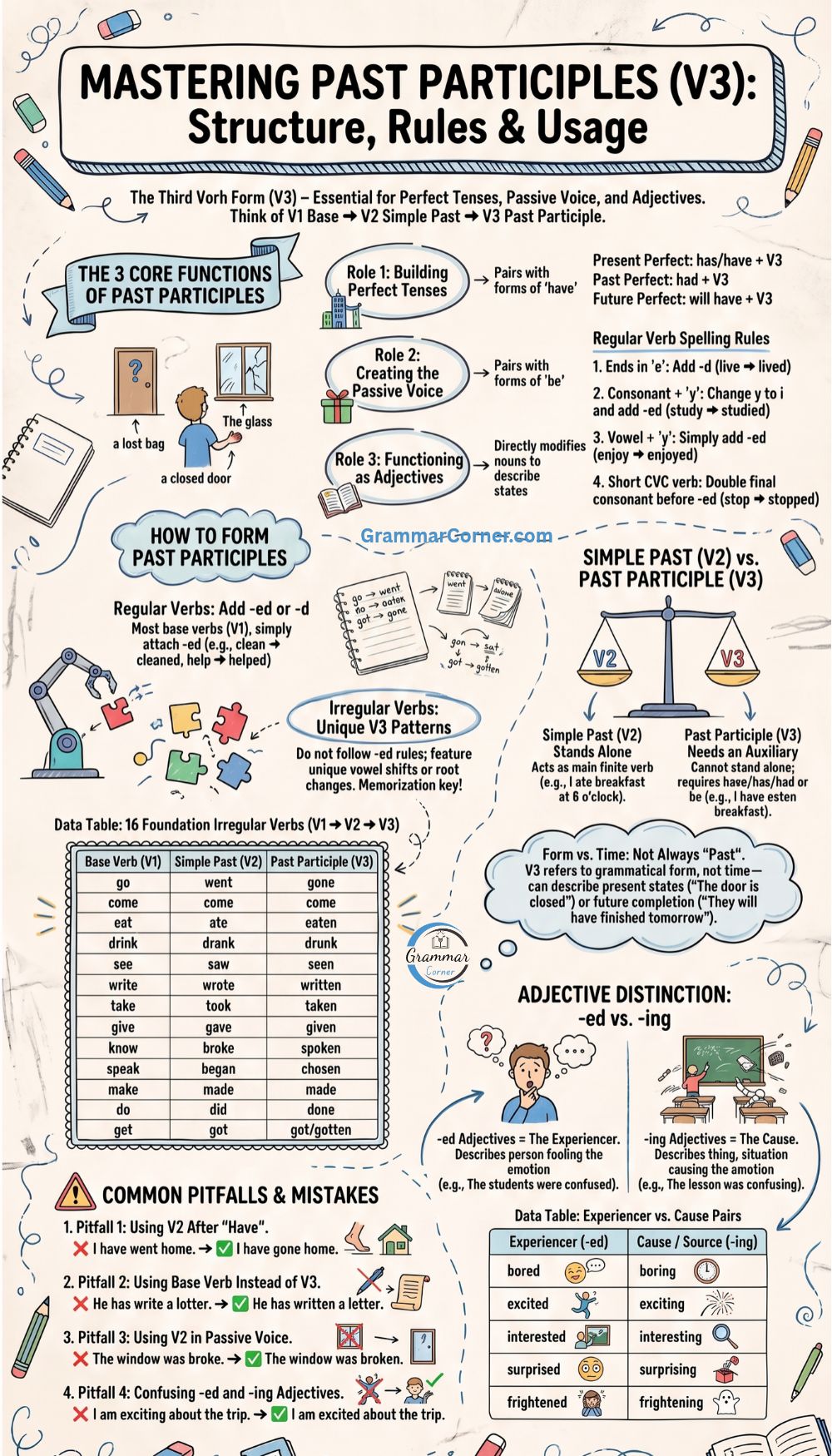
A past participle is a special non-finite verb form used across multiple core grammatical structures in English. It forms the backbone of perfect tenses, the passive voice, and participial adjectives.
Where Do We Use Past Participles?
The past participle plays four essential roles in English grammar:
Present, past, and future perfect (“I have eaten”).
Action received by the subject (“The door was opened”).
Describing states or nouns (“a broken window”).
Standard third entry in dictionary verb conjugation tables.
Regular vs. Irregular Past Participles
- play ➔ played
- clean ➔ cleaned
- open ➔ opened
- watch ➔ watched
- work ➔ worked
- eat ➔ eaten
- write ➔ written
- go ➔ gone
- break ➔ broken
- take ➔ taken
The Three Principal Verb Forms (V1, V2, V3)
English verb reference charts organize verbs into three principal parts:
| V1 Base Verb (Infinitive) | V2 Simple Past | V3 Past Participle |
|---|---|---|
| play | played | played |
| work | worked | worked |
| eat | ate | eaten |
| write | wrote | written |
| go | went | gone |
| take | took | taken |
| break | broke | broken |
Past Simple vs. Past Participle: Don’t Confuse Them!
Quick Challenge
Which of the following represents the correct past participle (V3) form of the irregular verb “write”? Tap your answer.
See the full explanation
Answer: C. written
Breakdown of the three verb forms for write:
- Base Form (V1): write (“I write emails daily.”)
- Simple Past (V2): wrote (“I wrote an email yesterday.”)
- Past Participle (V3): written (“The email has been written.” / “I have written the report.”)
How to Form the Past Participle
To build the past participle in English, verbs are divided into two main categories: regular verbs (which follow predictable spelling patterns) and irregular verbs (which have unique third forms).
Form both the simple past and past participle by adding -ed or -d.
Do not follow a single rule; must be memorized individually through usage tables.
Regular Verbs (Base Verb + -ed)
For most regular verbs, the past participle is identical to the simple past form:
| Base Verb (V1) | Past Participle (V3) |
|---|---|
| clean | cleaned (“I have cleaned my room.”) |
| jump | jumped (“The cat has jumped over the fence.”) |
| help | helped (“She has helped her brother.”) |
| wash | washed (“He has washed the car.”) |
| visit | visited (“She has visited her grandmother.”) |
| play | played (“They have played football.”) |
Regular Verb Spelling Rules
While most regular verbs simply attach -ed, specific ending letters require adjustments:
If the base verb already ends in e, only add -d:
- live ➔ lived (“She has lived here for five years.”)
- love ➔ loved | dance ➔ danced | close ➔ closed
If preceded by a consonant, change y to i and add -ed:
- study ➔ studied (“He has studied English for two years.”)
- carry ➔ carried | cry ➔ cried | try ➔ tried
If preceded by a vowel (a, e, i, o, u), do not change the y:
- enjoy ➔ enjoyed (“We have enjoyed the trip.”)
- play ➔ played | stay ➔ stayed
Short one-syllable verbs (consonant-vowel-consonant) double the final letter:
- stop ➔ stopped
- plan ➔ planned
- shop ➔ shopped
Quick Challenge
Which of the following correctly completes the present perfect sentence: “Sara has ______ English for three years.”? Tap your answer.
See the full explanation
Answer: B. studied
Spelling and grammar breakdown:
- Tense Requirement:
has + past participleforms the present perfect tense. - Spelling Rule (Consonant + y): The verb study ends in the consonant d followed by y. Drop the y and add -ied ➔ studied.
- Complete Sentence: “Sara has studied English for three years.”
Irregular Past Participles
Unlike regular verbs, irregular verbs do not follow the standard -ed pattern. Their past participles (V3) often feature vowel shifts, unique consonant endings, or distinct root changes.
How Can I Learn Irregular Past Participles?
Because irregular verbs do not follow a single rule, the most effective strategy is gradual, chunked practice in full context:
- go ➔ went ➔ gone (“I have gone home.”)
- eat ➔ ate ➔ eaten (“She has eaten lunch.”)
- write ➔ wrote ➔ written (“He has written a story.”)
- take ➔ took ➔ taken (“They have taken the bus.”)
- see ➔ saw ➔ seen (“We have seen that movie.”)
- break ➔ broke ➔ broken (“The vase has broken.”)
Common Irregular Past Participle Reference Table
Study these high-frequency irregular verbs across their three principal parts:
| V1 Base Verb | V2 Simple Past | V3 Past Participle |
|---|---|---|
| be | was / were | been |
| become | became | become |
| begin | began | begun |
| break | broke | broken |
| bring | brought | brought |
| buy | bought | bought |
| come | came | come |
| do | did | done |
| drink | drank | drunk |
| drive | drove | driven |
| eat | ate | eaten |
| fall | fell | fallen |
| feel | felt | felt |
| find | found | found |
| fly | flew | flown |
| forget | forgot | forgotten |
| get | got | got / gotten* |
| give | gave | given |
| go | went | gone |
| know | knew | known |
| make | made | made |
| read | read | read |
| run | ran | run |
| see | saw | seen |
| sing | sang | sung |
| speak | spoke | spoken |
| swim | swam | swum |
| take | took | taken |
| teach | taught | taught |
| tell | told | told |
| think | thought | thought |
| understand | understood | understood |
| wear | wore | worn |
| win | won | won |
| write | wrote | written |
*Note: Gotten is widely used in American English, while got is standard in British English for many past participle constructions.
How Are Past Participles Used?
A single past participle form can execute different grammatical functions depending on the surrounding sentence structure:
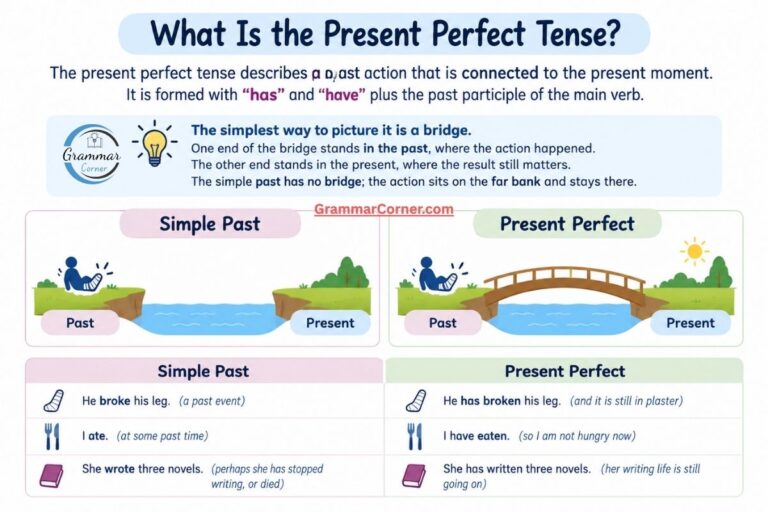
- 1. Perfect Tense: “The boy has broken the glass.” (Forms the present perfect with has).
- 2. Passive Voice: “The glass was broken by the boy.” (Receives the action after was).
- 3. Participial Adjective: “There is a broken glass on the floor.” (Directly describes the noun glass).
Past Participles in Perfect Tenses
The core framework for all perfect tenses pairs an auxiliary form of have with the past participle (V3):
- I have finished my homework.
- She has written a letter.
- They have gone home.
- We have eaten lunch.
✅ Yes: She has written
- I had finished my homework before dinner.
- She had gone home before I arrived.
- They had eaten before the movie started.
- I will have finished the work by tomorrow.
- She will have returned by Monday.
- They will have completed the project by next week.
Quick Challenge
Which of the following sentences correctly uses the irregular past participle in the present perfect tense? Tap your answer.
See the full explanation
Answer: “Have you ever eaten sushi at this restaurant?”
Grammar rule breakdown:
- Auxiliary Requirement: Present perfect questions begin with
Have / Has + Subject + V3 (Past Participle). - Conjugation Form: eat (V1) ➔ ate (V2) ➔ eaten (V3).
- Avoid Simple Past Substitution: Never use the V2 form (ate, saw, wrote, went) immediately following have / has / had.
Past Participles in the Passive Voice
Past participles are essential for constructing the passive voice, where the subject receives the action rather than performing it.
- The cake was eaten by the children.
- The letter was written by Sara.
- The house was built in 2010.
- The books were placed on the shelf.
Past Participles as Adjectives
A past participle can directly modify and describe a noun, functioning as a participial adjective:
- The boy found a lost wallet. (Describes the wallet’s state).
- The children were excited about the trip. (Describes their emotional condition).
- We sat near the closed door. (Modifies the noun door).
Past Participles and -ed vs. -ing Adjectives
Many emotional and sensory adjectives are formed from participles. Understanding when to use -ed vs. -ing ensures clear expression:
Describes the person or entity experiencing the feeling:
- “I was bored.” (I felt the boredom).
- “The children were excited.” (They felt the excitement).
- “We were surprised by the news.”
Describes the thing or situation causing the feeling:
- “The movie was boring.” (The film caused boredom).
- “The game was exciting.” (The match created excitement).
- “The news was surprising.”
• -ing: The cause of the emotion (“The lesson was confusing.”)
• -ed: The person experiencing the emotion (“The students were confused.”)
Past Participles in Participle Phrases
A past participle can introduce an introductory or descriptive phrase to add background context without creating an extra clause:
Past Participles in Reduced Clauses
In formal and academic writing, relative clauses containing a passive verb can be streamlined by dropping the relative pronoun and auxiliary be:
| Full Relative Clause | Reduced Participial Phrase |
|---|---|
| The cake which was made by Sara was delicious. | The cake made by Sara was delicious. |
| The book which was written by Mark became popular. | The book written by Mark became popular. |
| The picture which was painted by Ali is beautiful. | The picture painted by Ali is beautiful. |
Past Participle vs. Simple Past: Key Differences
Mastering verb usage requires recognizing when to use the independent past form (V2) vs. the dependent participle (V3):
Stands alone as the finite main verb of the sentence:
• “I went to school yesterday.”
• “She ate an apple.”
Requires an auxiliary (have/be) or acts as an adjective:
• “I have gone to school.”
• “She has eaten an apple.”
| V1 Base Verb | V2 Simple Past (Stands Alone) | V3 Past Participle (Needs Auxiliary) |
|---|---|---|
| go | went | gone |
| eat | ate | eaten |
| write | wrote | written |
| see | saw | seen |
| take | took | taken |
| break | broke | broken |
| do | did | done |
Quick Challenge
Which of the following sentences correctly uses a past participle as an adjective and pairs the present perfect with the proper V3 verb form? Tap your answer.
See the full explanation
Answer: “I have done my chores, but my brother needs to fix his broken bicycle.”
Grammar breakdown:
- Present Perfect:
have + doneuses the correct V3 form of do (do ➔ did ➔ done). - Participial Adjective: broken is a past participle functioning as an adjective to describe bicycle.
- Avoid V2/V3 Confusion: Never use have did or broke bicycle in standard English.
Past Participle vs. Present Participle
English has two primary types of participles: present participles (ending in -ing) and past participles (the third form, or V3). While both function in verb tenses and as adjectives, they convey distinct grammatical meanings.
Side-by-Side Participle Comparison
| Past Participle (V3) | Present Participle (-ing) |
|---|---|
| Usually V3 form (broken, written, eaten, played) | Usually verb + -ing (breaking, writing, eating, playing) |
| Used to form perfect tenses (have eaten) | Used to form continuous tenses (is eating) |
| Used to form the passive voice (was broken) | Not used to form the passive voice |
| As adjectives: describes the receiver/state (excited, tired) | As adjectives: describes the cause/source (exciting, tiring) |
Is the Past Participle Always About the Past?
No. The term “past participle” describes the grammatical form of the word, not necessarily the time of the action.
- “She has finished her homework.” ➔ Used with has to describe present completion (Present Perfect).
- “The door is closed.” ➔ Describes the current present state of the door.
- “They will have finished by tomorrow.” ➔ Used to express a future completed event.
Common Mistakes with Past Participles
Watch out for these five frequent pitfalls when forming perfect tenses and participial adjectives:
✅ Correct: I have gone home.
✅ Correct: She had eaten lunch.
✅ Correct: He has written a letter.
✅ Correct: She has finished her homework and has done it already.
✅ Correct: I am excited about the trip. (The trip is exciting; I feel excited).
Why Are Past Participles Important?
Past participles are essential building blocks across numerous core structures in English grammar:
They appear constantly in daily conversation and formal writing:
- “Have you eaten yet?”
- “I have seen that movie.”
- “She has gone home.”
- “The window was broken.”
- “He was tired after school.”
Quick Challenge
Which of the following sentences correctly uses a past participle within a perfect tense construction? Tap your answer.
See the full explanation
Answer: B. I have run five kilometres today.
Grammar breakdown:
- Verb Principal Parts: run (V1) ➔ ran (V2) ➔ run (V3).
- Tense Construction:
have + run (V3)forms the present perfect tense. - Distinction: running is a present participle, ran is simple past, and run serves as both base form and past participle.
Practice Exercises on Past Participles
Test your understanding of past participles (V3) across identification, conjugation, perfect tenses, passive voice, and participial adjectives.
- I have eaten breakfast. ➔ eaten
- She has written a story. ➔ written
- The window was broken. ➔ broken
- They have finished their homework. ➔ finished
- We had gone home. ➔ gone
- The lost dog was found. ➔ lost, found
- He has taken my book. ➔ taken
- The children were excited. ➔ excited
- go ➔ gone
- eat ➔ eaten
- write ➔ written
- see ➔ seen
- take ➔ taken
- break ➔ broken
- play ➔ played
- clean ➔ cleaned
- speak ➔ spoken
- swim ➔ swum
- I have finished my homework. (finish)
- She has bought a new book. (buy)
- They have gone to London. (go)
- He has broken the window. (break)
- We have eaten lunch. (eat)
- Sara has written a letter. (write)
- The teacher has helped the students. (help)
- My father has washed the car. (wash)
- I went to school yesterday. (Simple Past / V2)
- I have gone to school. (Past Participle / V3)
- She wrote a letter yesterday. (Simple Past / V2)
- She has written a letter. (Past Participle / V3)
- We ate lunch at noon. (Simple Past / V2)
- We have eaten lunch. (Past Participle / V3)
- The children were excited about the trip. (Experiencer)
- The movie was boring. (Cause of boredom)
- I was tired after the long walk. (Experiencer)
- The story was interesting. (Cause of interest)
- She was surprised by the gift. (Experiencer)
- She has finished her homework. (finish)
- They have eaten lunch. (eat)
- I have seen that movie before. (see)
- He has written the letter. (write)
- We had gone home before the rain started. (go)
- The window was broken by Tom. (break)
- The letter was written by Sara. (write)
- The cake was made by Mom. (make)
- The book was taken by Ali. (take)
- The song was sung by the children. (sing)
- I have went… ➔ I have gone to the market.
- She has wrote… ➔ She has written a story.
- He had ate… ➔ He had eaten breakfast.
- The window was broke… ➔ The window was broken.
- They have saw… ➔ They have seen the movie.
- I am exciting… ➔ I am excited about the trip.
Frequently Asked Questions About Past Participles
- go ➔ went ➔ gone (“She has gone home.”)
- eat ➔ ate ➔ eaten (“I have eaten breakfast.”)
- write ➔ wrote ➔ written (“He has written a letter.”)
Quick Challenge
Which of the following sentences correctly pairs an irregular past participle with its auxiliary and uses a participial adjective correctly? Tap your answer.
See the full explanation
Answer: “Sara has written a report about the broken chair.”
Grammatical structure analysis:
- Present Perfect:
has + writtencorrectly applies the third form of write (write ➔ wrote ➔ written). - Participial Adjective: broken functions as an adjective modifying the noun chair.
- Common Pitfall Avoided: Never substitute V2 forms (wrote, saw, broke, went) where V3 past participles (written, seen, broken, gone) are required.
What Is the Difference Between “Bored” and “Boring”?
The difference between -ed and -ing adjectives comes down to who experiences the emotion versus what causes it:
Describes the person who feels or experiences the emotion:
Describes the person, event, or object that causes the feeling:
Common Participial Adjective Pairs
| Experiencer State (-ed) | Source / Cause of Emotion (-ing) |
|---|---|
| excited (“The excited fans cheered.”) | exciting (“It was an exciting match.”) |
| interested (“She is interested in art.”) | interesting (“This is an interesting article.”) |
| surprised (“We were surprised by the gift.”) | surprising (“The score was surprising.”) |
| frightened (“The frightened dog hid.”) | frightening (“A frightening thunderstorm passed.”) |
| confused (“The confused students asked questions.”) | confusing (“The directions were confusing.”) |
Can a Past Participle Be Used Without “Have”?
While past participles pair with have / has / had to create perfect tenses, they are also used independently in two other major structures:
• “The window was broken.”
(Receives the action; paired with auxiliary was).
• “The broken window needs repair.”
(Directly modifies and describes the noun window).
Why Learn Irregular Past Participles?
Many of the most frequent everyday verbs in English do not take standard -ed endings. Attempting to add -ed to irregular verbs creates ungrammatical formations:
Is “-ed” Always a Past Participle?
Not necessarily. For regular verbs, the simple past tense (V2) and the past participle (V3) look identical in spelling, but their grammatical roles are distinct:
“I played football yesterday.”
Stands alone as the main, finite past action verb.
“I have played football before.”
Requires the auxiliary verb have to complete the tense.
How Many Past Participles Should You Learn First?
You do not need to memorize hundreds of forms simultaneously. Start with these 16 high-frequency foundation verbs before expanding your vocabulary:
Quick Challenge
Which of the following sentences correctly uses an -ed participial adjective to describe a person’s emotional state? Tap your answer.
See the full explanation
Answer: “The excited children boarded the bus for their museum field trip.”
Breakdown of emotional participle adjectives:
- Experiencer (-ed): The children feel the excitement ➔ excited children.
- Source (-ing): The trip itself creates the excitement ➔ exciting trip.
- Key Reminder: Use -ed when describing living beings feeling an emotion (bored, surprised, confused, frightened) and -ing for the entities causing that feeling (boring, surprising, confusing, frightening).