9 Parts of Speech (Chart, Rules, Examples & Definitions) – Ultimate Guide
Every sentence you have ever spoken or written is made up of nine basic building blocks. These are known as parts of speech. Some of them, like nouns and verbs, play an important role in the sentence. Others, like interjections, show up only when you’re excited, surprised, or annoyed. Once you learn to recognize all nine parts of speech, reading and writing English become much easier.
What Are Parts of Speech?
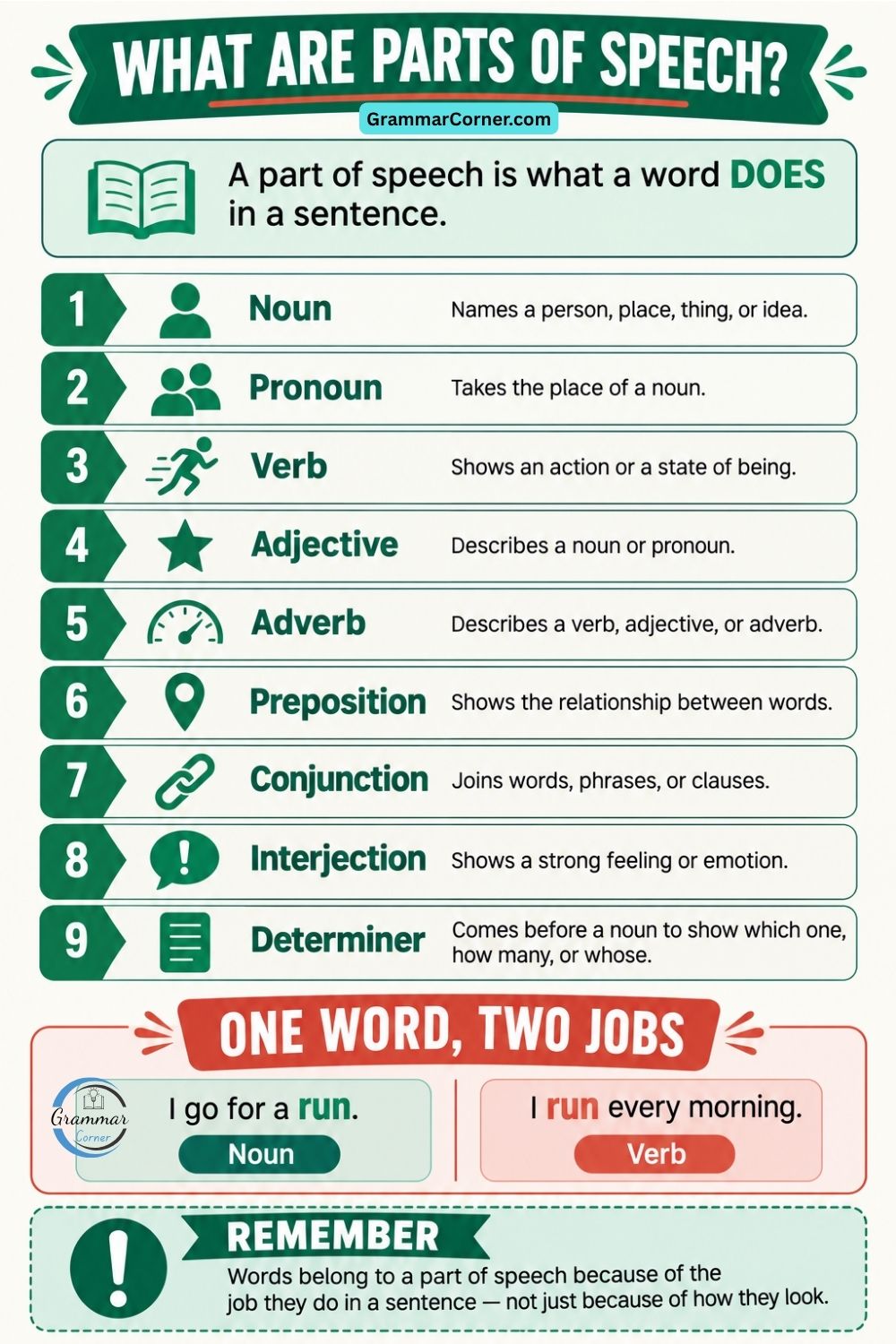
A part of speech is simply a category that tells you what a word does in a sentence. It isn’t about what the word means on its own. It’s about the job the word performs inside that sentence.
English grammar recognizes nine traditional categories: nouns, pronouns, verbs, adjectives, adverbs, prepositions, conjunctions, interjections, and determiners.
Older textbooks often list only eight parts of speech, folding determiners into the adjective category. Modern linguists usually treat determiners as their own group, because they behave differently enough to deserve one.
One Word, Two Different Jobs
Here’s the part that trips people up: a single word can switch categories depending on context. Look at the word run in these two sentences. Tap each button and watch its job change.
Try it: what is “run” doing here?
I go for a run every morning.
Noun — a thingSame spelling. Same pronunciation. Completely different job.
In the first sentence, a run is a thing you go for — a noun. In the second, run is an action you do — a verb.
Because words switch jobs like this, memorizing a word’s part of speech in isolation doesn’t work well. Always look at how the word is being used in that specific sentence.
Quick Overview Table
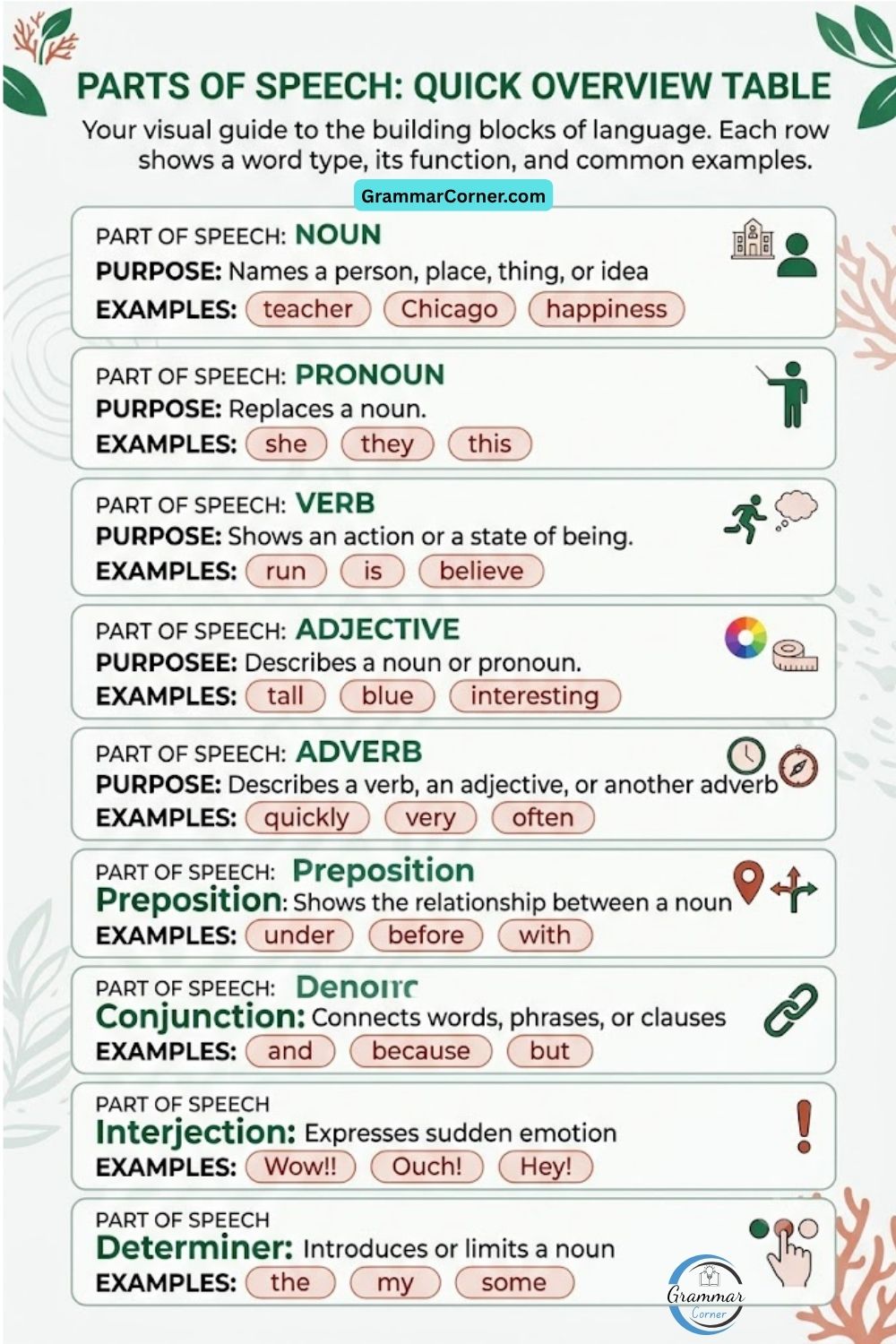
Here are all nine parts of speech side by side. Skim the table once now, then come back to it any time you need a quick reminder — each row tells you the job a word type does and shows a few everyday examples.
| Part of Speech | Purpose | Examples |
|---|---|---|
| Noun | Names a person, place, thing, or idea | teacherChicagohappiness |
| Pronoun | Replaces a noun | shetheythis |
| Verb | Shows an action or a state of being | runisbelieve |
| Adjective | Describes a noun or pronoun | tallblueinteresting |
| Adverb | Describes a verb, an adjective, or another adverb | quicklyveryoften |
| Preposition | Shows the relationship between a noun and other words | underbeforewith |
| Conjunction | Connects words, phrases, or clauses | andbecausebut |
| Interjection | Expresses sudden emotion | Wow!Ouch!Hey! |
| Determiner | Introduces or limits a noun | themysome |
1. Noun
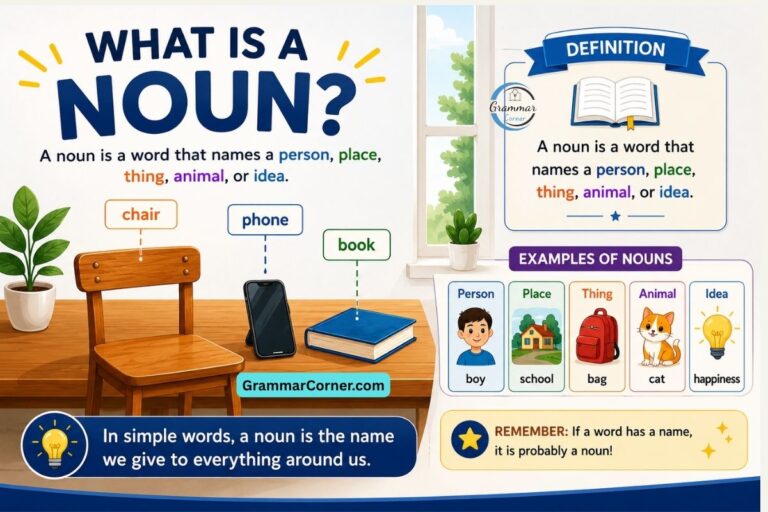
Look around you right now. A phone, a window, a friend in the next room — every one of those words is a noun. A noun names a person, place, thing, quality, or idea. Students usually meet this part of speech first because it is the most concrete of all: in many cases, you can literally point to a noun.
What Nouns Do in a Sentence
Nouns are the anchors of a sentence. They usually fill the subject slot — the who or what the sentence is about — and they often fill the object slot too, naming who or what receives the action. Take away the nouns and a sentence loses its footing; there is nothing left to talk about.
Types of Nouns
Not all nouns behave the same way. Here are the main types you will meet, each with everyday examples.
Common nouns
Name general people, places, or things. They are not capitalized unless they start a sentence.
- city
- dog
- book
- teacher
Proper nouns
Name specific people, places, or things — and they are always capitalized.
- Faisalabad
- Sarah
- Microsoft
- Monday
Concrete nouns
Name things you can experience with your five senses — you can see, hear, touch, taste, or smell them.
- rain
- coffee
- guitar
Abstract nouns
Name ideas, qualities, or states that you cannot touch or see.
- freedom
- courage
- anger
Collective nouns
Name a group of people or things treated as a single unit.
- team
- family
- audience
- flock
Countable nouns
Can be counted and have plural forms.
- one apple
- two apples
Uncountable nouns
Cannot be counted as individual units. You cannot say “two waters” in standard English unless the meaning changes (two glasses of water, for example).
- water
- furniture
- advice
- information
Try the number test yourself
Tap a word to put the number three in front of it and hear how it sounds.
Five Jobs a Noun Can Do
Once a noun enters a sentence, it takes on a specific job. The same word can do different jobs in different sentences. Here are the five main roles, with the noun doing each job highlighted.
- Subject — who or what the sentence is about The dog barked.
- Direct object — receives the action She fed the dog.
- Indirect object — the action is done for or to it She gave the dog a treat.
- Object of a preposition — follows words like under, on, near The bone is under the table.
- Subject complement — renames the subject after a verb like is My brother is a doctor.
Common Mistakes
Collective nouns are not plural nouns. In most American English usage, The team is winning is correct because the team acts as one unit. Writers sometimes produce The team are winning — a pattern that is more common in British English but inconsistent in American style.
Uncountable nouns cannot take plural endings. Writing furnitures or advices is a frequent slip. Use pieces of furniture and pieces of advice instead.
Quick Tip
If you can put a number directly in front of a noun (three chairs), it’s countable. If you can’t (three furnitures sounds wrong), it’s uncountable.
Mini Practice
Identify the nouns in this sentence:
The children played happily in the park near the old library.
Answer: children, park, library — each one names a person, place, or thing, while played, happily, and old are doing other jobs.
Pronoun
Read this sentence out loud: "Franklin went to Franklin's car because Franklin forgot Franklin's keys." Painful, isn't it? Now compare: "Franklin went to his car because he forgot his keys." The second version works because three of those Franklins were replaced by small stand-in words — pronouns.
Definition
A pronoun stands in for a noun so you don't have to repeat that noun again and again. Once your reader knows who or what you're talking about, a pronoun can carry the sentence forward without the clunky repetition.
Try it: swap the repeated nouns
Franklin went to Franklin's car because Franklin forgot Franklin's keys.
The highlighted words are the repeated nouns. Tap the button to replace them.
Purpose
Pronouns do two jobs at once. First, they keep sentences from sounding clunky and repetitive. Second, they glue ideas together: when a pronoun points back to something you've already mentioned, your reader can follow the thread from one sentence to the next without losing track.
Types of Pronouns
English sorts its pronouns into nine main groups, each with its own job.
-
Personal pronouns
Refer to specific people or things.
- I
- you
- he
- she
- it
- we
- they
-
Possessive pronouns
Show ownership.
- mine
- yours
- his
- hers
- ours
- theirs
-
Reflexive pronouns
Point back to the subject of the sentence.
- myself
- yourself
- himself
- herself
- itself
- ourselves
- themselves
She taught herself to paint.
-
Intensive pronouns
Look identical to reflexive pronouns, but they exist only to add emphasis — they don't receive an action.
- myself
- himself
- themselves
I myself saw it happen.
-
Demonstrative pronouns
Point to specific things.
- this
- that
- these
- those
-
Interrogative pronouns
Ask questions.
- who
- whom
- whose
- which
- what
-
Relative pronouns
Connect clauses.
- who
- whom
- whose
- which
- that
The man who called you is my uncle.
-
Indefinite pronouns
Refer to nonspecific people or things.
- someone
- anybody
- everything
- few
- several
- none
-
Reciprocal pronouns
Describe mutual actions between two or more people.
- each other
- one another
Sentence Examples
-
Everyone brought their own lunch.
Indefinite -
This is the book I told you about.
Demonstrative -
They looked at each other and laughed.
Reciprocal -
Whose backpack is this?
Interrogative
Common Mistakes
Mixing up "who" and "whom"
This one trips up even confident writers. Use who for subjects and whom for objects. Here's a quick trick: if you can replace the word with he or she, use who. If him or her fits better, use whom.
Who called you? → He called you. ✓
To whom did you give it? → You gave it to him. ✓
Using "myself" instead of "me"
Another common slip is swapping a plain personal pronoun for a reflexive or intensive one. "Myself" only works when the subject I already appears earlier in the same sentence — it can't step in for "me" on its own.
Please contact John or myself.
Please contact John or me.
Tip: Never use "myself" as a substitute for "I" or "me" unless the subject "I" already appears earlier in the same sentence. I made the cake myself works; Contact myself doesn't.
Practice
Replace the repeated nouns with pronouns:
Anna left Anna's phone at Anna's desk.
Answer: Anna left her phone at her desk.
Verb
Take the verb out of a sentence and everything stalls: "The children ___ across the field." Nothing happens until a verb turns the key — ran, skipped, wandered. Just as an engine powers a machine, a verb gives movement and meaning to a sentence.
Definition
A verb expresses an action, an occurrence, or a state of being. Every complete sentence needs one, and English gives you several kinds to work with.
Action Verbs
Action verbs show physical or mental activity. Some you can see happening; others happen entirely inside someone's head.
- run
- jump
- think
- decide
- whisper
Linking Verbs
Not every verb shows action. A linking verb connects the subject to more information about it — it works like an equals sign.
The soup smells amazing.
The soup isn't performing an action — it's simply being described.The most common linking verbs are the forms of be (am, is, are, was, were), along with:
- seem
- become
- appear
- feel
- look
- taste
- smell
- sound
Helping Verbs (Auxiliary Verbs)
Helping verbs team up with a main verb to build tense, mood, or voice. On their own they say very little — their job is support.
- do
- does
- did
- have
- has
- had
- can
- could
- will
- would
- shall
- should
- may
- might
- must
She has finished her homework.
They might arrive late.
Main Verbs
The main verb carries the core meaning of the verb phrase. Here's the earlier example again, this time with both parts labeled:
She hasHelping verb finishedMain verb her homework.
Transitive and Intransitive Verbs
A transitive verb needs a direct object to complete its meaning.
She bought a car.
"Car" is the direct object — it receives the action of buying.An intransitive verb doesn't take a direct object. The action begins and ends with the subject.
He sneezed.
And some verbs can work both ways, depending on the sentence:
Try it: one verb, two jobs
She sings a song. Intransitive
"She sings" is complete on its own — no object needed.
Regular and Irregular Verbs
Regular verbs
Form their past tense by adding -ed. Predictable and friendly.
- walk walked
Irregular verbs
Change form in unpredictable ways — you simply have to learn them.
- go went
- eat ate
- bring brought
Common Mistakes
Subject–verb agreement
This is one of the most common verb errors. The verb has to match the subject in number — and the trouble usually starts when other words squeeze in between them.
The list of items were long.
The list of items was long.
Try it: find the true subject
The list of items was long.
Which word does the verb really answer to?
Shifting tense mid-sentence
Another frequent mistake is switching verb tense in the middle of a sentence or paragraph without a reason. Pick a tense and stay with it unless the timeline genuinely changes.
She walked into the room and sees her friend.
She walked into the room and saw her friend.
Tip: Find the true subject before choosing your verb form. Prepositional phrases between the subject and verb ("of items," "in the box") never determine agreement.
Practice
Identify the verb type in this sentence:
He has been studying all night.
Answer: has been = helping verbs, studying = main verb.
Adjective
Compare "a bag" with "a small brown leather bag." Same object — but the second version tells you enough to spot it on a luggage carousel. The extra words doing that work are adjectives.
Definition
An adjective describes, modifies, or adds detail to a noun or pronoun. Whenever a word answers one of these three questions about a noun, you're looking at an adjective:
- What kind?
- How many?
- Which one?
Types of Adjectives
-
Descriptive
Describe a quality or feature.
- beautiful
- tall
- ancient
-
Quantitative
Tell how much or how many.
- few
- many
- several
-
Demonstrative
Point out a specific noun — when placed before it.
- this
- that
- these
- those
-
Possessive
Show who the noun belongs to — when placed before it.
- my
- your
- his
- her
-
Comparative
Compare one noun with another.
- taller
- more interesting
-
Superlative
Mark the highest degree in a group.
- tallest
- most interesting
-
Proper adjectives
Formed from proper nouns, and capitalized like them.
- American
- Victorian
- Shakespearean
Order of Adjectives
Here's something native speakers do without ever being taught it. When several adjectives line up before a noun, they follow an unconscious order:
- opinion
- size
- age
- shape
- color
- origin
- material
- purpose
Try it: build the bag, one adjective at a time
Each tap adds the next adjective in its natural slot.
You'll rarely need all eight at once. But even two or three adjectives usually fall into this order automatically — which is exactly why one of these sounds fine and the other sounds strange:
a big red barn
size before color ✓
a red big barn
color before size ✗
Comparison
Adjectives come in three degrees of strength:
Short adjectives take -er and -est
- Positive fast
- Comparative faster (comparing two things)
- Superlative fastest (comparing three or more)
Longer adjectives take more and most
- Positive beautiful
- Comparative more beautiful
- Superlative most beautiful
Common Mistakes
Doubling up comparatives and superlatives
"More faster" and "most fastest" try to compare twice in one breath. Choose one method — the ending or the extra word — never both.
more faster, most fastest
faster, fastest
Confusing adjectives with adverbs
This mix-up happens all the time, especially with "good" and "well."
She sings good.
She sings well.
Describing the verb "sings" needs an adverb.
Her singing is good.
Describing the noun "singing" needs an adjective.
Tip: If the word is describing a noun, it's an adjective. If it's describing a verb, an adjective, or another adverb, it's an adverb.
Practice
Tap every adjective you can find in this sentence, then check your answer:
Answer: tall, quiet, old, brown
Adverb
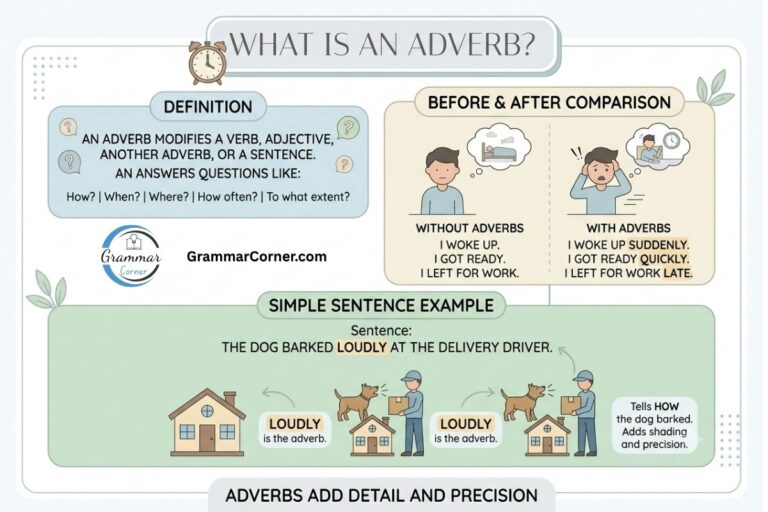
Adverbs are the tuners of a sentence. They can adjust three different kinds of words:
- Modifying a verb She sang beautifully.
- Modifying an adjective The music was surprisingly loud.
- Modifying another adverb He spoke very softly.
Definition
An adverb modifies a verb, an adjective, or another adverb. Many adverbs end in -ly — but plenty don't (soon, now, here, always, very), so spelling is not a reliable test. What matters is the job the word is doing.
Types of Adverbs
-
Manner
How?Describes how something happens.
- slowly
- carefully
- loudly
-
Time
When?Describes when it happens.
- yesterday
- soon
- now
-
Place
Where?Describes where it happens.
- here
- outside
- everywhere
-
Frequency
How often?Describes how often it happens.
- always
- sometimes
- rarely
-
Degree
How much?Describes intensity.
- very
- extremely
- barely
Placement
Where you put an adverb changes the emphasis — and sometimes the entire meaning. Watch what one word does to this sentence:
Try it: move "almost"
She almost drove her kids to school almost every day.
Meaning: she almost did this — but didn't actually drive them.
For everyday placement, three general rules cover most situations: manner adverbs go after the verb or its object, frequency adverbs go before the main verb but after "be" verbs, and time adverbs usually sit at the start or end of the sentence.
-
She quietly closed the door.
Manner -
He is always late. (after "is")
Frequency -
We rarely eat out. (before the main verb)
Frequency -
Yesterday, we went hiking.
Time
Common Mistakes
Using an adjective where an adverb belongs
This slip is extremely common in casual speech — the adjective sneaks in where an adverb should be describing the verb.
He drives careless.
He drives carelessly.
Leaning on intensifiers
Overusing adverbs — especially intensifiers like "very" and "really" — weakens writing. One strong, specific word usually beats a weak word propped up by an intensifier.
very tired
exhausted
Tip: Adverbs are optional extras. If removing a word doesn't break the sentence's grammar but only changes the detail or intensity, you're probably looking at an adverb.
Practice
Tap every adverb you can find in this sentence, then check your answer:
Answer: quickly, quietly, extremely
Preposition
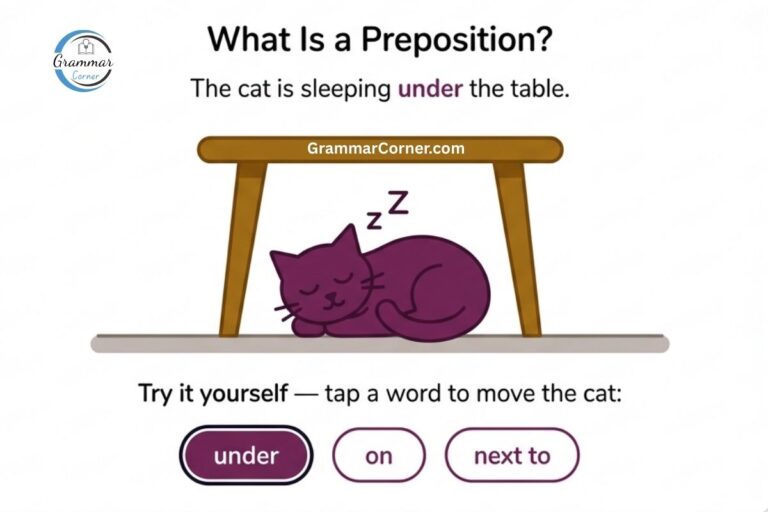
One tiny word can completely change where things stand. The ball is in the box, on the box, under the box — same ball, same box, three totally different pictures. Try it yourself:
Try it: move the ball with one word
The ball is on the box.
Definition
A preposition shows the relationship between a noun (or pronoun) and another word in the sentence. Those relationships usually involve time, place, direction, manner, or position — which is why the ball demo above works: each preposition redraws the relationship between the ball and the box.
Time
- at
- on
- in
- before
- after
- during
- since
- until
We'll meet at noon.
She's been studying since morning.
Place
- in
- on
- at
- under
- above
- between
- behind
- near
The keys are under the mat.
Direction and Movement
- to
- from
- into
- onto
- through
- across
- toward
He walked through the park.
She drove across the bridge.
Prepositional Phrases
A preposition never travels alone. It always starts a prepositional phrase — the preposition plus a noun or pronoun, which is called the object of the preposition.
The whole phrase "under the warm blanket" starts at the preposition and ends at its object.
Common Mistakes
Mixing up "in," "on," and "at"
These three confuse many learners, because the rules aren't always logical — they simply have to be learned as habits.
in
Months, years, and long periods
- in July
- in 2024
- in the morning
on
Specific days and dates
- on Monday
- on July 4th
at
Specific times and points
- at noon
- at the corner
The end-of-sentence "rule" that isn't
Many people were taught that you can never end a sentence with a preposition. That's a myth. In modern English, ending with a preposition is often perfectly natural — and frequently the better choice.
This is the pen with which I wrote the letter.
This is the pen I wrote the letter with.
Tip: If a small word is followed directly by a noun or pronoun and shows location, time, or direction, it's almost certainly a preposition.
Practice
Tap every preposition you can find in this sentence, then check your answer:
Answer: on, to, near
Conjunction
Words like and, but, and because are the bridges of English. They carry your reader from one idea to another — and they quietly signal how those ideas fit together.
Definition
A conjunction connects words, phrases, or clauses, and shows how the connected ideas relate to each other. The choice of conjunction is the relationship: and adds, but contrasts, because explains.
Coordinating Conjunctions
These connect grammatically equal elements — word to word, phrase to phrase, clause to clause. English has exactly seven, and generations of students have remembered them with one acronym: FANBOYS.
- Ffor
- Aand
- Nnor
- Bbut
- Oor
- Yyet
- Sso
I wanted to go, but I was too tired.
Subordinating Conjunctions
These connect a dependent clause to an independent clause, and they signal the relationship between the two — cause, contrast, time, or condition.
- because
- although
- since
- unless
- while
- if
- when
We stayed inside because it was raining.
Correlative Conjunctions
These always work in pairs — one part is incomplete without its partner.
- either...or
- neither...nor
- both...and
- not only...but also
- whether...or
She is both talented and hardworking.
Sentence Formation
The everyday payoff of conjunctions: they let you combine short, choppy sentences into smoother ones.
Try it: build the bridge
Two complete but choppy sentences, standing apart.
Common Mistakes
Unbalanced correlative pairs
Correlative conjunctions need parallel structure — whatever grammatical form follows the first half should also follow the second half.
She not only likes reading but also to write.
She not only likes reading but also writing.
-ing form on both sides — the pair is balanced.
Comma splices
A comma splice happens when two independent clauses are joined with only a comma and no conjunction. The comma alone isn't strong enough to hold two complete sentences together.
It was raining, we stayed inside.
It was raining, so we stayed inside.
Tip: When a coordinating conjunction joins two complete sentences, put a comma before it. When it joins just two words or short phrases, skip the comma.
Practice
Tap every conjunction you can find in this sentence, then check your answer:
Answer: Either...or (a correlative pair), but
Interjection
Stub your toe and the first word out of your mouth isn't a carefully built sentence — it's "Ouch!" That instant burst of feeling is an interjection at work.
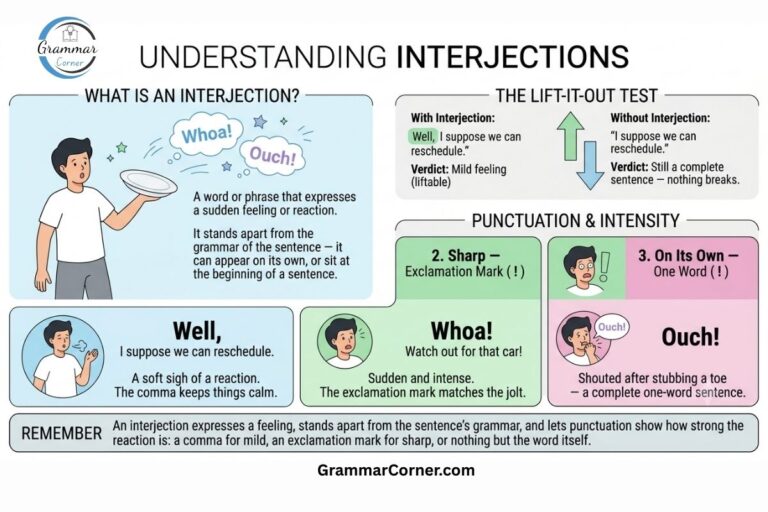
Definition
An interjection is a word or short phrase that expresses sudden emotion — surprise, joy, pain, frustration, hesitation. It usually stands apart from the grammatical structure of the sentence around it: the sentence would be complete without it.
Purpose
Interjections carry tone and feeling more than information. They show up constantly in speech and informal writing, and far less often in formal essays — a report doesn't gasp, but a conversation does.
Expressing Emotion
-
Surprise
- Wow!
- Whoa!
-
Pain
- Ouch!
- Ow!
-
Hesitation
- Um
- uh
- well
-
Agreement or realization
- Oh!
- Ah!
- Right!
-
Greeting
- Hey!
- Hi!
-
Disgust
- Ugh!
- Yuck!
Punctuation
How you punctuate an interjection depends on how much force it carries.
! Strong emotion
A strong interjection usually takes an exclamation point and can stand alone as its own utterance.
Ouch! That hurt.
, Mild emotion
A milder interjection blends into the sentence, set off with a comma.
Well, I suppose that could work.
Real-Life Usage
Interjections are everywhere in text messages, dialogue, comic books, and casual conversation. You'll rarely meet one in a formal report or academic paper — but dialogue-heavy writing, advertising, and everyday speech would sound robotic without them.
- Oops, I didn't mean to send that.
- Hey, wait for me!
Try it: the deletion test
Oops, I didn't mean to send that.
The interjection is carrying the emotion. Remove it and see what's left.
Tip: If a word could be deleted from a sentence without changing the sentence's grammatical structure, and it only adds emotional tone, it's an interjection.
Practice
Tap the interjection in this sentence, then check your answer:
Answer: Yikes
Part of Speech · 9 of 9
9. Determiner
A determiner introduces a noun and tells you which one, how many, or whose it is. Determiners always sit before the noun they modify — often before any adjectives too, the way the comes before old wooden door.
Why determiners get their own category
Older grammar books grouped words like “the,” “a,” “this,” and “my” under adjectives, since they technically modify nouns. Many modern grammarians separate them into their own category because they behave differently from descriptive adjectives.
Adjectives stack
“the big, old, red barn”
✓ works fine
Determiners don’t
“the my barn”
✗ doesn’t work
Determiners also don’t have comparative or superlative forms the way true adjectives do — there’s no “more the” or “mostest.”
Types of determiners
Tap a tag to see how that type works in a real sentence.
Common mistakes
“A” vs. “an”
The rule depends on sound, not spelling — use an before a vowel sound, not just a vowel letter.
- ✓ an hour (silent h, vowel sound)
- ✓ a university (starts with a “y” sound)
Overusing “the”
This trips up learners translating from languages that use articles differently.
- ✗ I like
themusic andtheart. - ✓ I like music and art. (speaking generally)
Tip
If you can ask “which one, whose, or how many” and the word answers that question directly before a noun, it’s a determiner.
Practice
Tap every word you think is a determiner, then check your answers.
Can One Word Belong to Different Parts of Speech?
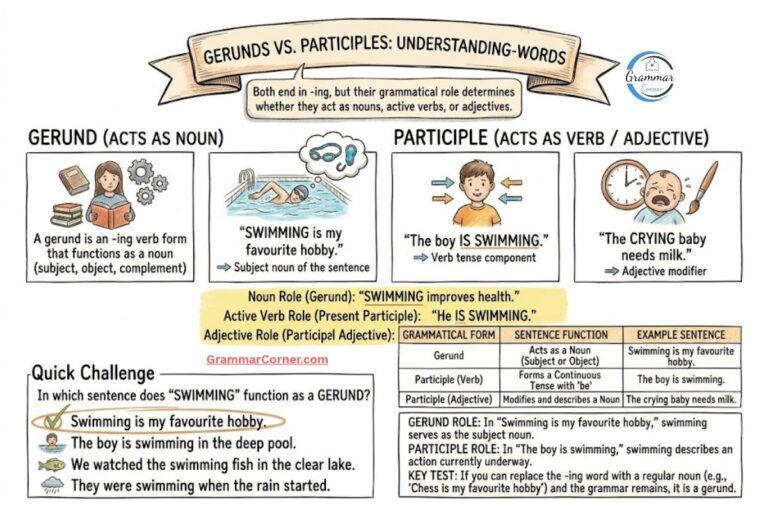
Yes — constantly. English reuses the same word for completely different jobs all the time, and the only way to know which job a word is doing is to look at the sentence around it.
Tap a word below to see it change roles right in front of you.
The takeaway: never assign a part of speech to a word just by memory. Look at the sentence it’s living in.
Parts of Speech in a Sentence
Let’s break down one full sentence, word by word:
The little boy quickly opened the old wooden door.
Notice how the determiner and adjectives stack up in order before the noun: determiner, then descriptive adjectives, then the noun itself — mirroring the adjective order pattern discussed earlier.
How Parts of Speech Work Together
A sentence isn’t just a random word pile. It’s closer to a small production line, where each part of speech has its own station.
Basic sentence pattern
Adding detail with adverbs and prepositions
Connecting two ideas with a conjunction
Common Mistakes Students Make
Verbs
Subject-verb agreement trips up even confident writers, especially with collective nouns and long subjects that put distance between the subject and its verb. Tense shifting midway through a paragraph, without a reason, is just as common.
Adjectives
Double comparatives like more better combine two comparative forms when only one is needed. Confusing adjectives with adverbs is just as frequent — drives good should be drives well.
Adverbs
Misplacing an adverb can shift a sentence’s meaning without the writer noticing. Overusing intensifiers like very and really is another habit worth breaking — a stronger, more specific word usually says it better.
Pronouns
Unclear pronoun references happen when it or they could point to more than one thing in the sentence. Mixing up who and whom is common too, along with using myself where me is the correct choice.
Prepositions
Mixing up in, on, and at for time and place is one of the most common preposition errors, especially for learners whose first language handles these relationships differently.
Determiners
Overusing or underusing articles — especially the — is a frequent slip, and so is choosing a instead of an based on spelling rather than sound.
Warning
Spellcheck and grammar-checking tools often miss these errors because the sentence is still technically “readable.” Careful proofreading — ideally reading your work out loud — catches far more of these mistakes than software does.
Memory Tricks
For remembering all nine categories, try this sentence, where the first letter of each word matches a part of speech:
Never
NounPut
PronounVegetables
VerbAnywhere
AdjectiveAdults
AdverbPrefuse
PrepositionClean
ConjunctionIce
InterjectionDrawers
DeterminerNouns vs. pronouns
A pronoun is a noun’s stunt double — it steps in so the real noun doesn’t have to repeat itself over and over.
Adjectives vs. adverbs
Adjectives describe things (nouns). Adverbs describe actions and qualities (verbs, adjectives, other adverbs). If it answers “how,” it’s usually an adverb.
Prepositions
Picture a mouse and a box. Almost anything a mouse can do to, in, on, under, behind, near, or around a box is a preposition.
“The mouse ran around the box.”
“The mouse hid under the box.”
FANBOYS
Just remember the acronym itself:
Practice Exercises
Exercise 1: Identify the Part of Speech
Identify the underlined word’s part of speech in each sentence.
Exercise 2: Choose the Correct Word
Exercise 3: Fill in the Blanks
Exercise 4: Error Correction
Exercise 5: Mixed Practice
Label every word in this sentence by part of speech. Tap a word to check yourself.
She carefully placed the fragile vase on the wooden shelf.
Frequently Asked Questions
What are the 9 parts of speech?
Noun, pronoun, verb, adjective, adverb, preposition, conjunction, interjection, and determiner.
Why are parts of speech important?
They explain how words function together, which makes it possible to build clear, grammatically correct sentences and to diagnose exactly what’s wrong when a sentence feels off.
What is the difference between a noun and a pronoun?
A noun directly names a person, place, thing, or idea. A pronoun replaces a noun so you don’t have to repeat it constantly.
Is “the” a determiner or an adjective?
Modern grammar classifies “the” as a determiner, not a true adjective, because it introduces a noun rather than describing its qualities.
Can a word belong to more than one part of speech?
Yes. Many English words shift categories depending on context — “light,” “fast,” and “well” are common examples.
What is the easiest way to learn parts of speech?
Practice identifying them in real sentences rather than memorizing definitions alone. Context-based practice sticks far better than flashcards.
What part of speech is “well”?
It depends on the sentence. It can be an adverb (she sang well), an adjective (she feels well), an interjection (Well, that’s surprising), or even a noun (a deep well).
Are articles parts of speech?
Articles (a, an, the) are a subtype of determiners, which is one of the nine parts of speech.
Why do some books list only eight parts of speech?
Older grammar traditions grouped determiners under adjectives. Many modern grammar references separate them because determiners behave differently from descriptive adjectives.
Which part of speech is used most often?
Nouns and verbs appear most frequently, since nearly every sentence needs at least one of each.
What’s the difference between a preposition and a conjunction?
A preposition connects a noun to the rest of the sentence and shows relationships like time or place. A conjunction connects clauses, phrases, or words to each other.
Do all adverbs end in “-ly”?
No. Words like fast, well, often, never, and soon are adverbs without an -ly ending.
What is a linking verb?
A linking verb connects the subject to a description or identity rather than showing action, such as is, seems, became, or feels.
Is “myself” always correct to use instead of “me”?
No. “Myself” should only appear when the subject “I” is already present in the sentence. Otherwise, use “me.”
What’s the difference between transitive and intransitive verbs?
A transitive verb requires a direct object to complete its meaning. An intransitive verb doesn’t need one.
How do I know if a word is a determiner or an adjective?
Determiners answer “which one, whose, or how many” and typically come first in a noun phrase. Adjectives describe qualities and can be stacked or compared (bigger, biggest), which determiners generally cannot.
Why does adjective order matter in English?
Native speakers unconsciously follow a set order (opinion, size, age, shape, color, origin, material, purpose). Breaking that order sounds noticeably off, even if listeners can’t explain why.
Can a sentence exist without an adjective or adverb?
Yes. Adjectives and adverbs are optional extras. A grammatically complete sentence only needs a subject and a verb, such as “Birds fly.”
What’s the difference between “who” and “whom”?
“Who” is used for subjects; “whom” is used for objects. If you can replace the word with “he” or “she,” use “who.” If it fits with “him” or “her,” use “whom.”
Do interjections ever appear in formal writing?
Rarely. They’re common in dialogue, advertising, and casual writing, but formal essays and reports generally avoid them.
Related posts:
- Complete Punctuation Guide
- Nouns Chart
- Pronouns Chart
- Verbs Chart
- Adverbs Chart
- Prepositions Chart
- Conjunction Chart