Pronouns Chart (Types, Examples and Rules) – Ultimate Guide
Picture this text message: “Oliver texted Sara to tell Sara that Oliver would pick Sara up at seven, but Oliver got stuck in traffic, so Oliver texted Sara again.”
Painful to read, right? Now compare it with how anyone would actually write it: “Oliver texted Sara to tell her that he would pick her up at seven, but he got stuck in traffic, so he texted her again.” Same information, far less clutter, and the words doing all that quiet cleanup are pronouns.
What Is a Pronoun?
A pronoun is a word that replaces a noun so you don’t have to keep repeating it.
You already use pronouns constantly. These are some of the most common ones:
- he
- she
- it
- they
- we
- you
- this
Here’s a simple sentence. Tap either highlighted word to see who it points back to:
Jake forgot umbrella at the office, so had to walk home in the rain.
Both words trace back to the same person.
His and he both refer back to Jake. They’re pronouns standing in for the noun Jake, so the sentence doesn’t have to say his name three times. The noun a pronoun points back to is called its antecedent, and a pronoun should always refer clearly to the correct one so readers know exactly who or what it means.
Pronouns do more than save words, though. They keep writing and speech moving naturally — the way real conversation actually sounds. Once you can spot them and use them with confidence, your sentences stop feeling clunky and start sounding like something a person would genuinely say.
Pronoun at a Glance (Quick Overview Table)
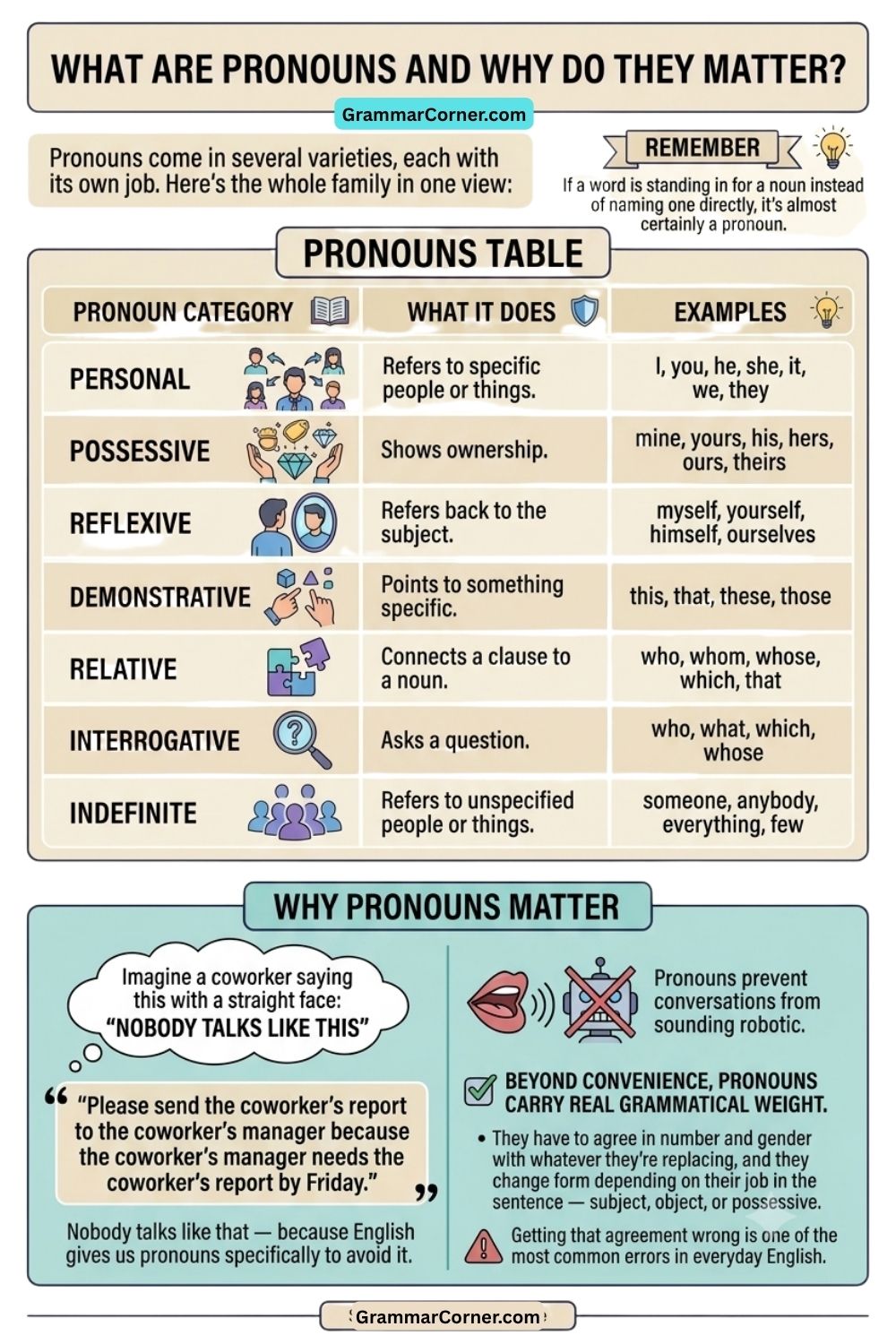
Pronouns come in several varieties, each with its own job. Here’s the whole family in one view:
Personal
Refers to specific people or things
- I
- you
- he
- she
- it
- we
- they
Possessive
Shows ownership
- mine
- yours
- his
- hers
- ours
- theirs
Reflexive
Refers back to the subject
- myself
- yourself
- himself
- ourselves
Demonstrative
Points to something specific
- this
- that
- these
- those
Relative
Connects a clause to a noun
- who
- whom
- whose
- which
- that
Interrogative
Asks a question
- who
- what
- which
- whose
Indefinite
Refers to unspecified people or things
- someone
- anybody
- everything
- few
| Category | What It Does | Examples |
|---|---|---|
| Personal | Refers to specific people or things | I, you, he, she, it, we, they |
| Possessive | Shows ownership | mine, yours, his, hers, ours, theirs |
| Reflexive | Refers back to the subject | myself, yourself, himself, ourselves |
| Demonstrative | Points to something specific | this, that, these, those |
| Relative | Connects a clause to a noun | who, whom, whose, which, that |
| Interrogative | Asks a question | who, what, which, whose |
| Indefinite | Refers to unspecified people or things | someone, anybody, everything, few |
If a word is standing in for a noun instead of naming one directly, it’s almost certainly a pronoun.
Why Pronouns Matter
Without pronouns, every sentence would have to repeat its nouns endlessly, and conversations would sound robotic fast. Imagine a coworker saying this with a straight face:
Nobody talks like that — because English gives us pronouns specifically to avoid it.
Beyond convenience, pronouns carry real grammatical weight. They have to agree in number and gender with whatever they’re replacing, and they change form depending on their job in the sentence — subject, object, or possessive. Getting that agreement wrong is one of the most common errors in everyday English.
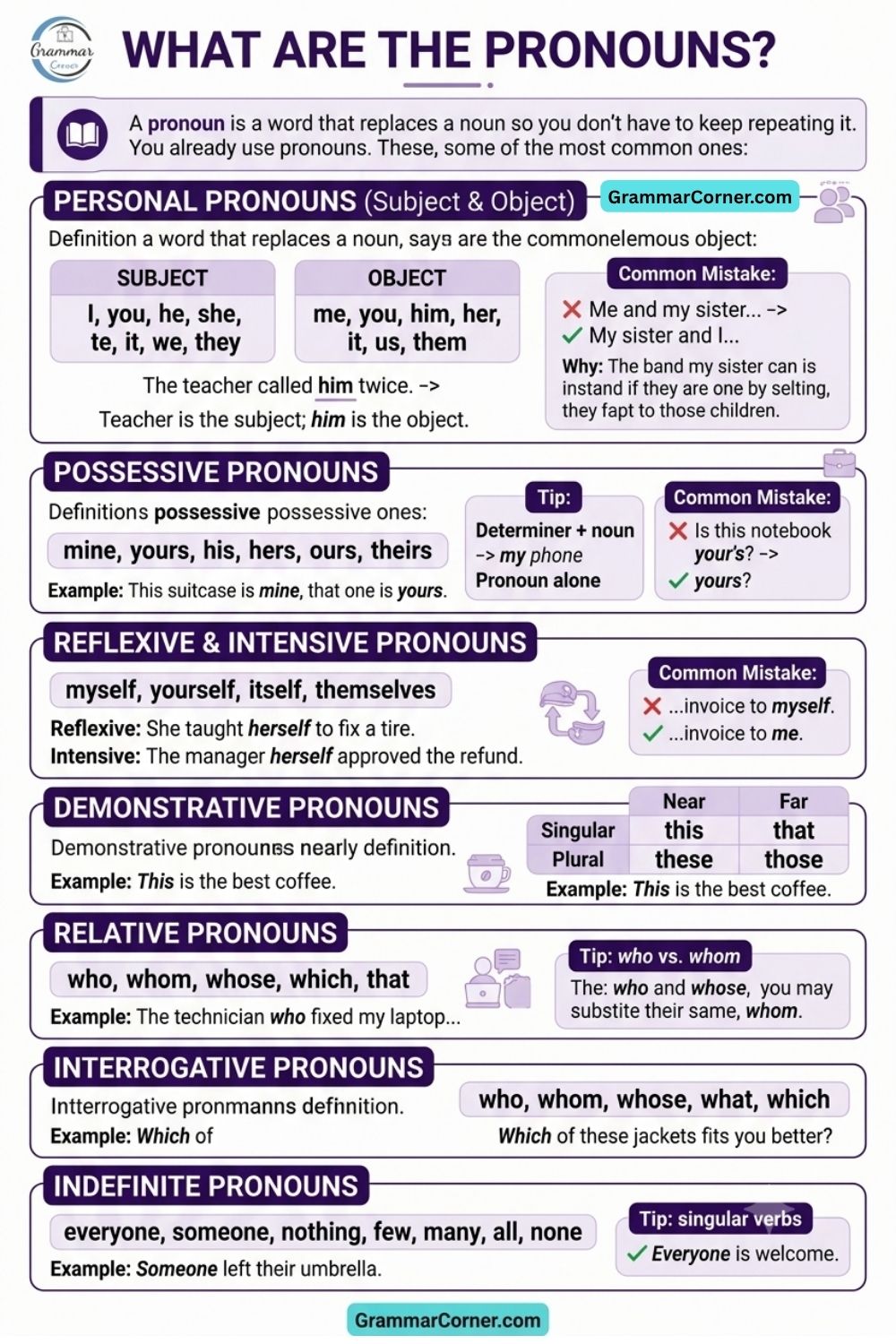
Types of Pronouns
Pronouns come in several flavors, and each one does a slightly different job. Some point to people, some show ownership, some connect ideas together, and some just ask questions. Let’s go through them one at a time.
Personal Pronouns
A personal pronoun refers to a specific person or thing — and it changes form depending on whether it’s doing the action or receiving it.
Subject pronouns
- I
- you
- he
- she
- it
- we
- they
Object pronouns
- me
- you
- him
- her
- it
- us
- them
Isubject called himobject twice, but hesubject didn’t answer.
I is the subject doing the calling; him is the object receiving the action.
✗ Incorrect: Me and my sister went shopping on Saturday.
✓ Correct: My sister and I went shopping on Saturday.
Why: I is the subject pronoun and belongs before the verb went.
Quick trick: remove the other person and see which pronoun still sounds right on its own.
✗ Me went shopping. — clearly doesn’t work
✓ I went shopping. — sounds right, so I wins
Possessive Pronouns
A possessive pronoun shows ownership and completely replaces the noun it’s describing, rather than sitting next to it.
- mine
- yours
- his
- hers
- its
- ours
- theirs
This suitcase is mine, and that one by the door is yours.
Neither mine nor yours is followed by a noun — they stand in for my suitcase and your suitcase all on their own. (Its belongs to this set in theory, but it almost never appears on its own in modern English.)
Words like my, your, his, her, its, our, and their look similar but always sit in front of a noun (“my phone,” “their car”). Possessive pronouns replace the noun entirely. Compare:
That’s my phone.
That phone is mine.
✗ Incorrect: Is this notebook your’s?
✓ Correct: Is this notebook yours?
Why: Possessive pronouns never take an apostrophe. Your’s, her’s, and their’s are common typing slips, but none of them are correct in standard English.
Reflexive and Intensive Pronouns
A reflexive pronoun refers back to the subject of the sentence — usually because the subject is doing something to or for itself.
- myself
- yourself
- himself
- herself
- itself
- ourselves
- yourselves
- themselves
She taught herself how to fix a bicycle tire using online videos.
Herself refers back to she ↩ the subject and the one receiving the action are the same person.
The same words can also work as intensive pronouns, which simply add emphasis rather than reflecting an action back onto the subject.
The manager herself approved the refund.
Here, herself isn’t grammatically necessary — it just emphasizes that the manager, and no one else, approved it.
Which one is which? Try deleting it
The two look identical, so here’s the tell: an intensive pronoun can be removed without breaking the sentence, but a reflexive one can’t.
She taught herself how to fix a bicycle tire.
✗ Breaks — taught whom? The sentence loses its meaning, so this one is reflexive.
The manager herself approved the refund.
✓ Still works — it was only there for emphasis, so this one is intensive.
✗ Incorrect: Please send the invoice to myself.
✓ Correct: Please send the invoice to me.
Why: Reflexive pronouns only work when the subject and object refer to the same person. Here, myself isn’t reflecting back onto a subject in the sentence — the writer just needs the plain object pronoun me.
Demonstrative Pronouns
A demonstrative pronoun points to a specific thing without naming it directly, based on distance or number.
This is the best coffee I’ve had all year.
This stands in for whatever specific cup or brand is being talked about, without repeating its name.
Relative Pronouns
A relative pronoun introduces a clause that gives more information about a noun mentioned earlier in the sentence.
- who
- whom
- whose
- which
- that
The technician who fixed my laptop was incredibly patient.
Who connects the clause fixed my laptop back to technician, telling you more about that person.
Use who when the pronoun is doing the action (a subject), and whom when it’s receiving the action (an object). A quick test: if you can replace it with he or she, use who; if you can replace it with him or her, use whom.
Who called you?He called you.
✓ He works — so who is correct.
Whom did you call?You called him.
✓ Him works — so whom is correct.
Interrogative Pronouns
An interrogative pronoun is used to ask a question.
- who
- whom
- whose
- what
- which
Which of these jackets fits you better?
Which is asking the listener to choose between specific options.
Indefinite Pronouns
An indefinite pronoun refers to people or things without specifying exactly who or what they are.
- everyone
- someone
- anybody
- nobody
- something
- anything
- few
- many
- several
- all
- none
Someone left their umbrella by the front door.
Someone doesn’t identify a specific person — which is exactly the point. The speaker genuinely doesn’t know who it was.
Words like everyone, everybody, someone, and nobody are grammatically singular, even though they often feel like they’re talking about a group — so they take a singular verb.
Everyone is welcome to join.
Everyone are welcome to join.
Functions of Pronouns in a Sentence
Just like nouns, pronouns can play several different roles depending on where they land in a sentence — and the same pronoun family often changes form to match its job.
Subject
The subject pronoun performs the action of the verb.
They arrived early for the concert.
They is doing the arriving, so it takes the subject form.
Direct Object
The direct object pronoun receives the action of the verb directly.
The coach praised them after the match.
Them is receiving the praising, so it switches to the object form.
Indirect Object
The indirect object pronoun shows who or what benefits from the action.
Grandma sent us a postcard from her trip.
Us is the indirect object — the ones receiving a postcard, which is the direct object.
Possessive Function
A possessive pronoun shows that something belongs to the person or thing it replaces.
The blue backpack is hers; the black one is mine.
Object of a Preposition
A pronoun that follows a preposition like with, for, to, or between is the object of that preposition.
This gift is for you and me.
✗ Incorrect: This gift is for you and I.
✓ Correct: This gift is for you and me.
Why: For is a preposition, and prepositions are always followed by object pronouns. Drop you and and test it alone: “This gift is for I” sounds clearly wrong, while “This gift is for me” sounds right.
Sentence breakdown: four pronouns, one sentence
Tap each highlighted word to reveal the job it’s doing:
subject (personal pronoun) gave reflexive — refers back to “She” a well-deserved break after finishing the project relative — introduces the clause subject inside the relative clause had been managing alone.
0 of 4 labeled.
Common Mistakes with Pronouns
1 Singular “they” with words like “every student”
⚠ Often flagged in formal style: Every student must bring their own laptop, and they should charge it the night before.
✓ Traditional formal style: Every student must bring his or her own laptop, and he or she should charge it the night before.
✓ Modern standard usage: Every student must bring their own laptop, and they should charge it the night before.
Why: Everyone and every student are grammatically singular, but using singular they to refer back to them is now widely accepted in both American and British English — especially when the person’s gender is unknown or irrelevant. Some formal or academic style guides still prefer he or she, so it’s worth checking what’s expected in a given context.
2 It’s vs. its
✗ Incorrect: The company announced it’s new policy yesterday.
✓ Correct: The company announced its new policy yesterday.
Why: Its without an apostrophe is possessive. It’s with an apostrophe always means it is or it has.
Quick test: read it’s as it is — if the sentence stops making sense, drop the apostrophe.
The company announced it is new policy yesterday.
✗ Nonsense — so the apostrophe doesn’t belong here. Its is correct.
3 Taller than I / taller than me
✓ Formal: My brother is taller than I. (short for “than I am”)
✓ Everyday, widely accepted: My brother is taller than me.
Why: Traditionally, than was treated as a conjunction introducing a shortened clause, which calls for the subject pronoun I. In casual, spoken English, than me is extremely common and accepted by most modern grammar guides — but formal or academic writing often still prefers than I.
4 “Myself” with no “I” to reflect
✗ Incorrect: The report was written by John and myself.
✓ Correct: The report was written by John and me.
Why: Myself needs a matching subject pronoun (I) somewhere in the same sentence to reflect back onto. Since there’s no I here, the plain object pronoun me is correct.
5 There / their / they’re
✗ Incorrect: Someone left there phone on the bus.
✓ Correct: Someone left their phone on the bus.
Why: There refers to a place, they’re is short for they are, and their is the possessive pronoun. Only their fits here, since the sentence is talking about ownership of the phone.
Sometimes a pronoun technically has a grammatically correct form — but no clear antecedent.
“Maria told her sister that she got the internship.”
It’s genuinely unclear whether she refers to Maria or the sister. When a sentence could be read two ways, it’s often clearer to repeat the noun instead of relying on the pronoun.
Tips for Using Pronouns Correctly
1 Match number and gender
Match every pronoun’s number and gender to its antecedent before moving on in a sentence. If the antecedent is plural (the players), the pronoun needs to be plural too (they, not he or she).
2 Test compound phrases alone
When you’re unsure whether to use a subject or object pronoun in a compound phrase like Sarah and I or Sarah and me, mentally remove the other name and see which pronoun still sounds natural on its own.
3 Keep references clear
Keep pronoun reference clear, especially in longer sentences with more than one possible antecedent. If there’s any doubt about who she, he, or it refers to, don’t be afraid to just repeat the noun.
4 Save reflexives for real reflections
Reserve reflexive pronouns like myself and yourself for situations where the subject and object are genuinely the same person. If you’re tempted to use myself just to sound more formal, it’s usually a sign that me or I is the better, plainer choice.
5 Mind the AmE/BrE collective-noun difference
American and British English mostly handle pronouns the same way, but pronoun agreement with collective nouns is a notable exception. American English tends to pair a collective noun like team or family with singular pronouns (“The team announced its schedule”), while British English often allows plural pronouns when the group is being thought of as individuals (“The team announced their schedule”).
Practice Exercises
Time to put pronouns to work. Try each exercise below, then check your answers as you go.
Exercise 1: Identify the Pronouns
Tap or click every word in each sentence that’s a pronoun. Then check your work.
Exercise 2: Classify Each Pronoun
Choose the correct type for each pronoun below.
Exercise 3: Fix the Mistake
Read each sentence, decide what’s wrong, then reveal the correction.
8. Me and him are going to the game tonight.
He and I are going to the game tonight.
Pronouns acting as the subject of a sentence take the subject form — “I” and “he,” not “me” and “him.”
9. The dog wagged it’s tail excitedly.
The dog wagged its tail excitedly.
“Its” shows possession here, so it never takes an apostrophe — “it’s” always means “it is” or “it has.”
10. Each employee must submit his or her badge, and their photo will be updated.
This sentence starts with “his or her” (singular) and then switches to “their.” Pick one style and keep it for the whole sentence:
Each employee must submit his or her badge, and his or her photo will be updated.
Each employee must submit their badge, and their photo will be updated. (modern singular “they”)
Show full answer key
Exercise 1
- She, herself, she
- Everyone, something
- that, you, mine, yours
Exercise 2
- 4. themselves — reflexive
- 5. those — demonstrative
- 6. anybody — indefinite
- 7. whose — relative
Exercise 3
- 8. He and I are going to the game tonight.
- 9. The dog wagged its tail excitedly.
- 10. The sentence mixes “his or her” (singular) with “their.” Stay consistent: use “his or her” throughout, or use “their” throughout.
Frequently Asked Questions
What's the difference between a pronoun and its antecedent?
The antecedent is the specific noun a pronoun refers back to. In "Marcus lost his wallet," "Marcus" is the antecedent, and "his" is the pronoun replacing it.
Is "who" always correct, or should I use "whom"?
"Who" is used when the pronoun acts as the subject of a clause, and "whom" is used when it acts as the object. In casual conversation, "who" is often used for both, but formal writing still distinguishes between them.
Can a sentence have a pronoun with no clear antecedent?
Grammatically, yes — indefinite pronouns like "someone" or "everything" don't need one. But personal pronouns like "she," "it," or "they" should always have a clear antecedent, or the sentence risks confusing the reader.
Is "you" singular or plural?
Both. Modern English uses "you" for one person or many, which is why some regional varieties have developed informal plurals like "you guys" or "y'all," even though these aren't part of standard grammar.
Why do pronouns change form (I vs. me, he vs. him)?
This is called case, and it reflects the pronoun's job in the sentence. Subject pronouns (I, he, she, they) perform the action; object pronouns (me, him, her, them) receive it.
Is using "their" for a single person grammatically correct?
Yes, when the person's gender is unknown, irrelevant, or nonbinary. Singular "they" has a long history in English and is now accepted by most major style guides, though some formal contexts still prefer "he or she."
See also: