Exclamation Marks Rules & Examples | Ultimate Guide
One small mark, a lot of feeling. The exclamation mark is how writing raises its voice.
Have you ever read a sentence and almost heard the writer shout with joy? That effect usually comes from one small symbol: the exclamation mark. It turns quiet words into powerful expressions and plain statements into sentences full of emotion.
In this article, you will learn what an exclamation mark is, when to use it, and — just as importantly — when to leave it out. Everything is explained in simple language, with plenty of everyday examples.
What Is an Exclamation Mark?
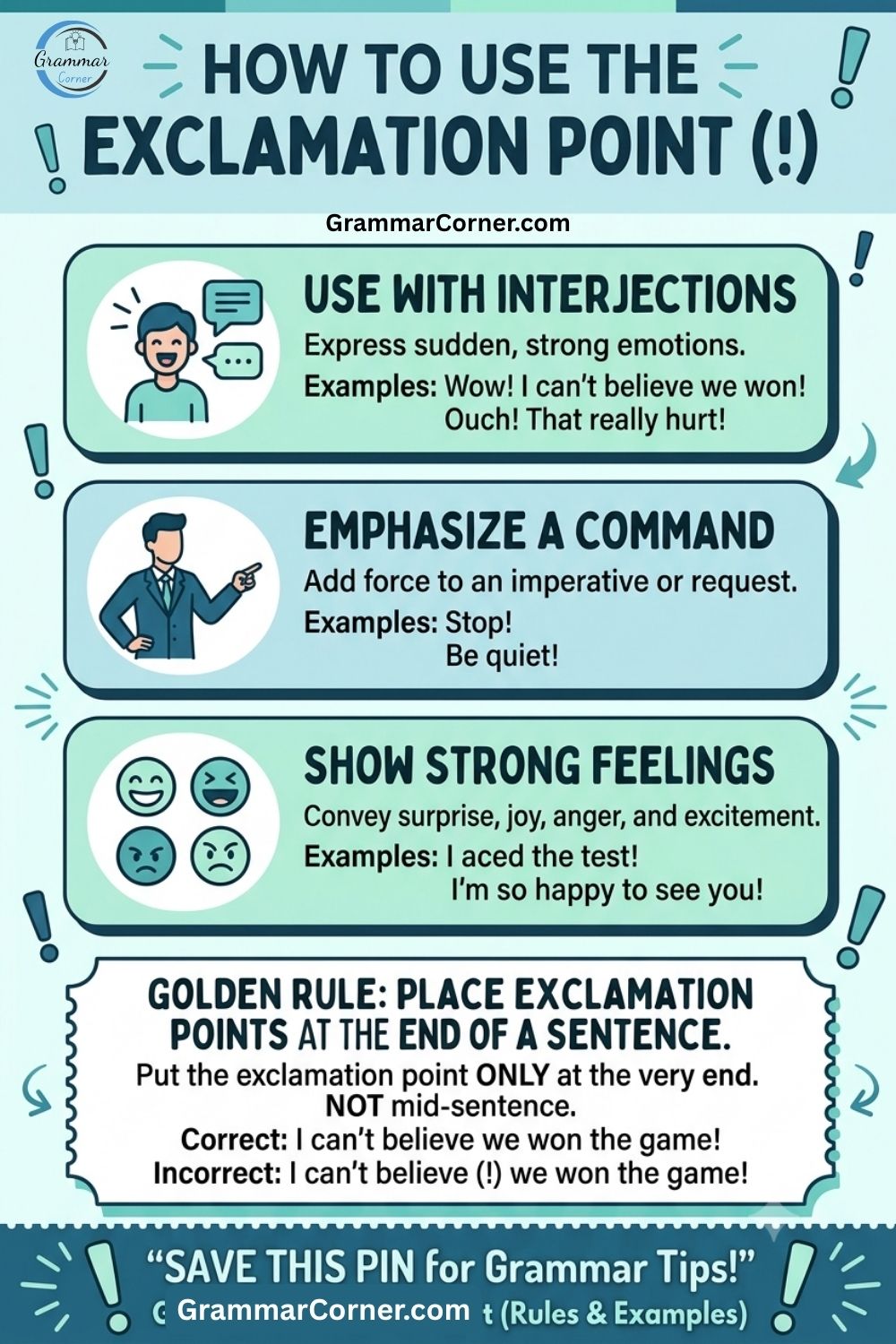
An exclamation mark ( ! ) is a punctuation mark that shows strong emotion or emphasis. Like a period, it usually sits at the end of a sentence — but instead of closing the sentence calmly, it ends it with energy.
Use an exclamation mark when your words carry a strong feeling. That feeling might be any of these:
-
Excitement
We’re going to the beach tomorrow!
-
Surprise
I can’t believe you’re here!
-
Joy
She said yes!
-
Anger
Stop touching my things!
-
Fear
There’s a snake behind you!
-
Admiration
What a beautiful painting!
-
Urgency
Call an ambulance!
-
Strong command
Sit down right now!
Here is the interesting part: the exclamation mark does not change the words in a sentence. It changes the tone. Try it yourself. Move the slider below and watch the same five words go from a calm report to an excited cheer.
Same words, different feeling
Slide from calm to excited and watch the punctuation change the tone.
We won the match.
Calm statement · ends with a periodBoth versions contain exactly the same words. With a period, We won the match. sounds like calm, everyday news. With an exclamation mark, We won the match! sounds like someone cheering from the stands. That is the whole job of this mark: it tells the reader how the sentence should feel.
An exclamation mark replaces the period at the end of a sentence. Never use both together.
Correct: We won the match! Incorrect: We won the match!.
This mark has two names. British English calls it an exclamation mark, while American English usually calls it an exclamation point. Both names refer to the same symbol, used in the same way.
Quick Check
Answer these three questions to see how well you understood the basics. Tap an option to check it instantly.
1. What does an exclamation mark mainly show?
2. Which sentence uses an exclamation mark naturally?
3. Where does an exclamation mark usually appear?
Why Is the Exclamation Mark Important?
Here is a problem every writer faces: writing is silent. When you speak, your listener hears the feeling behind your words — the excitement, the worry, the joy. When you write, all of that disappears. The reader sees nothing but words on a page.
The exclamation mark exists to fill that gap. It tells the reader how a sentence should feel, not just what it says. Used well, it makes writing warmer, livelier, and easier to understand.
When you speak
Your voice does the emotional work for you. Volume, tone, and pace tell the listener exactly how you feel.
When you write
The reader has only the words. Punctuation becomes your tone of voice — and the exclamation mark is its loudest tool.
The mark also signals urgency. A sign that reads Stop! grabs attention far faster than one that simply reads Stop. Same word, very different effect — try it for yourself.
Feel the difference
Tap a button and watch how one small mark changes the message.
Without the mark, the sign gives an instruction — polite, flat, and easy to walk past.
Remember An exclamation mark never changes what a sentence says. It changes how the sentence feels.
Appearance and Structure
The exclamation mark could hardly be simpler to draw: a single upright stroke with a dot sitting directly beneath it — !
Simple as it looks, each part has a job. Think of the stroke as the raised voice and the dot as the full stop hiding underneath. That is why the mark can end a sentence on its own — the “stop” is already built in.
Four quick facts
Where it appears
At the end of a sentence, a phrase, or even a single word — such as Help!
How it looks
One upright line above one dot, placed with no space before it.
On your keyboard
Press Shift + 1 on most English keyboards.
Its computer code
Unicode U+0021 — the same code computers use worldwide.
One spacing rule to lock in
The mark always sits tight against the last word. In English, there is never a space before an exclamation mark.
Watch out!
The mark touches the final word.
Watch out !
That stray space breaks the rule.
Good to know If you ever see a space before the mark in French books, that is not a mistake — French adds one on purpose. English never does.
Quick Check
Three fast questions. Tap an answer to see instant feedback.
Which sentence places the exclamation mark correctly?
What does an exclamation mark add that a full stop cannot?
How do you type an exclamation mark on most English keyboards?
Rules for Using Exclamation Marks
The exclamation mark has only a handful of rules, and every one of them is easy to remember. Master these five, and you will never misuse this mark again.
Use only one
A single exclamation mark carries all the feeling a sentence needs. Adding two or three does not make the emotion stronger — it only makes the writing look careless.
That’s incredible!
That’s incredible!!!
No space before it
The mark belongs directly after the last letter of the final word, with no gap in between. A stray space before it is a common typing slip, so it is worth a quick check.
Well done!
Well done !
Never add a period after it
An exclamation mark is a full stop in its own right. It already ends the sentence, so following it with a period doubles the punctuation for no reason.
Look out!
Look out!.
Capitalize the next word
Because the mark closes a sentence, whatever comes next is the start of a brand-new sentence — and every new sentence begins with a capital letter.
Slow down! You’ll crash.
Keep it inside the quotation marks
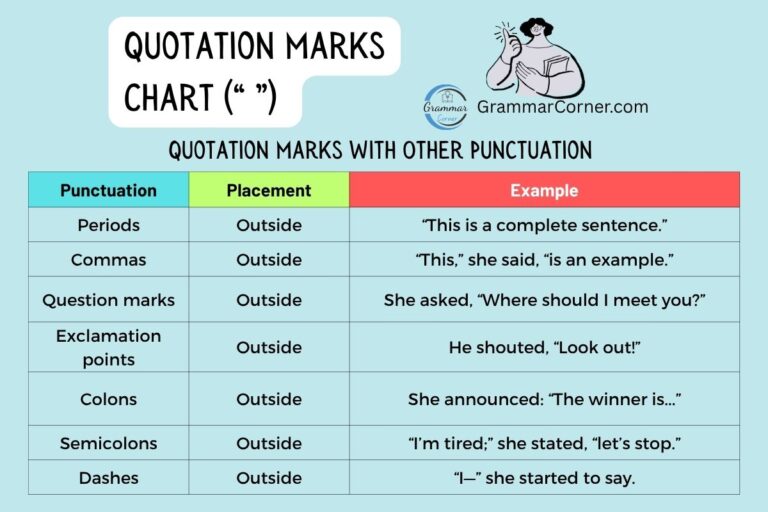
When the strong feeling belongs to the speaker, the exclamation mark stays inside the quotation marks with the words that carry it.
She yelled, Stop right there!
Try It: The Shout Meter
Rule 1 in action. Add marks to the sentence below and watch how the tone changes.
We won the final
No mark yet — the news sounds flat.
Remember: one exclamation mark says excited. Three say I forgot to proofread. In print and on screen alike, a single mark is always enough.
When to Use an Exclamation Mark
Reach for this mark when the emotion is the message. If the sentence would lose its spark with a plain period, an exclamation mark has earned its place. Here are the moments where it shines.
We’re getting a puppy!
Careful, the floor is wet!
You passed the exam!
Welcome home!
“Run!” he shouted.
In short, the exclamation mark feels at home in casual texts, friendly emails, greeting cards, advertisements, and the dialogue of a story — anywhere warmth, urgency, or drama belongs on the page.
When NOT to Use an Exclamation Mark
Knowing when to hold back matters just as much as knowing when to shout. Skip the exclamation mark in these situations.
Essays, reports, and research papers should sound calm and measured. Strong evidence persuades; loud punctuation does not.
A contract or an official letter loses its authority the moment it starts shouting. Keep the tone level and let the content speak.
Everyday facts need no extra volume. The train leaves at noon. A period does the job perfectly.
When every line ends with a bang, none of them stands out. Save the mark for the moments that truly deserve it.
See the Difference
Here is the same short email written two ways. Notice how the tone changes.
Please find the report attached!
I look forward to your reply!
Please find the report attached.
I look forward to your reply.
The second version sounds professional and self-assured. The first sounds as if the writer is nervously waving for attention — not the impression you want in a workplace email.
Quick Check: Bang or No Bang?
Decide whether each sentence deserves an exclamation mark.
The meeting starts at 9 a.m.
Watch out for that step
Please review the attached invoice
Mini Quiz: Master the Rules
Choose the best answer for each question. You will see feedback right away.
1. Which sentence is punctuated correctly?
2. The exclamation mark belongs to the speaker’s words. Which version is correct?
3. Which sentence should NOT end with an exclamation mark?
4. “Slow down! you’ll crash.” What is wrong with this sentence?
5. You are writing a formal research paper. Which ending fits best?
More to read
- Question Mark Guide
- Apostrophe Rules & Examples
- Semicolon Complete Guide
- Colon Rules and Examples
- Parentheses Complete Guide
Frequently Asked Questions About the Exclamation Mark!
Still have a question or two? You are not alone. These are the questions students and writers ask most often about the exclamation mark. Tap any question to see the answer.
What is an exclamation mark used for?
An exclamation mark shows strong feeling. It tells the reader that a sentence, a phrase, or even a single word carries emotion, urgency, or extra emphasis.
It always sits at the end of what it emphasizes:
In both cases, the mark works like a raised voice on paper. Without it, the words would sound flat and calm.
Can I use more than one exclamation mark?
One is always enough. Stacking two or three marks does not make a sentence more exciting — it only makes the writing look unpolished.
In casual texts and social media posts, extra marks are common and nobody will mind. But if you want your writing to look careful and confident, stick to one.
Is the exclamation mark allowed in formal writing?
Essays, reports, and official documents should keep a calm, measured tone. If something is truly surprising, let the words do the work instead of the punctuation.
Notice how the second version still sounds impressive. Strong word choice always beats loud punctuation in formal writing.
Do I put a space before an exclamation mark?
In English, the exclamation mark attaches directly to the last word, with no gap at all.
If you have seen a space before the mark, it was probably in French. French style adds a small space before it, but English never does.
Is it different in British and American English?
The only difference is the name. British writers usually say exclamation mark, while Americans often say exclamation point.
Everything else — where it goes, how it is spaced, and when to use it — works exactly the same on both sides of the Atlantic. Use whichever name feels natural to you.
How do I stop overusing it?
Try the read-aloud test. Read your sentence out loud and listen to your own voice.
If the sentence does not sound loud, urgent, or emotional when you say it, it does not need an exclamation mark. Swap it for a period.
A useful habit: draft your writing freely, then go back and remove every exclamation mark that fails the test. Most writers are surprised by how many disappear — and by how much stronger the remaining ones feel.
The exclamation mark is like salt in cooking. A small amount adds flavor; too much ruins the dish. When every sentence shouts, none of them stands out.
Quick Check: Did the Answers Stick?
Choose an answer to get instant feedback.
1.Which sentence is correctly punctuated?
2.You are writing a school report. Which version fits best?
3.In careful writing, how many exclamation marks should end a sentence?