What Does Ellipses (…) Mean? Examples, Rule and Chart
What Is an Ellipsis?
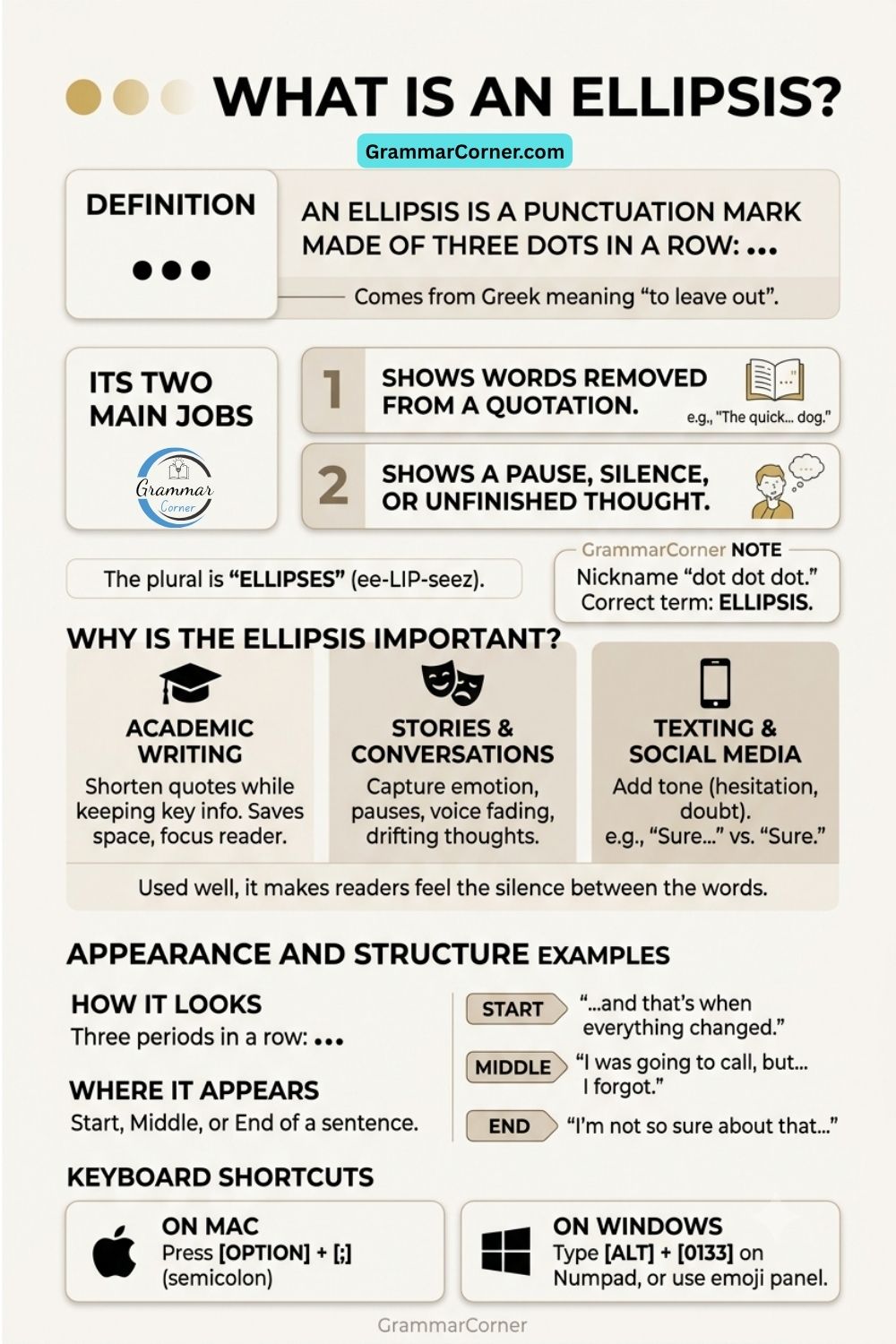
An ellipsis is a punctuation mark made of three dots in a row: …
The word “ellipsis” comes from a Greek word meaning “to leave out.” That’s a helpful clue, because the ellipsis often shows that something has been left out or trailed off.
Here are its two main jobs in simple terms:
- It shows that words have been removed from a quotation.
- It shows a pause, silence, or unfinished thought.
The plural of “ellipsis” is “ellipses” (pronounced ee-LIP-seez). So one mark is an ellipsis, and two or more are ellipses.
Why Is the Ellipsis Important?
At first, three dots may seem too small to matter. But the ellipsis carries real meaning that other marks can’t express.
Academic writing
It lets you shorten a long quote while keeping the important part. This saves space and keeps your reader focused.
Stories & conversations
It captures emotion. A pause before a hard answer, a voice fading away, or a thought that drifts off can all be shown with an ellipsis.
Texting & social media
It adds tone. “Sure…” feels very different from a plain “Sure.” The dots hint at hesitation or doubt.
So the ellipsis is important because it gives your writing rhythm, emotion, and honesty. Used well, it makes readers feel the silence between the words.
Appearance and Structure
Let’s look closely at how the ellipsis is built and typed.
How it looks: It is three periods in a row, like this: …
Where it appears: It can sit at the start, middle, or end of a sentence, depending on what you want to show.
- Start “…and that’s when everything changed.”
- Middle “I was going to call, but… I forgot.”
- End “I’m not so sure about that…“
Keyboard symbol: You can simply type three periods with your keyboard (. . .). Many word processors automatically turn them into a single ellipsis character.
Unicode character: The ellipsis has its own official character: … (Unicode U+2026). On many keyboards you can insert it with a shortcut.
On Mac
Press Option + ; (semicolon)
On Windows
Type Alt + 0133 on the number pad, or use the emoji/symbol panel.
Main Functions of the Ellipsis
The ellipsis has several clear uses. Let’s go through each one with examples.
To Show Omitted Words in a Quotation
When you quote someone but want to skip part of it, the ellipsis marks the gap. The reader knows some words were left out.
To Show a Pause or Hesitation
In dialogue and casual writing, the ellipsis shows someone pausing to think or feeling unsure.
“Well… I guess we could try.”
“I wanted to tell you something, but… never mind.”
To Show a Trailing Off or Unfinished Thought
Sometimes a sentence fades out instead of ending firmly. The ellipsis captures that fade.
“If only things had been different…“
“I thought you understood, but maybe…“
To Build Suspense or Tension
Writers use the ellipsis to slow the reader down and create a moment of drama.
“She opened the old door and saw…“
“The results are in, and the winner is…“
To Suggest an Ongoing List or Idea
The ellipsis can hint that a list continues without writing every item.
“We packed snacks, water, sunscreen, towels…“
Rules for Using the Ellipsis
Here are the five main rules, each with an example.
Use exactly three dots.
Don’t use two dots or five. The standard ellipsis is always three.
- “I wonder…”
- “I wonder..” (only two dots)
Handle the end of a sentence carefully.
If your quote ends and words are cut after a complete sentence, you may need a period plus the ellipsis — which looks like four dots. The first dot is the sentence’s own period.
- “The meeting is over. … Please leave quietly.” (a period ends the first sentence, then the ellipsis shows omitted words)
Don’t overuse it.
Too many ellipses make writing look uncertain or messy. Use them only when the pause or omission adds meaning.
- “So… I was thinking… maybe we could… talk later…” (four ellipses in one sentence — the reader hears hesitation, not meaning)
Keep quotations honest.
When you remove words from a quote, never change the speaker’s meaning. The ellipsis should shorten, not twist.
- Original: “The film was good in parts, but overall a disappointment.” Dishonest cut: “The film was good…” (the shortened quote reverses the reviewer’s verdict)
Match your spacing style.
Whether you use spaced dots (. . .) or a solid ellipsis (…), stay consistent across the whole piece.
When to Use the Ellipsis
Use an ellipsis when you want to:
- Trim a long quotation while keeping its key point. “The committee agreed … to delay the launch until spring.”
- Show a natural pause in speech or thought. “I was thinking … maybe we should start over.”
- Let a sentence trail off to suggest emotion or uncertainty. “If only I had said something sooner….”
- Create suspense before a reveal. “And the winner is … Amara!”
- Hint that a list or idea continues without listing everything. “Bring the basics — pens, paper, notebooks …”
In each of these cases, the dots add something a period or comma cannot.
When NOT to Use the Ellipsis
Avoid the ellipsis in these situations:
- In formal or professional writing where a clear ending is needed. A business report should end firmly, not trail off.
- As a replacement for other punctuation. Don’t use it instead of a period, comma, or dash out of habit.
- To fill space or add drama for no reason. Random dots make writing look unsure.
- Between every sentence in a text or email. Overuse can read as passive, moody, or unclear.
If you can remove the ellipsis and the sentence still says exactly what you mean, you probably didn’t need it.
Common Mistakes
Beginners and ESL learners often trip over the same few errors. Let’s fix them.
Using the wrong number of dots
Many writers type two or four dots by accident. The standard ellipsis has three.
The only time four dots appear is when a complete sentence ends with an ellipsis — three dots plus the period.
Overusing ellipses
Some writers add dots after almost every sentence. This makes the writing feel unsure and hard to follow.
Using it in place of a period
An ellipsis is not a normal full stop. Ending a plain statement with dots changes its tone.
Changing a quote’s meaning
Cutting words in a way that alters what the speaker meant is a serious error, especially in academic work.
Mixing it up with a dash
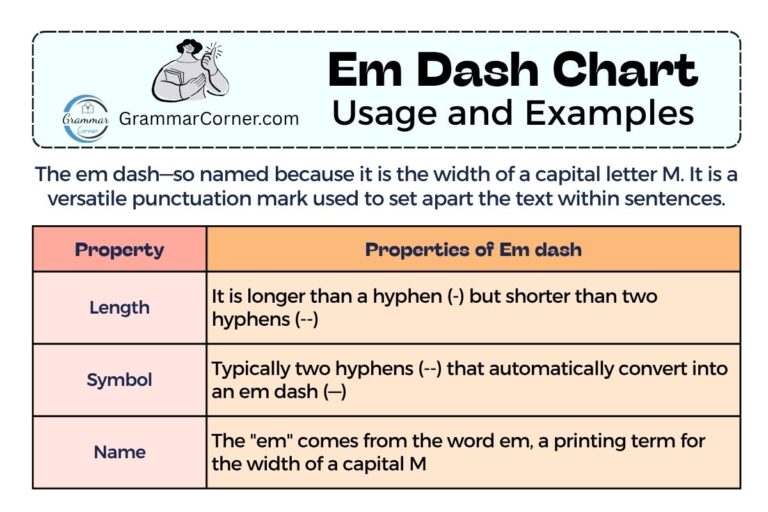
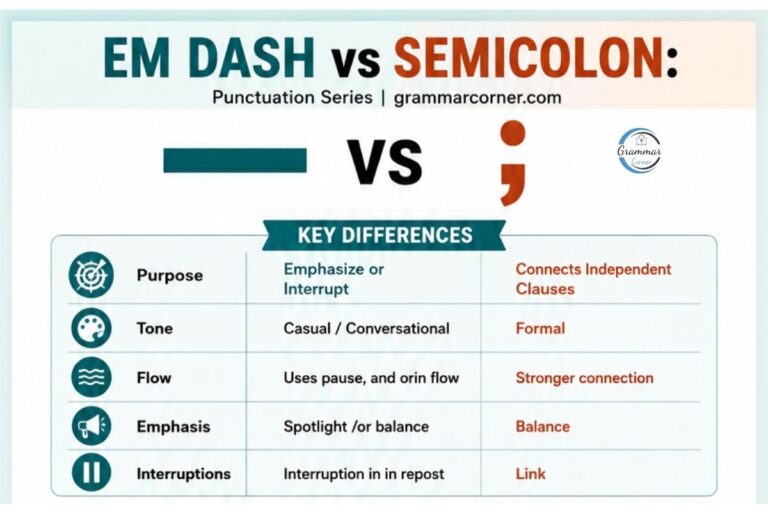
A dash (—) shows a sharp break or an added thought. An ellipsis shows a soft pause or missing words. They are not the same.
Forgetting spacing
Writers often switch between word…word and word … word in the same piece. Style guides differ on which spacing to use, but every guide agrees on one thing: pick one format and keep it consistent throughout your document.
Ellipsis vs. Period, Comma, and Dash
Don’t confuse the ellipsis with the period, comma, or dash. They can appear in similar places in a sentence, but each mark does a different job. This table shows the differences.
| Feature | Ellipsis (…) | Period (.) | Comma (,) | Dash (—) |
|---|---|---|---|---|
| Purpose | Shows a pause or omitted words | Ends a statement | Separates parts of a sentence | Marks a sharp break or added idea |
| Appearance | Three dots in a row | One dot at the baseline | One low curved mark | A long horizontal line |
| Position | Start, middle, or end | End of a sentence | Between words or clauses | Middle or between clauses |
| Function | Suggests silence, trailing off, or missing text | Signals a full stop | Creates a short separation | Adds emphasis or a strong pause |
| Example | “I’m not sure…” | “I’m not sure.” | “I’m not sure, but I’ll try.” | “I’m not sure—let’s ask her.” |
| Common mistake | Typing two or four dots instead of three | Using it after every fragment | Splicing two full sentences together | Confusing it with a hyphen |
Practice Exercises
Try these on your own. Tap an option in Part B for instant feedback, and use the Show answer buttons to check the rest.
Fill in the Blanks
Add an ellipsis where a pause or omission fits best.
-
“I was going to say yes, but ___”
Show answer
“I was going to say yes, but…” — the ellipsis shows the speaker trailing off.
-
“We packed sandwiches, fruit, juice ___”
Show answer
“We packed sandwiches, fruit, juice…” — the ellipsis suggests the list continues.
-
“So ___ what happens next?”
Show answer
“So… what happens next?” — the ellipsis creates a pause before the question.
Multiple Choice
Choose the correct option.
4. How many dots make a standard ellipsis?
5. Which sentence uses the ellipsis correctly?
6. When should you avoid an ellipsis?
Error Correction
Fix the mistake in each sentence.
-
“Please reply by noon…”
Show answer
“Please reply by noon.” — a clear deadline needs a period, not a trailing pause.
-
“We waited.. for the bus.”
Show answer
“We waited… for the bus.” — two dots become the correct three.
-
The report said profits “fell… sharply,” but a writer quoted it as profits “rose sharply.”
Show answer
Keep the quotation honest: “fell… sharply.” An ellipsis may shorten a quotation, but it must never change its meaning.
Sentence Rewriting
Rewrite each sentence to include a correct ellipsis that shows a pause.
-
“I don’t know what to say.”
Show sample answer
“I don’t know what to say…”
-
“Maybe we should go home now.”
Show sample answer
“Maybe we should go home now…”
Style note: In everyday writing, three dots at the end of a trailing sentence are fine. In formal styles, add a period after the ellipsis when it ends a complete sentence — four dots in total.
See also:
- Full Stop Rules and Examples
- Em Dash Rules and Examples
- Em Dash Vs. Semicolon
- Apostrophe Vs. Comma
- Exclamation Marks Rules and Examples