Noun Phrases Structure and Examples
What Is a Noun Phrase?
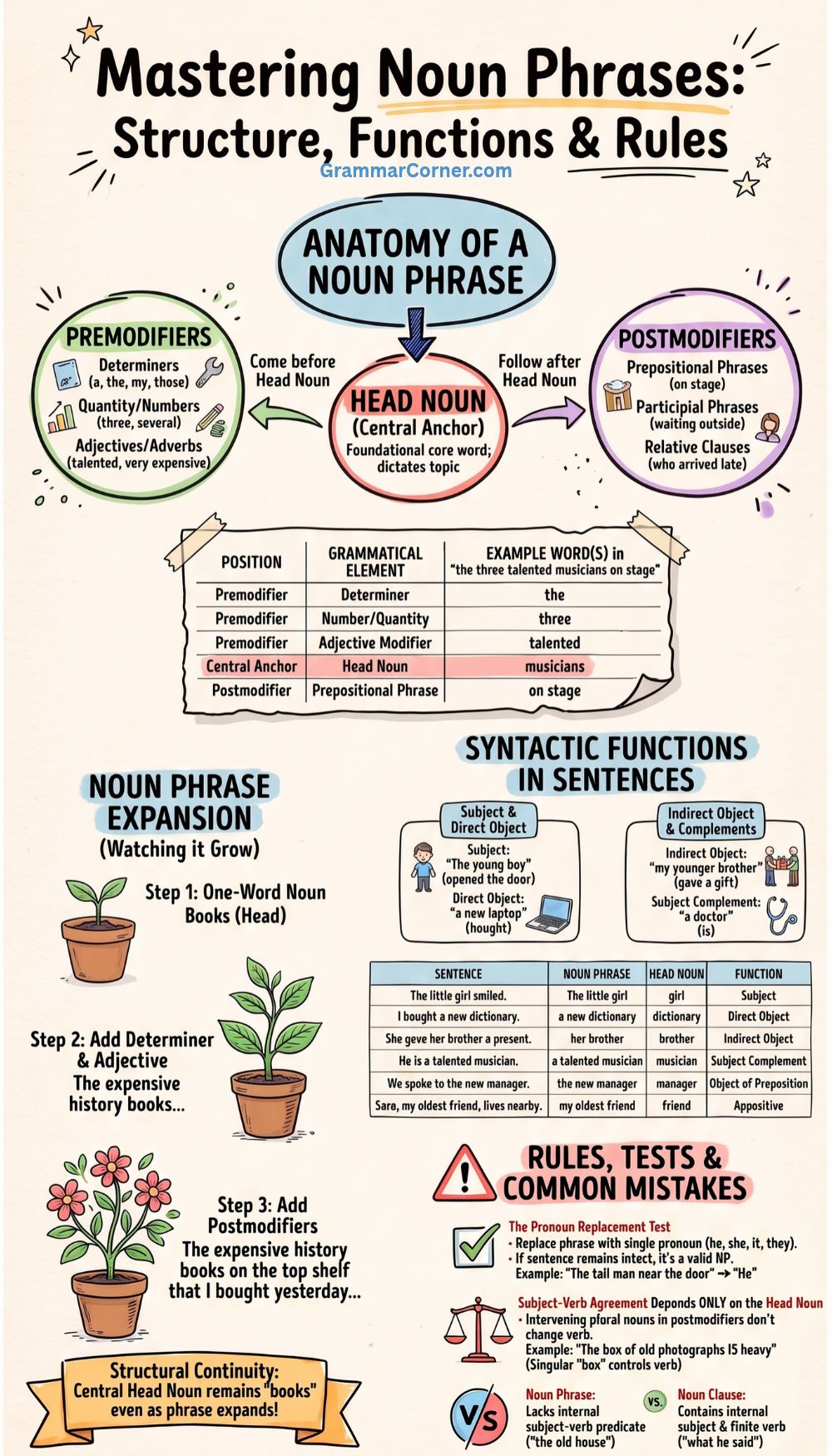
A noun phrase is a group of words that functions collectively as a noun in a sentence. It is structured around a central anchor called the head, which is typically a noun or a pronoun.
Instead of relying solely on an isolated noun to name a person, place, thing, or concept, sentences frequently expand the subject or object with accompanying descriptive details.
What Is the Head of a Noun Phrase?
The head is the foundational core word of the noun phrase. It carries the primary lexical meaning and determines the grammatical identity of the entire structure.
- Determiner: the
- Quantity: three
- Adjective Modifier: talented
- Head Noun: musicians
• Prepositional Modifier: near the river (supplies spatial information about the house)
Quick Challenge
In the noun phrase “the three talented musicians on stage,” which single word is the head noun? Tap your answer below.
See the full answer
Answer: “musicians”
The head noun is the core word that dictates what the entire phrase is fundamentally about. In “the three talented musicians on stage,” the (determiner), three (quantity), talented (adjective), and on stage (prepositional phrase) all modify and expand the central anchor: musicians.
How Is a Noun Phrase Formed?
Noun phrases range from a single determiner and noun to complex multi-layered units. Common formation patterns include:
The determiner identifies, limits, or specifies the head noun:
An adjective describes a quality, characteristic, or attribute of the noun:
Combines both specification and descriptive modification:
- the old house
- a beautiful garden
- those clever students
- the three extremely talented young musicians (Head: musicians)
A prepositional phrase follows the head noun to identify or describe it:
- the book on the table (Specifies which book)
- the woman in the blue dress
- the road to the village
A relative clause supplies extra identifying information about the head noun:
- the man who called yesterday
- the students who passed the examination
- the book that you recommended
Complex Noun Phrases with Multiple Modifiers
Multiple premodifiers and postmodifiers can combine around a single head noun:
- “the three beautiful paintings on the wall” ➔ Head: paintings
- “the two students waiting outside the classroom” ➔ Head: students
- “the old wooden table beside the window” ➔ Head: table
Parts of a Noun Phrase
A noun phrase is organized into four core structural positions:
1. The Head
The central anchor that defines the entire phrase:
- the car
- my old car
- my old car in the garage
2. Determiners
Determiners establish reference, definiteness, possession, or quantity:
Note: Bare plural or mass nouns do not require determiners to form valid noun phrases (e.g., “Students need regular practice.”).
3. Premodifiers
Premodifiers precede the head noun and can include adjectives, classifying nouns, numbers, or adverbs modifying an adjective:
- a beautiful garden (Adjective)
- a three-year-old child (Compound modifier)
- the school bus (Noun adjunct)
- a very expensive car (Adverb + Adjective)
4. Postmodifiers
Postmodifiers follow the head noun to provide descriptive or restrictive detail:
- the house near the river (Prepositional phrase)
- the students who arrived late (Relative clause)
- the man wearing a black coat (Participial phrase)
- a book to read during the journey (Infinitive phrase)
5. Complements of Nouns
A complement completes the intrinsic meaning required by specific abstract nouns:
The complement clause that the plan will work completes the core content of belief.
Common Elements in Noun Phrases
| Element | Position | Examples |
|---|---|---|
| Determiner | Before head | the, a, my, these |
| Number / Quantity | Before head | two, several, many |
| Adjective | Before head | red, beautiful, old |
| Adverb (Degree) | Before modifier | very, extremely |
| Head Noun | Central | house, students, idea |
| Prepositional phrase | After head | in the garden |
| Participial phrase | After head | waiting outside |
| Infinitive phrase | After head | to read |
| Relative clause | After head | who lives nearby |
Types of Words That Can Modify a Noun
A head noun can be modified by various grammatical units positioned either before it (premodifiers) or after it (postmodifiers).
Indicate general or specific reference:
Identify specific items based on proximity:
Express ownership or association:
State quantity, amount, or count:
Describe descriptive qualities or classification:
• an interesting story
• the old wooden bridge
• a small red Italian car (Head: car)
Intensify or modify the premodifying adjectives:
• an extremely difficult question
Postmodify the noun with contextual details:
• the book on the desk
• the house near the station
Add descriptive action without full clauses:
• the car damaged in the accident
• the children playing in the park
Express purpose, potential, or requirement:
• a place to stay
• something to eat
Full dependent clauses specifying the head:
• the book that I bought yesterday
• the students who passed the test
Functions of Noun Phrases
A noun phrase can fulfill every syntactic role typically occupied by a single noun:
Performs the action or serves as the topic of the clause:
- The young boy opened the door.
- The students in the front row answered the question.
Directly receives the action of a transitive verb:
- She bought a new laptop.
- We visited the old museum near the river.
Identifies the recipient of the direct object:
Renames or identifies the subject after a linking verb:
- My sister is a doctor.
- Mr. Ahmed became the school principal.
Renames or completes the direct object:
Serves as the nominal element governed by a preposition:
- She sat beside her best friend.
- We walked through the narrow street.
Renames or provides clarifying information about an adjacent noun:
Noun Phrase Examples in Different Roles
| Sentence | Noun Phrase | Head | Function |
|---|---|---|---|
| The little girl smiled. | The little girl | girl | Subject |
| I bought a new dictionary. | a new dictionary | dictionary | Direct object |
| She gave her brother a present. | her brother | brother | Indirect object |
| He is a talented musician. | a talented musician | musician | Subject complement |
| They elected him team captain. | team captain | captain | Object complement |
| We spoke to the new manager. | the new manager | manager | Object of prep |
| Sara, my oldest friend, lives nearby. | my oldest friend | friend | Appositive |
Noun Phrase Expansion: Watching the Phrase Grow
Examining how modifiers attach sequentially demonstrates how the structural anchor remains unchanged regardless of phrase length:
“Books can be expensive.”
“The books can be expensive.”
“The expensive books can be difficult to sell.”
“The expensive history books can be difficult to sell.”
“The expensive history books on the top shelf can be difficult to sell.”
“The expensive history books on the top shelf that I bought yesterday can be difficult to sell.”
Even as the noun phrase expands with determiners, adjectives, prepositional phrases, and relative clauses, the core head noun remains books.
Quick Challenge
In the sentence “She gave her younger brother a birthday present,” what is the grammatical function of the noun phrase “her younger brother”? Tap your answer.
See the full answer
Answer: Indirect Object
In ditransitive clauses with the verb gave, the person receiving the transferred item is the indirect object (her younger brother), while the thing being directly transferred is the direct object (a birthday present).
How to Identify a Noun Phrase
Isolating a noun phrase is most reliable when working from the central head word outward:
• In “The three young athletes won the race,” the central nominal element is athletes.
• In “The three young athletes from our school won the race,” every modifier from The through school forms a single noun phrase.
➔ The foundational anchor is athletes.
• “The three young athletes from our school won the race.” ➔ Subject
• “We congratulated the three young athletes from our school.” ➔ Direct Object
Noun Phrase vs. Noun
A noun is an isolated lexical word, whereas a noun phrase includes the head noun alongside its determiners and modifying words:
| Single Noun | Expanded Noun Phrase |
|---|---|
| house | the large house |
| students | the new students |
| book | that interesting book |
| teacher | my English teacher from Lahore |
| children | the children in the park |
Noun Phrase vs. Noun Clause
Both structures function nominally as subjects or objects, but a noun clause contains an internal subject-and-verb predicate:
Structural Contrast
| Feature | Noun Phrase | Noun Clause |
|---|---|---|
| Functions like a noun? | Yes | Yes |
| Subject + verb structure? | No | Yes |
| Example | the old house | what he said |
| Can function as subject? | Yes | Yes |
| Can function as object? | Yes | Yes |
“The students who passed the examination received certificates.”
Although this structure contains the relative clause who passed the examination, the entire unit is still a noun phrase headed by the noun students.
Noun Phrase vs. Verb Phrase
A noun phrase is built around a nominal head, while a verb phrase is centered on a lexical verb and its accompanying auxiliaries:
| Noun Phrase (Nominal Unit) | Verb Phrase (Predicative Unit) |
|---|---|
| the young boy | was running |
| my older sister | has finished |
| those difficult questions | might be answered |
| the new teacher | is explaining |
Noun Phrase vs. Adjective Phrase
An adjective phrase is anchored by an adjective, whereas a noun phrase is anchored by a noun:
- Complete Noun Phrase: a very beautiful painting
- Internal Adjective Phrase Modifier: very beautiful (Head: beautiful)
- Head Noun: painting
Premodifiers and Postmodifiers in Noun Phrases
Modifiers position before (premodifiers) or after (postmodifiers) the head noun to refine its meaning:
| Position | Example Phrase | Modifier Type |
|---|---|---|
| Before head | the old house | Adjective (old) |
| Before head | the large wooden table | Adjectives (large wooden) |
| After head | the house near the river | Prepositional phrase |
| After head | the students waiting outside | Participial phrase |
| After head | the woman who called me | Relative clause |
Integrated Example with Both Modifiers
• Quantity: three
• Premodifier: talented (adjective)
• Head Noun: students
• Postmodifier: from our school (prepositional phrase)
Noun Phrases and Subject–Verb Agreement
When a multi-word noun phrase occupies the subject position of a clause, the grammatical number (singular or plural) of the head noun controls the verb—not the intervening nouns inside attached modifiers.
• Head Noun: box (singular)
• ✅ Correct: “The box of old photographs is heavy.”
• ❌ Agreement Error: “The box of old photographs are heavy.”
Singular vs. Plural Head Comparisons
• “The groups of students are ready.” (Plural head: groups)
• “Several collections of rare books were donated.” (Plural head: collections)
Nouns occurring inside intervening prepositional modifiers (like photographs or books) often act as distractors. Always isolate the primary head noun before selecting the verb form.
Can a Noun Phrase Contain a Clause?
Yes. A noun phrase frequently embeds a relative clause or other dependent clause-like structures as a postmodifier:
- Complete Noun Phrase: The woman who lives next door
- Head Noun: woman
- Embedded Relative Clause: who lives next door
The presence of an internal subject-verb pair within the embedded modifier does not convert the entire overarching structure into a noun clause; the entire unit remains a noun phrase centered on woman.
Long and Complex Noun Phrases
Expanding noun phrases allows writers to pack dense factual and circumstantial context into a single clause:
“The researchers examined the data.”
Editing Rule for Overloaded Noun Phrases
When excessive modifiers crowd a single head noun, sentence readability drops. Use this two-step diagnostic to streamline complex constructions:
Why Are Noun Phrases Important?
Noun phrases enable writers to deliver rich, precise information economically without inflating paragraph length with repetitive coordinate clauses:
Key Applications Across Writing Domains
Common Mistakes with Noun Phrases
The presence of a noun inside a phrase does not make the entire unit a noun phrase:
• “the students in the large classroom” ➔ Noun Phrase (headed by students)
• “who the new teacher is” ➔ Noun Clause (contains subject + finite verb is)
Stacking too many premodifiers and postmodifying clauses buries the central noun and obscures sentence focus. When modifiers crowd the head, break the information across two balanced sentences.
Noun Phrases in Everyday English
In natural English, nouns rarely stand in isolation; determiners and modifiers specify reference and add descriptive precision:
✅ Natural NP: “Give me that blue book.”
✅ Natural NP: “I met my English teacher.”
✅ Natural NP: “She bought a small used car.”
Noun Phrase Examples in Sentences
| Sentence | Noun Phrase | Head | Function |
|---|---|---|---|
| The little boy is sleeping. | The little boy | boy | Subject |
| I bought a new laptop. | a new laptop | laptop | Direct object |
| She gave her younger sister a book. | her younger sister | sister | Indirect object |
| Those students from our school won. | Those students from our school | students | Subject |
| We visited the museum near the river. | the museum near the river | museum | Direct object |
| He became a successful businessman. | a successful businessman | businessman | Subject complement |
| I spoke to the man in the blue coat. | the man in the blue coat | man | Object of prep |
| Sara, my closest friend, helped me. | my closest friend | friend | Appositive |
Practice Exercises
- The young woman opened the door.
- We bought a very expensive computer.
- Those students from our school won the competition.
- My brother’s old bicycle needs repair.
- The book on the top shelf belongs to me.
- She invited her three closest friends.
- The man who lives next door is a doctor.
- Several interesting articles were published this month.
- I gave the new teacher a welcome card.
- The little house beside the river was sold.
| No. | Complete Noun Phrase | Head Noun |
|---|---|---|
| 1 | The young woman | woman |
| 2 | a very expensive computer | computer |
| 3 | Those students from our school | students |
| 4 | My brother’s old bicycle | bicycle |
| 5 | The book on the top shelf | book |
| 6 | her three closest friends | friends |
| 7 | The man who lives next door | man |
| 8 | Several interesting articles | articles |
| 9 | the new teacher | teacher |
| 10 | The little house beside the river | house |
Identify the grammatical role of the bold noun phrase:
- The new student answered the question.
- I bought a dictionary.
- She gave her brother a gift.
- My father is a doctor.
- We spoke to the school principal.
- Ali, my best friend, helped me.
| No. | Syntactic Function |
|---|---|
| 1 | Subject |
| 2 | Direct object |
| 3 | Indirect object |
| 4 | Subject complement (predicate noun) |
| 5 | Object of a preposition |
| 6 | Appositive |
Identify the central head noun in each phrase:
- the old wooden chair ➔ chair
- several difficult questions ➔ questions
- my younger sister ➔ sister
- the house near the railway station ➔ house
- those three talented musicians ➔ musicians
- the students waiting outside ➔ students
- a very interesting history book ➔ book
- the man who called yesterday ➔ man
Frequently Asked Questions About Noun Phrases
The head is houses.
Because box is singular, the singular verb is is used.