Em Dash vs Semicolon (Key Differences)
One breaks a sentence open for effect. The other quietly binds two full thoughts together. Here’s how to tell them apart—and use each with confidence.
Introduction
The em dash (—) and the semicolon (;) are two of the most misunderstood marks in English. Both can sit in the middle of a sentence and join ideas that a period would otherwise split apart, so writers often reach for whichever one feels right and hope for the best.
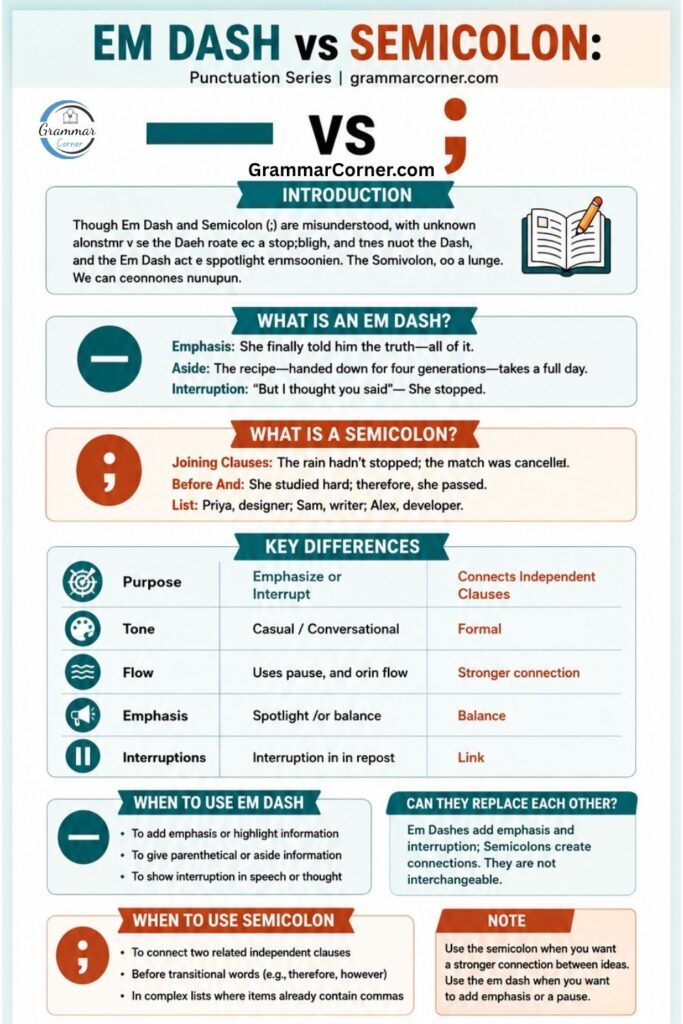
They aren’t interchangeable, though. The em dash is a spotlight: it interrupts, emphasizes, and adds a burst of extra information with a slightly informal, conversational energy. The semicolon is a hinge: it links two complete, closely related thoughts smoothly and formally, keeping them in one sentence because they belong together.
Confusing the two won’t always make a sentence wrong, but it will change its tone—and sometimes it produces an outright error. By the end of this guide you’ll know exactly what each mark does, when to pick one over the other, when they can safely swap, and how to avoid the mistakes that trip up even confident writers.
Quick answer: em dash vs semicolon
If you only remember one thing: use an em dash to add emphasis, insert an aside, or signal a sharp break; use a semicolon to join two complete sentences that are logically linked. The dash raises your voice; the semicolon lowers it.
Em dash —
- Adds emphasis or an abrupt interruption
- Feels more casual and conversational
- Draws the eye to what follows
Semicolon ;
- Connects two related independent clauses
- Feels more formal and measured
- Creates a smooth, logical link
What is an em dash?
An em dash is a long horizontal line—roughly the width of a capital M, which is where it gets its name. It’s the longest of the three common horizontal marks: the hyphen (-) is shortest, the en dash (–) is medium, and the em dash (—) is longest.
Its job is flexibility. A single em dash can introduce an explanation, a summary, or a dramatic afterthought. A pair of em dashes can wrap an aside in the middle of a sentence, doing the work of parentheses or commas but with more force. Because it creates a visible pause, it slows the reader down and pushes emphasis onto whatever comes next.
A quick note on spacing: American style guides (like Chicago) set the em dash closed up with no spaces around it, while some British and journalistic styles (like AP) use a spaced dash. Pick one convention and stay consistent.
Emphasis: She finally told him the truth—all of it.
Aside (pair): The recipe—handed down for four generations—takes a full day to make.
Summary: Fresh air, good food, no deadlines—that’s my idea of a holiday.
Interruption: “But I thought you said—” She stopped mid-sentence.
What is a semicolon?
A semicolon looks like a period sitting on top of a comma, and that’s a useful clue to what it does: it’s stronger than a comma but weaker than a period. Its main role is to join two independent clauses—two groups of words that could each stand alone as a sentence—when they’re closely related in meaning.
You can also place a semicolon before a conjunctive adverb such as however, therefore, moreover, or nevertheless when it links two complete sentences. And in one specialized job, semicolons separate items in a complex list where the items themselves already contain commas, keeping everything readable.
Joining clauses: The rain hadn’t stopped; the match was cancelled.
Before a conjunctive adverb: She studied hard all term; therefore, she passed with ease.
Complex list: The team includes Priya, the designer; Sam, the writer; and Alex, the developer.
Related contrast: Some people love winter; others count the days until spring.
Em dash vs semicolon: comparison table
| Feature | Em dash — | Semicolon ; |
|---|---|---|
| Appearance | Long horizontal line (—) | Dot above a comma (;) |
| Purpose | Emphasize, interrupt, add an aside | Link related complete thoughts |
| Tone | Conversational, energetic | Measured, smooth |
| Formality | More informal | More formal |
| Sentence flow | Creates a sharp break or pause | Creates a seamless connection |
| Independent clauses | Can join them, with emphasis | Its primary, standard job |
| Parenthetical info | Yes—a pair can wrap an aside | No |
| Emphasis | High—pulls the eye forward | Low—keeps clauses balanced |
| Best use | A dramatic or surprising addition | Two ideas that belong together |
| Example | I knew the answer—finally. | I knew the answer; I said nothing. |
Key differences between an em dash and a semicolon
Purpose
The em dash adds—it introduces extra information, an explanation, or a punchy afterthought. The semicolon connects—it fuses two complete, related sentences into one. One expands; the other links.
Tone
An em dash sounds like spoken language: a pause for effect, a change of direction. A semicolon sounds composed and deliberate, the mark of careful, formal prose.
Sentence flow
The dash breaks the flow on purpose, making the reader stop and take notice. The semicolon keeps the flow moving, gliding from one clause into the next without a hard stop.
Formality
Semicolons belong comfortably in essays, reports, and academic writing. Em dashes shine in blogs, fiction, marketing, and anywhere a lively, personal voice helps. Neither is “wrong” in the other setting, but each has a natural home.
Emphasis
Whatever follows an em dash gets the spotlight. A semicolon spreads weight evenly across both clauses, so neither side dominates.
Interruptions
Only the em dash marks an interruption—a thought that cuts off or a voice that breaks in. A semicolon can’t do this; it always joins two complete ideas.
Independent clauses
Both can sit between two independent clauses, but with a key difference: the semicolon is the standard, neutral choice, while the dash does the same job with added drama. What neither can do is join a complete sentence to a fragment as if the fragment were complete.
Try it: swap the mark, feel the change
Same two clauses, different mark. Tap to see how the tone shifts.
Dash: sharp, dramatic pause—builds suspense.
When to use an em dash
To add emphasis
Put the word or phrase you want to stress after a dash. The break makes it land harder than a comma would.
There was only one person she trusted—herself.
To insert extra information
Use a pair of em dashes to drop an aside into the middle of a sentence. This works like parentheses but keeps the aside part of the main voice rather than tucking it away.
The old bridge—closed for years—is finally being repaired.
To show an interruption
In dialogue, an em dash marks speech that’s cut off suddenly.
“If you’d just listen for one second—” But the door had already slammed.
To introduce a conclusion or explanation
A single dash can set up a payoff: a summary, a result, or an explanation of what came before.
He packed light, moved fast, and told no one—the plan depended on it.
When to use a semicolon
Joining related independent clauses
This is the semicolon’s core job. When two full sentences are closely linked—so closely that a period feels too abrupt—a semicolon holds them together without a conjunction like and or but.
The lecture ran long; nobody minded.
Before conjunctive adverbs
When words such as however, therefore, nevertheless, moreover, or consequently connect two independent clauses, put a semicolon before the adverb and a comma after it.
The forecast promised sun; however, it rained all afternoon.
Separating items in a complex list
When the items in a list already contain commas, semicolons act as “super-commas” to keep each item clearly separated.
We visited Paris, France; Rome, Italy; and Cairo, Egypt.
Can an em dash and a semicolon replace each other?
Sometimes—but not always. When both sides of the mark are complete, related independent clauses, either one can technically work. The choice then comes down to tone.
When the swap is fine. Both marks join two full sentences here, so both are grammatically correct; only the mood changes.
The semicolon version reads calm and even; the dash version adds a beat of tension before the second clause.
When the swap changes the tone too much. In a formal report, a dash where a semicolon belongs can read as too casual—and a semicolon where a dash belongs can drain the energy from a punchy line.
When the swap is simply wrong. If one side isn’t a complete sentence, the semicolon fails but the dash still works, because the dash doesn’t require two independent clauses.
Common mistakes to avoid
| Mistake | Correct usage | Why |
|---|---|---|
| Semicolon before a fragment | Use a dash or comma instead | A semicolon needs a full sentence on both sides. |
| Overusing em dashes | Limit to one or two per passage | Too many dashes kill the emphasis they create. |
| Using a semicolon and a conjunction together | Pick one: semicolon or “and/but” | “; and” is redundant; the semicolon already joins. |
| Replacing every comma with a dash | Keep commas for ordinary pauses | Dashes are for emphasis, not routine breaks. |
| Mixing spaced and closed dashes | Choose one style and stay consistent | Inconsistent spacing looks careless to readers. |
Em dash vs semicolon: correct vs incorrect examples
| Incorrect | Correct | Explanation |
|---|---|---|
| I love the beach; and the mountains. | I love the beach and the mountains. | No semicolon before “and”; the second part is a fragment. |
| We were late; because the train stopped. | We were late because the train stopped. | “Because…” is a dependent clause, so no semicolon. |
| Her answer surprised everyone; it was bold, clear; and honest. | Her answer surprised everyone—bold, clear, and honest. | A dash cleanly adds the summary; the semicolons were misused. |
| The plan—which was risky failed. | The plan—which was risky—failed. | An aside needs a dash on both sides. |
| He studied all night, he still felt unprepared. | He studied all night; he still felt unprepared. | Two full clauses need a semicolon, not a comma (comma splice). |
| Bring a coat—a hat—and gloves—it’s freezing. | Bring a coat, a hat, and gloves—it’s freezing. | Use commas for the list; one dash for the final emphasis. |
| She won the prize; a trip to Japan. | She won the prize—a trip to Japan. | The second part is a fragment, so a dash fits, not a semicolon. |
| The store was closed; however the sign said open. | The store was closed; however, the sign said open. | A conjunctive adverb like “however” needs a comma after it. |
Practice exercises
Part A — Fill in the blank with an em dash or a semicolon.
1. The lights flickered ___ then the room went dark.
2. She had one goal ___ to finish first.
3. The report was late ___ therefore, the client was upset.
Part B — Multiple choice. Which sentence is punctuated correctly?
1. Choose the correct sentence.
2. Which uses the em dash correctly?
3. Which list is punctuated correctly?
Part C — Rewrite each sentence, fixing the punctuation.
1. He was exhausted, he kept working.
2. My favourite season is autumn; the crisp cool one.
3. The meeting—which ran late—finally ended; and everyone left.
Frequently asked questions
Which is more formal, the em dash or the semicolon?
Which punctuation is better for essays?
Can an em dash replace a semicolon?
Can a semicolon replace a period?
Should I use spaces around an em dash?
Can I overuse em dashes?
Is the em dash the same as a hyphen or en dash?
Key takeaways
- Em dashes emphasize. They interrupt, spotlight, and add a burst of extra information.
- Semicolons connect. They link two complete, closely related thoughts smoothly.
- Choose by purpose and tone: the dash for energy and emphasis, the semicolon for balance and formality.
- Use em dashes sparingly—their power fades when they’re everywhere.
- Use semicolons when two complete sentences clearly belong together.
- When in doubt, check both sides of the mark: a semicolon demands two full sentences; a dash doesn’t.
See also
- Apostrophe Anchor Chart (Rules and Examples)
- Exclamation Point Rules and Examples
- Full Stop Complete Guide
- Colon Rules and Examples