Colon Chart: How and When to Use a Colon (Rules & Examples)
Quick Summary
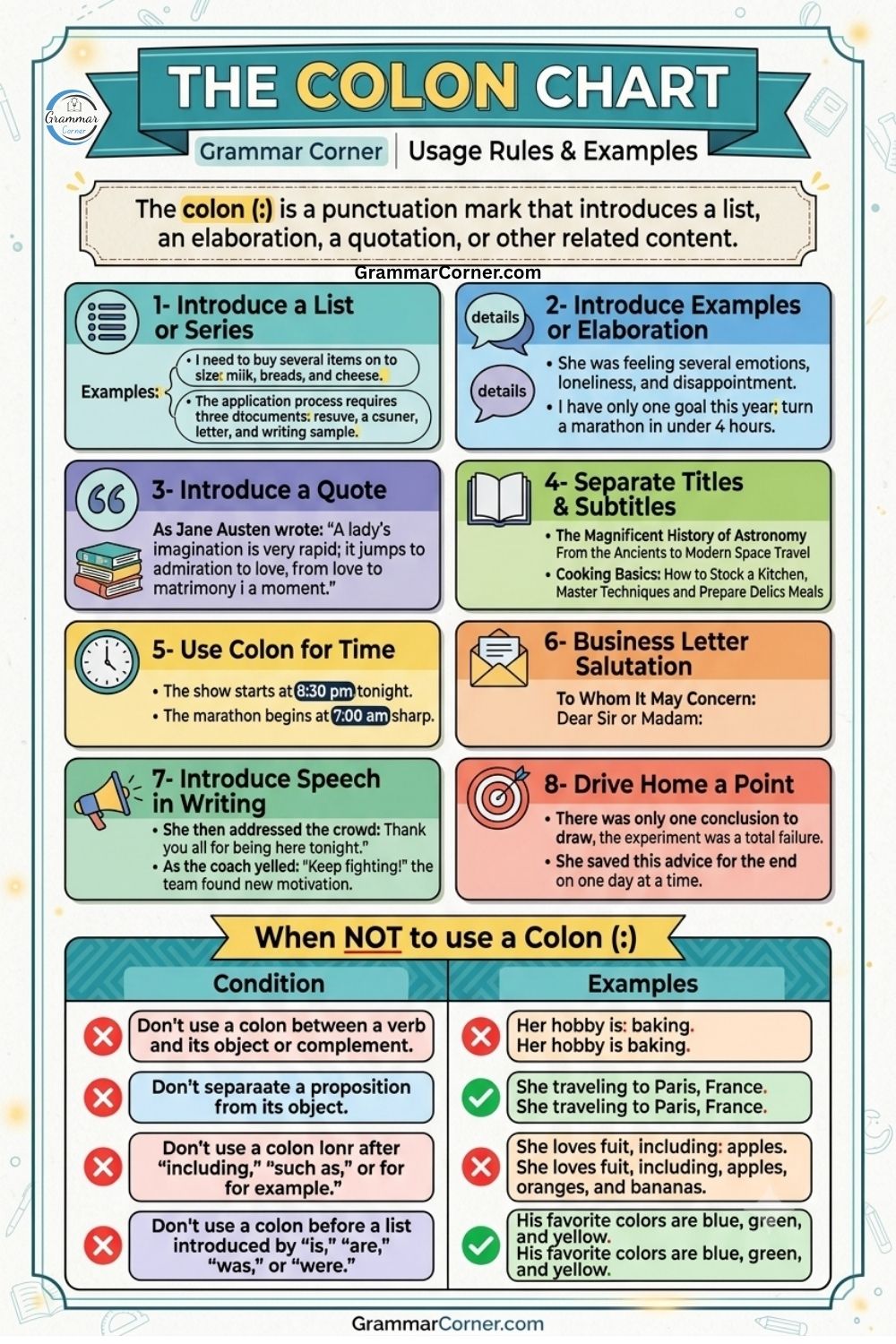
The colon (:) is a punctuation mark used to introduce what comes next — a list, an explanation, a quotation, or additional information. It tells the reader: more detail is coming.
- Its main job: introduce information that explains, supports, or expands the idea before it.
- Practical uses: separating hours from minutes (10:30) and opening a formal business letter.
- The golden condition: a complete sentence must come before the colon.
On this page show / hide
What is a Colon?
The colon (:) is a punctuation mark used to introduce what comes next, such as a list, an explanation, a quotation, or additional information. Its primary function is to introduce information that explains, supports, or expands on the idea that comes before it.
The colon also has several practical uses in writing. It separates hours from minutes in time expressions, as in 10:30, and introduces the greeting in a formal business letter. Most importantly, a colon signals to the reader that additional information is about to follow. Using the colon correctly helps writers produce clearer, more organized prose.
The 8 Rules for Using a Colon
Introduce a List or Series
Use a colon to introduce a detailed list or series that follows a complete sentence.
Introduce Examples or Elaboration
A colon introduces examples and details that further explain an idea.
Introduce a Quote
Place a colon to introduce a relevant quotation after context.
Separate Titles and Subtitles
Insert a colon between a title and its subtitle.
Denote Time
Use a colon between hours and minutes when expressing time.
Open a Business Letter
In a formal letter, a colon is placed after the opening salutation.
Introduce Speech in Writing
Insert a colon to introduce formally reported speech or dialogue.
Drive Home a Point
Use a colon to emphasize text, like a concluding phrase or a summary of the previous information.
Colon Chart: All Uses at a Glance
Every job the colon performs, condensed into one chart:
The Colon ( : ) Chart
One signal, eight jobs — a complete sentence first, then the colon opens the door
1Introduce a list
I need several items: bread, eggs, and cheese.
2Introduce elaboration
I have one goal this year: to run a marathon.
3Introduce a quote
Churchill stated: "Never give in…"
4Title : subtitle
Cooking Basics: How to Stock a Kitchen
5Time notation
The show starts at 8:30 p.m.
6Business salutation
To Whom It May Concern:
7Introduce speech
She addressed the crowd: "Thank you all."
8Drive home a point
The secret was simple: perseverance.
When NOT to Use a Colon
The colon works best when introducing content that supports a complete initial idea. In the following cases, a colon is inappropriate and standard conventions should be followed instead:
1. Don't put a colon between a verb and its object or complement
2. Don't separate a preposition from its object
3. Don't use a colon after "including," "such as," or "for example"
4. Don't use a colon before a list introduced by "is," "are," "was," or "were"
5. Don't use a colon to join two independent clauses
6. Don't put a colon between a pronoun subject and its verb
7. Don't use a colon to introduce an indirect question
8. Don't put a colon after the salutation of a friendly letter
Note"As follows" and "the following" DO take a colon
Phrases like as follows and the following are built to announce something — so a colon after them is correct, not a mistake. For the smoothest reading, let a full statement follow:
Capitalization After a Colon
In most cases, the word following a colon should not be capitalized, unless it begins a proper noun. If a colon introduces a list, the items usually remain lowercase:
If the colon leads into a noun, adjective, or sentence fragment that elaborates on the prior idea, it also remains lowercase:
However, if the colon introduces a proper noun, that noun is capitalized:
Style noteWhen a complete sentence follows the colon
Style guides split here. Chicago Manual of Style keeps a single complete sentence lowercase after a colon ("His message was clear: the package never arrived."), capitalizing only when the colon introduces two or more sentences or a quotation. AP Stylebook capitalizes any complete sentence after a colon. Pick one convention and apply it consistently — this site follows the Chicago approach.
Frequently Asked Questions About the Colon
What is the main purpose of a colon?
When should you capitalize the first letter after a colon?
Can a colon be used to join two independent clauses?
Is a colon appropriate after prepositions or between a subject and verb?
Should a colon follow "such as" or "including"?
Can a colon appear outside parentheses or brackets?
When formatting time, where does the colon go?
Do all business letter salutations require a colon?
How can overuse of colons be avoided?
Key Takeaways
- The colon introduces — lists, examples, quotes, speech, and emphatic conclusions.
- The golden condition: a complete sentence must come before the colon. "His favorite colors are: blue" fails because "His favorite colors are" isn't complete.
- Never split a verb from its object, a preposition from its object, or a subject from its verb with a colon — and never place one after "including" or "such as."
- "As follows" and "the following" do take a colon.
- Lowercase after the colon, except proper nouns — and know your style guide's rule for complete sentences (Chicago: lowercase; AP: capitalize).
- Also remember the practical jobs: time (8:30), titles ("Cooking Basics: …"), and formal salutations ("Dear Mr. Dublin:").
See also: