Passive Voice (Structure & Examples) | Active Vs. Passive Voice
What Is Passive Voice?
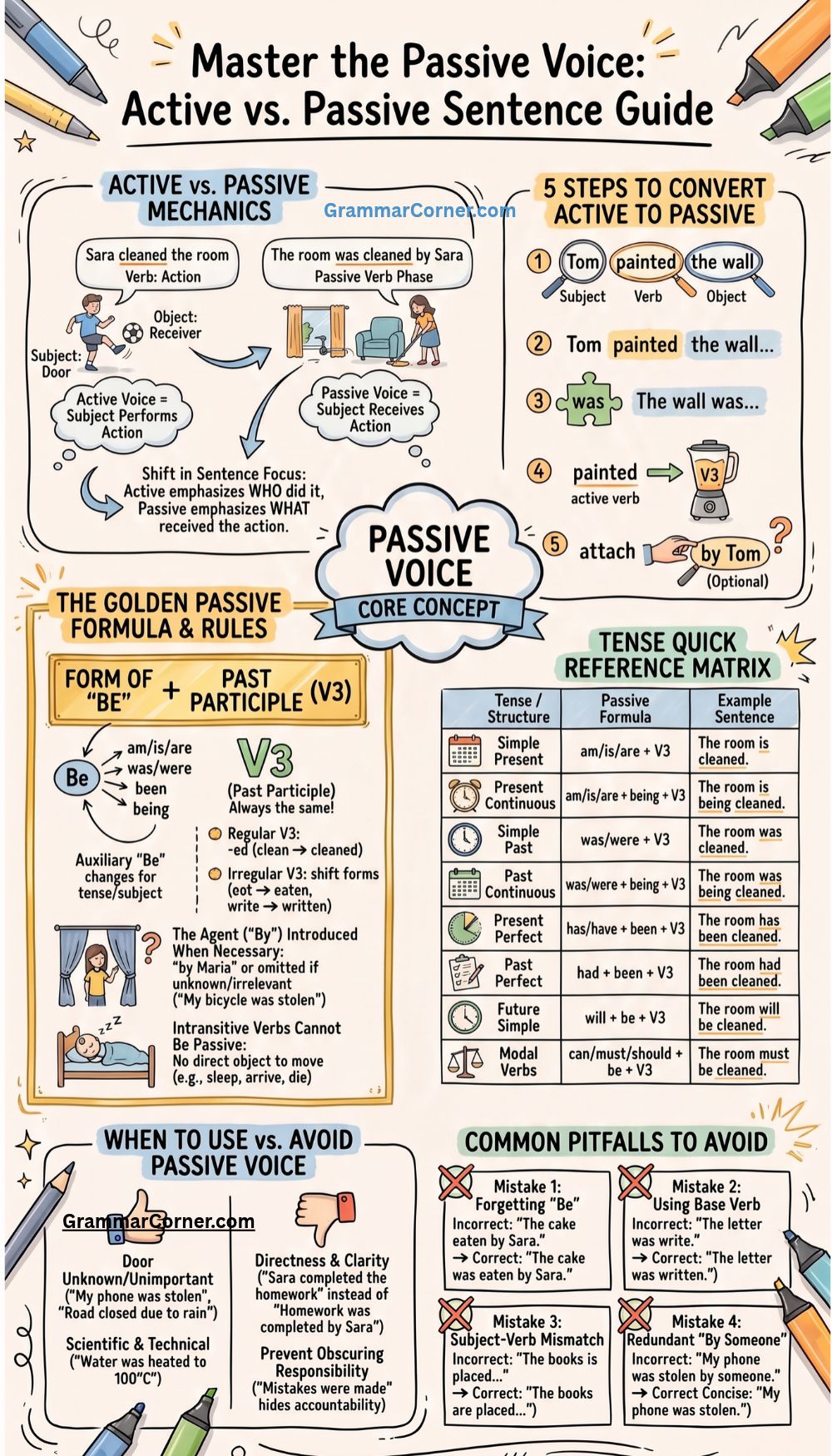
Passive voice is a sentence structure in which the subject receives the action rather than performing it. Grammatical voice reveals whether the subject of a sentence acts or is acted upon.
In active voice, the person or thing performing the action usually comes first. In passive voice, the person or thing receiving the action moves to the front of the sentence.
Comparing Active and Passive Voice
John (the subject) is actively performing the action of kicking.
The ball (the subject) is receiving the action of being kicked.
Both sentences describe the exact same event, but the sentence focus and grammatical subject change entirely.
Simple Trick to Remember Passive Voice
• Passive Voice: Something is done by someone.
Transformation Examples
| Active Voice (Doer Acts) | Passive Voice (Receiver Subject) |
|---|---|
| The boy opened the door. | The door was opened by the boy. |
| Sara cleaned the room. | The room was cleaned by Sara. |
| The chef cooked the food. | The food was cooked by the chef. |
✨ Quick Challenge
Which of the following sentences is written in the passive voice? Tap your answer.
See the full answer
Answer: “The car was washed by Sillah.”
Voice analysis breakdown:
- Subject Role: The car is the subject of the sentence, but it is not performing any action; it receives the washing.
- Passive Verb Structure: Formed using
was + past participle (washed). - Agent: by Sillah specifies who carried out the action.
Active Voice vs. Passive Voice
In active voice, the subject performs the action (Subject + Verb + Object). In passive voice, the object of the active sentence shifts into the subject position to receive the action.
- Subject (Doer): The girl
- Verb (Action): opened
- Object (Receiver): the window
- New Subject: The window (receives action)
- Passive Verb: was opened
- Agent (Optional): by the girl
Direct Comparisons
| Active Voice (Focus on Doer) | Passive Voice (Focus on Receiver) |
|---|---|
| The boy kicked the ball. | The ball was kicked by the boy. |
| Alina painted the wall. | The wall was painted by Alina. |
| The teacher checked the homework. | The homework was checked by the teacher. |
| Mom baked the cake. | The cake was baked by Mom. |
How to Form the Passive Voice
The auxiliary verb be changes based on the tense and subject number, while the main verb always stays in the past participle form:
• The door is opened. (Present)
• The door was opened. (Past)
• The door will be opened. (Future)
What Is a Past Participle?
The past participle is the third principal form of a verb:
- clean ➔ cleaned
- wash ➔ washed
- open ➔ opened
- paint ➔ painted
- eat ➔ eaten | write ➔ written
- break ➔ broken | take ➔ taken
- make ➔ made | see ➔ seen
❌ Incorrect: The letter was write by Ali.
Passive Voice in Different Tenses
Notice how the auxiliary verb be transforms across every tense while the main verb remains a past participle:
- English is spoken in many countries.
- The rooms are cleaned every day.
- The homework is checked by the teacher.
- The room is being cleaned now.
- The road is being repaired.
- The students are being taught English.
- The window was broken yesterday.
- The books were placed on the table.
- The cake was baked by Mom.
- The house was being painted when we arrived.
- The road was being repaired yesterday.
- The work has been completed.
- The letters have been sent.
- The classroom has been cleaned.
- The food had been eaten before we arrived.
- The work had been completed by noon.
- The results will be announced tomorrow.
- The bridge will be opened next week.
- The homework will be checked tomorrow.
- The rules must be followed.
- The door can be opened from inside.
- The homework should be completed today.
✨ Quick Challenge
Which of the following sentences correctly demonstrates the present continuous passive structure? Tap your answer.
See the full answer
Answer: “The homework is being checked by the teacher.”
Formula & conversion breakdown:
- Active Form: The teacher is checking the homework.
- Passive Transformation: Object (The homework) ➔ becomes the new subject.
- Continuous Passive Verb Formula:
is / are + being + past participle➔ is being checked. - Agent: by the teacher attributes the action to the original performer.
Passive Voice in Negative Sentences
To form a negative passive sentence, place not directly after the first helping verb (the auxiliary form of be, have, or a modal).
- The room is not cleaned every day.
- The letter was not sent yesterday.
- The homework has not been completed.
- The building will not be opened tomorrow.
Active: Sara did not clean the room.
Passive: The room was not cleaned by Sara.
Notice how the past tense auxiliary shifts from did not to was not + past participle.
Passive Voice in Questions
In passive questions, the auxiliary verb moves to the front of the sentence before the subject:
| Active Question | Passive Question |
|---|---|
| Did Tom break the window? | Was the window broken by Tom? |
| Does the teacher check the homework? | Is the homework checked by the teacher? |
| Did they deliver the books yesterday? | Were the books delivered yesterday? |
| Will they open the building tomorrow? | Will the building be opened tomorrow? |
| Did Sara send the letter? | Was the letter sent by Sara? |
What Is the Passive Agent?
The agent is the person or entity that performs the action in a passive sentence. The agent is typically introduced with the preposition “by”:
- The picture was painted by Maria. (Maria = agent)
- The cake was made by my mother. (my mother = agent)
Do We Always Need “By”?
No. In fact, the agent is frequently omitted when it is unknown, obvious from the context, or irrelevant to the message:
When Should We Use Passive Voice?
Passive voice is an effective tool when the emphasis belongs on the receiver or outcome of the action:
“My bicycle was stolen.” / “The window was broken.”
“The road was closed because of flooding.” (The status of the road is the primary information).
“The painting was created in 1889.” (The artwork itself is the topic of discussion).
“The water was heated to 100°C.” / “The seeds were placed in the soil.” (Focuses objectively on procedures).
When Should We Avoid Passive Voice?
- Active voice is more direct and concise: “Sara completed the homework” is tighter than “The homework was completed by Sara.”
- Passive voice can obscure responsibility: “The mistake was made” hides the doer, whereas “I made the mistake” is transparent and accountable.
✨ Quick Challenge
Which of the following represents the most natural and concise passive sentence when the perpetrator of the action is completely unknown? Tap your answer.
See the full answer
Answer: “The smartphone was stolen from the library table.”
Agent omission principles:
- Conciseness: In passive voice, when the agent is unknown or obvious, omitting “by someone” or “by people” creates cleaner prose.
- Structure: Formed with
was + past participle (stolen). - Focus: The receiver (The smartphone) remains the primary subject of the statement.
How to Change Active Voice into Passive Voice
Converting an active sentence into the passive voice follows a structured 5-step procedure. Consider transforming: “Tom painted the wall.”
Subject: Tom | Verb: painted (Past Simple) | Object: the wall
“The wall…”
Because the wall is singular and the tense is simple past, use was ➔ “The wall was…”
“The wall was painted…”
“The wall was painted by Tom.”
How to Change Passive Voice into Active Voice
Reversing the process from passive to active restores directness by placing the doer back at the front:
In “The window was broken by Ahmed”, the agent is Ahmed ➔ “Ahmed…”
Remove was, conjugate to active past simple (broke), and add the object ➔ “Ahmed broke the window.”
How to Identify Passive Voice
Caution: “Be” Does Not Always Mean Passive!
The verb be appears in many sentence types. A sentence is passive only when an action is being received by the subject:
- “Sara is happy.” (Linking verb + adjective; no action received).
- “Tom is running.” (Active present continuous; Tom performs the running).
- “The boy is tired.” (Adjective describing state).
- “The letter was written by Sara.” (Letter receives writing).
- “The books are kept on the shelf.” (Books receive action).
- “The boy was helped by his father.” (Boy receives help).
Verbs That Cannot Be Made Passive (Intransitive Verbs)
Passive voice rearranges the direct object into the new subject position. Verbs that do not take a direct object (intransitive verbs) cannot be converted into the passive voice.
Example: In “The baby slept,” there is no object receiving the sleeping, so no passive transformation is possible.
Special Passive Structures
Born is a past participle and requires a form of be:
❌ Incorrect: I born in 2015.
Passive Infinitive (to be + V3):
- She hopes to be invited to the party.
- He wants to be included in the team.
Passive Gerund (being + V3):
- She dislikes being ignored.
- The children enjoyed being taken to the zoo.
✨ Quick Challenge
Which of the following sentences correctly demonstrates a passive infinitive structure? Tap your answer.
See the full answer
Answer: “She hopes to be invited to the annual awards ceremony.”
Passive infinitive breakdown:
- Formula:
to be + past participle (V3) - Structure: to be (infinitive marker + base be) + invited (past participle).
- Receiver Meaning: The subject (She) wishes to receive the action of an invitation from someone else.
Common Mistakes in Passive Voice
When forming passive sentences, watch out for these five frequent pitfalls concerning auxiliary verbs, past participles, and unnecessary phrasing:
✅ Correct: The cake was eaten by Sara.
✅ Correct: The letter was written by Ali.
✅ Correct: The books are placed on the table.
✅ Concise: My phone was stolen.
Passive Voice: Quick Tense Reference Chart
Use this reference table to review the core formulas across all major tenses:
| Tense / Structure | Passive Formula | Example Sentence |
|---|---|---|
| Simple Present | am / is / are + V3 |
The room is cleaned. |
| Present Continuous | am / is / are + being + V3 |
The room is being cleaned. |
| Simple Past | was / were + V3 |
The room was cleaned. |
| Past Continuous | was / were + being + V3 |
The room was being cleaned. |
| Present Perfect | has / have + been + V3 |
The room has been cleaned. |
| Past Perfect | had + been + V3 |
The room had been cleaned. |
| Future Simple | will + be + V3 |
The room will be cleaned. |
| Modal Verbs | can / must / should + be + V3 |
The room must be cleaned. |
*Note: V3 represents the past participle form of the main verb.
5 Easy Rules to Remember Passive Voice
“The ball was kicked by Ali.” (The receiver of the action is placed in the subject position).
Incorporate is, are, was, were, been, being, or be matching the tense and number.
Ensure the main verb is in the third form (cleaned, written, eaten, broken, made).
State the agent (by Sara) only if knowing who did the action adds useful context.
Use active voice for direct, concise action and passive voice when highlighting the receiver, procedure, or outcome.
Practice Exercises on Passive Voice
Determine whether each sentence is written in the Active or Passive voice:
- The dog chased the cat. ➔ [Active]
- The cake was baked by Mom. ➔ [Passive]
- Sara opened the window. ➔ [Active]
- The homework was completed by Ali. ➔ [Passive]
- The teacher explained the lesson. ➔ [Active]
- The bicycle was repaired yesterday. ➔ [Passive]
- The children cleaned the classroom. ➔ [Active]
- The song was sung by Maria. ➔ [Passive]
- The house was painted last week. ➔ [Passive]
- John washed his car. ➔ [Active]
- Ali opened the door. ➔ The door was opened by Ali.
- Sara washed the car. ➔ The car was washed by Sara.
- The teacher checked the homework. ➔ The homework was checked by the teacher.
- The dog broke the vase. ➔ The vase was broken by the dog.
- Mom cooked the dinner. ➔ The dinner was cooked by Mom.
- The farmer planted the trees. ➔ The trees were planted by the farmer.
- The police caught the thief. ➔ The thief was caught by the police.
- The students cleaned the classroom. ➔ The classroom was cleaned by the students.
- John wrote the letter. ➔ The letter was written by John.
- The workers built the bridge. ➔ The bridge was built by the workers.
- The window was opened by Sara. ➔ Sara opened the window.
- The book was written by Ali. ➔ Ali wrote the book.
- The room was cleaned by the students. ➔ The students cleaned the room.
- The cake was made by my mother. ➔ My mother made the cake.
- The ball was kicked by Tom. ➔ Tom kicked the ball.
- The car was washed by John. ➔ John washed the car.
- The letter was sent by Ahmed. ➔ Ahmed sent the letter.
- The thief was caught by the police. ➔ The police caught the thief.
- The room is cleaned every morning. (clean)
- The letter was sent yesterday. (send)
- The road is being repaired now. (repair)
- The work will be finished tomorrow. (finish)
- The homework has already been completed. (complete)
- The windows were broken by the children. (break)
- English is spoken in many countries. (speak)
- The house was painted last year. (paint)
- The cake was eat by Sara. ➔ The cake was eaten by Sara.
- The books is kept on the table. ➔ The books are kept on the table.
- The letter was write by Ahmed. ➔ The letter was written by Ahmed.
- The room are cleaned every day. ➔ The room is cleaned every day.
- The window broken by the boy. ➔ The window was broken by the boy.
- The homework was complete by Ali. ➔ The homework was completed by Ali.
- The cars is washed every Sunday. ➔ The cars are washed every Sunday.
- The house were painted last year. ➔ The house was painted last year.
-
You want to emphasize who cleaned the classroom:
✔ Sara cleaned the classroom. (Active voice highlights Sara). -
You do not know who broke the window:
✔ The window was broken. (Passive voice omits the unknown doer). -
You are describing a procedure in a science experiment:
✔ The plant was placed in sunlight. (Passive voice focuses on the object and process). -
You want your sentence to be short, dynamic, and direct:
✔ John kicked the ball. (Active voice delivers concise prose).
✨ Quick Challenge
Which of the following sentences correctly applies passive voice in the simple past tense with accurate subject-verb agreement? Tap your answer.
See the full answer
Answer: “The letters were written by the manager yesterday afternoon.”
Rule verification breakdown:
- Plural Agreement: The letters = plural subject ➔ requires were (not was).
- Past Participle Form: written is the irregular third form (V3) of write.
- Complete Passive Verb Phrase:
were + writtensatisfies the simple past passive formula.
Frequently Asked Questions About Passive Voice
Find straightforward answers to the most common questions about recognizing, forming, and correctly applying passive voice in everyday writing.
Passive voice is a sentence structure where the subject receives the action rather than performing it.
• “The ball was kicked by Ali.” ➔ The ball receives the kicking action.
The foundational structure for every passive sentence is:
• “The door was opened.” (was = form of be; opened = past participle).
• Active Voice: The subject performs the action (“Ali kicked the ball.”).
• Passive Voice: The subject receives the action (“The ball was kicked by Ali.”).
No. We use “by” only when we want to identify the specific agent who performed the action (“The song was sung by Maria.”).
When the doer is unknown, irrelevant, or obvious, omit the agent: “The door was opened.” (Much cleaner than saying “…opened by someone”).
No. Passive voice is a completely valid grammatical construction. It is especially useful when highlighting the receiver, describing scientific procedures, or reporting outcomes where the doer is secondary.
No. A sentence can only be turned passive if the verb is transitive (takes a direct object):
• “Tom kicked the ball” ➔ “The ball was kicked by Tom.” (Has direct object: ball).
• “The baby slept” ➔ Cannot be made passive because slept is an intransitive verb with no receiver.
No. The word was is only passive when paired with an action verb in its past participle form:
• “Sara was happy.” ➔ Not passive (was is a linking verb followed by an adjective).
• “The window was broken.” ➔ Passive (was broken describes an action received).
A past participle is commonly the third principal form (V3) of a verb:
• eat ➔ ate ➔ eaten
• break ➔ broke ➔ broken
• take ➔ took ➔ taken
• make ➔ made ➔ made
Writers choose passive voice to place focus on the receiver, when the doer is unknown, or when the agent is irrelevant: “The road was closed because of flooding.” (The road’s status matters far more than who placed the barrier).
No. Select the voice that best fits your intent. Active voice is preferable for direct, lively, and concise storytelling (“The students cleaned the classroom”), while passive voice is ideal when emphasizing outcomes or processes.
Scan for a form of be + past participle:
✨ Quick Challenge
Based on the FAQ rules, which of the following sentences represents a genuine passive voice construction (rather than a linking verb or intransitive action)? Tap your answer.
See the full answer
Answer: “The books were placed on the table by the librarian.”
Passive voice checklist breakdown:
- Receiver as Subject: The books (plural subject).
- Auxiliary “Be”: were (past plural form).
- Past Participle: placed (V3 action verb).
- Formula Check:
Subject (Receiver) + were + V3 (placed) + by-agent.