Nonrestrictive Clauses (Rules and Examples) | Restrictive Vs Nonrestrictive Clause
What Is a Nonrestrictive Clause?
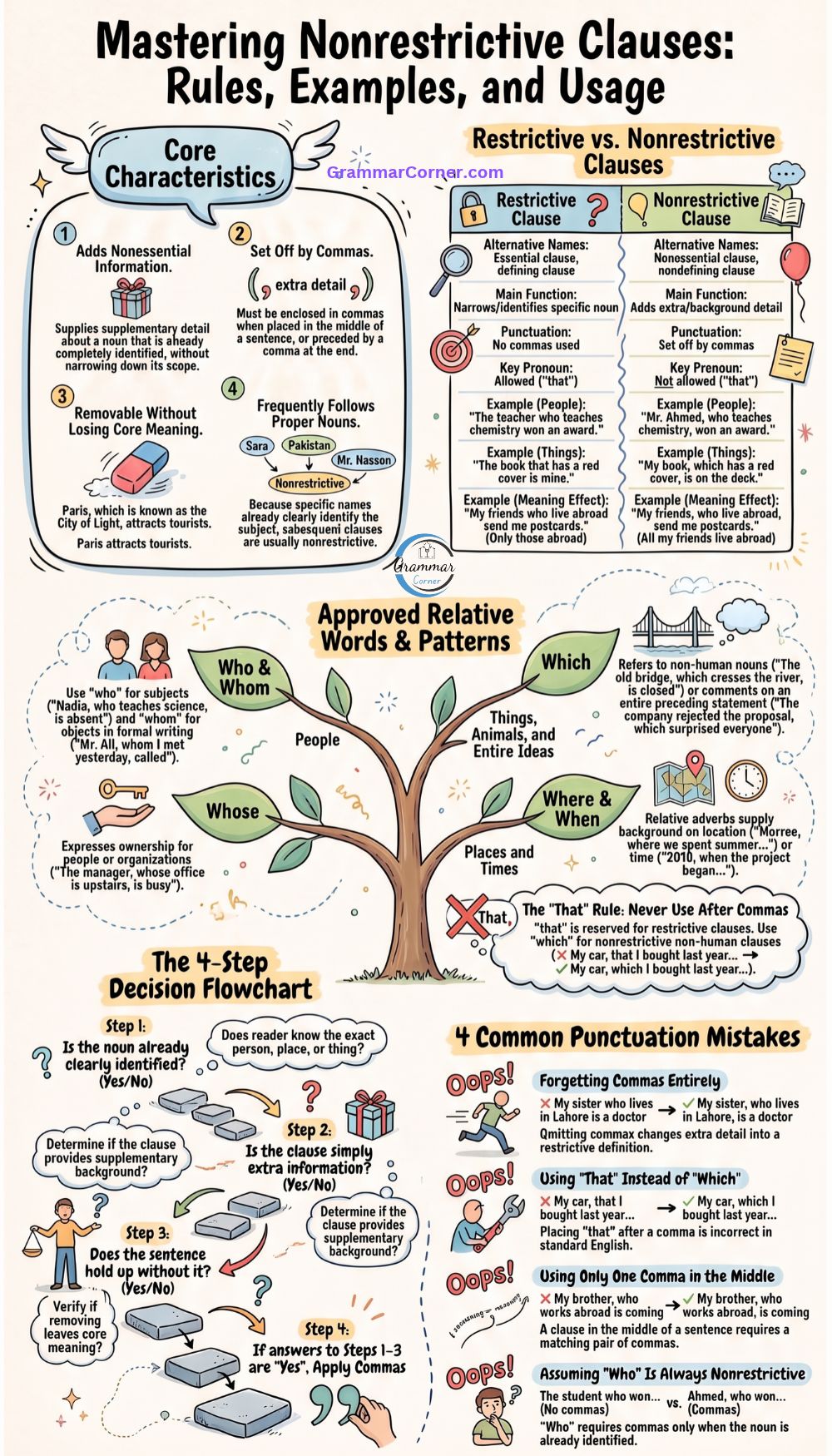
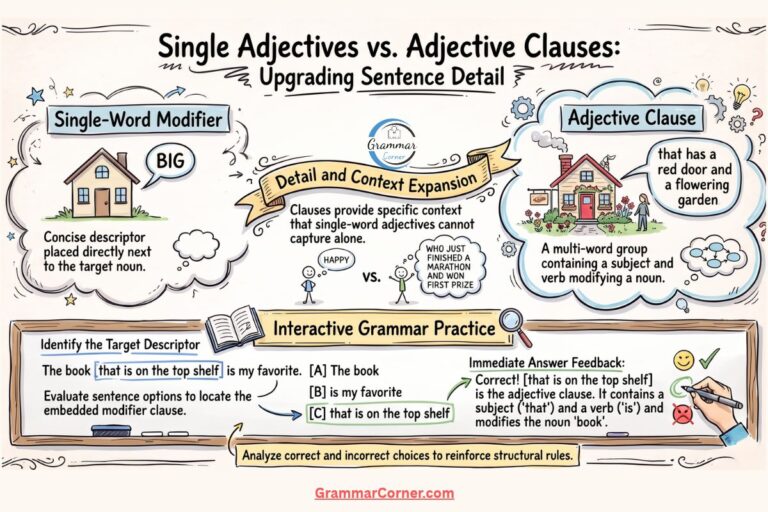
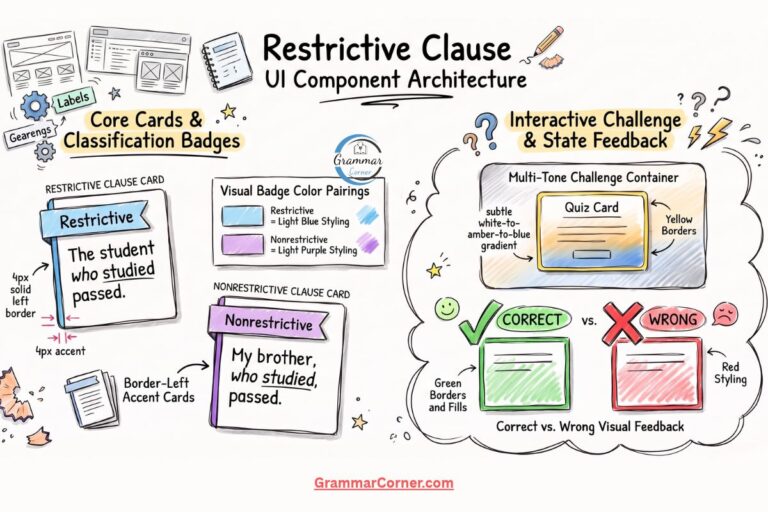
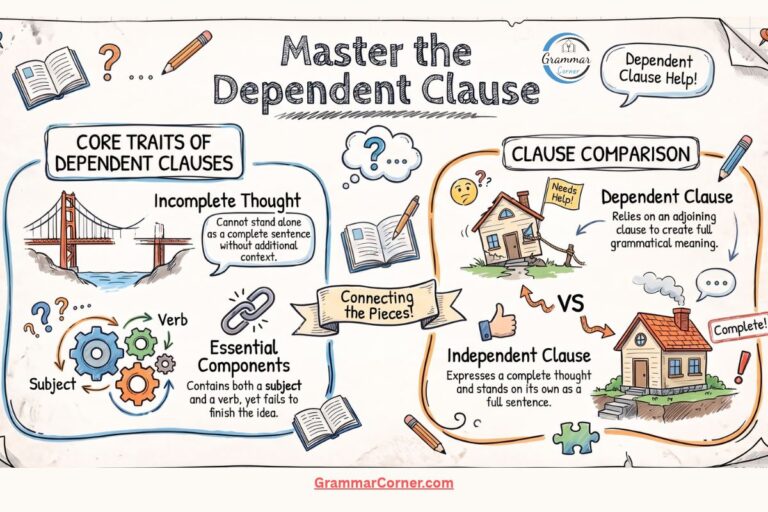
A nonrestrictive clause is a dependent clause that gives additional information about a noun or pronoun when that noun is already sufficiently identified.
Look at these two sentences:
They look almost identical. The only obvious difference is the pair of commas. But those commas can change the meaning.
That second type of clause is called a nonrestrictive clause. It does not narrow down the noun. It gives the reader something extra to know about it.
Also Known As
A nonrestrictive clause is also called a:
✨ Quick Challenge
Which of the following sentences contains a nonrestrictive clause (nonessential extra information set off by commas)? Tap your answer below.
See the full answer
Answer: “Paris, which is known as the City of Light, attracts millions of tourists.”
A nonrestrictive (nonessential) clause adds supplementary descriptive detail about a noun that is already completely identified. It can be removed from the sentence without changing the core meaning and is always set off by commas:
- “Paris, which is known as the City of Light, attracts millions of tourists.” ➔ Removing the clause leaves the complete core fact: “Paris attracts millions of tourists.”
- The other options use restrictive clauses (without commas) to restrict and identify which specific students, laptop, or person is meant.
Specific Nouns Often Take Nonrestrictive Clauses
Nonrestrictive clauses frequently follow nouns that are already specific. For example:
- Sara, who won the scholarship, thanked her teachers.
- Pakistan, which has a diverse landscape, attracts many travelers.
- Our English teacher, who has taught here for ten years, organized the event.
The nouns are already specific:
- Sara
- Pakistan
- our English teacher
The clauses are not needed to tell the reader which person or place is meant. This is why proper nouns often appear naturally with nonrestrictive clauses.
However, this is a tendency, not an automatic rule. Meaning remains more important than the type of noun.
Proper Nouns and Nonrestrictive Clauses
When a person, place, organization, or other proper noun is already clearly identified, a following relative clause will often be nonrestrictive.
For example:
“Mr. Hassan, who lives nearby, walks to work.”
The name Mr. Hassan already identifies the person.
Similarly:
“Islamabad, which is the capital of Pakistan, has many government buildings.”
The place name already identifies the city.
Compare This With a General Noun
Here, the relative clause helps identify which city is being discussed.
The choice depends on the meaning the writer intends.
Which Relative Words Can Introduce a Nonrestrictive Clause?
Nonrestrictive clauses commonly begin with relative pronouns such as:
Relative adverbs such as where and when can also introduce nonrestrictive relative clauses.
Common Patterns
| Relative Word | Typical Reference | Example |
|---|---|---|
| who | People | Nadia, who teaches science, is absent today. |
| whom | People as an object | Mr. Ali, whom I met yesterday, called again. |
| whose | Possession | The manager, whose office is upstairs, is busy. |
| which | Things, animals, or preceding ideas | The old bridge, which crosses the river, is closed. |
| where | Places | Murree, where we spent the summer, was cool. |
| when | Times | 2010, when the project began, seems like a long time ago. |
Why “That” Usually Does Not Work Here
One of the most important rules to remember is this:
Do not use “that” to introduce a nonrestrictive relative clause in standard edited English.
Here, that I bought yesterday is restrictive.
For nonrestrictive clauses, which is normally used for things, while who, whom, or whose can be used for people.
“Which” vs. “That”: A Simple Guide
This is one of the most common areas of confusion. In standard edited American English, the basic distinction is:
| Word | Restrictive Clause | Nonrestrictive Clause |
|---|---|---|
| that | Yes | No |
| which | Usually no in American English | Yes |
| who | Yes, for people | Yes, for people |
| whom | Yes, formal/object use | Yes, formal/object use |
| whose | Yes | Yes |
Examples:
- The laptop that I bought is fast.
- My laptop, which I bought last week, is fast.
- The woman who called earlier is waiting outside.
- Maria, who called earlier, is waiting outside.
English usage varies by dialect and style, particularly in the use of which in restrictive clauses. For learners who want a clear and consistent system, using that for restrictive clauses and which for nonrestrictive clauses is a practical convention.
Can “Who” Be Nonrestrictive?
Absolutely.
The clause who lives in Canada gives additional information about my brother.
The person is already identified.
Who vs. Whom
The choice between who and whom depends on the grammatical role of the relative pronoun.
-
Use who when it functions as the subject:
“My sister, who works at the hospital, called me.”
Here, who performs the action works. -
Use whom when it functions as an object, especially in formal writing:
“Mr. Lee, whom I met yesterday, sent the documents.”
Here, I met whom.
In everyday English, many speakers use who in places where traditional grammar would prescribe whom.
Can “Whose” Introduce a Nonrestrictive Clause?
Yes. Whose expresses possession.
What About “Where” and “When”?
Nonrestrictive relative clauses do not have to describe people or things directly. They can also provide additional information about places and times.
A Nonrestrictive Clause Can Refer to an Entire Idea
This is an especially useful feature of which. Sometimes which does not simply describe the noun immediately before it. It can comment on the idea expressed by the preceding clause.
Here, which surprised everyone can refer to the fact that the company rejected the proposal.
This construction lets a writer connect a comment to an entire preceding idea.
Nonrestrictive Clauses Can Make Writing Smoother
Without a nonrestrictive clause, you may need several short sentences:
The sentence is more compact, but the information remains organized. The clause does not merely make writing longer. It lets the writer decide which information is main and which information is background.
Compare Separate Sentences With a Nonrestrictive Clause
• His six months of training becomes supporting information.
This is one of the most useful features of nonrestrictive clauses: they allow you to rank information within a sentence.
What Happens When You Remove the Clause?
Take:
“The new library, which opened last month, is already crowded.”
Remove the clause:
“The new library is already crowded.”
The main statement survives.
Nonrestrictive Clause vs. Parenthetical Phrase
A nonrestrictive clause and a parenthetical phrase can both add extra information, but they are not exactly the same grammatical structure.
-
“My brother, who lives in Multan, is visiting us.”
Here, who lives in Multan is a clause because it has a subject (who) and a verb (lives). -
“My brother, a doctor in Australia, is visiting us.”
a doctor in Australia is a phrase, not a clause.
Both provide additional information, but their grammatical structures differ.
| Example | Structure |
|---|---|
| My brother, who lives in Multan, is visiting us. | Nonrestrictive clause |
| My brother, a doctor in Multan, is visiting us. | Parenthetical phrase |
| Sara, who won the prize, smiled. | Nonrestrictive clause |
| Sara, the prize winner, smiled. | Appositive phrase |
This distinction is useful when analyzing sentence structure.
Nonrestrictive Clauses in Formal Writing
These clauses are common in many kinds of writing:
They allow writers to provide background information without repeatedly beginning new sentences.
Common Mistakes With Nonrestrictive Clauses
The word who does not automatically make a clause nonrestrictive. Compare:
No commas. The clause identifies the student.
Commas. The name already identifies Ahmed.
A Simple Decision Process
When you are unsure whether to use commas, work through these questions:
A Side-by-Side Meaning Test
Sometimes the best way to understand the distinction is to put both versions next to each other:
| Restrictive | Nonrestrictive |
|---|---|
| The employees who work remotely attend the online meeting. | The employees, who work remotely, attend the online meeting. |
| The book that has a red cover is mine. | My book, which has a red cover, is on the desk. |
| The car that is parked outside belongs to Sara. | Sara’s car, which is parked outside, belongs to her. |
| The teacher who teaches chemistry won an award. | Mr. Ahmed, who teaches chemistry, won an award. |
• The restrictive version uses the clause to narrow the noun.
• The nonrestrictive version assumes the noun is already identified and adds a detail.
Nonrestrictive Clauses and Meaning: Be Careful
A comma can sometimes create a surprisingly large difference. Compare:
The punctuation tells the reader how to interpret the relationship between the noun and the clause.
Practice: Identify the Nonrestrictive Clause
Find the nonrestrictive clause in each sentence:
- Maria, who teaches English, is leading the workshop.
- My old laptop, which still works well, is now my backup computer.
- Mr. Ahmed, whose son studies abroad, attended the meeting.
- The village, where my mother grew up, has changed considerably.
- Our annual festival, which begins in October, attracts many visitors.
- The principal, whom I met yesterday, approved the proposal.
| No. | Nonrestrictive Clause |
|---|---|
| 1 | who teaches English |
| 2 | which still works well |
| 3 | whose son studies abroad |
| 4 | where my mother grew up |
| 5 | which begins in October |
| 6 | whom I met yesterday |
✨ Quick Challenge
Apply the decision process: Which sentence is punctuated correctly with a nonrestrictive clause (surrounded by commas) because the modified noun is already uniquely identified?
See the full answer
Answer: “Mount Everest, which is the highest mountain, attracts climbers worldwide.”
Using the decision rules:
- Question 1: Is the noun already identified? Yes, “Mount Everest” is a unique proper noun.
- Question 2: Is the clause giving extra information? Yes, mentioning that it is the highest mountain is added background knowledge.
- Question 3: Would the sentence still identify the same mountain without the clause? Yes (“Mount Everest attracts climbers worldwide”).
- Conclusion: The clause is nonrestrictive and must be enclosed in commas using which, not that.
Practice Exercises
Practice: Restrictive or Nonrestrictive?
Decide whether the bold clause is restrictive or nonrestrictive:
- The students who completed the test left the room.
- Sara, who completed the test early, left the room.
- The car that has a broken mirror belongs to my neighbor.
- My neighbor’s car, which has a broken mirror, is outside.
- The employees who work night shifts receive an additional allowance.
- Our employees, who work night shifts, receive an additional allowance.
| No. | Type | Why? |
|---|---|---|
| 1 | Restrictive | Identifies which students |
| 2 | Nonrestrictive | Sara is already identified |
| 3 | Restrictive | Identifies which car |
| 4 | Nonrestrictive | The car is already identified |
| 5 | Restrictive | Narrows the group of employees |
| 6 | Nonrestrictive | Adds information about the identified employees |
Practice: Add the Commas Where Needed
Correct the punctuation in these sentences:
- My brother who lives in Dubai is visiting next week.
- Lahore which is famous for its food attracts many tourists.
- The students who arrived early found seats.
- Mr. Khan who teaches physics organized the event.
- My phone which I bought last year still works perfectly.
The first, second, fourth, and fifth sentences treat the added information as nonrestrictive. The third sentence uses the clause to identify which students are meant.
A Compact Guide to Nonrestrictive Clauses
| Feature | Nonrestrictive Clause |
|---|---|
| Other names | Nonessential clause, nondefining clause |
| Grammatical type | Relative/adjective clause |
| Main purpose | Adds extra information |
| Identifies the noun? | No |
| Can it usually be removed? | Yes |
| Commas | Required around a middle clause |
| Comma before a final clause | Yes |
| Common relative words | who, whom, whose, which |
| Relative adverbs | where, when |
| “That” | Not used in standard nonrestrictive relative clauses |
| Can it describe a proper noun? | Yes, very commonly |
| Can it refer to an entire preceding idea? | Yes, especially with which |
Frequently Asked Questions