Active Voice Chart (Structure & Examples)
What Is Active Voice?
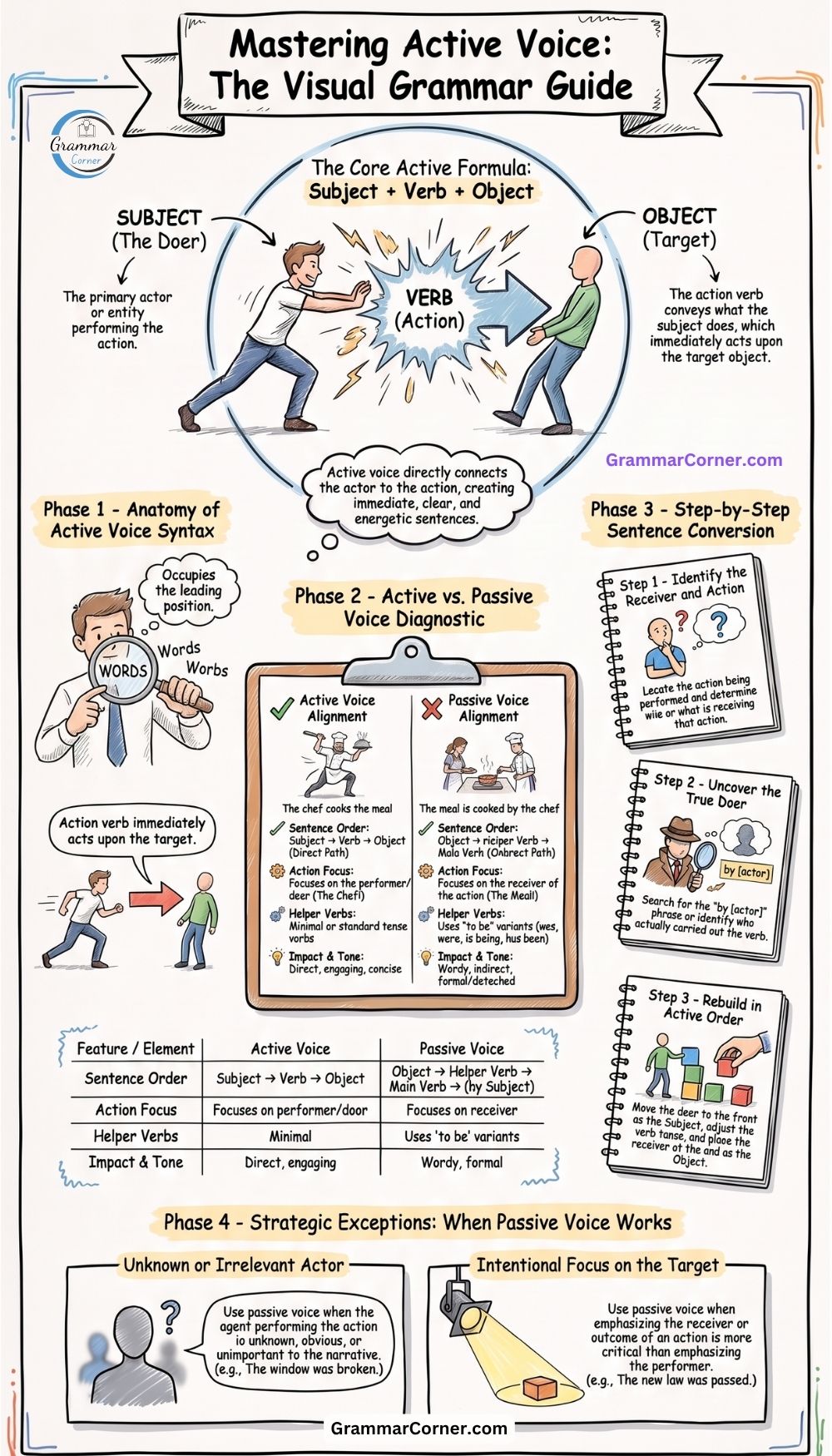
Active voice is a grammatical voice in which the grammatical subject of the sentence directly performs the action expressed by the verb.
It is one of the most fundamental structural frameworks in English, placing the agent—the person, animal, object, or concept performing the action—front and center in the subject position.
Core Structure: Subject + Verb + Object (SVO)
• Active Verb: opened (The completed action)
• Direct Object: the window (The entity receiving the action)
Because the subject Mania performs the verb opened, the sentence is structured in the active voice.
Why Use the Active Voice?
Active voice is standard in clear, engaging communication because it establishes direct agency and immediate clarity:
Active vs. Passive Voice: A Balanced View
While active voice produces vigorous, direct sentences, it is not mandatory in every context. Passive voice serves distinct communicative functions:
“The scientist discovered a new compound.” (Emphasizes the researcher)
“A new compound was discovered.” (Used when the performer is unknown, obvious, or less important than the outcome)
In an active sentence, the subject is the doer of the action. This direct alignment creates clear, economical sentences where readers instantly recognize the relationship between actor, action, and receiver.
What Is Active Voice?
An active voice is a grammatical voice in which the grammatical subject of the sentence directly performs the action expressed by the verb.
It is one of the most fundamental structural frameworks in English, placing the agent—the person, animal, object, or concept performing the action—front and center in the subject position.
Core Structure: Subject + Verb + Object (SVO)
• Active Verb: opened (The completed action)
• Direct Object: the window (The entity receiving the action)
Because the subject Mania performs the verb opened, the sentence is structured in the active voice.
Why Use the Active Voice?
Active voice is standard in clear, engaging communication because it establishes direct agency and immediate clarity:
Active vs. Passive Voice: A Balanced View
While active voice produces vigorous, direct sentences, it is not mandatory in every context. Passive voice serves distinct communicative functions:
“The scientist discovered a new compound.” (Emphasizes the researcher)
“A new compound was discovered.” (Used when the performer is unknown, obvious, or less important than the outcome)
In an active sentence, the subject is the doer of the action. This direct alignment creates clear, economical sentences where readers instantly recognize the relationship between actor, action, and receiver.
Quick Challenge
Three of these four sentences are in the active voice. One is in the passive voice. Tap the sentence that doesn’t belong.
See the full answer
Answer: “A new compound was discovered.”
In active voice sentences (Mania opened the window, The scientist discovered a compound, The team completed the project), the grammatical subject directly performs the action.
In “A new compound was discovered,” the subject (A new compound) is the recipient of the action rather than the performer, and the verb uses the passive formula was + past participle.
Active Voice vs. Passive Voice: What Is the Difference?
The essential distinction between active and passive voice lies in the syntactic position and functional role of the grammatical subject:
Active vs. Passive Voice Examples
| Active Voice (Agent First) | Passive Voice (Receiver First) |
|---|---|
| The boy kicked the ball. | The ball was kicked by the boy. |
| The company launched a new product. | A new product was launched by the company. |
| The teacher praised Ahmed. | Ahmed was praised by the teacher. |
| The storm damaged several houses. | Several houses were damaged by the storm. |
| The scientist conducted the experiment. | The experiment was conducted by the scientist. |
Feature-by-Feature Comparison
| Feature | Active Voice | Passive Voice |
|---|---|---|
| Main Focus | Doer of the action (Agent) | Receiver of the action or the result |
| Typical Word Order | Subject + Verb + Object | Receiver + be + Past Participle |
| Clarity of Agent | High (explicitly upfront) | Variable (agent may be omitted entirely) |
| Sentence Length | Typically concise and economical | Often longer due to auxiliary verbs & prepositions |
| Tone | Direct, vigorous, engaging | Objective, impersonal, or neutral |
| Best Application | Direct communication & storytelling | Scientific reports & when the agent is unknown |
How to Identify Active Voice
To verify whether a sentence is in the active voice, trace the mechanical link between the subject and the verb:
• In “The nurse checked the patient,” the subject is The nurse.
➔ Classification: Active Voice
➔ Subject: The gardener | Verb: watered | Did the gardener water? Yes ➔ Active Voice
• Sentence B: “The plants were watered by the gardener.”
➔ Subject: The plants | Verb: were watered | Did the plants water? No (they were acted upon) ➔ Passive Voice
Active Voice Sentence Structures
Active voice is not limited to sentences with direct objects. It adapts across multiple syntactic patterns:
Used with intransitive action verbs that do not require an object:
The primary active pattern where the subject acts upon a receiver:
Describes or renames the state/experience of the subject:
Active Voice Structure Across Tenses
The presence of auxiliary verbs like am, is, are, was, were does not automatically create passive voice. What matters is that the subject remains the performer of the action:
| Tense | Active Verb Formula | Active Voice Example |
|---|---|---|
| Simple Present | Subject + base / -s verb | They play cricket. |
| Present Continuous | Subject + am/is/are + -ing | They are playing cricket. |
| Simple Past | Subject + past verb (V2) | They played cricket. |
| Past Continuous | Subject + was/were + -ing | They were playing cricket. |
| Present Perfect | Subject + has/have + past participle (V3) | They have played cricket. |
| Past Perfect | Subject + had + past participle (V3) | They had played cricket. |
| Simple Future | Subject + will + base verb | They will play cricket. |
When Should You Use Active Voice?
Active voice is preferred whenever agency, efficiency, and direct accountability are central to communication.
Active voice makes research precise when the researchers, authors, or study participants are the direct agents of the methodological action:
- “We examined three groups of students.”
- “The researchers collected the data in June.”
In emails, project memos, and executive summaries, active constructions clarify responsibility and action items:
Everyday English naturally defaults to active voice for swift, intuitive delivery:
Instructional manuals and user guides rely on imperative active verbs so users immediately know what action to take:
- Open the file.
- Select the correct option.
- Press the button.
- Enter your password.
Active voice provides departmental accountability by attributing each operational deliverable directly to its team:
- The engineering team tested the machine.
- The marketing department prepared the campaign.
- The manager reviewed the final report.
When Is Active Voice Not the Best Choice?
Passive voice is often the superior rhetorical choice under specific communicative conditions:
Forcing an active voice sentence requires an artificial pronoun (“Someone stole my bicycle last night”), which dilutes focus from the theft.
The administrative authority that physically closed the road is secondary to the status of the road itself.
In experimental reporting, storage protocols are critical; the laboratory technician who performed the storage is not.
Shifting to active (“Police recovered several rare paintings…”) shifts reader focus from the cultural artifacts to the police department.
How to Change Passive Voice to Active Voice
Transforming a passive sentence with a stated by + agent phrase into the active voice follows a reliable 5-step sequence:
by phrase:• Passive: “The cake was decorated by Lina.” ➔ Agent = Lina.
➔ “Lina decorated the cake.”
Passive-to-Active Transformation Examples
| Passive Voice | Active Voice Transformation |
|---|---|
| The letter was written by Omar. | Omar wrote the letter. |
| The window was broken by the child. | The child broke the window. |
| The project was completed by the team. | The team completed the project. |
| The song was performed by the choir. | The choir performed the song. |
| The decision was announced by the director. | The director announced the decision. |
Quick Challenge
Which sentence is the correct active voice conversion of: “The final report was reviewed by the manager.”? Tap the correct option.
See the full answer
Answer: “The manager reviewed the final report.”
To convert from passive to active voice while preserving meaning and tense:
- Move the agent from the
byphrase (the manager) to the subject position. - Convert the passive verb was reviewed (simple past) to the active simple past verb reviewed.
- Move the original subject (the final report) into the direct object position after the verb.
Active Voice Across Tenses: Voice Conversion Table
When converting passive voice into active voice, the original grammatical tense must remain intact:
| Passive Voice | Active Voice Transformation |
|---|---|
| The room is cleaned by Sara. | Sara cleans the room. |
| The room is being cleaned by Sara. | Sara is cleaning the room. |
| The room was cleaned by Sara. | Sara cleaned the room. |
| The room was being cleaned by Sara. | Sara was cleaning the room. |
| The room has been cleaned by Sara. | Sara has cleaned the room. |
| The room had been cleaned by Sara. | Sara had cleaned the room. |
| The room will be cleaned by Sara. | Sara will clean the room. |
Active Voice with Questions and Commands
Active voice is not restricted to standard declarative statements; it functions identically in interrogative and imperative clauses.
The subject (the entity performing the action) remains positioned as the agent of the lexical verb:
- Did Ali finish the work? (Ali is the subject performing finish)
- Who opened the door? (Who acts as the agent)
- Has Sara completed the assignment?
Imperatives operate with an understood, implied second-person subject: (You).
• Underlying Active Structure: “[You] close the window.”
Common Mistakes with Active Voice
• “Sara likes chocolate.” ➔ Active voice (Subject holds the attitude)
• “The suspect was arrested at midnight.” (Clear, objective focus on the arrest)
Do not invent filler agents (e.g., “Police officers arrested the suspect…”) unless the specific identity of the arresting unit is necessary context.
by + agent phrase, do not fabricate one during conversion:
• ❌ Hallucinated Agent: “The technician damaged the computer.” (Distorts the facts)
• ✅ Accurate Active: “Someone damaged the computer.” (Maintains the unknown agent)
• ✅ Direct & Natural: “The manager considered the situation and made a decision.”
How Voice Shifts Semantic Emphasis
Review how shifting between active and passive alters the communicative focus of a clause:
| Active Voice | Passive Voice | Shift in Focus |
|---|---|---|
| The chef cooked dinner. | Dinner was cooked by the chef. | Focus on the chef vs. the dinner |
| The storm damaged the roof. | The roof was damaged by the storm. | Focus on the cause (storm) vs. the damage (roof) |
| The company hired five workers. | Five workers were hired by the company. | Focus on the employer vs. the new staff |
| Someone stole my phone. | My phone was stolen. | Active specifies an actor; passive omits the unknown thief |
| The teacher explained the rule. | The rule was explained by the teacher. | Focus on the instructor vs. the grammar rule |
Active Voice in Academic and Formal Writing
A widespread myth in academic writing suggests that formal research papers should exclusively rely on passive constructions. Contemporary style manuals (APA, MLA, Chicago) encourage the active voice for precision, clarity, and direct attribution of methodological decisions:
The Guiding Rule: Ask yourself: Who performed the action, and is their identity important to the reader? If yes, use active voice. If the identity is trivial, obvious, or distracting, use passive voice.
Active Voice in Everyday Communication
Everyday conversation naturally defaults to active voice because speakers intuitively identify who is responsible for an action. The choice of grammatical voice shapes focus, accountability, and conversational tone:
“Who broke the cup?” ➔ “Sam broke it.” (Clear agent, direct answer)
“The cup was broken.” (Omits the responsible agent; useful if the actor is unknown or intentionally unmentioned)
Practice Exercises
Determine whether each sentence uses active voice or passive voice:
- The gardener planted new flowers.
- The flowers were planted yesterday.
- My sister baked a chocolate cake.
- The window was cleaned by the caretaker.
- The children laughed loudly.
- The manager approved the proposal.
- The proposal was approved on Monday.
- The birds flew over the lake.
| No. | Voice Classification | Grammatical Reason |
|---|---|---|
| 1 | Active Voice | The subject (The gardener) performs the action of planting. |
| 2 | Passive Voice | The subject (The flowers) receives the action. |
| 3 | Active Voice | The subject (My sister) performs the action of baking. |
| 4 | Passive Voice | Contains was cleaned + by phrase agent. |
| 5 | Active Voice | Intransitive subject (The children) performs the action. |
| 6 | Active Voice | The subject (The manager) performs the approval. |
| 7 | Passive Voice | The subject (The proposal) receives the approval. |
| 8 | Active Voice | The subject (The birds) performs the action of flying. |
Rewrite each passive sentence into a direct active construction:
| Passive Sentence | Active Transformation |
|---|---|
| The book was written by Daniel. | Daniel wrote the book. |
| The car was repaired by the mechanic. | The mechanic repaired the car. |
| The students were praised by their teacher. | The teacher praised the students. |
| The package was delivered by the courier. | The courier delivered the package. |
| The final decision was made by the committee. | The committee made the final decision. |
Frequently Asked Questions About Active Voice
The boy actively performs the kicking.
Subject + Verb + Object (e.g., “The girl opened the door”). However, intransitive active sentences function without an object: Subject + Verb (e.g., “The girl smiled”).