Periodic Sentences (Structure & Examples)
What Is a Periodic Sentence?
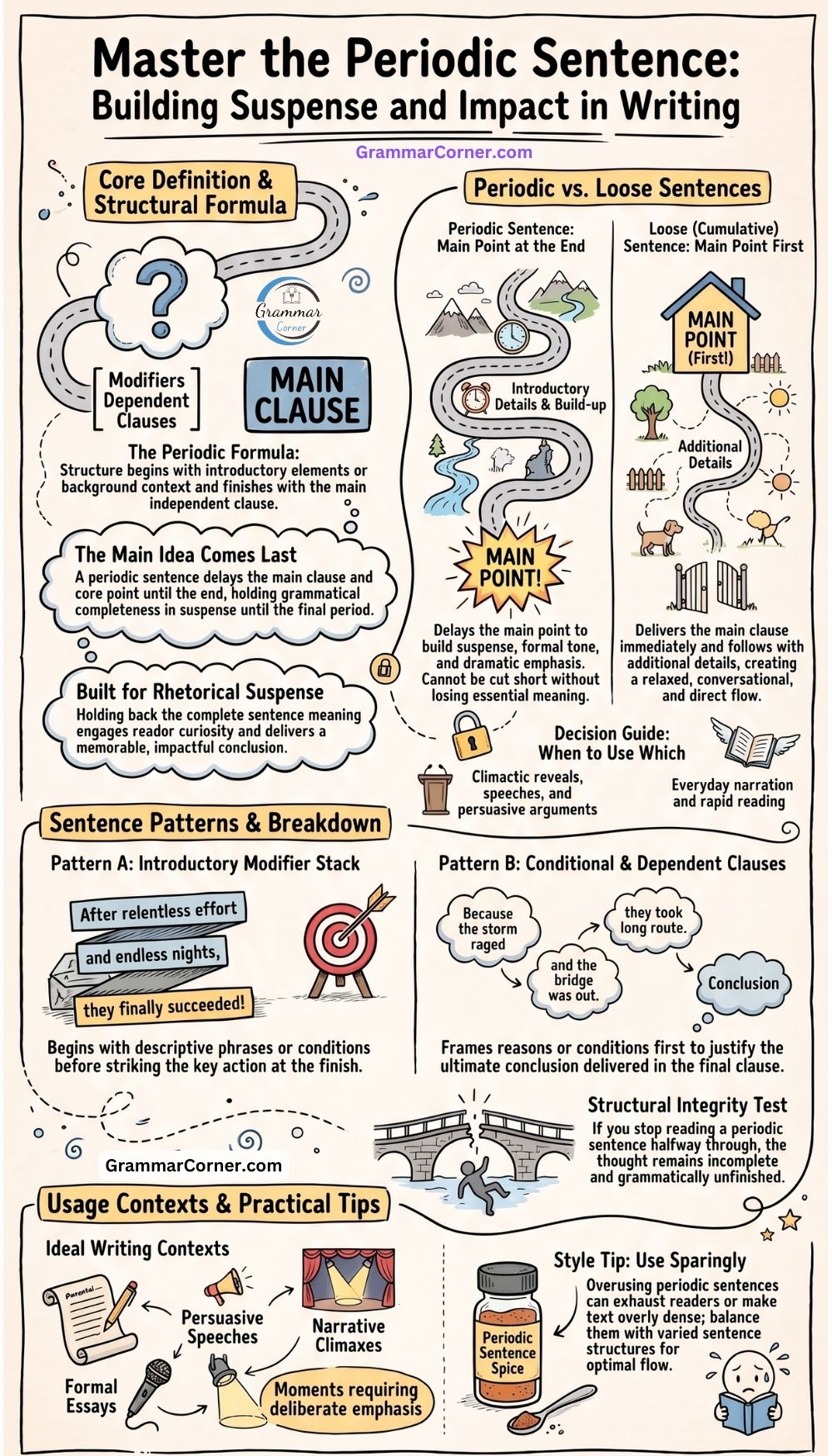
A periodic sentence is a sentence that delays its main clause or most important idea until the very end. It begins with supporting information, such as introductory phrases, descriptions, or dependent clauses. The reader does not receive the complete thought until the sentence reaches its conclusion.
Why Do Writers Use Periodic Sentences?
Writers strategically use periodic sentences to build suspense, heighten emphasis, slow down the reading pace, and give a crucial climax greater emotional or rhetorical impact.
Framework of a Periodic Sentence
Examine how the supporting details build momentum before revealing the core clause:
- Introductory Phase (Preparation): After months of planning, several unexpected delays, and countless revisions…
- Main Clause (The Climax): …the project finally succeeded.
✨ Quick Challenge
Which of the following examples is a true periodic sentence? Tap your answer.
See the full answer
Answer: “After days of grueling climbing, freezing temperatures, and near-exhaustion, the team reached the summit.”
A periodic sentence is structured to save the core meaning (the main independent clause) for the final beat. By placing the introductory phrases first, the writer forces the reader to wait for the resolution, generating narrative momentum.
Why Is It Called a Periodic Sentence?
The term periodic comes from the rhetorical idea of completing a thought only at the full “period” or end of a sentence. As the reader moves through the sentence, the meaning remains incomplete and structurally suspended until the final main clause resolves it.
Consider this example:
Until reaching the final words—we arrived safely—the reader is held in suspense, waiting to discover the ultimate outcome of the journey.
What Is the Structure of a Periodic Sentence?
Most periodic sentences place one or more introductory elements (such as prepositional phrases or dependent clauses) before the main independent clause.
Basic Formula Breakdown
| Part | Grammatical Function | Example Words |
|---|---|---|
| Introductory Clause | Sets the initial scenario | After the storm passed |
| Additional Detail | Builds interest and context | and the roads reopened, |
| Main Clause | Delivers the key climax/idea | the rescue teams returned home. |
How Does a Periodic Sentence Work?
A periodic sentence works primarily by delaying closure. Grammatically, readers naturally scan sentences looking for the subject and verb that complete the core thought. When a writer intentionally layers introductory descriptions before the main subject and verb, the reader is compelled to keep reading to find the resolution.
“In the quiet village, beneath the old oak tree, after everyone else had gone home, she waited.“
Notice how this sentence gradually narrows the reader’s focus—from the village, to the tree, to the time of night—until the final, dramatic action is revealed.
Examples of Periodic Sentences
Periodic Sentence vs. Loose Sentence
The clearest way to understand a periodic sentence is to contrast it directly with a loose sentence (also called a cumulative sentence). While a periodic sentence holds back the main clause until the end, a loose sentence delivers the main idea first and then attaches supporting details.
| Periodic Sentence (Main Idea Last) | Loose Sentence (Main Idea First) |
|---|---|
| After the long meeting and several disagreements, the committee reached a decision. | The committee reached a decision after the long meeting and several disagreements. |
| Despite the strong wind and freezing weather, the hikers continued. | The hikers continued despite the strong wind and freezing weather. |
| With careful research and months of testing, the scientists found the answer. | The scientists found the answer after months of testing and careful research. |
Effect on the Reader
| Sentence Type | Effect on Reader |
|---|---|
| Periodic Sentence | Builds suspense, adds dramatic weight, and emphasizes the final words. |
| Loose Sentence | Delivers information quickly, naturally, and conversationally. |
Periodic Sentence vs. Loose Sentence: Which Is Better?
Neither sentence structure is inherently “better” than the other. Both are grammatically correct, and skilled writers intentionally mix both patterns to create rhythmic variety.
- Create suspense or dramatic tension
- Emphasize the final statement/conclusion
- Present evidence or reasons before a claim
- Intentionally slow down the reading pace
- Communicate details quickly and directly
- Maintain a natural, conversational tone
- Keep complex writing smooth and easy to scan
- State the primary point immediately
What Is the Purpose of a Periodic Sentence?
Periodic sentences serve several distinct rhetorical and stylistic purposes in writing:
Forces the reader to continue reading to discover the ultimate payoff or outcome.
The final words naturally receive the greatest emphasis and reader focus.
Ideal for persuasive writing where support logically leads to a claim.
Unfolds descriptions gradually, guiding the reader step-by-step through a scene.
Where Are Periodic Sentences Used?
Periodic sentences are versatile tools used across many different forms of spoken and written prose:
Speakers build momentum toward a powerful climax:
Lays out evidence before declaring the core thesis:
Authors build atmosphere and narrative tension:
Helps organize multi-part arguments cleanly:
Can a Periodic Sentence Be Short?
Yes. Although many periodic sentences are fairly long and complex, sentence length is not a defining requirement. The defining feature of a periodic sentence is strictly the placement of the main idea at the end.
Delays the key descriptive idea until the final word.
The clause he apologized carries the core message at the end.
What Makes a Good Periodic Sentence?
A well-crafted periodic sentence should feel natural and powerful rather than forced or overly complex. Effective periodic sentences typically exhibit three main qualities:
The introductory section properly sets the scene and prepares the reader for what follows.
The climax at the end delivers the sentence’s most important message or action.
The supporting details build smoothly and logically toward the ultimate conclusion.
“After studying the evidence, speaking with witnesses, and reviewing the documents, the judge announced the decision.“
Notice how each introductory action leads step-by-step to the final judicial action.
Common Patterns of Periodic Sentences
Writers utilize several structural patterns to create periodic sentences:
The repetition builds a rhythmic momentum right before revealing the main result.
Periodic Sentence Patterns at a Glance
| Pattern Type | Example Sentence |
|---|---|
| One dependent clause | Although it was raining, we continued. |
| Two dependent clauses | Because the roads were closed and the buses were delayed, school started late. |
| Introductory phrases | With courage, patience, and determination, she succeeded. |
| Parallel phrases | Through practice, through discipline, and through effort, he improved. |
Punctuation in Periodic Sentences
Because periodic sentences rely on introductory clauses or phrases to build suspense, correct comma usage is vital to guide the reader. In almost all cases, a comma is required to separate the introductory sequence from the main clause.
When stacking multiple introductory elements, use commas to separate each item in the series:
How to Write a Periodic Sentence
Transforming a standard sentence into a periodic one is a three-step creative process:
(Details: “after months of training,” “despite several injuries,” “before a large crowd.”)
(Result: “After months of training, despite several injuries, and before a large crowd, the team won.”)
Another Example
How to Convert a Loose Sentence Into a Periodic Sentence
To convert a loose sentence (where the main idea comes first), simply relocate the supporting phrases to the front of the sentence.
Periodic: “After months of planning and several successful projects, the company expanded its offices.”
The core meaning remains identical, but the emphasis shifts from the *what* to the *context*.
More Conversion Examples
| Loose Sentence (Main Idea First) | Periodic Sentence (Main Idea Last) |
|---|---|
| She passed the exam after weeks of study. | After weeks of study, she passed the exam. |
| The festival opened after the mayor arrived. | After the mayor arrived, the festival opened. |
| The players celebrated after the final whistle. | After the final whistle, the players celebrated. |
✨ Quick Challenge
Which option is the correctly punctuated periodic conversion of the loose sentence: “The concert resumed after the rain ceased and the crew dried the stage”? Tap your answer.
See the full answer
Answer: “After the rain ceased and the crew dried the stage, the concert resumed.”
To convert a loose sentence into a periodic sentence:
- Front the introductory modifying elements (“After the rain ceased and the crew dried the stage”).
- Insert a comma to signal the boundary before the main clause.
- Deliver the main idea at the end (“the concert resumed”).
Periodic Sentences in Everyday Writing
Although periodic sentences are often associated with formal essays or speeches, they appear naturally across ordinary English communication as well:
Common Mistakes With Periodic Sentences
When incorporating periodic structures into your writing, avoid these four common pitfalls:
A periodic sentence should build suspense, not exhaust your reader.
❌ Overloaded:“After the long journey through the mountains, the unexpected rainstorm, the broken vehicle, the missing supplies, the confusing directions, and the growing darkness that covered the entire valley, the travelers eventually reached the small village where they hoped to find shelter for the night.”
Keep introductory elements focused—a concise version is always stronger.
The final clause receives maximum emphasis, so it must contain a meaningful conclusion.
If every sentence delays its main idea, the text becomes exhausting. Always mix periodic sentences with loose and simple structures.
Avoid rearranging phrases so heavily that the sentence sounds unnatural. The structure should feel deliberate, not awkward.
Periodic Sentence and Sentence Variety
Varying sentence architecture is essential for engaging writing. Compare these two paragraphs:
Periodic Sentences in Persuasive & Narrative Writing
Presents supporting evidence first so the conclusion feels fully justified upon arrival:
Builds atmosphere and tension immediately before major story turns:
Quick Comparison Table
| Feature | Periodic Sentence | Loose Sentence |
|---|---|---|
| Main Idea Position | At the end | At the beginning |
| Reader Effect | Suspense, dramatic weight | Immediacy, natural flow |
| Reading Pace | Slower, deliberate | Faster, conversational |
| Best Use Case | Emphasis, drama, persuasion | Clear explanations, casual context |
| Typical Structure | Supporting details + main clause | Main clause + supporting details |
Periodic Sentence Practice
Exercise 1: Identify the Periodic Sentences
Decide whether each sentence is periodic or not periodic:
- After weeks of practice, the band performed confidently.
- The band performed confidently after weeks of practice.
- Because the weather improved, the picnic continued.
- The picnic continued because the weather improved.
- With patience and determination, she solved the puzzle.
| Sentence | Answer |
|---|---|
| 1 | Periodic |
| 2 | Not periodic |
| 3 | Periodic |
| 4 | Not periodic |
| 5 | Periodic |
Exercise 2: Rewrite as Periodic Sentences
Rewrite each loose sentence so that the main idea comes at the end:
- The students completed the project after several days of research.
- The team celebrated after winning the championship.
- She accepted the invitation after talking with her parents.
- The meeting ended after everyone had spoken.
- The hikers reached the cabin after walking for hours.
Sample Answers:
- After several days of research, the students completed the project.
- After winning the championship, the team celebrated.
- After talking with her parents, she accepted the invitation.
- After everyone had spoken, the meeting ended.
- After walking for hours, the hikers reached the cabin.
Exercise 3: Complete the Periodic Sentence
Finish each sentence with a suitable main clause:
- After months of preparation, careful planning, and repeated practice, ___________.
- Because the roads were icy and visibility was poor, ___________.
- With courage, patience, and determination, ___________.
- After the lights went out and the room fell silent, ___________.
- Although the task seemed impossible at first, ___________.
Possible Answers:
- …the team performed successfully.
- …the school closed early.
- …she completed the challenge.
- …someone knocked at the door.
- …he eventually found a solution.
Frequently Asked Questions About Periodic Sentences