Exclamatory Sentences (Structure & Examples)
What Is an Exclamatory Sentence?
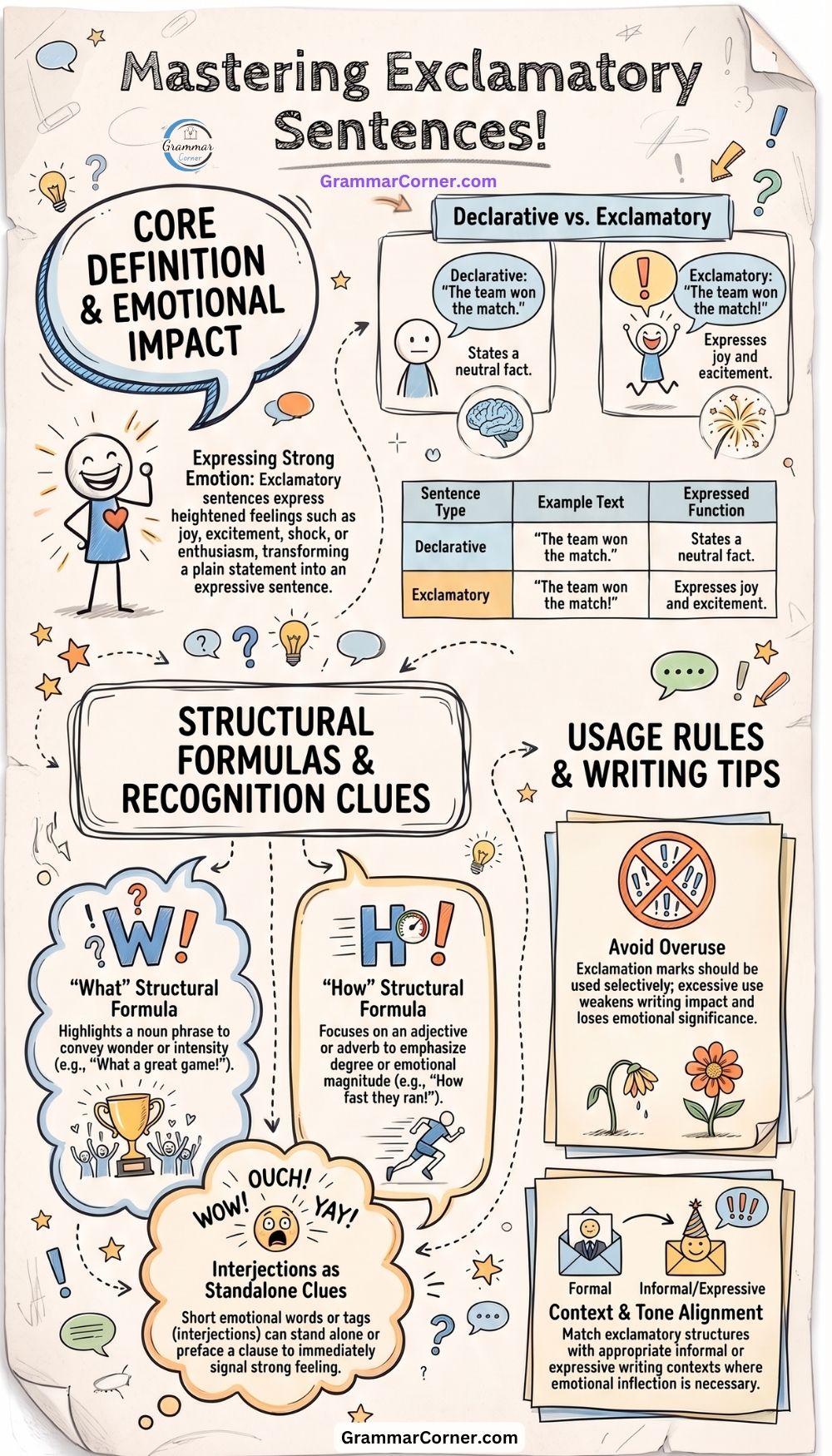
An exclamatory sentence is used to express a strong feeling. It communicates more than basic factual information by adding a layer of direct emotional reaction from the speaker.
Comparing Information vs. Emotion
Notice how a single punctuation shift transforms a sentence from a simple statement into an exclamatory sentence:
When and How Exclamatory Sentences Are Used
Exclamatory sentences are frequently used across informal, narrative, and expressive contexts:
Core Examples of Exclamatory Sentences
In each of these sentences, the speaker communicates more than facts—they express a strong emotional reaction:
- What a beautiful view!
- I can’t believe we won!
- That was an incredible performance!
Exclamatory Sentence Examples by Emotion
An exclamatory sentence does not have to express happiness. It can communicate almost any strong emotion, providing emotional force to the statement:
| Emotion Expressed | Example Sentence |
|---|---|
| Joy | We finally won! |
| Surprise | You are here already! |
| Anger | How could you do that! |
| Excitement | We are going on holiday! |
| Fear | There is a snake! |
| Admiration | What a wonderful painting! |
| Frustration | This computer is driving me crazy! |
| Disappointment | What a terrible mistake! |
✨ Quick Challenge
Which of the following sentences functions as an exclamatory sentence expressing a strong emotional reaction rather than neutral information or a command? Tap your answer.
See the full answer
Answer: “What an extraordinary discovery this is!”
Understanding exclamatory sentences:
- Exclamatory Purpose: Directly expresses strong emotion (admiration, wonder, shock, excitement) and ends with an exclamation point (!).
- Distinct Patterns: Often uses specialized structures beginning with What (e.g., “What a…”) or How (e.g., “How amazing…”) to amplify emotional intensity.
How to Recognize an Exclamatory Sentence
There are several distinct clues that can help you identify an exclamatory sentence quickly:
Exclamatory Sentence Structure
There is no single formula that every exclamatory sentence must follow. Several structural patterns are possible:
| Structure Pattern | Example Sentence |
|---|---|
| Statement + ! | You did it! |
| What + noun phrase + ! | What a beautiful painting! |
| How + adjective/adverb + ! | How quickly he runs! |
| Subject + verb + ! | She won! |
| Interjection + sentence | Wow! That was amazing! |
| Exclamatory clause | What a surprise this is! |
A standard statement structure like “I can’t believe we won!” is just as much an exclamatory sentence as “What an incredible victory!”
Exclamatory Sentences With “What”
The word “What” is commonly used in exclamatory structures to give emphasis to a noun or noun phrase. The choice of pattern depends on whether the noun is singular countable, plural, or uncountable.
- What a wonderful surprise!
- What a clever idea that was!
- What an exciting match this is!
- What beautiful flowers you have!
- What terrible weather we are having!
Exclamatory Sentences With “How”
The word “How” is commonly used to emphasize an adjective or an adverb directly.
- How beautiful she looks!
- How cold it is!
- How difficult this question is!
- How quickly he runs!
- How carefully she works!
- How beautifully they sing!
What a beautiful painting! → Here, what introduces a noun phrase (a beautiful painting).
How beautiful the painting is! → Here, how directly emphasizes the adjective (beautiful).
“What” vs. “How” Comparison
Because these two structures are easy to confuse, examine how the same core idea is expressed using both forms:
| With “What” (Noun Phrase) | With “How” (Adjective Emphasis) |
|---|---|
| What a beautiful dress! | How beautiful the dress is! |
| What an amazing idea! | How amazing the idea is! |
| What a clever student! | How clever the student is! |
| What beautiful flowers! | How beautiful the flowers are! |
| What terrible weather! | How terrible the weather is! |
• What → Emphasizes a noun or noun phrase.
• How → Emphasizes an adjective or adverb.
Exclamatory Sentences With Interjections
An interjection is a standalone word or short expression used to convey an immediate emotional reaction or feeling.
- Wow! That is incredible!
- Oh, I forgot my keys!
- Ouch! That really hurt!
- Hooray! We won the competition!
Interjection vs. Exclamatory Sentence
An important distinction is that an interjection and an exclamatory sentence are not identical. An interjection (like Wow!) expresses emotion without a subject or predicate, while a full clause (like That was amazing!) forms a complete sentence.
| Interjection (Expression Only) | Exclamatory Sentence (Full Structure) |
|---|---|
| Wow! | That was amazing! |
| Ouch! | That really hurt! |
| Hooray! | We have won the competition! |
| Oh no! | I have lost my wallet! |
Note that an interjection can also appear right before or inside an exclamatory sentence to add extra weight: “Wow, you look fantastic!”
Four Structural Forms of Exclamatory Sentences
Exclamatory sentences are defined by their emotional function, but they can also be classified by their clause structure. Whether simple or complex, the purpose remains the same: to express strong feeling.
Contains exactly one independent clause. Note: These do not have to be short to be “simple.”
- The baby is adorable!
- We won!
- What a beautiful day!
- She sings beautifully!
Contains two or more independent clauses joined together by conjunctions (like and, but, or).
- The weather is terrible, but what a beautiful view!
- We won the match, and everyone is celebrating!
- She worked incredibly hard, and she finally succeeded!
Contains one independent clause and at least one dependent clause. This structure is excellent for adding context to an emotion.
- How happy I was when I heard the news!
- What an amazing performance she gave although she had very little preparation!
Contains at least two independent clauses and at least one dependent clause.
- The show was incredible, and how lucky we were to get tickets when they were almost sold out!
- We finally reached the top, and what a beautiful view we saw after climbing for three hours!
Structural Comparison Summary
Use this reference table to understand how different grammatical structures host exclamatory content:
| Type | Basic Structure | Example |
|---|---|---|
| Simple | One independent clause | What a beautiful garden! |
| Compound | Two+ independent clauses | The garden is beautiful, and the flowers smell wonderful! |
| Complex | Ind. + dependent clause | How beautiful the garden is when the flowers bloom! |
| Compound-Complex | Two+ ind. + dependent clause | The garden looks beautiful, and how wonderful it feels when the flowers bloom! |
Exclamatory Sentences vs. Declarative Sentences
Both declarative and exclamatory sentences can state information. The primary difference lies in the emotional force behind the delivery.
| Feature | Declarative Sentence | Exclamatory Sentence |
|---|---|---|
| Function | Makes a straightforward statement | Adds strong emotion or emphasis |
| Punctuation | Usually ends with a period ( . ) | Normally ends with an exclamation mark ( ! ) |
| Example 1 | The concert was wonderful. | The concert was wonderful! |
| Example 2 | We won the match. | We won the match! |
Exclamatory vs. Interrogative Sentences
Because words like “what” and “how” introduce both questions and exclamations, identifying the sentence function requires looking beyond the opening word.
Quick Side-by-Side Comparison
| Exclamatory Structure | Interrogative Structure |
|---|---|
| What a beautiful dress! | What is the price of the dress? |
| How beautiful she looks! | How does she look? |
| What an exciting match! | What happened during the match? |
| How quickly he runs! | How quickly does he run? |
Exclamatory vs. Imperative Sentences
An imperative sentence gives an order, instruction, request, or command, whereas an exclamatory sentence primarily expresses an emotional state.
Note that punctuation alone cannot identify the type. Imperative sentences often end with an exclamation mark when the command is spoken with urgency or force.
Comparing Sentence Function by Context
| Sentence | Likely Function | Context / Purpose |
|---|---|---|
| Close the door. | Imperative | Standard instruction |
| Close the door! | Forceful Imperative | Urgent command or order |
| The door is finally closed! | Exclamatory | Statement of emotion/relief |
| What a heavy door! | Exclamatory | Reaction to a noun phrase |
Exclamatory Sentences and Exclamation Marks
The exclamation mark (!) is the punctuation mark most closely associated with exclamatory sentences. It signals emotional emphasis to the reader.
- Stop! → Functionally an imperative command.
- Where is he! → An emotionally charged question rather than a standard exclamatory clause.
When Should You Use an Exclamation Mark?
Use an exclamation mark when you genuinely want to convey strong emotion, urgency, surprise, or intense reaction. The punctuation mark should always have a clear purpose—adding one to a plain statement just to make it look important is unnecessary.
Can Exclamatory Sentences Be Used in Formal Writing?
Yes, but they should generally be used sparingly.
In casual writing, text messages, personal letters, advertisements, creative stories, and spoken dialogue, exclamatory sentences feel completely natural (e.g., “That was such a great experience!”).
In academic or professional writing, however, excessive exclamation marks can sound overly emotional or informal. A skilled writer creates emphasis through precise vocabulary and logical reasoning rather than punctuation alone.
“This discovery is absolutely incredible!”
“This discovery is particularly significant because it changes our understanding of the process.”
How Many Exclamation Marks Should You Use?
Normally, one exclamation mark is always enough.
Common Mistakes With Exclamatory Sentences
Because exclamatory structures overlap with questions, commands, and interjections, English learners frequently encounter subtle errors. Here are six common pitfalls to avoid.
The opening word “what” alone does not determine the sentence type. Context and structure matter.
Like “what,” the word “how” frequently introduces questions rather than emotional exclamations.
Misplacing articles like a/an disrupts the standard exclamatory pattern (What + a/an + adjective + noun).
A single exclamation word is an interjection, whereas a complete exclamatory sentence contains a subject and predicate.
Stacking multiple exclamation points weakens the professional polish of your writing.
The same punctuation mark can accompany forceful commands or emotional questions.
How to Change a Declarative Sentence Into an Exclamatory Sentence
Changing a standard statement into an exclamatory sentence involves more than just swapping a period for an exclamation mark. The word order should be restructured to lead with “What” or “How” to emphasize the emotional reaction.
| Declarative Statement | Exclamatory Transformation | Key Focus |
|---|---|---|
| The house is beautiful. | What a beautiful house! | Emphasizes noun phrase (a beautiful house) |
| The baby is very cute. | How cute the baby is! | Emphasizes adjective (cute) |
| It was a wonderful experience. | What a wonderful experience it was! | Emphasizes noun phrase (a wonderful experience) |
| She sings very beautifully. | How beautifully she sings! | Emphasizes adverb (beautifully) |
Exclamatory Sentences in Everyday Conversation
In spoken English, people naturally lean on exclamatory sentences to express immediate, unfiltered emotional reactions to unexpected or high-energy situations.
Exclamatory Sentences in Creative Writing
Authors use exclamatory sentences to make dialogue vivid and convey a character’s heightened state of mind. However, restraint is crucial: overusing exclamation marks dilutes their impact and makes dialogue feel exaggerated.
“Look at that!” Sara shouted. “The whole sky is glowing!”
“I can’t believe it!” she cried. “We actually won!”
“I can’t believe it!!! We actually won!!! This is amazing!!!”
The controlled version communicates excitement cleanly without cluttering the page or forcing the punctuation to do all the heavy lifting.
Exclamatory Sentences in Advertisements & Personal Writing
Copywriters rely heavily on exclamatory sentences to grab attention, generate enthusiasm, and build an emotional hook around products or services.
- What an incredible offer!
- Don’t miss this opportunity!
- Get yours today!
- Happy birthday!
- Congratulations!
- I can’t wait to see you!
Practice: Identify the Exclamatory Sentences
Test your understanding! Read through the sentences below and determine which ones are functioning as true exclamatory sentences.
- The weather is beautiful.
- What a beautiful morning!
- Where are you going?
- I can’t believe we won!
- Please close the window.
- How quickly she runs!
- What is your favorite subject?
- This is an incredible opportunity!
Answer Key & Explanations
| No. | Result | Reason |
|---|---|---|
| 1 | Not Exclamatory | Makes a straightforward statement (Declarative). |
| 2 | Exclamatory | Expresses strong admiration using What + noun phrase. |
| 3 | Not Exclamatory | Asks a question (Interrogative). |
| 4 | Exclamatory | Expresses strong surprise and excitement. |
| 5 | Not Exclamatory | Gives a polite request (Imperative). |
| 6 | Exclamatory | Expresses admiration/surprise using How + adverb. |
| 7 | Not Exclamatory | Asks a direct question (Interrogative). |
| 8 | Exclamatory | Expresses strong enthusiasm about a noun phrase. |
✨ Quick Challenge
Which of the following sentences functions as a true exclamatory sentence formed with a “How / What” emotional pattern? Tap your answer.
See the full answer
Answer: “How wonderfully you played today!”
Distinguishing exclamatory patterns from questions:
- Exclamatory Construction: “How wonderfully you played today!” uses
How + adverb + subject + verbwithout subject-verb inversion to express spontaneous admiration. - Interrogative Questions: Sentences like “How did you solve…?” or “What is the schedule…?” invert auxiliary verbs to request missing facts rather than projecting pure emotion.
Practice Exercise 1: Choose “What” or “How”
Complete each sentence below by inserting the correct word: What or How.
- ______ a beautiful painting!
- ______ beautiful the painting is!
- ______ an interesting story!
- ______ interesting the story is!
- ______ wonderful news!
- ______ quickly he runs!
- ______ a clever idea!
- ______ carefully she works!
Answer Key & Explanations
| No. | Answer | Target Structure |
|---|---|---|
| 1 | What | Followed by noun phrase (a beautiful painting) |
| 2 | How | Followed directly by adjective (beautiful) |
| 3 | What | Followed by noun phrase (an interesting story) |
| 4 | How | Followed directly by adjective (interesting) |
| 5 | What | Followed by uncountable noun phrase (wonderful news) |
| 6 | How | Followed directly by adverb (quickly) |
| 7 | What | Followed by noun phrase (a clever idea) |
| 8 | How | Followed directly by adverb (carefully) |
• Use What before a noun or noun phrase.
• Use How before an adjective or adverb.
Practice Exercise 2: Transform Statements into Exclamations
Rewrite each standard declarative sentence as an energetic exclamatory sentence.
- The house is beautiful.
- The child is adorable.
- The movie was wonderful.
- She sings beautifully.
- It was an exciting match.
Suggested Answers
| Declarative Statement | Exclamatory Transformation |
|---|---|
| The house is beautiful. | What a beautiful house! |
| The child is adorable. | How adorable the child is! |
| The movie was wonderful. | What a wonderful movie! |
| She sings beautifully. | How beautifully she sings! |
| It was an exciting match. | What an exciting match it was! |
Note: Depending on context, there may be more than one natural way to rephrase these sentences.
Frequently Asked Questions About Exclamatory Sentences