Adverbs That Start With O (Common, Positive & Descriptive Adverbs)
Some of English’s most useful adverbs start with O. They let you express frequency, manner, emphasis, and sequence more precisely.
Learning them makes your speaking and writing sound more fluent and natural.
Adverbs that start with O include:
- occasionally
- often
- openly
- originally
Quick Challenge
Choose the correct O-adverb to complete the sentence:
We __________ go hiking on weekends.
Show the answer
Answer: A) often ✅
Often is an adverb of frequency, so it tells us how frequently the action happens. Orange and office are nouns — and orange can also be an adjective — so neither completes the sentence.
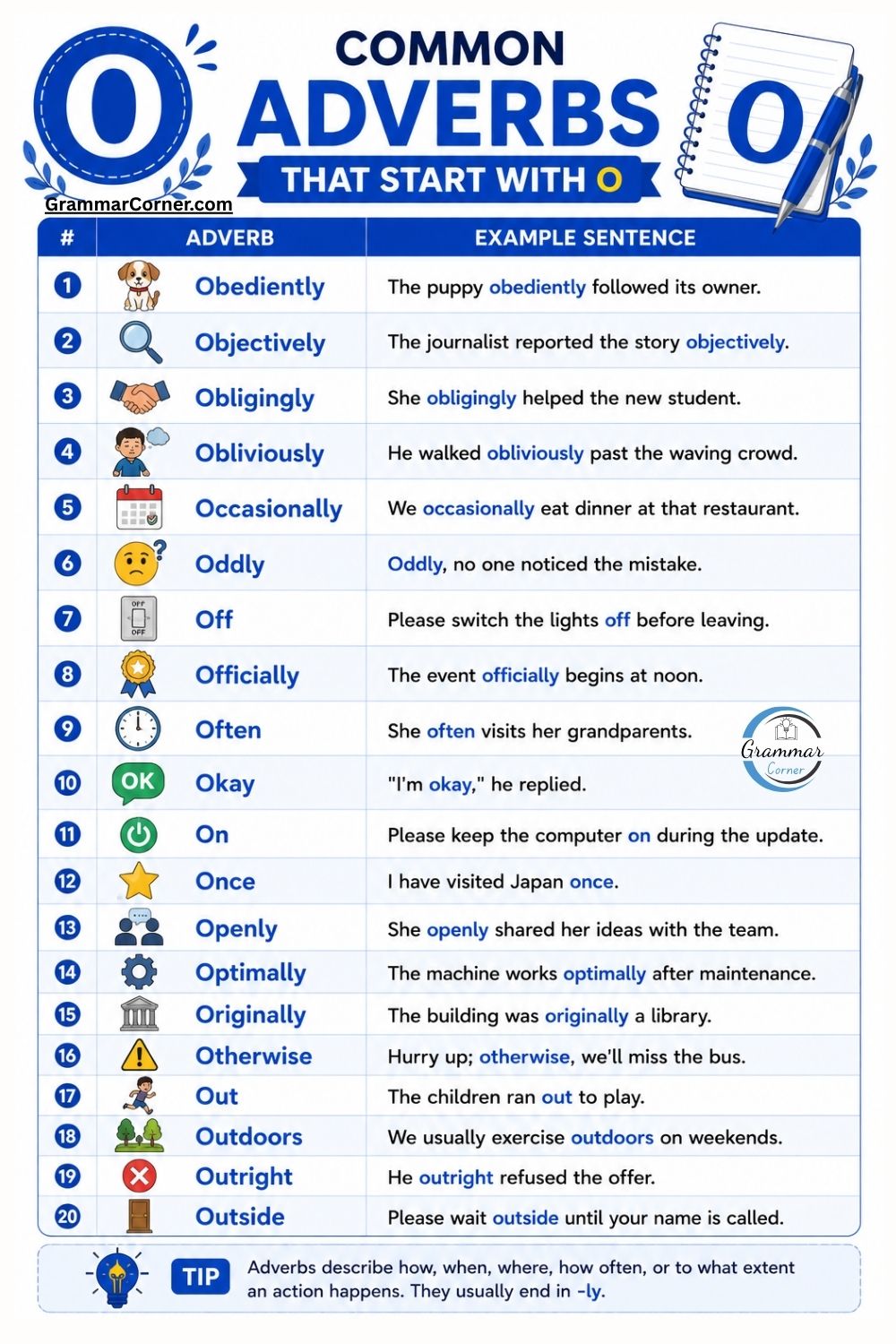
Common Adverbs that Start with O
| Adverb | Example Sentence |
|---|---|
| Obediently | The puppy obediently followed its owner. |
| Objectively | The journalist reported the story objectively. |
| Obligingly | She obligingly helped the new student. |
| Obliviously | He walked obliviously past the waving crowd. |
| Occasionally | We occasionally eat dinner at that restaurant. |
| Oddly | Oddly, no one noticed the mistake. |
| Off | Please switch the lights off before leaving. |
| Officially | The event officially begins at noon. |
| Often | She often visits her grandparents. |
| Okay | "I'm okay," he replied. |
| On | Please keep the computer on during the update. |
| Once | I have visited Japan once. |
| Openly | She openly shared her ideas with the team. |
| Optimally | The machine works optimally after maintenance. |
| Originally | The building was originally a library. |
| Otherwise | Hurry up; otherwise, we'll miss the bus. |
| Out | The children ran out to play. |
| Outdoors | We usually exercise outdoors on weekends. |
| Outright | He outright refused the offer. |
| Outside | Please wait outside until your name is called. |
| Over | The game is over now. |
| Overboard | The sailor accidentally fell overboard. |
| Overhead | Birds flew overhead during the picnic. |
| Overnight | The package arrived overnight. |
| Overland | They traveled overland across the country. |
| Overseas | She works overseas for a technology company. |
| Overwhelmingly | The proposal was overwhelmingly approved. |
| Overtly | He overtly expressed his opinion. |
| Owingly | The debt was owingly acknowledged. (Rare) |
| Obscurely | The ancient text was obscurely written. |
| Offhand | He answered the question offhand. |
| Offstage | The actor waited offstage before the performance. |
| Onward | The hikers continued onward despite the rain. |
| Oppositely | The magnets faced oppositely. |
| Ordinarily | We ordinarily start work at 9 a.m. |
| Organically | The vegetables were organically grown. |
| Ostensibly | He ostensibly visited for business reasons. |
| Ostentatiously | She ostentatiously displayed her collection. |
| Outwardly | He appeared outwardly calm. |
| Overall | Overall, the project was a success. |
Positive Adverbs that Start with O
| Adverb | Example Sentence |
|---|---|
| Positive Openheartedly | She openheartedly welcomed every new student. |
| Positive Optimistically | The team optimistically prepared for the final match. |
| Positive Orderly | The children lined up orderly before entering the classroom. |
| Positive Outstandingly | The athlete performed outstandingly throughout the tournament. |
| Positive Openhandedly | The charity openhandedly supported families in need. |
| Positive Open-mindedly | He open-mindedly considered everyone's suggestions. |
| Positive Obingly | She obligingly assisted the elderly neighbor. |
| Positive Omnisciently | The narrator omnisciently describes every character's thoughts. |
| Positive Opulently | The hall was opulently decorated for the celebration. |
| Positive Overflowingly | The audience applauded overflowingly with enthusiasm. |
| Positive Observantly | The detective observantly noticed every detail. |
| Positive Opportunely | She arrived opportunely just before the meeting began. |
| Positive Originatively | The designer originatively solved the problem. |
| Positive Obediently | The children obediently followed the teacher's instructions. |
| Positive Officially | The new library was officially opened today. |
| Positive Organically | The garden was organically maintained without chemicals. |
| Positive Outspokenly | She outspokenly defended equal opportunities. |
| Positive Overflowingly | The flowers bloomed overflowingly in spring. |
| Positive Oecumenically | The leaders worked oecumenically to promote unity. |
| Positive Ominously | The clouds gathered ominously before the storm. |
| Positive Overjoyedly | The children overjoyedly celebrated their victory. |
| Positive Overabundantly | The orchard produced fruit overabundantly this season. |
| Positive Overgenerously | He overgenerously donated supplies to the shelter. |
| Positive Overkindly | She overkindly praised every student's effort. |
| Positive Overcarefully | He overcarefully wrapped the fragile gift. |
Five-Letter Adverbs That Start with O
Only a few common English adverbs beginning with O have exactly five letters. Here are the most useful ones.
| Adverb | Example Sentence |
|---|---|
| Often | We often visit our grandparents on weekends. |
| Onward(commonly written as onwards in British English) | The hikers moved onward after a short break. |
Descriptive Adverbs That Start with O
These O-adverbs describe how, when, where, or to what extent an action happens.
| Adverb | Meaning | Example |
|---|---|---|
| Obediently | In an obedient manner | The puppy sat obediently by its owner. |
| Objectively | Without personal bias | The report was written objectively. |
| Obliviously | Without being aware | He walked obliviously into the room. |
| Occasionally | From time to time | We occasionally eat out on Fridays. |
| Officially | In an official manner | The event officially began at noon. |
| Often | Frequently | She often reads before bed. |
| Openly | In an honest or public way | They openly discussed the problem. |
| Optimistically | In a hopeful manner | He spoke optimistically about the future. |
| Ordinarily | Usually; normally | Ordinarily, the shop opens at 9 a.m. |
| Originally | At first | The building was originally a school. |
| Otherwise | In a different way | Leave now; otherwise, you’ll be late. |
| Outwardly | In outward appearance | She appeared outwardly calm. |
| Overhead | Above one’s head | The birds flew overhead. |
| Overnight | During the night | The package arrived overnight. |
| Overwhelmingly | To a very great extent | The proposal was overwhelmingly supported. |
Adverbs That Start with O to Describe a Person
These adverbs describe how a person behaves, communicates, thinks, or performs an action.
| Adverb | Meaning | Example |
|---|---|---|
| Obediently | In a respectful and compliant way | The child listened obediently. |
| Objectively | Without personal opinion | She judged the situation objectively. |
| Obliviously | Without noticing what is happening | He walked obliviously through the crowd. |
| Officially | In an authorized manner | She officially announced the results. |
| Often | Frequently | He often volunteers at the shelter. |
| Openly | In an honest and direct way | She spoke openly about her experiences. |
| Optimistically | With hope and confidence | They looked optimistically toward the future. |
| Ordinarily | In a usual manner | He ordinarily arrives early. |
| Originally | At the beginning | She originally planned to become a doctor. |
| Outwardly | In visible appearance | He remained outwardly confident. |
| Overconfidently | With excessive confidence | He answered the questions overconfidently. |
| Overenthusiastically | With too much enthusiasm | The fans cheered overenthusiastically. |
Real-Life Example
Picture a new hire who responds overenthusiastically to every idea in a meeting — cheering even the small, routine suggestions the same way as the big ones. The team starts to wonder if the praise means anything. That’s the line this word points to: enthusiasm is good, but overenthusiastically signals so much of it that it stops feeling genuine.
Common Mistakes When Using O-Adverbs
-
Objective or Objectively?
✕Incorrect: She answered the question objective.
✓Correct: She answered the question objectively.
Why? Objectively describes how she answered. Objective is an adjective: an objective report.
-
Orderly Is an Adjective, Not an Adverb
✕Incorrect: The students worked orderly during the science experiment.
✓Correct: The students worked in an orderly manner during the science experiment.
Why? Orderly ends in -ly, but in modern English it’s an adjective — an orderly queue, an orderly retreat. Its old adverb use has all but disappeared, so use the phrase in an orderly manner instead.
-
Open or Openly?
✕Incorrect: He spoke open about his experience.
✓Correct: He spoke openly about his experience.
Why? Openly modifies the verb spoke. Open is usually an adjective.
-
Mixing an Adjective and an Adverb in a Pair
✕Incorrect: The volunteers helped generous and obligingly.
✓Correct: The volunteers helped generously and obligingly.
Why? Both words describe the verb helped, so both need to be adverbs.
-
Adding -s to Often
✕Incorrect: She visits her grandparents oftens.
✓Correct: She often visits her grandparents.
Why? Adverbs have no plural form, so often never takes an -s.
The correction moves the word as well. Frequency adverbs like often, always, and never normally sit before the main verb.
-
Adding -ly to Overnight
✕Incorrect: The package arrived overnightly.
✓Correct: The package arrived overnight.
Why? Overnight is already an adverb, so it needs no ending. The same is true of fast, late, and hard.
-
More Objective or More Objectively?
✕Incorrect: He acted more objective than before.
✓Correct: He acted more objectively than before.
Why? The phrase modifies the verb acted, so the adverb form is still needed once more is added.
-
Doubling the -ly Ending
✕Incorrect: She smiled openheartedlyly at everyone.
✓Correct: She smiled openheartedly at everyone.
Why? A word that already ends in -ly is complete. Never attach the ending twice.
-
Honest and Openly Don’t Match
✕Incorrect: They discussed the issue honest and openly.
✓Correct: They discussed the issue honestly and openly.
Why? Both words describe discussed, so pair an adverb with an adverb.
-
More Easier Is Two Mistakes at Once
✕Incorrect: The teacher explained the lesson more easier and objectively.
✓Correct: The teacher explained the lesson more easily and objectively.
Why? Two problems sit in that sentence. Easier is a comparative adjective where an adverb is needed, and more easier doubles the comparative — you use either more or the -er ending, never both.
-
Outstanding or Outstandingly?
✕Incorrect: The athlete performed outstanding during the competition.
✓Correct: The athlete performed outstandingly during the competition.
Why? Outstandingly describes the verb performed. Outstanding is an adjective: an outstanding athlete.
-
Adding -s to Occasionally
✕Incorrect: She occasionallys forgets her umbrella.
✓Correct: She occasionally forgets her umbrella.
Why? The -s ending belongs to the verb, not the adverb. Forgets already carries it.
Practice Exercises
Exercise 1: Fill in the Blanks
Complete each sentence using the correct O-adverb from the word bank.
- She __________ shares her ideas during team meetings.
- We __________ go hiking on weekends.
- The teacher judged the debate __________.
- The package arrived __________.
- He looked calm __________, but he was worried inside.
- The detective __________ examined the evidence.
- The team prepared __________ for the championship.
- I __________ visit my cousins during school holidays.
Show Answers
- openly
- occasionally
- objectively
- overnight
- outwardly
- observantly
- optimistically
- often
Exercise 2: Choose the Correct Adverb
Choose the best answer.
- The manager handled the complaint __________.
- She spoke __________ about her goals.
- We meet __________ on Friday afternoons.
- The scientist examined the results __________.
- The guests arrived __________.
Show Answers
- B. objectively
- A. openly
- A. often
- A. observantly
- A. overnight
Exercise 3: Match the Adverb with Its Meaning
- Often
- Occasionally
- Openly
- Objectively
- Overnight
- Optimistically
- Outwardly
- Observantly
- A. In a fair and unbiased way
- B. At times, but not regularly
- C. Frequently
- D. Honestly and without hiding anything
- E. During the night
- F. With hope and confidence
- G. In outward appearance
- H. While paying close attention
Show Answers
- Often → C
- Occasionally → B
- Openly → D
- Objectively → A
- Overnight → E
- Optimistically → F
- Outwardly → G
- Observantly → H
Exercise 4: Choose the Best O-Adverb
Complete each sentence with the most suitable adverb.
- The children __________ admitted their mistake.
- The committee reviewed every application __________.
- We __________ eat at that café because the food is excellent.
- The flowers bloomed __________ after the spring rain.
- The package was delivered __________.
Show Answers
- A. openly
- A. objectively
- A. often
- C. organically
- A. overnight
Exercise 5: Correct the Mistake
Rewrite each sentence correctly.
- She answered objective.
- He spoke open about the issue.
- We oftens visit our grandparents.
- The athlete performed outstanding.
- The parcel arrived overnightly.
Show Answers
- She answered objectively.
- He spoke openly about the issue.
- We often visit our grandparents.
- The athlete performed outstandingly.
- The parcel arrived overnight.
Exercise 6: Write Your Own Sentences
Write one sentence using each of these O-adverbs.
- Often
- Occasionally
- Openly
- Objectively
- Optimistically
- Overnight
Show Sample Answers
- I often read before going to bed.
- We occasionally eat at a new restaurant.
- She openly thanked everyone for their support.
- The judge objectively considered all the evidence.
- The students optimistically prepared for the competition.
- The package arrived overnight.
Frequently Asked Questions
What are adverbs that start with O?
Adverbs that start with O are words beginning with the letter O that modify verbs, adjectives, other adverbs, or entire sentences. Examples include often, openly, occasionally, officially, and originally.
Is often an adverb?
Yes. Often is an adverb of frequency. It tells how often an action happens.
- She often visits her grandparents.
- We often study together after class.
What is the difference between often and occasionally?
Both are adverbs of frequency, but they indicate different levels of frequency.
- Often means frequently or many times.
- Occasionally means sometimes, but not very often.
Can O-adverbs describe a person?
Yes. O-adverbs describe how a person acts, speaks, thinks, or behaves, not the person directly. For example, She spoke openly and He answered objectively.
Are all O-adverbs formed by adding -ly?
No. While many O-adverbs end in -ly, some common ones do not, such as often, otherwise, overhead, and overnight.
See also: