Adverbs That Start With P (Common, Positive & Descriptive Adverbs)
The letter P supplies a lot of useful adverbs — words that add detail, precision, and emphasis to a sentence.
From everyday conversation to academic writing, they help you explain actions more clearly and communicate with confidence.
Adverbs that start with P include:
- partially
- patiently
- perfectly
- probably
Quick Challenge
Choose the correct P-adverb to complete the sentence:
The students waited __________ for the teacher to arrive.
Show the answer
Answer: A) patiently ✅
Patiently is an adverb that describes how the students waited. Pencil and playground are nouns, so neither fits the sentence.
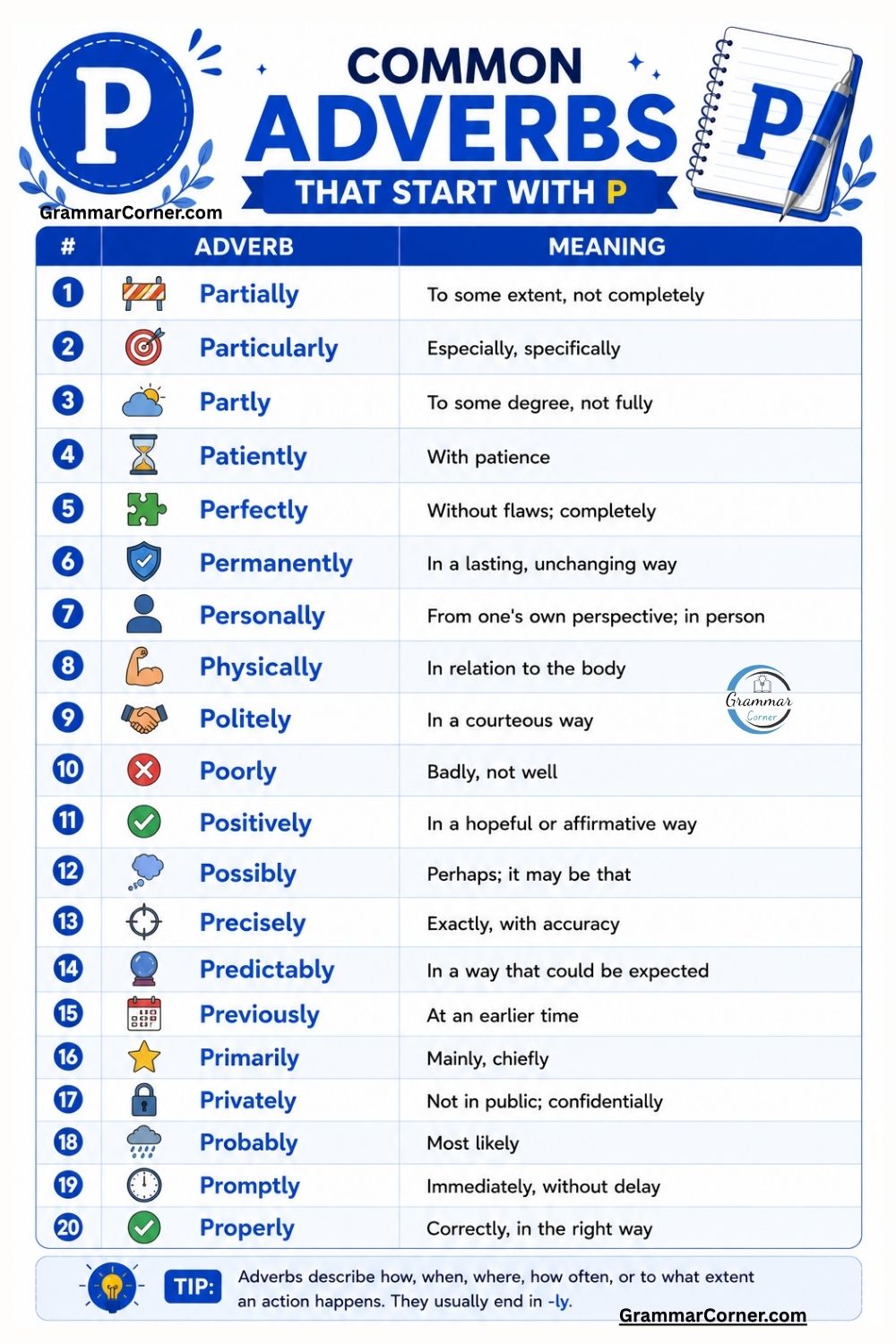
Common Adverbs That Start with P
| Adverb | Meaning | Example Sentence |
|---|---|---|
| Partially | To some extent, not completely | The road was partially blocked after the storm. |
| Particularly | Especially, specifically | I particularly enjoyed the final chapter. |
| Partly | To some degree, not fully | The sky is partly cloudy today. |
| Patiently | With patience | She patiently explained the lesson to the class. |
| Perfectly | Without flaws; completely | The puzzle fits perfectly in the frame. |
| Permanently | In a lasting, unchanging way | The family permanently moved to another city. |
| Personally | From one’s own perspective; in person | I personally prefer reading before bed. |
| Physically | In relation to the body | He is physically stronger than before. |
| Politely | In a courteous way | The student politely asked for more time. |
| Poorly | Badly, not well | The machine was poorly maintained. |
| Positively | In a hopeful or affirmative way | She responded positively to the suggestion. |
| Possibly | Perhaps; it may be that | We could possibly finish the project today. |
| Precisely | Exactly, with accuracy | The scientist measured the sample precisely. |
| Predictably | In a way that could be expected | The experienced team predictably won the match. |
| Previously | At an earlier time | I had previously visited that museum. |
| Primarily | Mainly, chiefly | The course is primarily designed for beginners. |
| Privately | Not in public; confidentially | They discussed the matter privately. |
| Probably | Most likely | It will probably rain this evening. |
| Promptly | Immediately, without delay | The train departed promptly at 8:00 a.m. |
| Properly | Correctly, in the right way | Please wash your hands properly before eating. |
Positive Adverbs That Start with P
| Adverb | Meaning | Example Sentence |
|---|---|---|
| Peacefully | In a calm, undisturbed way | The baby slept peacefully through the night. |
| Pleasantly | In an agreeable, enjoyable way | She smiled pleasantly at the visitors. |
| Playfully | In a fun, teasing way | The puppy chased the ball playfully. |
| Powerfully | With great strength or force | The speaker delivered the message powerfully. |
| Praiseworthily | In a way that deserves praise | The volunteers worked praiseworthily during the campaign. |
| Prayerfully | With hope and sincere wishing | They waited prayerfully for good news. |
| Productively | In a way that produces good results | The team worked productively all afternoon. |
| Professionally | In a skilled, businesslike way | She handled the customer complaint professionally. |
| Progressively | In a gradually increasing way | His language skills improved progressively over the year. |
| Prosperously | In a successful, thriving way | The business grew prosperously after the expansion. |
| Proudly | With a feeling of pride | She proudly displayed her award. |
| Promptly | Immediately, without delay | He promptly replied to every email. |
| Proactively | By acting in advance, before it’s needed | The manager proactively solved the issue before it became serious. |
| Purely | Entirely, only | She acted purely out of kindness. |
| Purposefully | With a clear intention | The athlete walked purposefully toward the finish line. |
Five-Letter Adverbs that Start with P
| Adverb | Example Sentence |
|---|---|
| Plain | Please speak plain so everyone understands. |
| Prior | The tickets must be purchased prior to the event. |
| Proud | She stood proud after completing the marathon. |
Descriptive Adverbs That Start with P
| Adverb | Meaning | Example Sentence |
|---|---|---|
| Painfully | In a way that causes pain or discomfort | The truth became painfully obvious. |
| Partially | To some extent; not completely | The road was partially closed after the storm. |
| Particularly | Especially | I particularly enjoyed the final chapter. |
| Passionately | With strong emotion | She passionately defended her opinion. |
| Patiently | In a calm and tolerant manner | He patiently explained the instructions. |
| Peacefully | In a calm and quiet way | The baby slept peacefully. |
| Perfectly | Without mistakes | She perfectly understood the lesson. |
| Permanently | For all time | The museum was permanently closed. |
| Persistently | Continuously and determinedly | The athlete persistently trained every morning. |
| Personally | In a personal manner | I personally thanked every volunteer. |
| Physically | In a bodily way | The job is physically demanding. |
| Playfully | In a fun or teasing way | The puppies playfully chased each other. |
| Pleasantly | In an enjoyable manner | The guests chatted pleasantly after dinner. |
| Politely | In a respectful manner | She politely greeted the visitors. |
| Poorly | In an unsatisfactory way | The machine was poorly maintained. |
| Positively | In an optimistic or affirmative way | She responded positively to the feedback. |
| Powerfully | With great strength | The speaker powerfully delivered the message. |
| Precisely | Exactly | The train arrived precisely at noon. |
| Predictably | As expected | The team predictably won the match. |
| Preferably | Ideally | Please arrive preferably before 9 a.m. |
| Prematurely | Too early | The flowers bloomed prematurely. |
| Presently | Soon; at the present time | The manager will arrive presently. |
| Presumably | As can reasonably be assumed | She is presumably on her way. |
| Primarily | Mainly | The book is primarily intended for beginners. |
| Privately | In a private manner | They discussed the matter privately. |
| Probably | Most likely | It will probably rain later. |
| Professionally | In a skilled or professional manner | He handled the complaint professionally. |
| Promptly | Without delay | The doctor promptly treated the patient. |
| Properly | Correctly | Please wash your hands properly. |
| Proudly | With pride | The graduates proudly accepted their diplomas. |
Adverbs That Start with P to Describe a Person
| Adverb | Meaning | Example Sentence |
|---|---|---|
| Painfully | In an emotionally or physically difficult way | He painfully admitted his mistake. |
| Passionately | With great enthusiasm | She passionately supports animal welfare. |
| Patiently | With patience | The teacher patiently answered every question. |
| Peacefully | In a calm manner | The children peacefully played together. |
| Perfectly | Without mistakes | She perfectly completed the routine. |
| Persistently | With determination | He persistently pursued his goals. |
| Personally | In person or individually | She personally welcomed every guest. |
| Playfully | In a fun-loving way | The kitten playfully jumped around the room. |
| Pleasantly | In a friendly manner | He pleasantly greeted the visitors. |
| Politely | With good manners | The student politely asked a question. |
| Positively | With optimism | She positively influenced her classmates. |
| Powerfully | With great strength or impact | The speaker powerfully inspired the audience. |
| Precisely | Accurately | He precisely explained the procedure. |
| Predictably | In an expected way | She predictably chose her favorite book. |
| Preferably | Ideally | Students should preferably submit assignments early. |
| Presumably | Based on reasonable assumption | He is presumably waiting outside. |
| Primarily | Mainly | She is primarily responsible for the project. |
| Privately | In a confidential manner | The manager privately discussed the issue. |
| Probably | Most likely | They will probably arrive before noon. |
| Professionally | With skill and courtesy | The nurse professionally cared for every patient. |
| Promptly | Without delay | She promptly replied to the email. |
| Properly | Correctly | He properly followed the instructions. |
| Proudly | With pride | The parents proudly watched their daughter graduate. |
| Prudently | Wisely and carefully | She prudently saved money each month. |
| Purposefully | With clear intention | He purposefully walked toward the finish line. |
Common Mistakes When Using O-Adverbs
Learners often confuse O-adverbs with adjectives, prepositions, or similar-looking words. Here are the slips that come up most, and how to fix them.
-
Using an Adjective Instead of an Adverb
✕Incorrect: She spoke open about the problem.
✓Correct: She spoke openly about the problem.
Why? Open is an adjective; openly is the adverb that describes how she spoke.
-
Spelling Often as “Offen”
✕Incorrect: I offen visit my grandparents.
✓Correct: I often visit my grandparents.
Why? The spelling is always often. Many speakers leave the t silent, which is where the mistake comes from, but both pronunciations are accepted and only one spelling is.
-
Occasional or Occasionally?
✕Incorrect: We occasional eat out on Fridays.
✓Correct: We occasionally eat out on Fridays.
Why? Occasional is an adjective — an occasional treat. Occasionally is the adverb that modifies the verb eat.
-
Punctuating Otherwise
✕Incorrect: You should leave, you will otherwise miss the bus.
✓Correct: You should leave; otherwise, you will miss the bus.
Why? Otherwise introduces a consequence, so it opens the second clause and takes a semicolon before it and a comma after it. The original also joins two complete sentences with only a comma.
-
Ordinary or Ordinarily?
✕Incorrect: He ordinary arrives early.
✓Correct: He ordinarily arrives early.
Why? Ordinary is an adjective; ordinarily is the adverb meaning usually.
-
Official or Officially?
✕Incorrect: The event was official opened at noon.
✓Correct: The event was officially opened at noon.
Why? Officially describes how the event was opened. Official would describe a noun: an official announcement.
-
Original or Originally?
✕Incorrect: The building original served as a library.
✓Correct: The building originally served as a library.
Why? Original is an adjective. Originally is the adverb meaning at first.
Practice Exercises
Exercise 1: Fill in the Blanks
Tap the correct O-adverb to complete each sentence.
-
We __________ go for a walk after dinner.
-
She spoke __________ about her experience.
-
The meeting was __________ scheduled for Monday.
-
They __________ visit their cousins during holidays.
-
Leave now; __________, you will miss the train.
Exercise 2: Choose the Correct Adverb
Tap the word that fits each sentence.
-
The manager responded __________ to the complaint.
-
We __________ play chess after school.
-
She spoke __________ about the team’s chances.
-
The company was __________ founded in 1995.
-
The students worked __________ throughout the lesson.
Show the answer key
Exercise 1: Fill in the Blanks
- often
- openly
- originally
- occasionally
- otherwise
Exercise 2: Choose the Correct Adverb
- A) officially
- A) often
- A) optimistically
- A) originally
- A) obediently
Frequently Asked Questions
What are adverbs that start with P?
Adverbs that start with P are adverbs whose spelling begins with the letter P. They describe how, when, where, how often, or to what extent an action happens. Examples include patiently, politely, perfectly, promptly, and probably.
What are some common P-adverbs?
Some common P-adverbs are patiently, politely, perfectly, properly, probably, precisely, personally, primarily, promptly, and peacefully.
What are some positive adverbs that start with P?
Positive P-adverbs include patiently, peacefully, perfectly, pleasantly, politely, positively, powerfully, professionally, prudently, and purposefully.
Which P-adverbs describe how someone does something?
Many P-adverbs describe manner, including patiently, politely, peacefully, pleasantly, professionally, playfully, properly, powerfully, precisely, and purposefully.
What are some P-adverbs that describe a person?
To describe a person’s actions, you can use adverbs such as patiently, politely, pleasantly, professionally, prudently, purposefully, passionately, playfully, persistently, and positively.
Is “patiently” an adverb?
Yes. Patiently is an adverb that means in a calm and tolerant manner.
Example: The teacher patiently explained the lesson again.
Is “politely” an adverb?
Yes. Politely is an adverb that means with good manners or respect.
Example: She politely thanked the waiter.
What is the difference between “personal” and “personally”?
Personal is an adjective, while personally is an adverb.
- This is a personal decision. (adjective)
- I personally agree with the proposal. (adverb)
Is “probably” an adverb?
Yes. Probably is an adverb that expresses likelihood.
Example: It will probably rain this afternoon.
Is “promptly” an adverb?
Yes. Promptly is an adverb meaning without delay or on time.
Example: The doctor promptly treated the patient.
Do all P-adverbs end in “-ly”?
No. Many P-adverbs end in -ly, such as patiently and politely, but some words beginning with P, such as prior and plain, can also function as adverbs in certain contexts.
How can I identify a P-adverb in a sentence?
Ask whether the word describes how, when, where, how often, or to what extent an action happens. If it does, it is functioning as an adverb.
Can P-adverbs modify adjectives?
Yes. Some P-adverbs can modify adjectives.
Example: The solution was perfectly clear.
Here, perfectly modifies the adjective clear.
Can one adverb modify another adverb?
Yes. An adverb can modify another adverb.
Example: She responded quite politely.
Here, quite modifies the adverb politely.
See also: