Prepositional Phrases Structure, Rules and Examples
What Is a Prepositional Phrase?
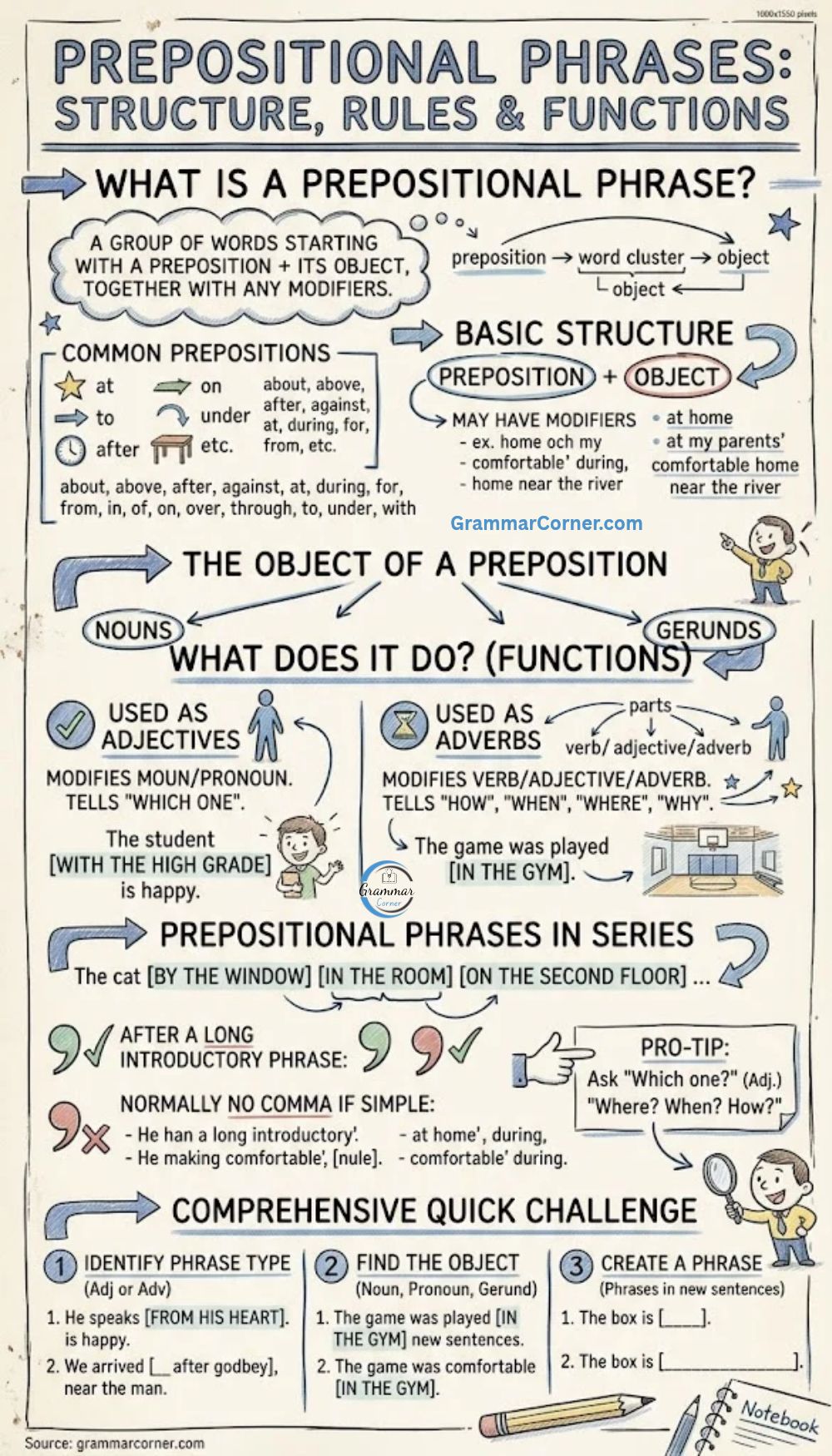
The prepositional phrase is used to tell someone where something happens, when it happens, how it happens, why it happens, or which person or thing we are talking about.
Common prepositions include:
- about, above, across, after, against, along, among, around, at
- before, behind, below, beneath, beside, between, beyond, by
- during, for, from, in, inside, into, near, of, off, on
- over, through, to, toward, under, until, up, with, within, without
Consider these sentences:
- The keys are on the table.
- We arrived after lunch.
- The woman in the blue dress is my teacher.
- He completed the work with great care.
The highlighted groups are all prepositional phrases. They add information to the sentence, but they do not normally express a complete thought by them.
Quick Challenge
Part A. Identify the prepositional phrase in each sentence. Tap an option to check your answer.
Correct — on the table begins with the preposition on and contains its object, table.
Correct — after lunch is a prepositional phrase. The preposition is after and its object is lunch.
Correct — in the blue dress is a prepositional phrase. It begins with the preposition in.
Correct — with great care begins with the preposition with and forms a prepositional phrase.
Correct — on the desk is a prepositional phrase. On is the preposition and desk is its object.
Correct — through the park is a prepositional phrase. It begins with the preposition through.
Structure of a Prepositional Phrase
The basic structure can be represented as:
Preposition + object of the preposition
For example:
on the chair
- on = preposition
- chair = object
However, the object can have modifiers:
on the old wooden chair
- on = preposition
- the old wooden chair = object phrase
- old, wooden = modifiers of the object
Another example:
with my younger brother
- with = preposition
- brother = object
- my, younger = modifiers
Therefore, a prepositional phrase does not necessarily contain only two words. It may be short or quite long.
Compare:
- at home
- at my home
- at my parents’ comfortable home
- at my parents’ comfortable home near the river
All four are prepositional phrases, although their length and complexity differ.
The Object of a Preposition
Consider:
The book is on the desk.
Here:
- on = preposition
- desk = object of the preposition
- on the desk = prepositional phrase
The object does not always have to be a single noun.
A Noun as the Object
She sat beside the window.
Window is the object of beside.
A Pronoun as the Object
This gift is for him.
Him is the object of for.
Notice that object pronouns are normally used after prepositions:
- for me
- with him
- between us
- to her
- from them
Not:
- for I
- with he
- between we
A Noun Phrase as the Object
She sat beside the large window.
The complete noun phrase the large window functions as the object of beside.
A Gerund as the Object
A gerund can also occur after a preposition:
He left without saying goodbye.
Here saying goodbye functions as the object of without.
This is why we normally say:
She is interested in learning English.
rather than:
She is interested in learn English.
After the preposition in, the gerund form learning is appropriate.
Prepositional Phrase Examples
Here are some straightforward examples:
| Sentence | Prepositional Phrase |
|---|---|
| The children are in the garden. | in the garden |
| He stood near the door. | near the door |
| We arrived after sunset. | after sunset |
| She walked through the park. | through the park |
| The letter is from my brother. | from my brother |
| They travelled by train. | by train |
| He worked with great patience. | with great patience |
| The shoes are under the bed. | under the bed |
The important point is that the prepositional phrase provides information about another word or part of the sentence.
What Does a Prepositional Phrase Do?
Prepositional phrases have several possible functions, but two major grammatical functions are especially important:
- They can function adjectivally, modifying a noun or pronoun.
- They can function adverbially, modifying a verb or, in some constructions, an adjective or adverb.
The same preposition can introduce either type.
Prepositional Phrases Used as Adjectives
A prepositional phrase functions as an adjective when it gives information about a noun or pronoun.
Consider:
The man in the black coat is my uncle.
Which man?
The man in the black coat.
The phrase in the black coat identifies or describes man, so it has an adjectival function.
More examples:
- The book on the table belongs to Sarah.
- The students from Class 10 won the competition.
- I met a woman with a beautiful voice.
- The road to the airport is crowded.
- The house near the river was sold yesterday.
In each sentence, the prepositional phrase tells us something about a noun.
A Simple Test
Ask:
Which one?
or
What kind?
For example:
The boy with the red bag is my brother.
Which boy?
The boy with the red bag.
Therefore, with the red bag is functioning adjectivally.
Prepositional Phrases Used as Adverbs
A prepositional phrase functions as an adverb when it provides information about an action or another element of the sentence.
It may tell us:
- where something happens
- when something happens
- how something happens
- why something happens
- under what circumstances something happens
For example:
The children played in the garden.
Where did they play?
In the garden.
Therefore, in the garden functions adverbially.
More examples:
We arrived after sunset.
When did we arrive? After sunset.
She spoke with confidence.
How did she speak? With confidence.
They stayed indoors because of the rain.
Why did they stay indoors? Because of the rain.
He lives near the university.
Where does he live? Near the university.
Adverbial Prepositional Phrases Can Express Different Meanings
Prepositional phrases used adverbially can provide several kinds of information.
Place
- The children are playing in the garden.
- She lives near the airport.
- The dog slept under the table.
Time
- We will meet after lunch.
- He arrived before noon.
- They stayed there during the summer.
Direction
- She walked toward the door.
- They travelled to Islamabad.
- The bird flew across the river.
Manner
- He completed the task with care.
- She answered the question without hesitation.
Cause or Reason
- He was tired from the long journey.
- The match was cancelled because of heavy rain.
Purpose
- She went to the library for research.
The exact interpretation depends on the context and the relationship created by the preposition.
Adjectival vs. Adverbial Prepositional Phrases
This distinction is one of the most important things to learn.
Compare these two sentences:
The students in the classroom are studying.
Here, in the classroom describes students. It answers: Which students? So it is adjectival.
The students are studying in the classroom.
Here, in the classroom tells us where they are studying. It answers: Where are they studying? So it is adverbial.
The words are almost identical, but their grammatical function changes according to what they modify.
Quick Challenge
Part A. Identify whether the bold phrase is adjectival or adverbial. Tap to check.
The man with the umbrella is my neighbour.
✅ Adjectival — modifies man.
The man walked with an umbrella.
✅ Adverbial — tells us how/with what he walked.
The keys on the desk are mine.
✅ Adjectival — modifies keys.
She left the keys on the desk.
✅ Adverbial — tells us where she left the keys.
Show Summary Answers
- Adjectival — modifies man.
- Adverbial — tells us how/with what he walked.
- Adjectival — modifies keys.
- Adverbial — tells us where she left the keys.
Where Can a Prepositional Phrase Appear?
A prepositional phrase can appear at the beginning, middle, or end of a sentence.
At the Beginning
- After the meeting, we went home.
- In the morning, I usually read the newspaper.
- During the holidays, the children visited their grandparents.
When a longer introductory prepositional phrase appears at the beginning of a sentence, a comma is often used to separate it from the main clause.
In the Middle
- The woman in the blue dress is my sister.
- The car outside the house belongs to my neighbour.
- The book on the top shelf is very old.
Here, the phrase is placed close to the noun it describes.
At the End
- We met after the meeting.
- She lives near the university.
- He put the bag under the chair.
The position often depends on what the phrase is modifying and what information the writer wants to emphasize.
Prepositional Phrases Can Be Long
There is no rule that says a prepositional phrase must be short.
Compare:
He sat near the window.
and:
He sat near the large window at the back of the old classroom.
The second sentence contains a much longer prepositional phrase structure.
Long phrases can make writing more informative, but they should be used carefully. If too many phrases are attached to one sentence, the reader may have difficulty determining which phrase modifies which word.
For example:
The painting on the wall in the hallway of the museum near the entrance was expensive.
This sentence is grammatically possible, but it contains several layers of information. A clearer version might be:
The painting on the wall of the museum’s main hallway was expensive.
Good grammar is not merely about making a sentence technically correct. It is also about making the relationship between ideas easy to understand.
Multiple Prepositional Phrases in One Sentence
A sentence can contain several prepositional phrases.
Consider:
The students in the classroom studied for three hours without a break.
There are three prepositional phrases:
- in the classroom — describes the students.
- for three hours — tells us how long they studied.
- without a break — adds information about the circumstances of the studying.
Another example:
The man at the door spoke with the officer about the incident.
Here, several relationships are expressed through prepositional phrases.
Multiple prepositional phrases are common in both everyday English and formal writing.
Prepositional Phrases Within Other Phrases
A prepositional phrase can sometimes contain another prepositional phrase.
For example:
The book on the table near the window is mine.
Here:
- on the table near the window describes the book.
- near the window gives additional information about the table.
This kind of structure is useful but can become confusing when too many phrases are stacked together.
When a sentence becomes difficult to follow, consider dividing it into two sentences or rearranging the phrases.
Common Prepositions Used in Prepositional Phrases
There are many prepositions in English. Some of the most common are:
Place
in, on, at, under, above, below, beside, behind, near, between, among, inside, outside, over
- in the room
- on the wall
- under the bed
- beside the car
- behind the house
Time
at, on, in, before, after, during, since, until, by, from
- at noon
- on Monday
- in July
- after dinner
- during the meeting
- since childhood
Direction and Movement
to, toward, into, onto, through, across, along, around, from, past
- to the market
- toward the station
- into the room
- across the road
- through the tunnel
Other Relationships
with, without, about, for, of, by, despite, against, except, regarding
- with my friends
- without permission
- about the problem
- for my brother
- despite the difficulties
Prepositional Phrases of Place
Prepositional phrases are frequently used to indicate location.
- The children are in the room.
- The keys are on the table.
- The car is behind the house.
- She sat beside her mother.
- The school is near the hospital.
Some prepositions of place have very specific meanings.
Compare:
- in the box — inside the box
- on the box — on its surface
- under the box — beneath it
- beside the box — next to it
- behind the box — at its rear
Choosing the correct preposition can therefore change the meaning of the entire sentence.
Prepositional Phrases of Time
Prepositional phrases are also widely used to indicate time.
- We arrived at noon.
- She was born in 1995.
- The meeting is on Monday.
- They left after dinner.
- He worked there for five years.
- She has lived here since 2020.
A useful distinction is:
At
Often used for specific times:
- at 5 p.m.
- at noon
- at midnight
On
Often used with days and dates:
- on Monday
- on Friday morning
- on 5 September
In
Often used with months, years, seasons, and longer periods:
- in July
- in 2026
- in winter
- in the morning
These are general patterns, and English contains exceptions and fixed expressions that must be learned separately.
Prepositional Phrases of Direction and Movement
Prepositions can show movement from one place to another.
- She walked to the station.
- The child ran into the room.
- They travelled across the country.
- He moved toward the door.
- We drove through the tunnel.
Notice the difference between location and movement:
He is in the room.
This tells us where he is.
He walked into the room.
This shows movement from outside to inside.
Prepositional Phrases and Phrasal Verbs
A prepositional phrase should not automatically be confused with a phrasal verb.
Compare:
She looked at the painting.
Here, at the painting is a prepositional phrase. The word at has an object: painting.
She looked up the word.
Here, up is functioning as part of the phrasal verb look up.
The distinction can sometimes be subtle, but one useful clue is that a true preposition normally introduces an object.
Compare:
- He walked through the door. (through has the object door, so through the door is a prepositional phrase.)
- He woke up. (There is no object after up. Here, up is functioning as a particle in the phrasal verb wake up.)
Prepositional Phrases and Adjective Phrases
You may encounter the term adjectival phrase or adjective phrase when discussing prepositional phrases.
A prepositional phrase is not automatically an adjective phrase simply because it contains an adjective.
Its grammatical function depends on what it modifies.
For example:
The woman with the red bag is my teacher.
The phrase with the red bag is prepositional in structure and adjectival in function because it modifies woman.
Similarly:
- The man from London arrived yesterday.
From London is a prepositional phrase functioning adjectivally.
Prepositional Phrases and Adverb Phrases
The same principle applies to adverbial use.
He worked with great concentration.
The phrase with great concentration is prepositional in structure but adverbial in function because it modifies the action worked.
This distinction is useful:
- Prepositional phrase describes the form or structure.
- Adjectival/adverbial function describes the job the phrase performs.
This is why the same type of phrase can have different grammatical functions.
Common Fixed Prepositional Expressions
English contains many expressions beginning with prepositions that are frequently used as fixed combinations.
Examples include:
- in fact, in general, in addition to, in charge of
- in time, on time, on purpose, on behalf of
- at first, at last, at least
- by accident, by mistake, for example, for instance
- out of order, out of date, under pressure, under control
- with regard to, without doubt
Some of these expressions function more like adverbials or idiomatic expressions than ordinary descriptive prepositional phrases. Nevertheless, learning common combinations helps learners use English more naturally.
Preposition + Gerund
One particularly important rule concerns gerunds.
When a preposition is followed by a verb, the verb normally takes the -ing form.
Examples:
- She is interested in learning English.
- He left without saying goodbye.
- They succeeded by working together.
- She improved her English through reading books.
Not:
She is interested in learn English.
Not:
He left without say goodbye.
Here, learning, saying, working, and reading function as objects of the respective prepositions.
Quick Challenge
Part A. Choose the correct form. Tap to check.
She is good at (speak / speaking) English.
✅ speaking — follows the preposition “at”.
He left without (say / saying) goodbye.
✅ saying — follows the preposition “without”.
They improved by (practice / practising) every day.
✅ practising — follows the preposition “by”.
Show Summary Answers
- speaking
- saying
- practising
Prepositional Phrases and Sentence Meaning
Changing a preposition can significantly change meaning.
Compare:
- The picture is on the wall.
- The picture is above the wall.
- The picture is beside the wall.
Likewise:
- He walked to the school.
- He walked from the school.
- He walked through the school.
- He walked around the school.
The preposition establishes the relationship, so choosing the correct one is essential.
This is especially important for English learners because prepositions often do not correspond directly to the prepositions used in other languages.
Common Errors with Prepositional Phrases
-
1. Using the Wrong Preposition
Incorrect: She is good in mathematics.
Correct: She is good at mathematics.
Some combinations must simply be learned as standard usage.
Other examples:
- interested in
- afraid of
- responsible for
- depend on
- listen to
- belong to
- arrive at a place
- arrive in a city or country
-
2. Using the Wrong Pronoun After a Preposition
Incorrect: This gift is for I.
Correct: This gift is for me.
Incorrect: She sat between he and I.
Correct: She sat between him and me.
Prepositions normally take object forms of pronouns.
-
3. Using a Base Verb After a Preposition
Incorrect: He left without say goodbye.
Correct: He left without saying goodbye.
Incorrect: She succeeded by work hard.
Correct: She succeeded by working hard.
-
4. Creating an Ambiguous Modifier
Consider:
The police arrested the man with the knife.
Who had the knife—the police or the man?
The sentence may be understood as saying that the man had the knife, but the construction can sometimes be ambiguous.
A clearer sentence might be:
The police arrested the man who was carrying a knife.
Good writing should not merely be grammatically acceptable; it should also make the intended meaning clear.
Avoiding Misplaced Prepositional Phrases
A prepositional phrase should be placed as close as practical to the word it modifies.
Consider:
She saw a man with a telescope.
This could mean:
- She used a telescope to see the man.
- The man had a telescope.
The sentence is grammatically possible but ambiguous.
A clearer version would be:
Using a telescope, she saw a man.
or:
She saw a man who was carrying a telescope.
This problem is sometimes described as a misplaced modifier or an ambiguous modifier.
Ending a Sentence with a Preposition
A traditional grammar rule sometimes taught learners says:
Never end a sentence with a preposition.
Modern English does not follow this as an absolute rule.
For example:
Who are you talking to?
This is natural English.
A more formal alternative is:
To whom are you talking?
Both are grammatically possible, although the second is considerably more formal.
Similarly:
What are you looking at?
is perfectly natural in ordinary English.
The important point is to consider context, style, and clarity rather than mechanically avoiding every sentence-final preposition.
Prepositional Phrase vs. Clause
A prepositional phrase should not be confused with a clause.
A clause normally contains a subject and a verb.
Compare:
After the meeting, we went home.
After the meeting is a prepositional phrase.
Now compare:
After the meeting ended, we went home.
After the meeting ended is a clause because it contains the subject the meeting and the verb ended.
This distinction matters when analyzing sentence structure.
Prepositional Phrase vs. Infinitive Phrase
The word to can sometimes cause confusion because it can function as either a preposition or part of an infinitive.
Compare:
She went to the market.
Here, to is a preposition and the market is its object.
But:
She wants to study.
Here, to study is an infinitive, not a prepositional phrase.
A useful test is to look at what follows to:
- to + noun/pronoun → often a preposition
- to + base verb → infinitive marker
For example:
- He went to school. (Prepositional phrase)
- He wants to study. (Infinitive phrase)
Prepositional Phrases in Formal Writing
Prepositional phrases are especially common in academic, legal, professional, and descriptive writing because they allow writers to express relationships precisely.
For example:
- The application for the grant was submitted before the deadline.
- The documents in the court file were examined during the hearing.
- The report from the investigation team was submitted to the committee.
However, formal writing should not become overloaded with prepositional phrases.
Too many phrases can make a sentence unnecessarily heavy:
The report of the committee on the investigation into the allegations against the officer regarding the incident at the office was submitted to the authority.
A clearer version may be:
The committee submitted its report on the allegations against the officer to the authority.
How to Identify a Prepositional Phrase
When you are asked to identify a prepositional phrase, follow these steps.
-
Step 1: Look for a preposition
Find words such as: in, on, at, by, for, from, with, under, over, after, before, between, among, through, without
-
Step 2: Find its object
Ask: Preposition + what? or Preposition + whom?
For example: The cat is under the table. Under what? The table. Therefore, under the table is the prepositional phrase.
-
Step 3: Include the modifiers
If the sentence says: The cat is under the large wooden table. The entire phrase is: under the large wooden table, not merely under the table.
-
Step 4: Determine its function
Ask what the phrase modifies. If it modifies a noun or pronoun, it is adjectival. If it provides information about an action or another element, it is adverbial.
Quick Challenge: Identify the Prepositional Phrases
Identify the prepositional phrase in each sentence and determine whether it is adjectival or adverbial.
Part 1: Function Analysis
The girl with the long hair is my cousin.
✅ Adjectival — modifies girl.
We waited at the bus stop.
✅ Adverbial — tells where they waited.
The books on the shelf belong to me.
✅ Adjectival — modifies books.
They arrived after the ceremony.
✅ Adverbial — tells when they arrived.
The man from Canada is a doctor.
✅ Adjectival — modifies man.
She completed the work with great care.
✅ Adverbial — tells how she completed the work.
The house near the river is very old.
✅ Adjectival — modifies house.
He walked through the narrow street.
✅ Adverbial — tells where/how he walked.
Show Complete Analysis Key
- with the long hair — adjectival; modifies girl.
- at the bus stop — adverbial; tells where they waited.
- on the shelf — adjectival; modifies books.
- after the ceremony — adverbial; tells when they arrived.
- from Canada — adjectival; modifies man.
- with great care — adverbial; tells how she completed the work.
- near the river — adjectival; modifies house.
- through the narrow street — adverbial; tells where/how he walked.
Quick Challenge: Find the Preposition and Its Object
Identify the preposition, object, and complete prepositional phrase.
The children played in the garden.
✅ Correct — in is the preposition, garden is its object, and the complete phrase is in the garden.
She spoke with her teacher.
✅ Correct — with is the preposition, teacher is its object, and the complete phrase is with her teacher.
The car behind the house is mine.
✅ Correct — behind is the preposition, house is its object, and the complete phrase is behind the house.
He left without saying goodbye.
✅ Correct — without is the preposition, and saying goodbye is its object. The complete phrase is without saying goodbye.
Show Complete Answer Key
- Preposition: in — Object: garden — Phrase: in the garden.
- Preposition: with — Object: teacher — Phrase: with her teacher.
- Preposition: behind — Object: house — Phrase: behind the house.
- Preposition: without — Object: saying goodbye — Phrase: without saying goodbye.
Quick Challenge: Choose the Correct Preposition
Choose the most appropriate preposition.
She is interested ___ learning English.
✅ b) in — the standard combination is interested in.
The book is ___ the table.
✅ a) on — indicates position on a surface.
He arrived ___ the airport early.
✅ a) at — used for a specific location or building.
They travelled ___ the tunnel.
✅ a) through — indicates movement from one side to the other.
She succeeded ___ working hard.
✅ a) by — indicates method or means.
Show Complete Answer Key
- b) in — She is interested in learning English.
- a) on — The book is on the table.
- a) at — He arrived at the airport early.
- a) through — They travelled through the tunnel.
- a) by — She succeeded by working hard.
Quick Challenge: Adjectival or Adverbial?
Determine the function of the bold prepositional phrase.
The woman in the red coat is a lawyer.
✅ Adjectival — modifies woman.
The woman walked in the red coat.
✅ Adverbial — describes how or with what she walked.
The students from Class 9 won the match.
✅ Adjectival — modifies students.
The students studied after school.
✅ Adverbial — tells when they studied.
The house on the corner has been sold.
✅ Adjectival — modifies house.
We waited on the corner.
✅ Adverbial — tells where they waited.
Show Complete Answer Key
- Adjectival — in the red coat modifies woman.
- Adverbial — in the red coat describes how or with what she walked.
- Adjectival — from Class 9 modifies students.
- Adverbial — after school tells when the students studied.
- Adjectival — on the corner modifies house.
- Adverbial — on the corner tells where they waited.
Why Are Prepositional Phrases Important?
Prepositional phrases may look like small grammatical structures, but they perform a major role in English.
They help us express:
- place — in the room
- time — after dinner
- direction — toward the station
- distance or position — near the house
- manner — with care
- cause — because of the rain
- purpose — for research
- association — with my friends
- description — the man in the blue shirt
Without prepositional phrases, many sentences would be much less precise.
Compare:
The children played.
with:
The children played in the park after school.
The first sentence gives us the basic action. The second tells us where and when it happened.
Frequently Asked Questions About Prepositional Phrases
-
What is a prepositional phrase?
A prepositional phrase is a group of words that begins with a preposition and includes its object and any words modifying the object. For example, “under the table” is a prepositional phrase. Here, under is the preposition and table is its object.
-
What are some examples of prepositional phrases?
Common examples include “in the room,” “on the table,” “after dinner,” “with my friends,” “under the bed,” “near the school,” and “through the tunnel.” These phrases provide additional information about place, time, direction, manner, or other relationships.
-
What are the parts of a prepositional phrase?
A prepositional phrase normally contains a preposition and an object of the preposition. The object may be accompanied by modifiers. For example, in “under the old wooden bridge,” “under” is the preposition, while “the old wooden bridge” is the object phrase.
-
What are the two main functions of prepositional phrases?
Prepositional phrases commonly function adjectivally or adverbially. An adjectival prepositional phrase modifies a noun or pronoun, while an adverbial prepositional phrase provides information about an action or another element of the sentence.
-
How can I tell whether a prepositional phrase is adjectival or adverbial?
Look at what the phrase modifies. If it describes a noun or pronoun, it is adjectival. If it gives information about an action, such as where, when, or how something happens, it is generally adverbial. For example, “the man in the blue shirt” contains an adjectival phrase because in the blue shirt describes man. In “He works in the office,” the phrase in the office tells us where he works and therefore has an adverbial function.
-
Can a prepositional phrase appear at the beginning of a sentence?
Yes. A prepositional phrase can appear at the beginning of a sentence (e.g., “After the meeting, we went home.”). An introductory phrase is often followed by a comma, particularly when it is relatively long or provides introductory information.
-
Can a sentence contain more than one prepositional phrase?
Yes. A sentence can contain several prepositional phrases, such as “The students in the classroom studied for three hours without a break.” Each phrase contributes different information to the sentence.
-
Can a prepositional phrase contain a gerund?
Yes. A gerund can function as the object of a preposition, such as in “She improved her English by reading books.” After a preposition, the -ing form is generally used when a verb follows.
-
Can “to” be a preposition?
Yes. To can function as a preposition when it is followed by a noun or pronoun (e.g., “She went to the market.”). However, to can also be an infinitive marker (e.g., “She wants to study.”). Therefore, not every expression beginning with to is a prepositional phrase.
-
Can a prepositional phrase modify a verb?
Yes. When a prepositional phrase gives information about an action, it can function adverbially, as in “They waited at the station.”
-
Can a prepositional phrase modify a noun?
Yes. A prepositional phrase can function adjectivally by modifying a noun, as in “The woman with the red bag is my teacher.”
-
What is the difference between a preposition and a prepositional phrase?
A preposition is a single word that establishes a relationship (e.g., in, on, under). A prepositional phrase contains the preposition together with its object and any necessary modifiers (e.g., under the table).
-
Are prepositional phrases always at the end of a sentence?
No. They can appear at the beginning, middle, or end of a sentence depending on what they modify and how the sentence is structured.
-
Can a prepositional phrase be a complete sentence?
Generally, no. A prepositional phrase is normally only one part of a sentence because it does not express a complete thought by itself.
-
What is the difference between a prepositional phrase and a clause?
A prepositional phrase does not normally contain a subject and a finite verb, whereas a clause contains a subject-verb relationship (e.g., “After the meeting” vs. “After the meeting ended”).
-
What are common mistakes involving prepositional phrases?
Common mistakes include using the wrong preposition, using the wrong pronoun after a preposition, placing a modifying phrase where its meaning becomes unclear, and using a base verb instead of a gerund after a preposition (e.g., ❌ She is interested in learn English. ✅ She is interested in learning English.).
-
Is it wrong to end a sentence with a preposition?
No. Ending a sentence with a preposition is not automatically grammatically incorrect. In everyday English, sentences such as “Who are you talking to?” are completely natural.
-
How can I identify a prepositional phrase in a sentence?
First, look for a preposition. Then identify the noun, pronoun, or noun-like expression connected to it, include any modifiers that belong to the object, and finally, determine what the complete phrase modifies.