Funny Phrases for Friends, Daily Life and Work
What Are Funny Phrases?
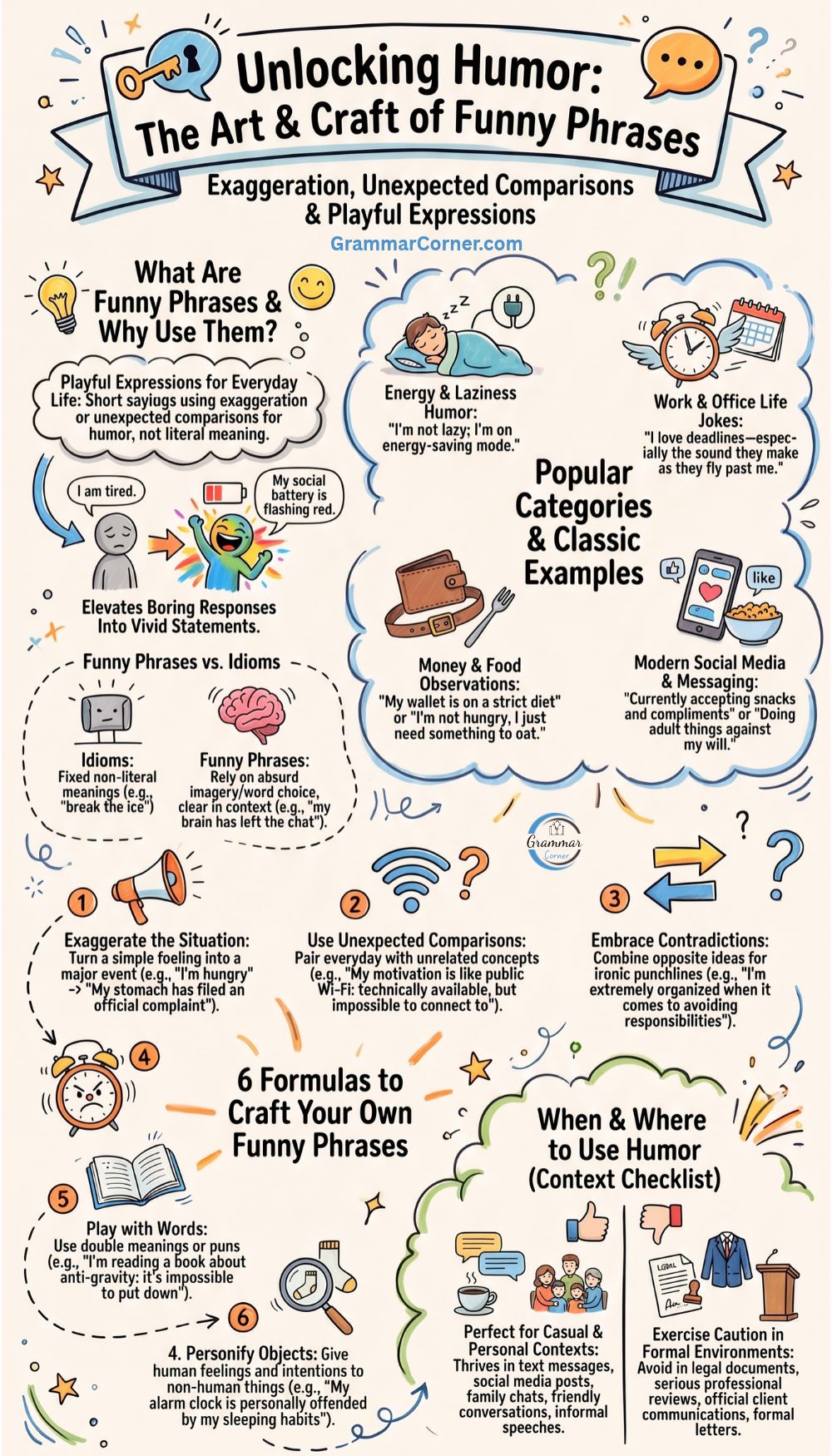
Funny phrases can be used in everyday conversations, text messages, social media posts, captions, speeches, and informal writing. Some are used to describe a person’s mood, while others make fun of common situations such as being tired, hungry, late, confused, or lazy.
For example:
I’m not lazy; I’m on energy-saving mode.
My brain has left the chat.
I need a six-month vacation, twice a year.
These phrases are not usually meant to be taken literally. Their humor comes from exaggeration or an unexpected comparison.
Why Do People Use Funny Phrases?
Funny phrases make ordinary conversations more interesting. Instead of giving a plain response, a person can use humor to express the same idea in a more memorable way.
For example, instead of saying:
“I am very tired.”
You could say:
“I’m running on one percent battery.”
The second sentence communicates the same basic idea but does it in a funnier and more vivid way.
Funny phrases can be useful because they:
- Make conversations more entertaining
- Help people express emotions creatively
- Make social media captions more engaging
- Break the ice in awkward situations
- Make messages sound friendly and relaxed
- Add personality to everyday communication
- Help speakers connect with an audience
- Make ordinary observations more memorable
Types of Funny Phrases
Funny phrases come in many forms. Understanding the different types can help you recognize and use them naturally.
Funny Phrases About Everyday Life
These phrases turn ordinary experiences into humorous observations.
“Adulting is just Googling how to do things you thought adults already knew.”
The humor comes from the contrast between what people expect adulthood to be and what it is actually like.
Funny Phrases About Food
Food provides endless opportunities for humor.
“I’m not hungry. I just need something to eat.”
The contradiction makes the phrase funny.
Funny Phrases About Work
Work-related humor is especially common in casual conversations and social media.
“I love deadlines. I especially love the sound they make as they fly past me.”
Funny Phrases About Sleep
People often use funny expressions to describe how much they love sleeping.
“Sleep is my favorite meeting.”
Funny Phrases About Laziness
These phrases exaggerate a person’s desire to avoid unnecessary effort.
“I’m not lazy. I’m selectively energetic.”
Funny Phrases About Money
Money-related jokes are another common source of funny expressions.
“My wallet and I are currently taking some time apart.”
Funny Phrases About Relationships
Relationship humor often relies on playful exaggeration.
“Behind every successful person is a surprised partner.”
Funny Phrases About Confusion
These phrases are useful when you do not understand what is happening.
“I understand nothing, but I’m enjoying the experience.”
50 Funny Phrases You Can Use in Everyday Conversation
Here are 50 funny phrases that can be used in casual conversations, messages, captions, and informal situations.
- I’m not lazy; I’m on energy-saving mode.
- My brain has left the chat.
- I need a six-month vacation, twice a year.
- I’m not arguing; I’m just explaining why I’m right.
- My wallet is on a strict diet.
- I came, I saw, I forgot what I was doing.
- I’m not late; everyone else is just early.
- My bed and I have a very serious relationship.
- I’m silently judging my own decisions.
- I need coffee before I can pretend to be productive.
- My plans sounded better when I was making them.
- I’m busy doing absolutely nothing.
- I have a lot of things to do, so naturally I’m taking a nap.
- I’m not ignoring you; I’m buffering.
- My attention span just went on vacation.
- I’m fluent in sarcasm.
- I’m trying to be normal, but it’s not working.
- My motivation and I are currently not on speaking terms.
- I followed my heart, and it led me to the refrigerator.
- I need a personal assistant for my personal assistant.
- I’m not confused; I’m exploring alternative possibilities.
- My brain is loading. Please wait.
- I have enough problems without adding a gym membership.
- I’m multitasking: I can waste time in several ways at once.
- My life needs a pause button.
- I’m not procrastinating; I’m waiting for inspiration.
- My cooking has two settings: edible and mysterious.
- I have a complicated relationship with mornings.
- I planned to be productive today, but then I remembered the internet exists.
- My social battery is flashing red.
- I’m just one snack away from happiness.
- My memory is excellent; I just forgot where I put it.
- I’m not talking to myself. I’m having a staff meeting.
- I need directions to my own life.
- I have reached my daily limit of responsible decisions.
- I’m allergic to unnecessary drama.
- My weekend disappeared faster than my salary.
- I don’t need an alarm; my responsibilities wake me up.
- I’m emotionally attached to my blanket.
- I’m not avoiding work; I’m giving it some space.
- My diet starts tomorrow, as usual.
- I have two moods: hungry and thinking about food.
- I’m trying to save money, but money keeps leaving me.
- My patience has officially left the building.
- I’m not short; I’m concentrated awesome.
- My room isn’t messy; everything is exactly where I left it.
- I’m an expert at making simple things complicated.
- I don’t need therapy; I need a beach and unlimited snacks.
- Today’s goal: survive without making it weird.
- I’m doing my best, and apparently my best needs a little improvement.
Funny Phrases for Friends
Friends are usually the easiest people with whom to use humorous expressions because casual conversations allow more freedom.
Here are a few examples:
- “You’re my favorite person to do absolutely nothing with.”
- “We don’t need a plan. We have confidence.”
- “Our friendship is mostly sending each other nonsense.”
- “You bring out the weird in me.”
- “We’re not getting older; we’re becoming classics.”
The best funny phrases between friends are usually playful rather than insulting. Know your audience before making a joke about someone’s appearance, habits, relationships, or personal life.
Funny Phrases for Text Messages
Funny phrases can make ordinary text messages much more entertaining.
Instead of:
“What are you doing?”
You could write:
“What kind of trouble are you getting into today?”
Instead of:
“I’m tired.”
Try:
“My battery is at 2%, and there’s no charger in sight.”
Instead of:
“I’m hungry.”
Try:
“My stomach has officially submitted a complaint.”
These expressions work particularly well in informal conversations because they sound natural and relaxed.
Funny Phrases for Social Media Captions
Funny phrases are popular in social media captions because a short humorous sentence can say a lot without requiring a long explanation.
Some examples include:
- “Currently accepting snacks and compliments.”
- “Life is short. Eat dessert first.”
- “Too glam to give a damn.”
- “I woke up like this. Unfortunately.”
- “Proof that I occasionally leave the house.”
- “Doing adult things against my will.”
- “Just pretending I know what I’m doing.”
- “Confidence level: accidentally sent the message to the wrong person.”
A good funny caption is usually short, easy to understand, and connected to the picture or situation.
Funny Phrases About Work and Office Life
Work can be stressful, so people often use humor to make it more bearable.
Here are some examples:
- “I’m not avoiding work; I’m strategically delaying it.”
- “My inbox has developed its own ecosystem.”
- “I work well under pressure, especially when the pressure is imaginary.”
- “Meetings: because emails weren’t complicated enough.”
- “I need a vacation from my vacation planning.”
- “Coffee: the unofficial office manager.”
- “I arrived at work, so technically I’ve already achieved something.”
These expressions are generally suitable for informal conversations with colleagues, but they may not be appropriate in formal emails or professional documents.
Funny Phrases About Being Tired
When someone is exhausted, a humorous phrase can communicate the feeling without sounding overly serious.
For example:
- “I’m tired enough to sleep through my own alarm.”
- “My eyes are open, but my brain is still asleep.”
- “I need sleep like plants need sunlight.”
- “I’m running on caffeine and questionable decisions.”
- “My energy has officially gone offline.”
Funny Phrases About Food
Food-related humor is almost universally relatable.
Try these expressions:
- “I’m not eating too much; I’m preparing for winter.”
- “Calories don’t count when nobody is watching.”
- “My favorite exercise is lifting food to my mouth.”
- “I followed my diet until I saw dessert.”
- “First we eat, then we figure out the rest.”
Funny Phrases About Money
Money humor often works because many people recognize the situation immediately.
For example:
- “I checked my bank account and decided to stay home.”
- “My money has a habit of disappearing.”
- “I’m financially responsible until I see something I like.”
- “My wallet needs emotional support.”
- “I’m not broke; I’m temporarily financially challenged.”
Funny Phrases About Laziness
Sometimes the easiest way to describe laziness is to exaggerate it.
- “I’m not lazy; I’m conserving energy.”
- “Why stand when you can sit?”
- “My motivation is currently unavailable.”
- “I’ll do it tomorrow. Tomorrow sounds productive.”
- “I’m taking a break from taking breaks.”
Funny Phrases About Mondays
Monday is a popular subject for jokes because it marks the beginning of the working week.
Some examples are:
- “Monday needs a weekend to recover from itself.”
- “It’s Monday again? That seems unnecessary.”
- “Dear Monday, we need to talk.”
- “Monday and I have unresolved issues.”
- “I survived Monday. Please respect my achievement.”
Funny Phrases About Being Late
Being late can be embarrassing, but humor can sometimes make the situation less awkward.
- “I’m not late. I’m making an entrance.”
- “I was ready on time; leaving was the difficult part.”
- “Time and I have different opinions.”
- “I’m operating on my own schedule.”
- “I apologize for my dramatic entrance.”
Of course, humor should not replace a genuine apology when being late causes someone inconvenience.
How to Create Your Own Funny Phrases
You do not have to memorize hundreds of expressions. You can also create your own funny phrases by using a few simple techniques.
-
1. Exaggerate the Situation
Take a normal situation and make it sound much bigger than it really is.
Normal: “I am very hungry.”
Funny: “My stomach is preparing a formal complaint.”
-
2. Use Unexpected Comparisons
Compare something ordinary with something completely unexpected.
“My motivation is like public Wi-Fi: technically available, but impossible to connect to.”
-
3. Use Contradictions
Contradictions can make a sentence surprisingly funny.
“I’m extremely organized when it comes to avoiding responsibilities.”
-
4. Give Human Qualities to Objects
Treat an object as if it has feelings or intentions.
“My alarm clock is personally offended by my sleeping habits.”
-
5. Use Wordplay
Wordplay involves using words in clever or unexpected ways.
“I’m reading a book about anti-gravity. It’s impossible to put down.”
-
6. Turn an Ordinary Observation Into a Joke
Look at something everyone experiences and describe it from a different angle.
“The fastest way to find something is to buy a replacement.”
This type of humor works because the situation is familiar to many people.
Funny Phrases vs. Idioms
Funny phrases are not necessarily idioms.
An idiom is an expression whose meaning cannot always be understood by looking at the individual words.
For example:
“Break the ice.”
This does not normally mean physically breaking ice. It means starting a friendly conversation or making people feel more comfortable.
A funny phrase, on the other hand, may have a literal meaning but still be humorous because of exaggeration or word choice.
“My brain has left the chat.”
The phrase is funny because the brain obviously cannot literally leave a conversation.
When Should You Use Funny Phrases?
Funny phrases are most appropriate in informal situations, such as:
- Conversations with friends
- Family chats
- Text messages
- Social media posts
- Casual emails
- Informal presentations
- Humorous speeches
- Online comments
However, humor should be used carefully in formal situations. A joke that works with a close friend may not work with a manager, client, teacher, judge, or professional audience.
Always consider the person, situation, relationship, and subject before using a humorous expression.
How to Use Funny Phrases Naturally
A funny phrase works best when it fits the situation. Avoid adding humor simply because you have memorized a funny expression.
For example, if your friend says:
“I have been studying for five hours.”
You might respond:
“Congratulations. Your brain deserves a vacation.”
The phrase feels natural because it directly relates to what your friend said.
Good humor should feel like part of the conversation rather than something forced into it.
Funny Phrases vs. Funny Sayings
The terms funny phrases and funny sayings are sometimes used interchangeably, but there is a small difference.
A funny phrase can be any humorous expression used in a particular situation.
“My brain is still loading.”
A funny saying is often a more established expression that people repeat because it contains humor, irony, or a clever observation.
“I’m not arguing; I’m just explaining why I’m right.”
In everyday English, however, there is considerable overlap between the two.
Practice Exercise 1: Choose the Best Funny Phrase
Choose the phrase that best completes each sentence.
Select the correct choice
1. You have been working all day and feel exhausted. You say:
A. My brain is on vacation.
B. I am buying a new car.
C. The weather is beautiful.
✅ A — Communicates exhaustion playfully.
2. Your friend asks why you are late. You reply:
A. I am making an entrance.
B. I am very hungry.
C. I love Mondays.
✅ A — A humorous way to address being late.
3. You check your bank account and have very little money. You say:
A. My wallet is on a strict diet.
B. My brain has left the chat.
C. I need directions.
✅ A — Uses financial humor for low funds.
4. You are extremely hungry. You say:
A. My stomach has officially submitted a complaint.
B. My alarm clock is angry.
C. I am not late.
✅ A — Exaggerates hunger effectively.
5. Someone asks why you are not working. You say:
A. I am strategically delaying it.
B. My wallet is rich.
C. I love waking up early.
✅ A — A witty response about work avoidance.
Answers: A, A, A, A, A
Practice Exercise 2: Make the Sentences Funny
Rewrite each ordinary sentence as a funny phrase.
1. I am very tired.
2. I am hungry.
3. I am late.
4. I have no money.
5. I do not understand what is happening.
Sample Answers:
- 1. My battery is at one percent.
- 2. My stomach has filed an official complaint.
- 3. I’m not late; I’m making an entrance.
- 4. My wallet is on a strict diet.
- 5. My brain has left the chat.
Frequently Asked Questions About Funny Phrases
-
What are funny phrases?
Funny phrases are humorous expressions that make people laugh or smile. They often use exaggeration, irony, wordplay, unexpected comparisons, or contradictions.
-
Where can I use funny phrases?
You can use them in casual conversations, text messages, social media captions, comments, speeches, and informal writing. They should generally be avoided when a serious or highly formal tone is required.
-
What makes a phrase funny?
A phrase can be funny because it is unexpected, exaggerated, ironic, clever, relatable, or based on wordplay. Timing and context also play an important role.
-
Are funny phrases the same as jokes?
Not exactly. A joke usually has a setup and a punchline, while a funny phrase can be a single humorous expression without a full joke.
-
Can I use funny phrases in professional communication?
It depends on the workplace and the person receiving the message. Light humor may be appropriate in a friendly workplace, but formal letters, official documents, legal writing, and serious professional communication generally require a more restrained tone.
-
How can I make my own funny phrases?
Start with an ordinary situation and exaggerate it, use an unexpected comparison, create a contradiction, personify an object, or play with words. The closer the phrase is to a familiar experience, the more relatable it is likely to be.
-
Are funny phrases appropriate for children?
Many funny phrases are suitable for children, especially simple expressions involving food, school, animals, sleep, and everyday activities. However, humor should always be age-appropriate.
-
Can funny phrases improve my English?
Yes. Learning funny phrases can help you understand informal English, conversational expressions, humor, wordplay, and cultural references. They can also make your spoken English sound more natural when used appropriately.