Common Phrases: Useful Phrases for Everyday Conversation
What Are Common English Phrases?
In real conversations, people use familiar combinations of words again and again. These combinations are known as common English phrases.
Learning common phrases provides you ready-made language that you can use in everyday situations. Instead of thinking about every word separately, you begin to recognize useful patterns and use them naturally.
For example, instead of learning only the word recommend, you can learn the complete expression:
What would you recommend?
You can then adapt the pattern:
- What would you recommend for dinner?
- What would you recommend for a beginner?
- What would you recommend I visit?
Some phrases are complete expressions
- Thank you very much.
- I’m not sure.
- That sounds good.
- See you later.
Others work as sentence patterns
- I’d like to …
- I’m looking for …
- Could you please …?
- I’m interested in …
- It depends on …
These patterns are particularly useful because you can replace one part of the expression to create many different sentences.
For example:
- I’m looking for a hotel.
- I’m looking for my keys.
- I’m looking for a new job.
- I’m looking for an English course.
Quick Challenge
Part A. Is each phrase below a complete phrase or a sentence pattern? Tap an option to check your answer.
This is correct — nothing changes; you use it exactly as it is.
This is correct — you fill the slot: I’d like to order a coffee.
This is correct — you fill the slot: It depends on the weather.
This is correct — a ready-made response used word for word.
This is correct — you fill the slot: Could you please repeat that?
This is correct — a fixed farewell used exactly as written.
Part B. Complete each sentence pattern with your own words. Then check the sample answers below.
- I’m looking for ___________.
- I’m interested in ___________.
- I’d like to ___________.
Show sample answers
Many answers are possible. Here are some examples:
- I’m looking for a good restaurant near here.
- I’m interested in learning Spanish.
- I’d like to order a coffee, please.
Why Are Common English Phrases Important?
Knowing common phrases can make English communication easier for several reasons.
-
They make speaking easier
You do not have to construct every sentence from the beginning. Familiar expressions can come to mind more quickly.
-
They improve conversational fluency
Fluent speakers naturally use recurring expressions. Learning these expressions helps your speech sound more natural.
-
They improve listening skills
When you recognize frequently used phrases, spoken English becomes easier to follow.
-
They make communication more practical
You can learn expressions specifically for situations you actually encounter, such as shopping, traveling, studying, working, or meeting new people.
-
They build confidence
Having a collection of useful phrases gives you something reliable to use when you are unsure what to say.
Common English Phrases for Daily Conversation
1. Common Greetings
These expressions are useful when beginning a conversation.
- Hello!
- Hi!
- Good morning.
- Good afternoon.
- Good evening.
- How are you?
- How’s everything?
- How have you been?
- How’s your day going?
- Nice to see you.
Example
A: Good morning. How’s your day going?
B: Pretty well, thanks. How about yours?
2. Introducing Yourself
Use these expressions when meeting someone for the first time.
- My name is…
- I’m…
- I’m pleased to meet you.
- Nice to meet you.
- It’s a pleasure to meet you.
- I don’t think we’ve met before.
- Let me introduce myself.
- I’d like to introduce myself.
Example
Hi, I’m Daniel. I don’t think we’ve met before.
3. Introducing Other People
When introducing someone else, you can say:
- This is my friend, Sarah.
- I’d like you to meet John.
- Have you met David?
- Let me introduce you to my colleague.
- I’d like you to meet my brother.
Example
I’d like you to meet my colleague, Maria.
4. Asking How Someone Is
Instead of always using How are you?, you can use:
- How are things?
- How’s life?
- How’s everything going?
- How have things been?
- What have you been up to?
- How are you doing?
- How’s your family?
Possible answers include:
- I’m doing well.
- I’m pretty good.
- I’m great, thanks.
- Not too bad.
- I’ve been better.
- I’m doing okay.
5. Common Phrases for Small Talk
Small talk helps people begin and maintain casual conversations.
- What have you been doing lately?
- How was your weekend?
- How was your day?
- Did you have a good weekend?
- What are you up to today?
- Have you been busy lately?
- How’s work going?
- How’s everything at home?
- What’s new?
- Anything interesting happening?
6. Saying Thank You
Showing appreciation is an essential part of polite English.
- Thank you.
- Thanks.
- Thanks a lot.
- Thank you so much.
- I really appreciate it.
- I appreciate your help.
- That’s very kind of you.
- Thanks for your help.
- I can’t thank you enough.
- That’s really helpful.
Example
Thanks for helping me with this. I really appreciate it.
7. Responding to Thanks
When someone thanks you, you can reply:
- You’re welcome.
- You’re very welcome.
- No problem.
- No worries.
- My pleasure.
- Anytime.
- Glad I could help.
- Don’t mention it.
- Happy to help.
8. Common Phrases for Apologizing
Use these expressions when you make a mistake or inconvenience someone.
- I’m sorry.
- I’m really sorry.
- Sorry about that.
- I apologize.
- Please forgive me.
- It was my fault.
- I didn’t mean to do that.
- I should have told you earlier.
- I’m sorry for the delay.
- I hope you can forgive me.
Example
I’m sorry for the delay. I should have informed you earlier.
9. Responding to an Apology
You can respond to an apology with:
- That’s okay.
- It’s all right.
- No problem.
- Don’t worry about it.
- It happens.
- Forget about it.
Choose your response according to the seriousness of the situation.
10. Asking for Help
These phrases are useful when you need assistance.
- Can you help me?
- Could you help me?
- Could you give me a hand?
- Can you help me with this?
- Would you mind helping me?
- Could you do me a favor?
- Can I ask you a favor?
- Do you have a minute?
Example
Could you give me a hand with these files?
11. Making Polite Requests
The way you make a request can affect how polite you sound.
- Could you please…?
- Would you please…?
- Can you please…?
- Would you mind…?
- Could I ask you to…?
- Would it be possible to…?
- I’d appreciate it if you could…
Examples
Could you please send me the document?
Would you mind opening the window?
I’d appreciate it if you could reply soon.
12. Asking for Information
Use these expressions when you need information.
- Can you tell me…?
- Could you tell me…?
- Do you know…?
- Would you happen to know…?
- Do you have any idea…?
- I’d like to know…
- Could you explain…?
- I was wondering if you could…
Example
Could you tell me when the meeting starts?
13. Asking Someone to Repeat Something
You will often need clarification when speaking English.
- Could you repeat that?
- Could you say that again?
- Sorry, I didn’t hear you.
- Could you speak more slowly?
- What did you say?
- Could you explain that again?
- What do you mean?
- I’m not sure I understand.
Example
I’m not sure I understand. Could you explain that again?
14. Saying You Don’t Know
Instead of repeating I don’t know, try:
- I’m not sure.
- I have no idea.
- I really don’t know.
- I’m not certain.
- I can’t say for sure.
- I’m afraid I don’t know.
- I’ll have to check.
- Let me find out.
15. Expressing an Opinion
These phrases help you introduce your personal view.
- I think…
- I believe…
- In my opinion…
- Personally, I think…
- From my point of view…
- The way I see it…
- As far as I’m concerned…
- I’d say…
- It seems to me that…
- If you ask me…
Example
In my opinion, students learn better when they practice regularly.
16. Agreeing With Someone
Use these expressions when you share someone’s opinion.
- I agree.
- Exactly.
- Absolutely.
- That’s true.
- You’re right.
- I completely agree.
- That’s a good point.
- I couldn’t agree more.
- That’s exactly what I think.
17. Disagreeing Politely
Disagreement does not have to sound aggressive.
- I don’t think so.
- I’m not sure I agree.
- I see your point, but…
- I understand what you mean, but…
- I’m afraid I disagree.
- I see things differently.
- I’m not convinced.
- I’m not so sure about that.
Example
I see your point, but I think there is another way to look at it.
18. Expressing Likes and Dislikes
Use these phrases to talk about your preferences.
- I like…
- I really like…
- I love…
- I’m interested in…
- I’m really into…
- I’m not a big fan of…
- It’s not really my thing.
- I don’t particularly like…
- I can’t stand…
Example
I’m not a big fan of horror movies.
19. Making Suggestions
When you want to propose an idea, try:
- How about…?
- What about…?
- Why don’t we…?
- Maybe we should…
- We could…
- I’d suggest…
- I’d recommend…
- Have you considered…?
Example
How about meeting at the library tomorrow?
20. Accepting a Suggestion
You can respond with:
- That sounds good.
- Sounds great.
- That’s a good idea.
- I’d be happy to.
- Sure, why not?
- That works for me.
- I’m okay with that.
21. Inviting Someone
Use these expressions to invite someone somewhere.
- Would you like to join us?
- Do you want to come with us?
- Would you like to go out?
- Are you free this evening?
- Are you doing anything on Saturday?
- Would you like to have dinner with us?
- Why don’t you join us?
22. Accepting an Invitation
Useful responses include:
- I’d love to.
- That sounds great.
- Sure, I’d love to.
- I’d be happy to join you.
- That would be wonderful.
- Count me in.
23. Politely Refusing an Invitation
You do not always have to say a direct no.
- I’d love to, but I can’t.
- I’m sorry, I’m busy that day.
- Unfortunately, I can’t make it.
- Maybe another time.
- I’m afraid I won’t be able to come.
- Let me check my schedule first.
24. Talking About Work
These phrases are useful when discussing occupations and employment.
- What do you do?
- What do you do for a living?
- Where do you work?
- I work as a…
- I work for…
- I work in…
- I’m looking for a job.
- I’m currently unemployed.
- I work from home.
- I’m self-employed.
Example
What do you do for a living?
I work as an accountant.
25. Talking About Your Daily Routine
Common sentence patterns include:
- I usually wake up at…
- I normally have breakfast at…
- I go to work at…
- I spend most of my day…
- I usually get home around…
- I go to bed at…
- I rarely…
- I often…
- I sometimes…
- I usually…
26. Talking About the Past
Useful expressions include:
- Yesterday, I…
- Last week, I…
- A few days ago, I…
- When I was younger…
- I used to…
- I remember when…
- A long time ago…
- The last time I…
Example
When I was younger, I used to play football every weekend.
27. Talking About the Future
You can talk about plans and expectations with:
- I’m going to…
- I’m planning to…
- I hope to…
- I’d like to…
- I’m thinking about…
- I might…
- I may…
- I’m looking forward to…
- I expect to…
Example
I’m planning to start an English course next month.
28. Talking About Feelings
Use these expressions to describe your emotional state.
- I’m happy.
- I’m excited.
- I’m worried.
- I’m nervous.
- I’m disappointed.
- I’m tired.
- I’m exhausted.
- I’m confused.
- I’m upset.
- I’m feeling much better.
- I’m not feeling very well.
29. Giving Advice
When someone asks for advice, these structures are useful:
- You should…
- You shouldn’t…
- Maybe you should…
- If I were you, I’d…
- I’d recommend…
- Why don’t you…?
- Have you thought about…?
- It might be better to…
Example
If I were you, I’d talk to your teacher about the problem.
30. Common Phrases for Shopping
Shopping requires several useful expressions.
- I’m looking for…
- Where can I find…?
- How much is this?
- How much does this cost?
- Do you have this in another size?
- Do you have another color?
- Can I try this on?
- Is this on sale?
- I’ll take it.
- Can I pay by card?
31. Common Phrases at a Restaurant
Useful restaurant expressions include:
- Do you have a table for two?
- I’d like to order…
- Could I see the menu?
- What do you recommend?
- What are today’s specials?
- Could I have some water, please?
- Could we have the bill, please?
- Can I pay by card?
- Could I have this to take away?
- There’s a problem with my order.
32. Common Phrases for Travel
When traveling, you may need to ask about transportation, accommodation, or directions.
- Where is the nearest station?
- How do I get to the airport?
- Where can I buy a ticket?
- How much is a ticket?
- What time does the train leave?
- Which platform do I need?
- Is this the right bus?
- Where is the check-in desk?
- Has the flight been delayed?
- Where can I collect my luggage?
33. Common Phrases for Asking Directions
If you are unfamiliar with an area, these expressions are useful:
- Excuse me, where is the bank?
- How can I get there?
- Could you tell me how to get to the station?
- Is there a supermarket nearby?
- Is it far from here?
- How long does it take to walk there?
- Should I turn left here?
- Am I going in the right direction?
34. Common Phrases for Telephone Conversations
Telephone English often uses slightly different expressions.
- Hello, this is…
- May I speak to…?
- I’m calling about…
- I’m returning your call.
- Could you hold for a moment?
- I’ll put you through.
- Can I leave a message?
- Could you call me back?
- I’ll call you later.
- Thanks for calling.
35. Common Phrases for Complaining
A complaint can be direct while remaining polite.
- There’s a problem with…
- I’m afraid there’s been a mistake.
- This isn’t what I ordered.
- I’m not satisfied with…
- Could you please look into this?
- Could you explain what happened?
- I’d like to make a complaint.
- Could you please resolve this issue?
Example
I’m afraid there’s been a mistake with my order. Could you please check it?
36. Common Phrases for Encouragement
Use encouraging expressions when someone is struggling.
- You can do it.
- Keep going.
- Don’t give up.
- Keep trying.
- You’re doing well.
- You’re getting better.
- Keep up the good work.
- Give it your best shot.
- You’ve got this.
- Don’t lose hope.
37. Common Phrases for Being Late
If you arrive late, you can explain the situation politely.
- Sorry I’m late.
- I’m sorry for keeping you waiting.
- I got stuck in traffic.
- I couldn’t find a parking space.
- My train was delayed.
- I lost track of time.
- I had an unexpected problem.
- I’ll try not to be late again.
38. Common Phrases for Decisions
When you need time to decide, use:
- Let me think about it.
- I need some time to decide.
- I’m not sure yet.
- I’m still considering my options.
- I’m having second thoughts.
- I’ve changed my mind.
- I’ve made my decision.
- It’s up to you.
39. Common Phrases for Certainty and Uncertainty
When you are certain
- I’m sure.
- I’m absolutely certain.
- I have no doubt.
- I’m convinced.
- There’s no question about it.
When you are uncertain
- I’m not sure.
- It’s possible.
- It might happen.
- There’s a chance.
- I can’t say for certain.
- It seems likely.
- It’s unlikely.
40. Common Phrases for Ending a Conversation
Ending a conversation politely is an important conversational skill.
- It was nice talking to you.
- It was great seeing you.
- I should get going.
- I have to get back to work.
- I’d better be going.
- I’ll talk to you later.
- See you soon.
- Take care.
- Have a great day.
- See you next time.
Common English Phrases for Talking About Health and Well-Being
- I’m not feeling well.— I am feeling sick or unwell.
- I feel much better now.— My health has improved.
- I have a headache.— My head hurts.
- I’m feeling a little tired.— I have low energy.
- Take care of yourself.— A friendly way to express concern.
- Get some rest.— Advice to relax and recover.
- I need to see a doctor.— I need medical attention.
- How are you feeling today?— Asking about someone’s health.
- I’m feeling under the weather.— I am slightly ill.
- I hope you feel better soon.— A kind expression for someone who is sick.
Common English Phrases for Talking About Family and Relationships
- How is your family?— Asking about someone’s family.
- I’m close to my family.— Having a strong relationship with family members.
- We get along very well.— We have a good relationship.
- We don’t always agree.— We sometimes have different opinions.
- I haven’t seen him in a while.— It has been some time since the last meeting.
- We’ve known each other for years.— We have known one another for a long time.
- Please give my regards to your family.— A polite way to send greetings.
- We keep in touch regularly.— We communicate with each other often.
- I’m happy for you.— Expressing happiness about another person’s situation.
- That means a lot to me.— Saying that someone’s words or actions are important to you.
Common English Phrases for Talking About Weather and Seasons
- It’s a beautiful day.— The weather is pleasant.
- It’s getting colder.— The temperature is falling.
- It’s really hot today.— The temperature is high.
- It looks like rain.— Rain seems likely.
- It’s raining heavily.— There is a lot of rain.
- The weather is changing.— Weather conditions are becoming different.
- It’s quite humid today.— There is a lot of moisture in the air.
- I love this kind of weather.— Expressing a preference for particular weather.
- The weather has been unpredictable lately.— The weather has been changing unexpectedly.
- I hope it clears up soon.— Hoping that bad weather will end.
Common English Phrases for Technology and the Internet
- My phone is about to die.— The phone battery is almost empty.
- Can you send it to me?— Asking someone to send a file, message, or other information.
- I’ll send you the link.— Offering to share a webpage or online resource.
- The internet is really slow.— The internet connection is working slowly.
- I can’t connect to the Wi-Fi.— Unable to establish a Wi-Fi connection.
- Can you check your messages?— Asking someone to look at their messages.
- I’ll call you on video.— Saying that you will make a video call.
- The app isn’t working.— An application is not functioning properly.
- I’ll download it later.— Saying that you will save something from the internet later.
- Can you send me a screenshot?— Asking someone to send an image of what appears on their screen.
Common English Phrases for Celebrations and Special Occasions
- Congratulations!— Used to celebrate someone’s achievement or good news.
- Happy birthday!— A greeting for someone’s birthday.
- Have a wonderful day!— A friendly wish for someone’s day.
- Best wishes!— A general expression of good wishes.
- I’m so happy for you.— Expressing happiness about someone’s good news.
- Enjoy the celebration!— Encouraging someone to enjoy a special event.
- Have a great time!— Wishing someone an enjoyable experience.
- That’s wonderful news!— Showing happiness or excitement about news.
- I wish you all the best.— Expressing sincere good wishes.
- Let’s celebrate!— Suggesting that people celebrate an achievement or special event.
Common English Sentence Patterns
Learning individual phrases is useful, but learning patterns can be even more powerful.
“I’d like to…”
Use this when expressing a desire or making a polite request.
- I’d like to speak to the manager.
- I’d like to learn Spanish.
- I’d like to make an appointment.
“I’m interested in…”
Use this to talk about something that attracts your attention.
- I’m interested in photography.
- I’m interested in taking an English course.
“I’m looking for…”
Use this when searching for something.
- I’m looking for a hotel.
- I’m looking for a new apartment.
- I’m looking for my phone.
“I’m thinking about…”
Use this when considering an idea or possibility.
- I’m thinking about changing jobs.
- I’m thinking about buying a new computer.
“Would you mind…?”
This is a useful polite request structure.
- Would you mind closing the door?
- Would you mind waiting for a few minutes?
“If I were you…”
Use this pattern when giving advice.
- If I were you, I’d wait.
- If I were you, I’d talk to your manager.
“It depends on…”
Use this when the answer changes according to circumstances.
- It depends on the weather.
- It depends on how much time we have.
“I’m not sure if…”
Use this when you are uncertain about something.
- I’m not sure if I can come.
- I’m not sure if that’s correct.
Formal and Informal English Phrases
English has different levels of formality. A phrase that sounds perfectly natural with a friend may not be suitable in a job interview or formal email.
| More formal | More casual |
|---|---|
| How are you? | What’s up? |
| I apologize. | Sorry about that. |
| Could you help me? | Can you help me out? |
| I have to leave. | I’ve got to go. |
| Please wait a moment. | Hang on a second. |
| I do not know. | I have no idea. |
| Would you like to…? | Do you want to…? |
| I agree. | Exactly! |
The important lesson is not that one form is always better than the other. Context determines which expression is appropriate.
Common Mistakes When Using English Phrases
-
1. Translating directly from your first language
A phrase that sounds natural in another language may sound strange when translated word for word into English.
Learn commonly used English expressions as complete patterns.
-
2. Using informal phrases in formal situations
Words such as gonna, wanna, gotta, and highly casual expressions may be appropriate among friends but should generally be avoided in formal academic or professional writing.
-
3. Memorizing phrases without understanding them
Do not learn a phrase merely because it appears on a list. Understand:
- what it means
- when to use it
- whether it is formal or informal
- what words can replace parts of it
- how it sounds in natural speech
-
4. Learning too many phrases at once
Trying to memorize hundreds of expressions in a single day is usually ineffective.
Choose a small group, practice them, and return to them regularly.
-
5. Learning phrases without speaking them
If your goal is better speaking, read phrases aloud. Practice them in short conversations and create your own examples.
How to Memorize Common English Phrases
A good learning strategy is more important than simply collecting long lists.
-
Learn phrases by topic
Study restaurant phrases together, travel phrases together, and workplace phrases together.
-
Learn phrases in groups
For example, learn the entire sequence: Could you please…?, Would you mind…?, I’d appreciate it if…. This helps you understand different ways of making requests.
-
Create personal examples
If you learn I’m looking forward to…, make sentences about your own life: I’m looking forward to the weekend. I’m looking forward to my vacation.
-
Practice aloud
Read the phrase, cover the text, and try to say it from memory.
-
Use spaced repetition
Review new phrases after a day, then several days later, and again after a longer interval.
-
Practice both questions and answers
Do not only learn Where do you work?. Also learn possible responses: I work at a bank. This helps you prepare for actual conversations.
How Many English Phrases Should You Learn Every Day?
There is no fixed number that works for everyone.
For beginners, five to ten useful phrases per day can be a practical starting point. The important thing is not the number of phrases but whether you can remember and use them.
Learning ten phrases that you can confidently use is much more valuable than reading 100 phrases and forgetting most of them.
How to Use Common Phrases in Real Conversations
Suppose you have learned:
What do you recommend?
Don’t stop after memorizing the sentence.
Use it in different contexts:
At a restaurant: What do you recommend?
At a hotel: What restaurant would you recommend?
When learning English: What book would you recommend?
This technique turns one phrase into a flexible communication tool.
Practice Exercises: Test Your Knowledge of Common English Phrases
Learning common English phrases is easier when you actively use them. Try these three exercises without looking at the answers first.
Exercise 1: Fill in the Blanks
Complete each sentence with the most suitable phrase from the box.
Phrases Bank
By theway · How about · I have no idea · It’s up to you · Are you sure · I’m looking forward to
- __________ meeting you next week.
- __________ what time the shop closes.
- __________ taking a short break before we continue?
- __________ that you locked the door?
- We can go by bus or taxi. __________.
- __________, did you hear about Sarah’s new job?
Exercise 2: Choose the Best Response
Choose the phrase that best completes each conversation.
1. A: Would you like some coffee?
B: __________
✅ b) Yes, please — standard polite acceptance.
2. A: I’m sorry I’m late.
B: __________
✅ a) That’s all right. — standard response to an apology.
3. A: Why don’t we meet after work?
B: __________
✅ a) That sounds good. — accepts a suggestion positively.
4. A: Could you explain that again?
B: __________
✅ a) Sure, no problem. — agrees to repeat or clarify.
5. A: I don’t think this plan will work.
B: __________
✅ a) I see your point. — acknowledges another person’s perspective.
Show Complete Answer Key
Exercise 1
- I’m looking forward to
- I have no idea
- How about
- Are you sure
- It’s up to you
- By the way
Exercise 2
- b) Yes, please
- a) That’s all right.
- a) That sounds good.
- a) Sure, no problem.
- a) I see your point.
Frequently Asked Questions About Common English Phrases
-
What are common English phrases?
Common English phrases are groups of words that people frequently use together in everyday communication. They may be complete expressions or reusable sentence patterns.
-
What are the most useful English phrases for beginners?
Beginners should start with expressions for greetings, introductions, requests, thanks, apologies, clarification, shopping, food, directions, and everyday conversation.
-
How can I speak English more naturally?
Learn frequently used phrases rather than studying only individual vocabulary words. Practice them aloud, listen to natural English, and use the phrases in different situations.
-
Is it better to learn words or phrases?
Both are important. Individual words increase your vocabulary, while phrases show you how words are naturally combined in communication.
-
How many phrases should I learn each day?
Start with around five to ten phrases and focus on remembering and using them. Quality and regular practice are more important than the number you study.
-
Should I memorize English phrases?
Yes, but don’t memorize them mechanically. Understand their meaning, pronunciation, grammatical pattern, and appropriate context.
-
What is the difference between a phrase and a sentence?
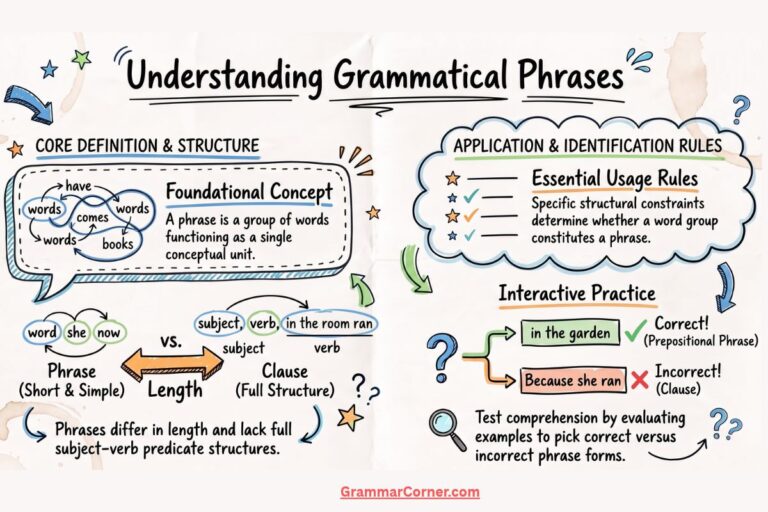
A phrase is a group of words that may not express a complete thought, while a sentence normally contains a complete idea. For example, “after work” is a phrase, while “I’ll call you after work” is a complete sentence.
-
Are common English phrases useful for speaking tests?
Yes. Useful phrases can help you organize answers, express opinions, explain ideas, agree or disagree, and respond more naturally during speaking examinations.
-
How can I remember phrases for a long time?
Use active recall, repetition, speaking practice, and personal examples. Try using each new phrase in several different sentences.