Phrases with Get (Meaning & Examples)
The verb get appears everywhere in spoken and written English. It can describe receiving something, becoming something, reaching a place, understanding an idea, or dealing with a situation. It also forms a huge number of phrasal verbs and idiomatic expressions.
For English learners, get can be confusing because its meaning often changes completely when another word is added. For example, get up means to rise, get over means to recover from something, and get along means to have a good relationship.
Here are some of the most useful phrases with get, organized by meaning and situation.
Everyday Phrases With Get
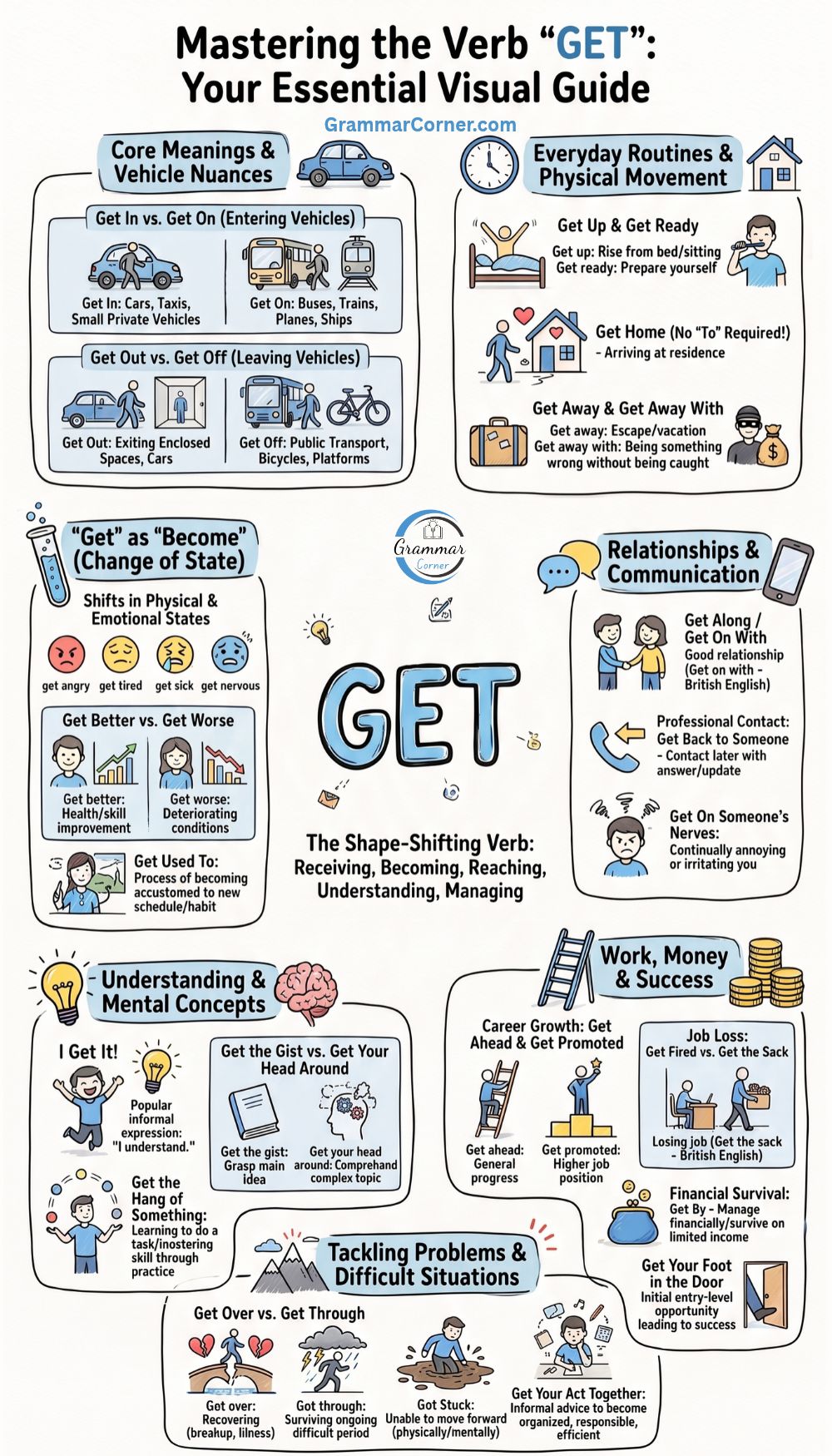
Get up
Meaning: To rise from a bed or sitting position.
“I usually get up at seven in the morning.”
This is one of the most common get expressions in everyday English.
Get ready
Meaning: To prepare yourself for something.
“Get ready; the bus will arrive soon.”
It can refer to preparing for work, school, travel, an event, or any other activity.
Get dressed
Meaning: To put on clothes.
“She got dressed quickly and left for work.”
Get home
Meaning: To arrive at one’s home.
“What time did you get home last night?”
Notice that English normally says get home, not “get to home.”
Get going
Meaning: To start moving or leave.
“We should get going before it gets dark.”
It can also mean beginning an activity.
Get back
Meaning: To return.
“I’ll call you when I get back.”
The phrase can refer to returning to a place, situation, or previous activity.
Get in
Meaning: To enter a place, vehicle, or building.
“Get in the car; we’re already late.”
Get out
Meaning: To leave or move outside.
“We need to get out before the shop closes.”
It can also be used as an urgent command.
Get away
Meaning: To leave or escape from a place or situation.
“They managed to get away before the police arrived.”
It can also mean taking a short vacation: “We need to get away for a few days.”
Get together
Meaning: To meet socially or gather in one place.
“Let’s get together for dinner this weekend.”
It can also describe people forming a group for a particular purpose.
Quick Challenge
Choose the correct phrase to complete the sentence:
It’s already 6 p.m. We really need to __________ if we want to catch the train.
Reveal Answer
Answer: B. get going ✅
Explanation: Get going means to start moving or leave, which fits needing to hurry for the train. Get together means to meet socially, and get dressed means to put on clothes — neither fits this situation.
Phrases With Get About People and Relationships
Get along
Meaning: To have a good relationship with someone.
“My brother and I get along very well.”
The expression is often followed by with: get along with someone.
Get on with someone
Meaning: To have a good relationship with someone.
“She gets on well with her new colleagues.”
This form is particularly common in British English.
Get to know
Meaning: To gradually become familiar with a person.
“It takes time to get to know someone.”
Get acquainted with
Meaning: To become familiar with a person or subject.
“I spent the first week getting acquainted with my new team.”
This is somewhat more formal than get to know.
Get in touch
Meaning: To contact someone.
“I’ll get in touch with you tomorrow.”
It is commonly followed by with.
Get hold of someone
Meaning: To successfully contact or reach someone.
“I’ve been trying to get hold of the manager all morning.”
It can also mean obtaining something.
Get back to someone
Meaning: To contact someone again, usually with information or an answer.
“I’ll check the details and get back to you.”
This is extremely common in professional communication.
Get on someone’s nerves
Meaning: To annoy someone.
“His constant complaining is getting on my nerves.”
Get on well
Meaning: To have a good relationship.
“The two new employees get on well.”
Get even
Meaning: To take revenge or retaliate.
“He promised to get even with the person who betrayed him.”
This is an informal expression and can suggest revenge.
Phrases With Get About Problems and Difficult Situations
Get over
Meaning: To recover from an illness, disappointment, breakup, or difficult experience.
“It took her several months to get over the breakup.”
Get through
Meaning: To successfully deal with or survive a difficult experience.
“We’ll get through this difficult period together.”
It can also mean successfully contacting someone by telephone.
Get by
Meaning: To manage with what you have.
“We don’t earn much, but we get by.”
Get out of trouble
Meaning: To escape or resolve a difficult situation.
“He managed to get out of trouble without being punished.”
Get into trouble
Meaning: To become involved in a difficult or problematic situation.
“He got into trouble at school for breaking the rules.”
Get stuck
Meaning: To become unable to move forward or continue.
“I got stuck in traffic for two hours.”
It can also describe difficulty with a task: “I got stuck on the last question.”
Get around a problem
Meaning: To find a way of dealing with or avoiding a problem.
“We need to find a way to get around this problem.”
Get out of hand
Meaning: To become difficult to control.
“The argument quickly got out of hand.”
Get your act together
Meaning: To become organized, responsible, or more effective.
“You need to get your act together if you want to finish the project.”
This is informal and can sound critical.
Get your priorities straight
Meaning: To decide what is most important and deal with those things first.
“You need to get your priorities straight before taking on another project.”
Quick Challenge
Choose the correct phrase to complete the sentence:
She was caught skipping class and __________ with the principal.
Reveal Answer
Answer: B. got into trouble ✅
Explanation: Get into trouble means to become involved in a difficult or problematic situation, which matches being caught and facing consequences. Get by means to manage with what you have, and get over means to recover from something — neither fits here.
Phrases With Get Meaning Become
One of the most important uses of get is to describe a change of state.
Get angry
Meaning: To become angry.
“Try not to get angry over small mistakes.”
Get tired
Meaning: To become tired.
“I get tired after working long hours.”
Get sick
Meaning: To become ill.
“She got sick after eating the food.”
Get better
Meaning: To improve or recover.
“I hope you get better soon.”
Get worse
Meaning: To become less good or more serious.
“The weather is getting worse.”
Get nervous
Meaning: To become nervous.
“I always get nervous before an interview.”
Get excited
Meaning: To become excited.
“The children got excited when they saw the presents.”
Get married
Meaning: To enter into marriage.
“They are planning to get married next year.”
Get lost
Meaning: To become unable to find one’s way.
“We got lost while driving through the countryside.”
It can also be used as an informal command meaning “go away,” depending on tone.
Get used to
Meaning: To become accustomed to something.
“It took me a few weeks to get used to the new schedule.”
Phrases With Get and Understanding
Get it
Meaning: To understand something.
“I didn’t understand the joke at first, but now I get it.”
This is very common in informal conversation.
Get the point
Meaning: To understand the main idea.
“Do you get the point I’m trying to make?”
Get the idea
Meaning: To understand what someone means or what should be done.
“Once I saw the example, I got the idea.”
Get the message
Meaning: To understand an implied warning, request, or meaning.
“He kept dropping hints until she finally got the message.”
Get the picture
Meaning: To understand the situation.
“After hearing the whole story, I finally got the picture.”
Get the hang of something
Meaning: To learn how to do something.
“Once you get the hang of the software, it becomes much easier.”
This is especially useful when talking about learning a skill.
Get the gist
Meaning: To understand the main idea without knowing every detail.
“I didn’t read the entire report, but I got the gist.”
Get your head around something
Meaning: To understand something complicated.
“I’m still trying to get my head around the new regulations.”
This is informal and particularly common in British English.
Phrases With Get and Success or Achievement
Get ahead
Meaning: To make progress or become successful.
“She works hard because she wants to get ahead in her career.”
Get ahead of yourself
Meaning: To think or act as though something will happen before it actually does.
“Don’t get ahead of yourself; we haven’t won yet.”
Get the job done
Meaning: To complete a task successfully.
“We don’t have much time, but we’ll get the job done.”
Get results
Meaning: To achieve the desired outcome.
“This approach gets results.”
Get somewhere
Meaning: To make progress.
“We’re finally getting somewhere with the investigation.”
Get things done
Meaning: To complete tasks efficiently.
“She is very organized and knows how to get things done.”
Get your hands on something
Meaning: To obtain or find something.
“I need to get my hands on a copy of that report.”
The phrase can suggest eagerness to obtain something.
Phrases With Get and Work
Get to work
Meaning: To begin working.
“It’s eight o’clock, so let’s get to work.”
Get off work
Meaning: To finish work for the day.
“What time do you get off work?”
Get back to work
Meaning: To return to working after a break or interruption.
“Lunch is over, so we’d better get back to work.”
Get the sack
Meaning: To lose one’s job.
“He got the sack after repeatedly arriving late.”
This is informal and particularly common in British English.
Get fired
Meaning: To be dismissed from a job.
“He got fired for repeatedly ignoring company rules.”
Get promoted
Meaning: To receive a higher position at work.
“She worked hard and eventually got promoted.”
Get a raise
Meaning: To receive an increase in pay.
“He got a raise after taking on additional responsibilities.”
Phrases With Get and Communication
Get back to you
Meaning: To contact someone again later, usually with an answer.
“Let me check the figures and get back to you.”
Get in contact
Meaning: To establish communication with someone.
“Please get in contact if you need further information.”
Get through to someone
Meaning: To successfully communicate with someone or make them understand something.
“I tried explaining the problem, but I couldn’t get through to him.”
Get across
Meaning: To successfully communicate an idea or message.
“She used a simple example to get her point across.”
Get back at someone
Meaning: To take revenge on someone.
“He wanted to get back at his former business partner.”
Get word
Meaning: To receive information or news.
“We got word that the meeting had been canceled.”
This expression is more common in storytelling and informal writing.
Quick Challenge
Choose the correct phrase to complete the sentence:
After missing several deadlines, he was afraid he would __________.
Reveal Answer
Answer: C. get the sack ✅
Explanation: “Get the sack” (or get fired) means to lose one’s job, which fits the context of failing to meet deadlines. “Get a raise” and “get promoted” are positive outcomes, whereas missing deadlines would result in negative consequences.
Phrases With Get and Money
Get paid
Meaning: To receive payment for work.
“We get paid at the end of each month.”
Get rich
Meaning: To become wealthy.
“He dreams of getting rich through his business.”
Get by on
Meaning: To manage financially using a particular amount of money or resource.
“They manage to get by on a modest income.”
Get your money’s worth
Meaning: To receive enough value for the money you have spent.
“We stayed all day because we wanted to get our money’s worth.”
Get into debt
Meaning: To become indebted.
“Many people get into debt by spending more than they can afford.”
Get out of debt
Meaning: To repay money owed and become free from debt.
“They are working hard to get out of debt.”
Phrases With Get and Opportunities
Get a chance
Meaning: To have an opportunity to do something.
“I hope I get a chance to visit the city someday.”
Get an opportunity
Meaning: To receive an opportunity.
“She got an opportunity to study abroad.”
Get a break
Meaning: To receive an opportunity, advantage, or relief.
“He finally got a break when a major company offered him a contract.”
Get your foot in the door
Meaning: To obtain an initial opportunity that may lead to something better.
“The internship helped her get her foot in the door.”
This is a common idiom for entering a career or organization.
Get a head start
Meaning: To begin earlier than others and gain an advantage.
“We left early to get a head start on the journey.”
Get the green light
Meaning: To receive permission or approval to proceed.
“The project got the green light from management.”
Phrases With Get and Decisions
Get your mind off something
Meaning: To stop thinking about something, usually a problem or worry.
“Go for a walk and get your mind off work.”
Get your priorities right
Meaning: To correctly identify what deserves the most attention.
“You need to get your priorities right before making another commitment.”
Get your facts straight
Meaning: To make sure that the information you have is correct.
“Get your facts straight before making such a serious accusation.”
Get your story straight
Meaning: To make sure that what you say is consistent and accurate.
“The investigators told the suspects to get their stories straight.”
It can also imply that someone is giving contradictory explanations.
Get the wrong idea
Meaning: To misunderstand a situation or someone’s intentions.
“Don’t get the wrong idea; we’re just friends.”
Get the wrong impression
Meaning: To form an incorrect opinion about someone or something.
“Don’t get the wrong impression from his silence.”
Phrases With Get and Time
Get around to something
Meaning: To finally find time to do something.
“I haven’t got around to replying to your email yet.”
This phrase often suggests that something has been delayed.
Get ahead of schedule
Meaning: To progress faster than planned.
“The construction team is getting ahead of schedule.”
Get behind
Meaning: To fail to make expected progress.
“I got behind with my work after taking several days off.”
Get back on track
Meaning: To return to the correct course or routine.
“After a difficult month, the company is finally getting back on track.”
Phrases With Get in Social and Informal English
Get a kick out of something
Meaning: To enjoy something or find it amusing.
“She gets a kick out of watching old comedy shows.”
Get a kick out of someone
Meaning: To find someone’s behavior amusing or entertaining.
“His children get a kick out of seeing him dance.”
Get a load of this
Meaning: Used to introduce something surprising, interesting, or amusing.
“Get a load of this—we won the competition!”
This is highly informal.
Get real
Meaning: To be realistic or stop pretending.
“Get real. That plan would cost far too much.”
It can sound blunt or confrontational.
Get lost!
Meaning: An informal and sometimes rude way of telling someone to leave.
“He became annoyed and told the stranger to get lost.”
Get a life
Meaning: A rude or humorous way of telling someone to find more interesting things to do.
“You spend all day criticizing people online. Get a life!”
Get a grip
Meaning: To regain emotional control.
“Take a breath and get a grip.”
It can sound unsympathetic if used with someone who is genuinely distressed.
Get over yourself
Meaning: To stop behaving as though you are more important than you really are.
“Get over yourself; nobody was criticizing you.”
This is informal and can sound rude.
Get a move on
Meaning: To hurry up.
“Get a move on or we’ll miss the train.”
Get out of here
Meaning: To leave a place; it can also express disbelief or surprise.
“Get out of here! You actually won?”
The meaning depends heavily on context and tone.
Phrases With Get and Physical Movement
Get on
Meaning: To board a bus, train, plane, or other vehicle.
“We need to get on the train before the doors close.”
Get off
Meaning: To leave a bus, train, plane, or other vehicle.
“We get off at the next station.”
Get across
Meaning: To move from one side to another.
“We need to get across the river before dark.”
The same phrase can also mean successfully communicate an idea.
Get through
Meaning: To pass through a place or opening.
“The door was narrow, but we managed to get through.”
Get around
Meaning: To move from place to place.
“It’s easy to get around the city by bus.”
It can also mean avoiding a rule or problem.
Get back
Meaning: To return to a previous place.
“What time will you get back?”
Get away with
Meaning: To do something wrong without being caught or punished.
“He thought he could get away with lying to the manager.”
This is one of the most useful get idioms for everyday English.
Get into
Meaning: To enter a vehicle or become involved in something.
“Get into the car before it starts raining.”
It can also mean becoming interested in an activity: “She got into photography.”
Get out of
Meaning: To leave, escape, or avoid something.
“He tried to get out of doing the assignment.”
Get through with something
Meaning: To finish or complete something.
“I just want to get through with this work before dinner.”
Quick Challenge: Choose the Correct Phrase
Choose the best phrase to complete each sentence.
-
“I don’t understand the joke. I just don’t ______.”
a) get it
b) get away
c) get ahead -
“We have been friends for years, and we ______ very well.”
a) get along
b) get over
c) get across -
“The meeting was difficult, but we managed to ______ it.”
a) get through
b) get dressed
c) get even -
“I haven’t ______ answering your email yet.”
a) got around to
b) got lost
c) got fired -
“The company finally ______ for the new project.”
a) got the green light
b) got wasted
c) got stuck
Answers:
- a) get it
- a) get along
- a) get through
- a) got around to
- a) got the green light
Practice Exercises
Exercise 1: Fill in the Blanks
Use the correct phrase from the box.
- “I’ll ______ with you once I have the information.”
- “She works hard because she wants to ______ in her career.”
- “I need to ______ for the meeting.”
- “It took him several weeks to ______ the new routine.”
- “We ______ at the end of every month.”
- “I hope you ______ soon.”
- “We ______ in traffic for almost an hour.”
- “What time will you ______ home?”
Answers:
- get in touch
- get ahead
- get ready
- get used to
- get paid
- get better
- get stuck
- get back
Exercise 2: Match the Phrase With Its Meaning
Phrases:
- Get over
- Get by
- Get away with
- Get the hang of
- Get your act together
- Get a head start
- Get on someone’s nerves
- Get the wrong idea
Meanings:
- a. Understand how to do something
- b. Annoy someone
- c. Recover from something
- d. Manage with limited resources
- e. Misunderstand a situation
- f. Avoid punishment for something wrong
- g. Become organized and responsible
- h. Begin earlier to gain an advantage
Answers:
1-c, 2-d, 3-f, 4-a, 5-g, 6-h, 7-b, 8-e.
Exercise 3: Rewrite the Sentences
Replace the underlined words with a suitable phrase containing get.
- “I finally understood what she meant.”
- “We need to leave now.”
- “He recovered from the illness quickly.”
- “She contacted her old teacher.”
- “They became involved in a serious argument.”
- “I need to find time to clean the garage.”
- “He escaped punishment for his mistake.”
- “We need to return to our previous plan.”
Answers:
- “I finally got what she meant.”
- “We need to get going now.”
- “He got over the illness quickly.”
- “She got in touch with her old teacher.”
- “They got into a serious argument.”
- “I need to get around to cleaning the garage.”
- “He got away with his mistake.”
- “We need to get back on track.”
FAQs About Phrases With Get
What are the most common phrases with “get”?
Some of the most common include get up, get ready, get back, get out, get along, get over, get through, get away, get used to, get better, and get in touch.
Why does “get” have so many meanings?
Get is a highly flexible English verb. Its meaning changes according to the words that follow it and the context in which it is used. It can mean receive, obtain, become, arrive, understand, or manage, among many other things.
What does “get over” mean?
Get over usually means to recover from an illness, disappointment, breakup, or difficult experience. For example, “It took him months to get over the disappointment.”
What does “get along” mean?
Get along means to have a good relationship with someone. For example, “The two brothers get along very well.”
What does “get by” mean?
Get by means to manage despite having limited money, resources, or advantages. For example, “They don’t earn much, but they get by.”
What does “get away with” mean?
Get away with means to do something wrong without receiving the expected punishment or consequences. For example, “He thought he could get away with cheating.”
What does “get the hang of it” mean?
It means to learn how to do something or begin to understand how something works. For example, “You’ll get the hang of the new software after a few days.”
What does “get back to you” mean?
It means to contact someone again later, usually after obtaining information or making a decision. For example, “I’ll check the details and get back to you.”
Is “get” informal English?
No. Get is used in both informal and formal English. However, some expressions containing get, such as get wasted, get lost, get a life, and get plastered, are informal and should be used according to the situation.
What is the difference between “get in” and “get on”?
Both can mean entering a vehicle, but get in is commonly used with cars, taxis, and other smaller vehicles, while get on is generally used with buses, trains, planes, and ships.
What is the difference between “get out” and “get off”?
Get out commonly refers to leaving a room, building, car, or other enclosed place. Get off is normally used for leaving public transport or a surface, such as a bus, train, bicycle, or table.
What does “get ahead” mean?
Get ahead means to make progress or become successful, particularly in one’s career or life. For example, “She works hard to get ahead.”