Email Preheader CTA Phrases (Types and Examples)
What Is an Email Preheader?
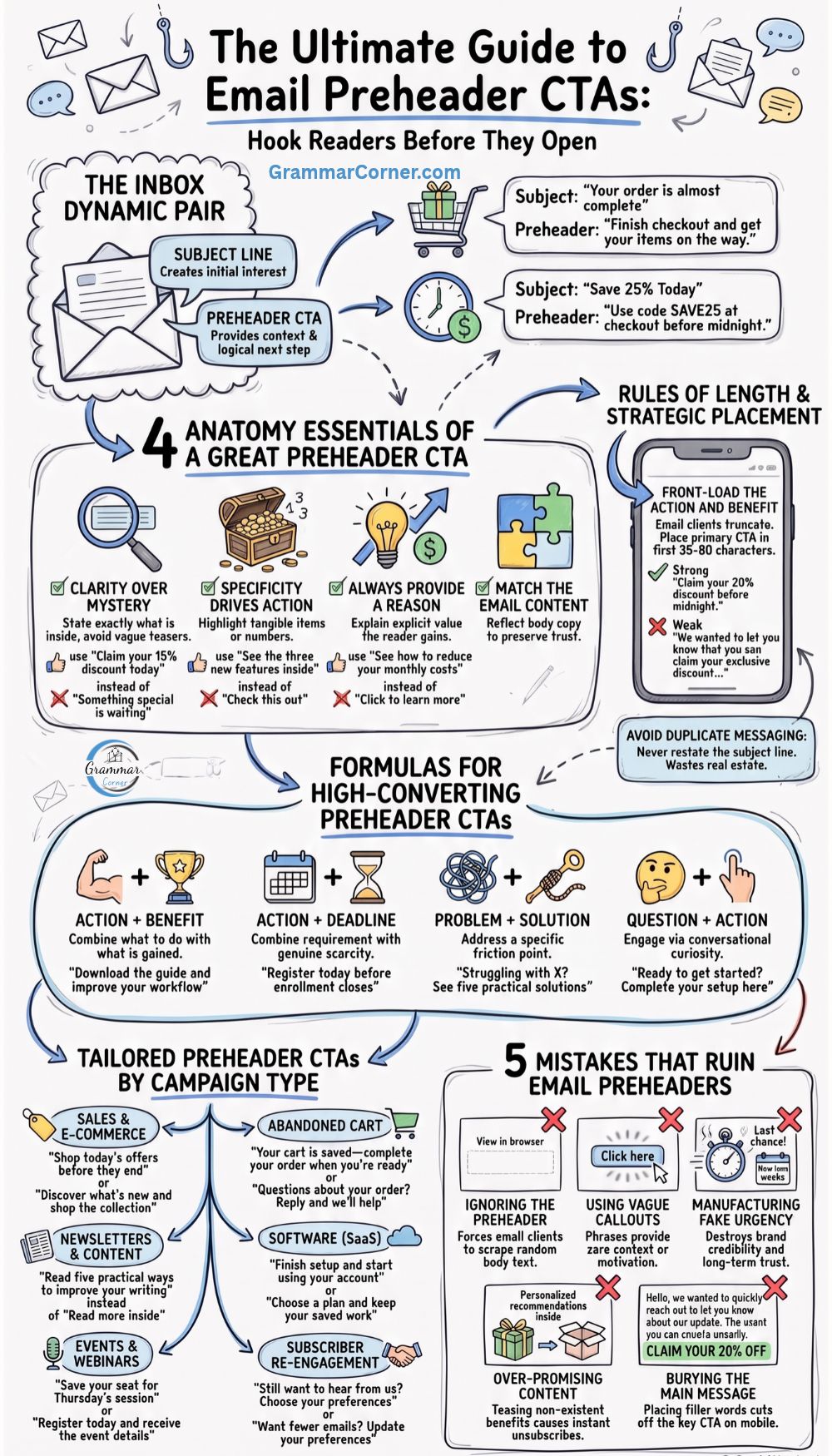
That small line of text can have a surprisingly important job. A good subject line attracts attention, while a well-written preheader gives the reader another reason to open the email. When the preheader also contains a clear call to action (CTA), it can guide the reader toward the next step before they even open the message.
For example:
Subject: Your 20% discount is waiting
Preheader: Use your code today and save on your next order.
The subject creates interest. The preheader explains what the reader can do with that offer.
What Is a Preheader CTA Phrase?
CTA stands for Call to Action. It tells the reader what you want them to do.
Common CTA phrases include:
- Shop the sale
- Claim your discount
- Read the full guide
- Book your appointment
- Save your seat
- Start your free trial
- Complete your order
- See what’s new
- Register today
- Choose your plan
A preheader CTA does not necessarily have to be a traditional command such as “Buy Now.” It can combine an action with a benefit.
For example:
Claim your discount before midnight.
or:
See what’s new and find your favourite.
The best wording depends on the purpose of the email.
Why Are Preheader CTA Phrases Important?
The preheader gives marketers another opportunity to communicate with subscribers before the email is opened.
A subject line might say:
Subject: Your free trial is ending
A weak preheader could be:
We wanted to remind you about your account.
A stronger version would be:
Choose a plan today to keep your saved work.
The second preheader tells the reader both what to do and why it matters.
The preheader therefore has several possible jobs:
- reinforce the subject line
- provide additional information
- highlight a benefit
- create appropriate urgency
- overcome hesitation
- tell the reader what to do next
- encourage a click, reply, purchase, registration, or other action
A useful preheader should add something to the subject line rather than simply repeat it.
Subject Line vs. Preheader CTA
The subject line and preheader should be treated as a pair.
Think of them as two parts of one message.
Example 1
Subject: Your order is almost complete
Preheader: Finish checkout and get your items on the way.
The subject introduces the situation.
The preheader supplies the next step.
Example 2
Subject: Meet our newest collection
Preheader: Explore the latest styles before they’re gone.
The subject creates interest.
The preheader gives the reader a reason to act.
Example 3
Subject: Ready for your next lesson?
Preheader: Continue where you left off in just five minutes.
Here, the preheader makes the benefit more specific.
The important point is that the two lines should not compete with each other. They should work together.
What Makes a Good Email Preheader CTA?
A strong preheader CTA usually has four qualities.
-
1. It Is Clear
The reader should understand what the email offers or what action is expected.
Weak: Something special is waiting for you.
Better: Claim your 15% discount today.
The second version is much easier to understand.
-
2. It Is Specific
Specific language is usually more useful than vague language.
Weak: Check this out.
Better: See the three new features inside.
-
3. It Provides a Reason
Simply telling someone to click is often less persuasive than explaining what they will get.
Weak: Click to learn more.
Better: See how to reduce your monthly costs.
-
4. It Matches the Email
The CTA should accurately reflect what the email actually contains.
If the preheader says: Compare the new plans inside. the email should make those plans easy to find.
A CTA that promises something the email does not deliver can create disappointment and reduce trust.
How Long Should an Email Preheader Be?
There is no single character limit that works perfectly everywhere. Different email clients, devices, screen sizes, and inbox settings display different amounts of preview text.
For that reason, the safest approach is to put the most important information near the beginning.
For example:
Claim your 20% discount before midnight.
is stronger than:
We wanted to let you know that you can claim your exclusive discount, which will remain available until midnight tonight.
The first version communicates the important information immediately.
A practical approach is to make the opening portion meaningful even if the rest of the preheader is cut off. Some email guidance recommends ensuring the key message appears within roughly the first 35–80 characters, while mobile displays can vary considerably.
Simple rule:
Put the action and benefit first.
Don’t make the reader wait until the end of the sentence to discover why the email matters.
Should a Preheader Repeat the Subject Line?
Generally, no.
Repeating the subject line wastes valuable preview space.
For example:
Subject: Save 25% Today
Preheader: Save 25% today with our special offer.
The reader has learned almost nothing new.
A better combination would be:
Subject: Save 25% Today
Preheader: Use code SAVE25 at checkout before midnight.
Now the preheader adds useful information.
It gives the reader the code and the deadline.
Email Preheader CTA Phrases for Sales Emails
Sales emails often need a direct and benefit-focused CTA.
Examples:
- Shop today’s offers before they end.
- Claim your discount and save today.
- Use your code at checkout.
- Explore the sale and find your favourites.
- Save 20% on your next order.
- Grab your offer before it expires.
- See today’s best deals inside.
- Shop now and enjoy free delivery.
- Unlock your exclusive offer today.
- Complete your purchase and save.
The CTA should reflect the actual offer. If there is no genuine deadline, avoid creating artificial urgency.
Email Preheader CTA Phrases for E-commerce
E-commerce emails often have a straightforward objective: encourage the recipient to browse, shop, or complete a purchase.
Try phrases such as:
- Discover what’s new and shop the collection.
- Find your favourites before they’re gone.
- Explore the new arrivals today.
- Shop your saved items now.
- See the latest styles inside.
- Get free shipping on your next order.
- Complete your order and enjoy your discount.
- Explore today’s customer favourites.
- Find your next favourite product.
- Shop the collection while stocks last.
Avoid using phrases such as “last chance” or “selling out” unless they accurately describe the situation.
Email Preheader CTA Phrases for Abandoned Cart Emails
An abandoned-cart email reminds a customer about products they left behind.
The preheader can reduce friction and encourage them to return.
Examples:
- Your cart is saved—complete your order when you’re ready.
- Still interested? Your items are waiting.
- Return to your cart and finish your order.
- Your favourites are still in your cart.
- Complete checkout and get your order on its way.
- Take another look before you decide.
- Your cart is waiting for you.
- Ready to complete your order?
- Your selected items are still available.
- Need help deciding? We’ve got answers.
A particularly useful approach is to address hesitation rather than simply saying “Buy now.”
For example:
Questions about your order? Reply and we’ll help.
That can feel more helpful than another aggressive sales message.
Email Preheader CTA Phrases for Newsletters
Newsletter emails usually have a different purpose from promotional emails. The CTA may encourage the reader to read an article, discover a story, watch a video, or explore new information.
Examples:
- Read the three-minute guide inside.
- See what’s happening this week.
- Discover our top stories for today.
- Read the full analysis inside.
- Catch up on what you missed.
- Explore this week’s most useful tips.
- Start with the five-minute guide.
- See the key ideas in one place.
- Read our latest insights.
- Find out what changed this week.
For content emails, specificity is particularly useful. Instead of:
Read more inside.
try:
Read five practical ways to improve your writing.
The reader immediately knows what they will find.
Email Preheader CTA Phrases for Product Launches
When introducing a new product, the preheader can complement the announcement by focusing on discovery.
Examples:
- Meet our newest product.
- Get the first look inside.
- Explore what’s new today.
- See the new collection first.
- Discover the features we’ve just added.
- Take a first look at what’s new.
- Explore the product everyone has been waiting for.
- See what we’ve been working on.
- Discover the new experience today.
- Be among the first to explore it.
A launch preheader does not always need to push a purchase. Sometimes the right action is simply to learn more.
Email Preheader CTA Phrases for SaaS and Software Emails
Software companies often need subscribers to start a trial, activate a feature, upgrade an account, or complete setup.
Examples:
- Finish setup and start using your account.
- Explore the new features today.
- Choose a plan and keep your saved work.
- Complete your setup in a few minutes.
- See what’s new in your dashboard.
- Activate your account and get started.
- Upgrade your plan to unlock more features.
- Continue where you left off.
- Book a quick walkthrough with our team.
- See how the latest update can help.
For SaaS emails, the best CTA often focuses on the value the user retains or gains, rather than simply saying “Upgrade now.”
Email Preheader CTA Phrases for Webinars and Events
For event emails, the CTA usually involves registration or attendance.
Examples:
- Save your seat for Thursday’s session.
- Register today and reserve your place.
- Choose your session time.
- Join us for the live workshop.
- Reserve your place before registration closes.
- Register now and receive the event details.
- Save the date and confirm your attendance.
- Join the conversation live.
- Bring your questions to the session.
- Book your place for the next webinar.
If the event genuinely has limited capacity, that information can be useful. Avoid implying that seats are limited when they are not.
Email Preheader CTA Phrases for Appointment Emails
Service businesses can use preheaders to encourage recipients to book or confirm an appointment.
Examples:
- Choose a convenient time for your appointment.
- Book your appointment in a few clicks.
- Confirm your appointment today.
- Pick a time that works for you.
- Reserve your preferred appointment time.
- Complete your booking here.
- Choose your preferred date and time.
- Need to reschedule? Pick a new time.
These phrases work best when the action is simple and the recipient knows exactly what will happen after clicking.
Email Preheader CTA Phrases for Lead Generation
Lead-generation emails often ask readers to book a call, request information, download a resource, or reply.
Examples:
- Book a quick call to discuss your options.
- See how the solution works.
- Reply and we’ll answer your questions.
- Get the full guide inside.
- Choose a time for a quick conversation.
- See the two-minute overview.
- Request your free consultation.
- Download the checklist and get started.
- Compare your options before deciding.
- Reply with a convenient time.
The lower the effort required from the recipient, the easier it is for the CTA to feel natural.
Email Preheader CTA Phrases for Re-Engagement Emails
Re-engagement emails are sent to subscribers who have stopped interacting with previous emails.
A softer approach often works better than pressure.
Examples:
- Still want to hear from us? Choose your preferences.
- Choose the topics you’d like to receive.
- Update your email preferences here.
- Stay subscribed and choose what interests you.
- Want fewer emails? Update your preferences.
- Tell us what’d you like to receive.
- Keep the emails that matter to you.
- Choose your favourite topics.
- Stay with us or update your preferences.
- Take control of your inbox.
Re-engagement messages should respect the reader’s choice. A preheader that sounds threatening or overly dramatic can damage the relationship.
Benefit-Led Preheader CTA Phrases
A benefit-led CTA tells readers what they will gain.
Examples:
- Save time with these five simple tips.
- Get your free guide today.
- Discover three ways to improve your results.
- Save 20% on your next order.
- Learn how to finish the task faster.
- See the tools that can simplify your workflow.
- Get more from your current plan.
- Find the solution you’ve been looking for.
Benefit-led CTAs are particularly useful when the reader already knows the problem but needs a reason to take action.
Urgency-Based Preheader CTA Phrases
Urgency can encourage action when there is a genuine deadline.
Examples:
- Claim your offer before midnight.
- Register before enrollment closes.
- Use your discount before it expires.
- Book your place before Friday.
- Complete your order before the offer ends.
- Get the early-bird price until Thursday.
- Last day to claim your bonus.
The key is truthful urgency.
Do not invent a deadline simply because urgent language sounds more persuasive. False scarcity can undermine trust.
Curiosity-Based Preheader CTA Phrases
Curiosity can work when the email contains something genuinely interesting.
Examples:
- See what changed inside.
- Find out what you’ve been missing.
- Discover the feature users requested most.
- See why customers are talking about this.
- There’s something new in your account.
- Find the answer inside.
- Take a first look at what’s coming.
- See the idea behind our latest update.
However, curiosity should still give the reader some useful information. A vague phrase such as “You need to see this” may generate curiosity but tells the reader almost nothing.
Question-Based Preheader CTA Phrases
Questions can make a preheader feel conversational.
Examples:
- Ready to see what’s new?
- Still looking for the right plan?
- Want to save on your next order?
- Need help choosing the right option?
- Ready to finish your setup?
- Looking for a faster way to do this?
- Want to see the results?
Questions work particularly well when they reflect a problem or decision that the reader is already considering.
Reply-Based Preheader CTA Phrases
Not every email needs to send the reader to a webpage. Sometimes the best CTA is simply to reply.
Examples:
- Reply with your preferred time.
- Have a question? Just reply to this email.
- Tell us what you think.
- Reply and we’ll help you choose.
- Send us your questions before the session.
- Reply with “YES” to get started.
- Let us know which option works best.
- Need help? Reply and we’ll take it from here.
This approach can make an email feel more personal and less like a traditional marketing campaign.
Personalised Preheader CTA Phrases
Personalization can make a preheader more relevant when it is based on useful customer information.
Examples:
- Sarah, your saved items are still waiting.
- See recommendations based on your recent purchases.
- Your account is ready—complete your setup.
- Continue your course from where you stopped.
Personalization should feel useful rather than intrusive. Only use information that is appropriate for the recipient and relevant to the email.
Common Mistakes in Email Preheader CTAs
Even a short preheader can go wrong.
-
Repeating the Subject Line
If the subject and preheader say essentially the same thing, one of them is doing unnecessary work.
Instead, use the preheader to provide another piece of information.
-
Making the CTA Too Vague
Phrases such as:
Click here.
Check this out.
Learn more.do not tell the reader much.
A stronger alternative might be:
See three ways to reduce your costs.
-
Making It Too Long
A long preheader may be cut off on mobile devices.
Put the strongest information first.
-
Using Fake Urgency
Avoid:
Last chance!
when the same offer will continue for another two weeks.
Urgency works best when it reflects a real deadline.
Promising Something the Email Does Not Contain
If the preheader promises:
See your personalised recommendations.
the email should actually provide personalised recommendations.
Ignoring the Preheader Completely
If you do not intentionally write the preheader, an email client may pull unrelated text from the beginning of the email body. This can result in preview text such as navigation links, browser-view instructions, or other boilerplate content.
How to Write an Effective Preheader CTA
A simple process can make writing much easier.
-
Step 1: Identify the Purpose
Ask: What do I want the recipient to do?
For example:
- purchase, register, click, read, reply, book, download, upgrade, complete an order
-
Step 2: Identify the Benefit
Ask: What does the reader get by taking that action?
For example:
- Save 20%
- Learn how to improve your writing
- Keep access to your account
- Reserve your seat
-
Step 3: Combine the Action and Benefit
For example:
Action: Shop | Benefit: Save 20%
Becomes:
Shop today and save 20%.
Or:
Action: Register | Benefit: Get the replay
Becomes:
Register today and receive the replay.
-
Step 4: Remove Unnecessary Words
Instead of:
We wanted to let you know that you can now take advantage of this special opportunity.
write:
Claim your special offer today.
Shorter does not automatically mean better, but unnecessary words make the important part harder to find.
-
Step 5: Check It With the Subject Line
Read the subject and preheader together.
If the two lines sound repetitive, rewrite the preheader.
A Simple Formula for Writing Preheader CTAs
Several formulas can help when you are stuck.
- Action + Benefit
Download the guide and improve your workflow. - Action + Deadline
Register today before enrollment closes. - Benefit + Action
Save 20% when you shop the collection. - Problem + Solution
Struggling with X? See five practical solutions. - Question + Action
Ready to get started? Complete your setup here. - Action + Specific Result
Read the guide and learn five ways to save time.
These are starting points, not rigid formulas. The best preheaders sound natural and fit the email’s purpose.
Quick Challenge: Improve the Preheader
Consider this email:
Subject: Your cart is waiting
Preheader: We wanted to remind you about your shopping cart.
Is this the strongest possible preheader?
Not really. It repeats the basic idea without giving the reader much additional motivation.
A stronger version could be:
Complete your order and get your favourites on the way.
Another possibility:
Still deciding? Take another look at your saved items.
The better version depends on what the email is trying to achieve.
Quick Challenge: Choose the Better CTA
Select the stronger option
1.
A: Click here for more information.
B: See how the new feature can save you time.
✅ B — offers a clear benefit instead of a vague instruction.
2.
A: Don’t miss this amazing opportunity!!!
B: Register today and reserve your seat.
✅ B — direct, specific, and professional.
3.
A: We are pleased to inform you about our latest products.
B: Explore the new collection today.
✅ B — concise and action-oriented.
Show Challenge Answers
- B
- B
- B
The stronger options are more direct and tell the reader what they can do.
Should You Use Emojis in Preheader CTAs?
Emojis can work in some marketing emails, but they should be used carefully.
For example:
🎁 Claim your free gift today.
or:
✨ Explore the new collection.
They may help an email stand out, but they are not necessary. A clear CTA is more important than decoration.
The choice should depend on the brand, audience, industry, and tone of the campaign.
How to Test Email Preheader CTA Phrases
You do not have to guess which preheader works best.
You can test different versions.
For example:
Version A: See the new features inside.
Version B: Explore the new features and save time.
Both encourage the reader to open the email, but Version B communicates a clearer benefit.
You can also test different approaches:
- benefit vs. urgency
- direct CTA vs. curiosity
- short vs. moderately detailed
- personalized vs. general
- purchase-focused vs. information-focused
For meaningful testing, keep the objective clear and avoid changing too many elements at the same time. It is also useful to look beyond opens and consider clicks, conversions, replies, revenue, unsubscribes, and complaints, depending on the purpose of the campaign.
A Collection of Short Email Preheader CTA Phrases
Here is a quick list you can adapt for different campaigns:
General
- See what’s waiting inside.
- Explore the details today.
- Take the next step here.
- Find out what’s new.
- Get started in minutes.
- See what’s changed.
- Explore your options.
- Take a closer look.
Sales
- Shop now and save.
- Claim your discount today.
- Use your code before it expires.
- Explore today’s offers.
- Save on your next order.
Content
- Read the full guide inside.
- Discover five useful tips.
- See the latest insights.
- Read the full story.
- Start with the quick guide.
Events
- Save your seat today.
- Register for the live session.
- Choose your session time.
- Reserve your place now.
SaaS
- Complete your setup today.
- Explore the latest features.
- Choose your plan and continue.
- See what’s new in your account.
Abandoned Cart
- Complete your order when you’re ready.
- Your saved items are still waiting.
- Return to your cart today.
- Take another look before deciding.
Re-engagement
- Choose the emails you want.
- Update your preferences.
- Tell us what interests you.
- Stay subscribed on your terms.
Frequently Asked Questions About Email Preheader CTA Phrases
-
What is an email preheader CTA phrase?
An email preheader CTA phrase is a short call-to-action message placed in the preview text that appears near an email’s subject line. It encourages the recipient to take a specific action, such as shopping, registering, reading an article, booking an appointment, or completing an order.
-
How is a preheader different from an email subject line?
The subject line mainly captures the recipient’s attention and encourages them to open the email. The preheader provides additional context and can explain the benefit or suggest the next action. For example, the subject might say “Your special offer is here,” while the preheader could say “Claim your 20% discount before midnight.”
-
What makes a good email preheader CTA?
A good preheader CTA is clear, concise, relevant, and action-oriented. It should tell readers what they can do or what they will gain. Instead of “Click here to learn more,” a stronger option would be “See five ways to save time.” The preheader should also complement rather than simply repeat the subject line.
-
How long should an email preheader CTA be?
There is no universal character limit because different email clients and devices display different amounts of preview text. As a practical rule, keep the message concise and place the most important information near the beginning. This helps ensure that the CTA or main benefit remains visible even when the text is truncated.
-
What are some examples of email preheader CTA phrases?
Examples include “Claim your discount today,” “Explore the new collection,” “Save your seat for Thursday’s session,” “Complete your order and get it on the way,” “Read the full guide inside,” and “Complete your setup in a few minutes.” The best phrase depends on the purpose and audience of the email.