Em Dash Chart (Usage and Examples)
An em dash (—) is a versatile punctuation mark used to set apart text within a sentence. The name comes from typography: it is the width of a capital letter M.
It is the longest of the three horizontal marks — longer than a hyphen (-) and longer than an en dash (–). Used properly, it adds emphasis and clarifies meaning, which is why it’s a staple of modern prose and dialogue.
How to Type an Em Dash
The em dash has no dedicated key, but every platform has a quick route to it:
🖥️ Windows
Hold Alt and type 0151 on the numeric keypad.
Mac
Press Shift + Option + – (minus).
📝 Word processors
Type two hyphens — between words — Microsoft Word, Google Docs, and most editors auto-convert them to an em dash (—).
📋 Copy & paste
Use the copy button at the top of this page — the fastest route of all.
The Five Jobs of the Em Dash
Em dashes serve multiple purposes and flex to fit many sentences. Here are the five jobs they perform best:
Offset a parenthetical phrase or clause
Like parentheses, but louder — the aside demands attention instead of whispering.
Emphasize a concluding phrase
A single dash before the finale acts like a drumroll for the sentence’s final point.
Indicate an interruption in dialogue
“Objection!” a voice rang out from the audience.
The dash at the point of the cut-off shows speech breaking mid-thought — a fiction writer’s essential tool.
Set off an amplifying or explanatory aside
Separate clauses in complex sentences
Em dashes separate supplementary text with greater emphasis than parentheses and more flexibility than commas.
Rescuing Appositives with Internal Punctuation
The em dash’s superpower is setting off appositives — words or phrases that describe a noun — when they contain internal punctuation like commas, parentheses, colons, or semicolons. The dashes prevent messy layering of identical marks.
See it for yourself. Each demo below starts with the tangled version — click the buttons to watch the em dashes untangle it:
My mentor, Jill, a highly experienced psychologist with over 15 years of expertise in cognitive behavioral therapy, provided invaluable career advice.
Five commas doing three different jobs — readers can’t tell where the description of Jill starts and ends.
Our skilled sales team (led by Jim Morgan (recipient of the Top Salesperson award for 3 consecutive years)) has consistently exceeded quarterly revenue targets.
Parentheses inside parentheses strain readability — which closing mark belongs to which opener?
The startup invested over $10 million into launching their new drug: allocating the capital across three areas: 60% toward research, 30% toward clinical trials, and 10% toward marketing.
Two colons in one sentence confuse the hierarchy — which one introduces the real list?
The 600-page bill contained sweeping provisions; changing drug pricing policies; allocating $500 billion in infrastructure spending; and overhauling the tax code; making its passage uncertain.
The semicolons separating list items blur into the sentence’s own structure — where does the list end?
In every case the em dashes act as the outer brackets, letting the commas, parentheses, colons, or semicolons do their inner work without convoluting the sentence. This clarifies appositives of any length or complexity.
Offsetting Lists with Em Dashes
Em dashes are an effective technique for bringing emphasis to lists within sentences. The strong visual separation draws the reader’s eye straight to the key items:
- When the list sits mid-sentence, place an em dash before and after the list.
- Enclose the entire list between the dashes — never just one item.
- When the list ends the sentence, use only the opening dash — the sentence’s period finishes it: She mastered three skills—writing, editing, and design.
- No spaces between the dashes and adjacent text (see the spacing note below).
Em Dash vs. En Dash vs. Hyphen
The em dash (—) should not be confused with the en dash (–), which is slightly shorter — the width of a capital N. And neither is a hyphen (-). Each mark has its own job:
| Mark | Length | Main job | Example |
|---|---|---|---|
| Hyphen ( – ) | Shortest | Joins words and word parts | well-known, mother-in-law, re-enter |
| En dash ( – ) | Width of N | Ranges and connections between things | pages 5–7, the 2024–25 season, the Miami–New York flight |
| Em dash ( — ) | Width of M (longest) | Sets apart text: asides, emphasis, interruptions | She won—against all odds—on her first attempt. |
The memory hook: hyphens join, en dashes connect, em dashes interrupt. En dashes quietly link numbers and destinations; em dashes set text apart as true punctuation.
1. The final score was 98?92 in overtime.
2. Her answer?a firm, unhesitating no?ended the debate.
3. My six?year?old nephew corrected my grammar.
Proper Em Dash Placement
- Use paired dashes mid-sentence for asides; a single dash before a concluding phrase.
- Limit em dashes to one pair (or one single dash) per sentence — more, and the emphasis collapses into noise.
- Avoid over-nesting dashes with other punctuation; rephrase instead.
- Use sparingly in formal academic writing, where commas, colons, and parentheses are preferred.
The Spacing Question: It Depends on Your Style Guide
Should there be spaces around an em dash? Both answers are “correct” — it depends which standard you follow:
Chicago Manual of Style (books, most websites): no spaces — the dash touches the words on both sides: She won—against all odds.
AP Stylebook (news media): a space on each side: She won — against all odds.
Pick one convention and stay consistent throughout your document. On this site, we follow the closed-up Chicago style.
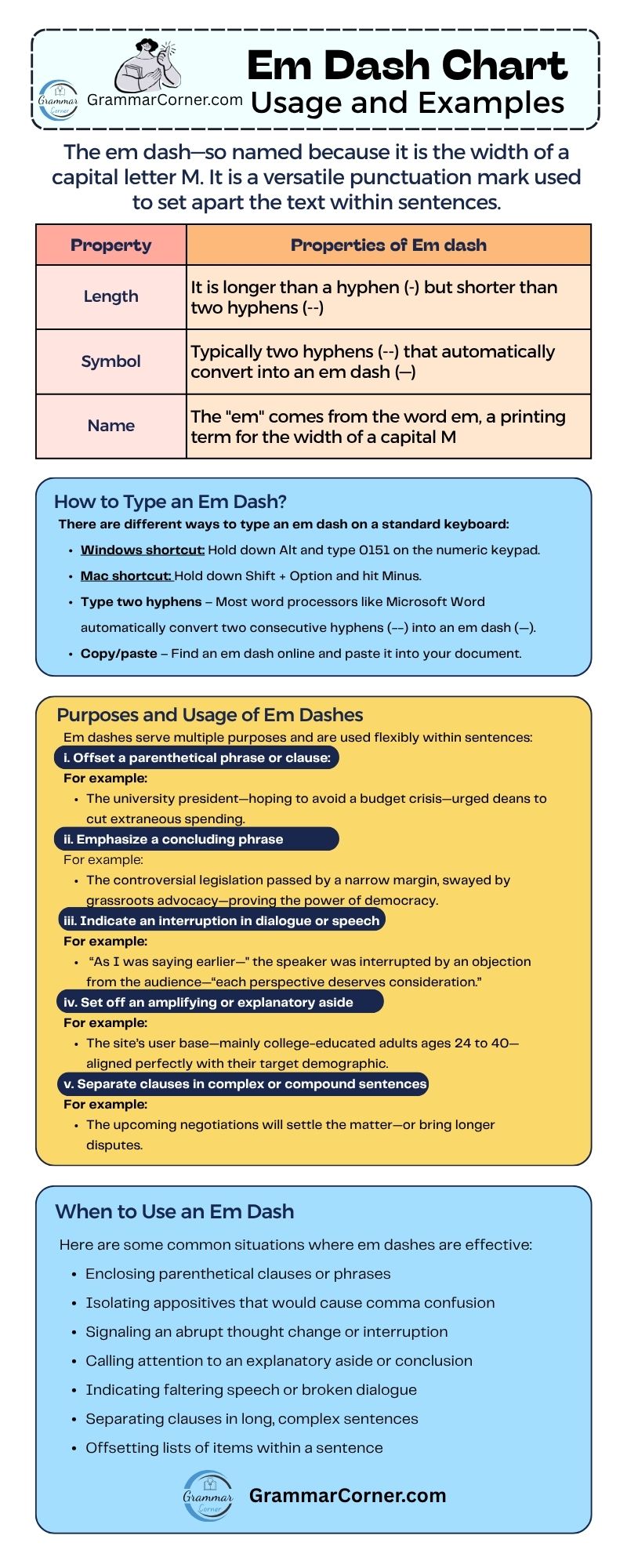
Em Dash Chart
Everything in this guide, condensed into one chart — save it or share it:
Interactive Quiz: Test Your Dash Skills
Answer all 8 questions for instant feedback and a final score.
1. Rank the three marks from shortest to longest.
The hyphen is shortest; the en dash is the width of a capital N; the em dash — the width of a capital M — is longest.
2. Which sentence uses paired em dashes correctly?
A mid-sentence aside needs a dash on both sides. Opening with a dash and closing with a comma leaves the aside dangling.
3. “The meeting runs from 2__4 pm.” Which mark fills the blank?
Number and time ranges take the en dash: 2–4 pm, pages 5–7, the 2024–25 season.
4. Why use em dashes around an appositive that contains commas?
Dashes act as visible outer brackets — “My mentor, Jill—a psychologist with 15 years of expertise—provided advice” keeps the description clearly bounded.
5. A dash-offset list ends the sentence. What closes it?
“She mastered three skills—writing, editing, and design.” The period does the closing; a second dash only appears when the sentence continues afterward.
6. In dialogue, what does an em dash at the end of a quote signal?
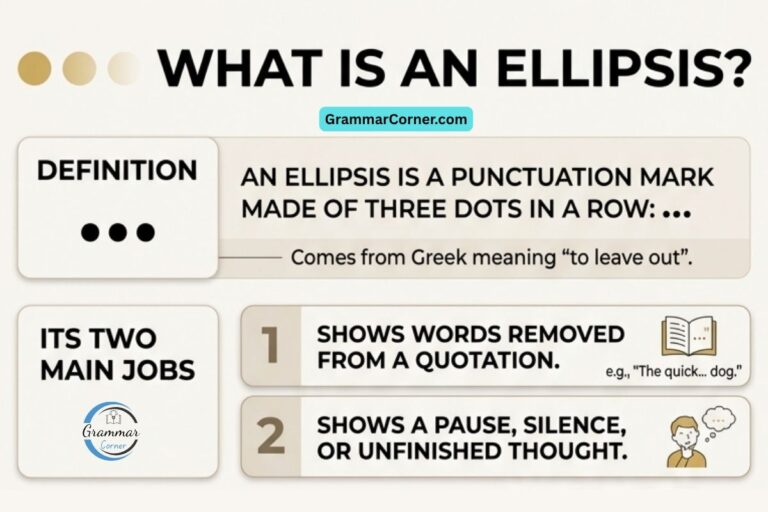
A dash marks an abrupt interruption (“Each perspective deserves—”). A slow trail-off is the ellipsis’s job (…).
7. Which spacing claim is accurate?
It’s a style-guide split, not a grammar rule. Pick one convention and stay consistent.
8. “My six__year__old nephew corrected my grammar.” Which mark?
Compound modifiers before a noun are joined by hyphens — the joining mark, not the interrupting one.
Em Dash FAQs
What does “em” in em dash actually mean?
Is an em dash the same as two hyphens (–)?
Can I use an em dash instead of a colon or semicolon?
How many em dashes can one sentence contain?
Are em dashes acceptable in academic writing?
Do I capitalize the word after an em dash?
Key Points to Remember
- Size order: hyphen (-) < en dash (–) < em dash (—) — the em dash is the longest, the width of a capital M.
- Hyphens join, en dashes connect, em dashes interrupt.
- Paired dashes for mid-sentence asides; a single dash for an emphatic finale — and when a dash-offset list ends the sentence, the period closes it, not a second dash.
- Em dashes rescue appositives full of commas, colons, or semicolons by acting as clear outer brackets.
- Spacing is a style choice: closed up (Chicago) or spaced (AP) — pick one and be consistent.
- One dash moment per sentence keeps the emphasis powerful.
Check also: