Gerunds (Uses and Examples) | Gerunds vs Infinitives
What Is a Gerund?
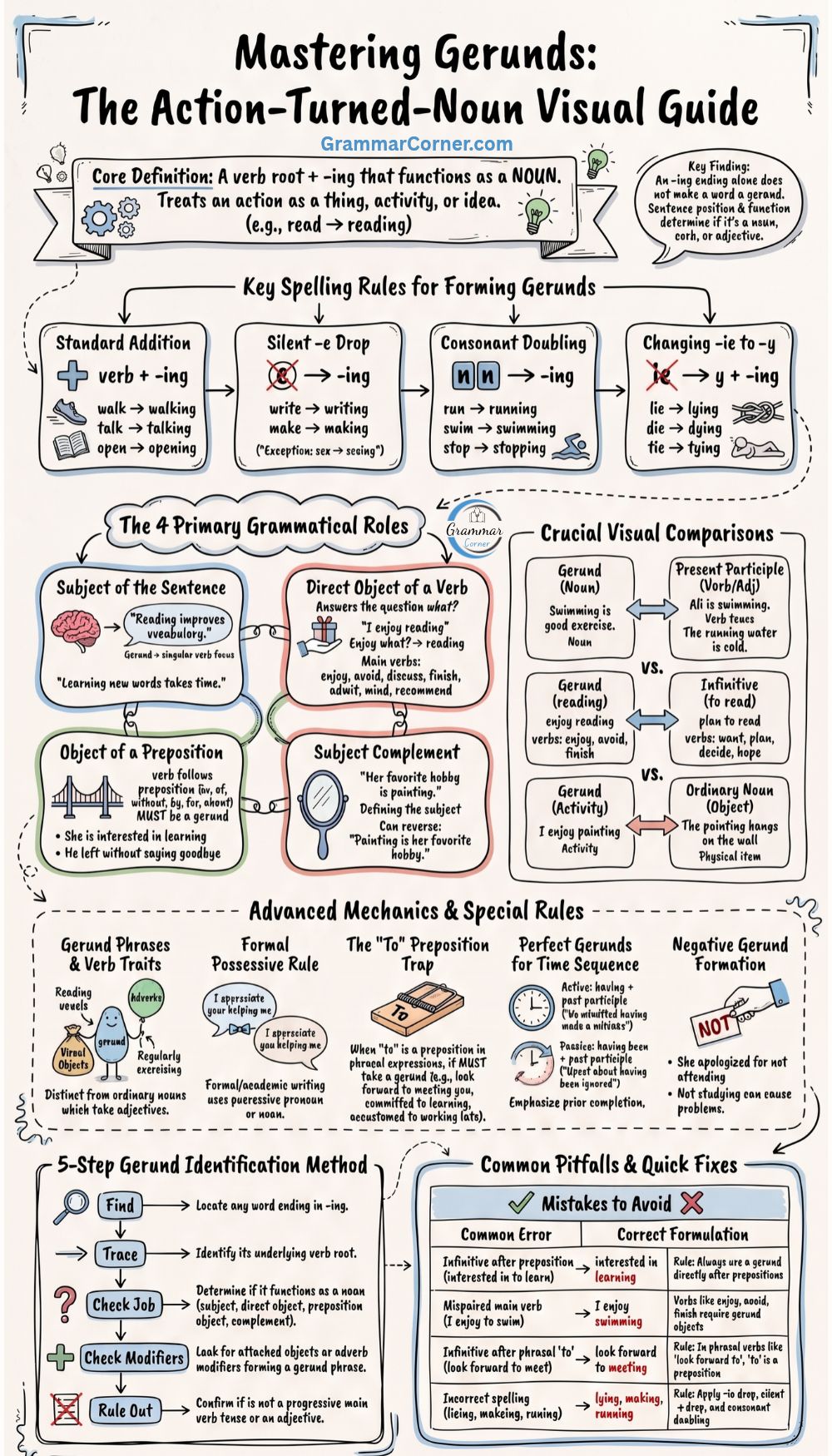
A gerund is one of the most versatile forms in English grammar. It treats an action as a thing, idea, activity, or experience by taking a verb root and adding an -ing suffix to perform a noun-like function.
Words like reading, swimming, writing, cooking, and traveling may look like ordinary verb forms, but they function as nouns when positioned correctly in a sentence:
| Example Sentence | Grammatical Role |
|---|---|
| Reading improves your vocabulary. | Subject of the sentence |
| I enjoy reading. | Direct object |
| She is interested in learning English. | Object of a preposition |
| His favorite activity is cycling. | Subject complement |
An -ing ending alone does not automatically make a word a gerund. Its functional role within the sentence determines whether it operates as a noun, a verb phrase, or an adjective.
Quick Challenge #1
In which sentence does the word running function as a gerund? Tap an option.
See the full explanation
Answer: B. Running keeps me fit.
Grammar breakdown:
- Gerund Subject: Running acts as a noun naming an activity and serves as the subject.
- Other Functions: Quick Challenge #1 also highlights running as a present participle verb phrase (“is running”) and as an adjective (“running water”).
How Are Gerunds Formed?
The fundamental structure of a gerund is created by appending the -ing suffix to a verb root. While straightforward, specific spelling conventions apply depending on how the base verb ends.
| Verb | Gerund Form |
|---|---|
| read | reading |
| play | playing |
| work | working |
| swim | swimming |
| write | writing |
| dance | dancing |
| study | studying |
| run | running |
Key Spelling Rules for Adding -ing
Most verbs take the suffix directly:
- talk ➔ talking
- walk ➔ walking
- eat ➔ eating
- open ➔ opening
Verbs ending in a silent e normally drop it:
- make ➔ making
- write ➔ writing
- take ➔ taking
*Exception: Verbs ending in -ee retain letters (e.g., see ➔ seeing).
Short verbs often double their final consonant:
- run ➔ running
- sit ➔ sitting
- swim ➔ swimming
- stop ➔ stopping
Verbs ending in -ie shift to -y:
- lie ➔ lying
- die ➔ dying
- tie ➔ tying
*Note: Spellings like lieing or dieing are incorrect.
Pronunciation and syllable stress patterns dictate consonant doubling, so always verify base verb transformations when writing formally.
Quick Challenge
Which spelling of the gerund is correct for the verb lie? Tap an option.
See the full explanation
Answer: B. lying
Grammar breakdown:
- IE Rule: Verbs ending in -ie (like lie, die, tie) convert their ending to -y before adding -ing (lying, dying, tying).
- Incorrect Form: Forms like lieing violate standard English spelling conventions.
Gerunds as the Subject of a Sentence
A gerund can function as the subject of a sentence. In this position, the gerund directly names the activity, behavior, or action being discussed.
- Reading improves concentration.
- Walking is good for your health.
- Learning requires patience.
- Cooking can be relaxing.
The activity itself operates as the active subject.
- Reading books before bedtime helps me relax.
- Learning a new language takes time.
- Walking through the old city was unforgettable.
The entire phrase functions collectively as the subject.
Gerunds as the Object of a Verb
A gerund can also function as the direct object of a verb, answering the question what?
| Example Sentence | Question Breakdown |
|---|---|
| I enjoy reading. | I enjoy what? ➔ reading |
| She avoids driving at night. | She avoids what? ➔ driving |
| They discussed moving. | They discussed what? ➔ moving |
| We finished cleaning. | We finished what? ➔ cleaning |
| He admitted making a mistake. | He admitted what? ➔ making |
Common Verbs Followed by Gerunds
Many English verbs naturally take gerunds as objects rather than infinitives. Key verbs include:
The choice between a gerund and an infinitive depends entirely on the main verb. Memorizing verb patterns helps ensure natural sentence construction.
Quick Challenge
Which verb form correctly completes the sentence: “She avoided ______ the difficult question.”? Tap an option.
See the full explanation
Answer: B. answering
Grammar breakdown:
- Direct Object Gerund: The verb avoid requires a gerund object to answer what was avoided (avoided what? ➔ answering).
- Verb Patterns: Verbs like avoid, enjoy, and finish take gerunds instead of infinitives.
Gerunds as the Object of a Preposition
One of the most critical rules in English grammar is that a gerund commonly follows a preposition. Whenever a verb immediately follows a preposition, it must take the -ing form rather than the infinitive.
| Example Sentence | Preposition & Object |
|---|---|
| She is interested in learning. | in (preposition) ➔ learning (gerund) |
| He left without saying goodbye. | without (preposition) ➔ saying |
| They talked about moving abroad. | about (preposition) ➔ moving |
| I am tired of waiting. | of (preposition) ➔ waiting |
| She succeeded by working hard. | by (preposition) ➔ working |
| He apologized for being late. | for (preposition) ➔ being |
The Special Case of “To”
The word to can cause confusion because it serves dual functions in English grammar: it can form an infinitive or act as a preposition.
I want to learn English.
Here, to introduces a base infinitive verb.
I am committed to learning English.
Here, to functions as a preposition and requires a gerund.
Common phrasal expressions where to acts as a preposition followed by a gerund include:
• She is accustomed to working late.
Gerunds as Subject Complements
A gerund can also function as a subject complement, typically appearing after a linking verb such as be to provide additional clarification about the subject.
| Example Sentence | Reversed Structure |
|---|---|
| Her favorite hobby is painting. | Painting is her favorite hobby. |
| My greatest interest is reading. | Reading is my greatest interest. |
| His main concern was finding a solution. | Finding a solution was his main concern. |
| Their favorite activity is cycling. | Cycling is their favorite activity. |
Because subject complements equate directly with the subject, sentences using gerunds in this position can frequently be reversed without changing the core meaning.
Quick Challenge
Which sentence correctly follows English preposition grammar? Tap an option.
See the full explanation
Answer: B. He left without saying goodbye.
Grammar breakdown:
- Preposition Object Rule: Prepositions (such as without, in, by, and for) must be followed by gerunds (-ing forms) rather than infinitives (to say).
- Additional Mastery: Remember that even expressions ending in to functioning as prepositions (like look forward to) require gerund objects.
Gerunds and Possessives
A gerund can be preceded by a possessive noun or a possessive pronoun whenever a sentence focuses specifically on the person performing the action of the gerund.
| Formal Possessive Form | Everyday Object Pronoun Form |
|---|---|
| I appreciate your helping me. | I appreciate you helping me. |
| We objected to Ali’s leaving early. | We objected to Ali leaving early. |
| She was annoyed by his arriving late. | She was annoyed by him arriving late. |
What Is a Gerund Phrase?
A gerund phrase consists of a gerund combined with other words that complete, modify, or expand its meaning.
Example: Reading books in the evening is relaxing.
- Gerund: reading
- Modifiers/Objects: books in the evening
- Function: The entire group operates collectively as the subject.
Standard pattern:
Example: Reading (Gerund) + difficult books (object) + regularly (modifier).
A gerund retains underlying characteristics of a verb because it can take direct objects and accept adverb modifiers. Simultaneously, the entire phrase functions as a noun within the sentence.
Quick Challenge
Which sentence features the preferred formal possessive structure before a gerund? Tap an option.
See the full explanation
Answer: B. We were surprised by his arriving late.
Grammar breakdown:
- Possessive Rule: Formal writing requires possessive determiners (such as his, your, or their) or possessive nouns before gerunds to clearly attribute the action.
- Gerund Phrases: Remember that gerund phrases expand on this core structure by including objects and modifiers while maintaining a noun-like role.
Gerunds Can Take Objects
Although a gerund functions syntactically as a noun, it retains core verbal characteristics—allowing it to take direct objects and accept adverb modifiers. This dual nature is why gerunds are classified as verbals.
- Reading novels improves vocabulary. (Gerund: reading | Object: novels)
- Writing clear sentences requires practice. (Gerund: writing | Object: clear sentences)
- Quickly finishing the assignment…
- Regularly exercising improves fitness.
- Carefully checking the documents…
*Note: Ordinary nouns take adjectives (careful checking), whereas gerunds take adverbs (carefully checking).
Gerunds vs. Present Participles
Distinguishing between gerunds and present participles is a common hurdle because both typically end in -ing. However, they perform entirely different grammatical roles.
| Sentence | Target Word | Grammatical Function |
|---|---|---|
| Running is healthy. | running | Gerund (Noun / Subject) |
| She is running. | running | Present Participle (Verb phrase) |
| The running water is cold. | running | Present Participle / Adjective |
Recognizing that gerunds take objects and adverbs while retaining noun roles makes them much easier to identify across complex texts.
Quick Challenge #2
Determine whether the -ing word in this sentence is a gerund or a present participle: “The barking dog woke me up.” Tap an option.
See the full explanation
Answer: B. Present participle
Grammar breakdown:
- Adjectival Participle: In “The barking dog”, barking describes the dog directly, fulfilling an adjectival role rather than a noun role.
- Other Quick Challenge Examples: “Dancing is her favorite hobby” (Gerund), “The children are dancing” (Present participle), “He enjoys dancing” (Gerund).
Gerunds vs. Infinitives
Both gerunds and infinitives can perform noun-like functions in English grammar, but they are not universally interchangeable. Understanding which form to use depends directly on the governing main verb.
- reading
- writing
- swimming
- traveling
- to read
- to write
- to swim
- to travel
| Verbs Followed by Gerunds | Verbs Followed by Infinitives |
|---|---|
| enjoy reading | want to go |
| avoid driving | hope to succeed |
| finish working | plan to travel |
| suggest leaving | decide to stay |
| consider moving | agree to help |
| practice speaking | promise to return |
The choice between a gerund and an infinitive is governed primarily by the main verb. Memorizing which category a verb belongs to prevents common grammatical errors.
Quick Challenge
Which sentence correctly pairs the main verb with its required complement form? Tap an option.
See the full explanation
Answer: B. She enjoys painting landscapes.
Grammar breakdown:
- Verb Governance: Verbs like enjoy require gerund objects (painting), while verbs like plan require infinitives (to paint).
- Grammatical Fit: Mixing these patterns (such as saying enjoys to paint) results in ungrammatical phrasing.
Perfect Gerunds
When it is necessary to emphasize that one action occurred prior to another, English employs the perfect gerund. This advanced structure highlights a distinct time sequence.
| Active Perfect Gerunds | Passive Perfect Gerunds |
|---|---|
| She denied having seen the document. | She denied having been informed. |
| I regretted having spoken so harshly. | They were proud of having been selected. |
| They were proud of having completed the project. | She was upset about having been ignored. |
While perfectly grammatical, perfect gerunds are advanced structures that are often unnecessary when the chronological relationship is already clear from the broader context.
Gerunds After Phrasal Verbs
Gerunds also frequently occur directly after phrasal verbs, acting as the object of the phrasal verb or of a preposition contained within the expression.
- I can’t give up smoking.
- She kept on talking.
- He ended up missing the train.
- We need to cut down on spending.
Pay special attention to phrasal verbs containing to:
- ✓ We look forward to hearing from you.
- ✗ We look forward to hear from you.
Here, to is a preposition, so the gerund hearing is required.
Quick Challenge
Which sentence correctly uses a gerund after a phrasal verb ending in a preposition? Tap an option.
See the full explanation
Answer: B. We look forward to meeting you.
Grammar breakdown:
- Prepositional Phrasal Verbs: Expressions like look forward to contain the preposition to, which must be followed by a gerund (meeting) rather than a base infinitive verb.
- Perfect Gerunds: Remember that perfect gerunds (having + past participle) emphasize that an action occurred prior to the main clause verb.
Common Expressions Followed by Gerunds
Numerous fixed English expressions naturally require an -ing gerund form. Learning these patterns as standard blocks makes natural usage much easier.
• We succeeded in completing the task.
• They prevented him from entering the building.
Gerunds in Negative Forms
To construct a negative gerund, simply place not directly before the gerund form.
| Example Sentence | Negative Structure |
|---|---|
| Not studying can cause problems. | Negative gerund subject |
| He admitted not knowing the answer. | Negative gerund object |
| She apologized for not attending the meeting. | Negative object of preposition |
| He regretted not having prepared properly. | Negative perfect gerund |
Gerunds in Formal and Academic Writing
Gerunds are especially powerful in formal writing because they package actions into clean concepts and abstract ideas.
Additional examples of concise academic phrasing utilizing gerund phrases include:
- Reducing costs is essential.
- Improving public services requires long-term planning.
- Protecting the environment is a shared responsibility.
- Providing accurate information should be a priority.
While gerunds create smoother, more professional prose when used appropriately, excessive reliance on noun-like constructions can make writing heavy. Balance them with active clauses.
Quick Challenge
Which sentence correctly formats a negative gerund? Tap an option.
See the full explanation
Answer: B. She apologized for not attending the meeting.
Grammar breakdown:
- Negative Placement: To negate a gerund, place not immediately preceding the -ing form (not attending, not knowing).
- Academic Utility: Negative and positive gerunds alike enhance professional writing by condensing clauses into precise conceptual subjects.
Common Mistakes with Gerunds
Mastering gerunds requires avoiding several frequent pitfalls. Reviewing these common mistakes prevents recurring grammatical errors in writing and conversation.
| Common Mistake | Correction / Explanation |
|---|---|
| Mistake 1: Treating every -ing word as a gerund. |
She is reading (Participle) Reading is enjoyable (Gerund) The reading child (Adjectival) |
| Mistake 2: Using an infinitive after a preposition. ✗ She is interested in to learn. |
✓ She is interested in learning. Always use a gerund after prepositions. |
| Mistake 3: Using the wrong form after verbs. ✗ I enjoy to swim. |
✓ I enjoy swimming. Verbs like enjoy require gerund objects. |
| Mistake 4: Confusing “to” as infinitive vs. preposition. ✗ I look forward to meet you. |
✓ I look forward to meeting you. In phrasal verbs, to is a preposition. |
| Mistake 5: Incorrect spelling. ✗ lieing / makeing / runing |
✓ lying / making / running Master spelling rules alongside syntax. |
Always examine the structural function of an -ing word within its sentence rather than assuming its category based on the ending alone.
Quick Challenge
Which sentence corrects a common prepositional gerund error? Tap an option.
See the full explanation
Answer: B. She is interested in learning English.
Grammar breakdown:
- Preposition Rule: Prepositions (such as in, at, without) must be followed by gerunds (-ing forms) rather than infinitives (to learn).
- Common Pitfalls: Avoiding mistakes like mixing up infinitives after prepositions and misapplying spelling rules (e.g., lieing vs. lying) ensures polished, error-free writing.
How to Identify a Gerund in a Sentence
When encountering an -ing word, relying on a systematic multi-step verification method is far more reliable than simply looking for the suffix alone.
- Step 1 (Find): Look for any word ending in -ing (e.g., Reading books is useful.).
- Step 2 (Trace): Identify its base verb root (e.g., reading originates from read).
- Step 3 (Job): Ask if it acts as a noun (e.g., operating as the subject).
- Step 4 (Modifiers): Check for objects or adverbs (e.g., in Reading books regularly…, books is an object and regularly is an adverb).
| Example Sentence | Target Phrase | Identified Function |
|---|---|---|
| Learning a language takes patience. | Learning a language | Subject (Gerund phrase) |
| She enjoys cooking for her family. | cooking for her family | Direct object of enjoys |
| He apologized for arriving late. | arriving late | Object of preposition for |
| Her favorite activity is painting landscapes. | painting landscapes | Subject complement |
| Being treated unfairly made him angry. | Being treated unfairly | Subject (Passive gerund phrase) |
Following this 5-step identification protocol ensures absolute accuracy when distinguishing gerunds from present participles and adjectives across all forms of writing.
Quick Challenge #3
In the sentence “She enjoys cooking for her family,” what is the function of the gerund phrase? Tap an option.
See the full explanation
Answer: B. Direct object of ‘enjoys’
Grammar breakdown:
- Direct Object Role: The gerund phrase answers what is enjoyed (She enjoys what? ➔ cooking for her family).
- Additional Quick Challenge Functions: Other examples from Quick Challenge #3 include subjects (Learning a language, Being treated unfairly), prepositional objects (arriving late), and subject complements (painting landscapes).
Gerund or Noun? They Are Not Always the Same
Many -ing forms have evolved into fully established ordinary nouns in English. Context ultimately determines whether a term operates as a gerund (naming an action) or as a standard noun (referring to a physical object or entity).
Common examples include words like swimming, shopping, building, painting, and meeting.
- I enjoy painting. (Refers to the activity of painting)
- Building houses requires skill. (Refers to the action of building)
- The painting hangs on the wall. (Refers to a physical artwork)
- The building is very old. (Refers to a physical structure)
Gerunds and Pronouns
When a pronoun refers to the person performing the action expressed by a gerund, formal English strongly prefers a possessive form, whereas informal speech frequently employs objective pronouns.
| Formal Possessive Style | Informal Object Style |
|---|---|
| I appreciate your helping me. | I appreciate you helping me. |
| We objected to his leaving early. | We objected to him leaving early. |
| She was surprised by their arriving soon. | She was surprised by them arriving soon. |
Punctuation with Gerunds
A gerund normally does not require special punctuation merely because it is present in a sentence.
Context determines whether an -ing word is a gerund or a noun, formal contexts favor possessives with pronouns, and standard gerund phrases require no special commas.
Quick Challenge
In the sentence “The ancient painting was restored,” what is the grammatical role of the word painting? Tap an option.
See the full explanation
Answer: B. Ordinary noun
Grammar breakdown:
- Noun vs. Gerund: When an -ing word denotes a concrete physical object or artifact (like a framed painting or an old building), it operates as a standard noun rather than a gerund naming an action.
- Pronouns & Punctuation: Remember that formal writing prefers possessive pronouns before gerunds, and gerund phrases never require arbitrary commas.
Why Are Gerunds Important?
Gerunds make it possible to discuss actions as ideas or abstract concepts, transforming clunky clauses into smooth, professional sentences.
Gerunds are particularly useful and frequently encountered when discussing:
Because of their versatility, they remain staples in both everyday conversation and formal academic writing.
Mastering gerund forms, subject-verb agreements, prepositional objects, and infinitive contrasts ensures complete command over English grammar.
Quick Challenge #4
Choose the correct form for the sentence: “She is interested in ______ Spanish.” Tap an option.
See the full explanation
Answer: B. learning
Grammar breakdown:
- Prepositional Rule: Following prepositions (such as in, for, of), verbs must take the gerund form (learning, arriving, meeting).
- Other Quick Challenge #4 Solutions: enjoy reading, decided to leave (infinitive after decide), apologized for arriving, look forward to meeting, and stopped smoking (ending the activity).
A Simple Formula for Remembering Gerunds
A dependable formula for mastering the gerund concept relies on recognizing both form and syntax: Verb + -ing = Gerund when it functions as a noun.
The -ing ending tells you the base form, but the surrounding sentence structure reveals its true grammatical function.
Quick Reference Table
A comprehensive summary of gerund structures, functional roles, and advanced applications:
| Gerund Category / Use | Example Sentence |
|---|---|
| Subject | Swimming is relaxing. |
| Direct object | I enjoy swimming. |
| Object of preposition | She is good at swimming. |
| Subject complement | Her hobby is swimming. |
| Possessive construction | I appreciate your helping me. |
| Gerund phrase | Swimming in the morning feels refreshing. |
| Passive gerund | He dislikes being criticized. |
| Perfect gerund | She regretted having spoken harshly. |
| Perfect passive gerund | He denied having been informed. |
Quick Challenge
According to the quick reference formula, which sentence uses reading as a gerund functioning as a direct object? Tap an option.
See the full explanation
Answer: B. I enjoy reading.
Grammar breakdown:
- Direct Object Role: Following the transitive verb enjoy, reading answers what is enjoyed, fulfilling a direct object noun role.
- Formula Application: Applying the simple formula (Verb + -ing = Gerund when acting as a noun) confirms its categorization across subjects, objects, and advanced passive structures.