Third Conditional (Structure, Rules and Examples)
What Is the Third Conditional?
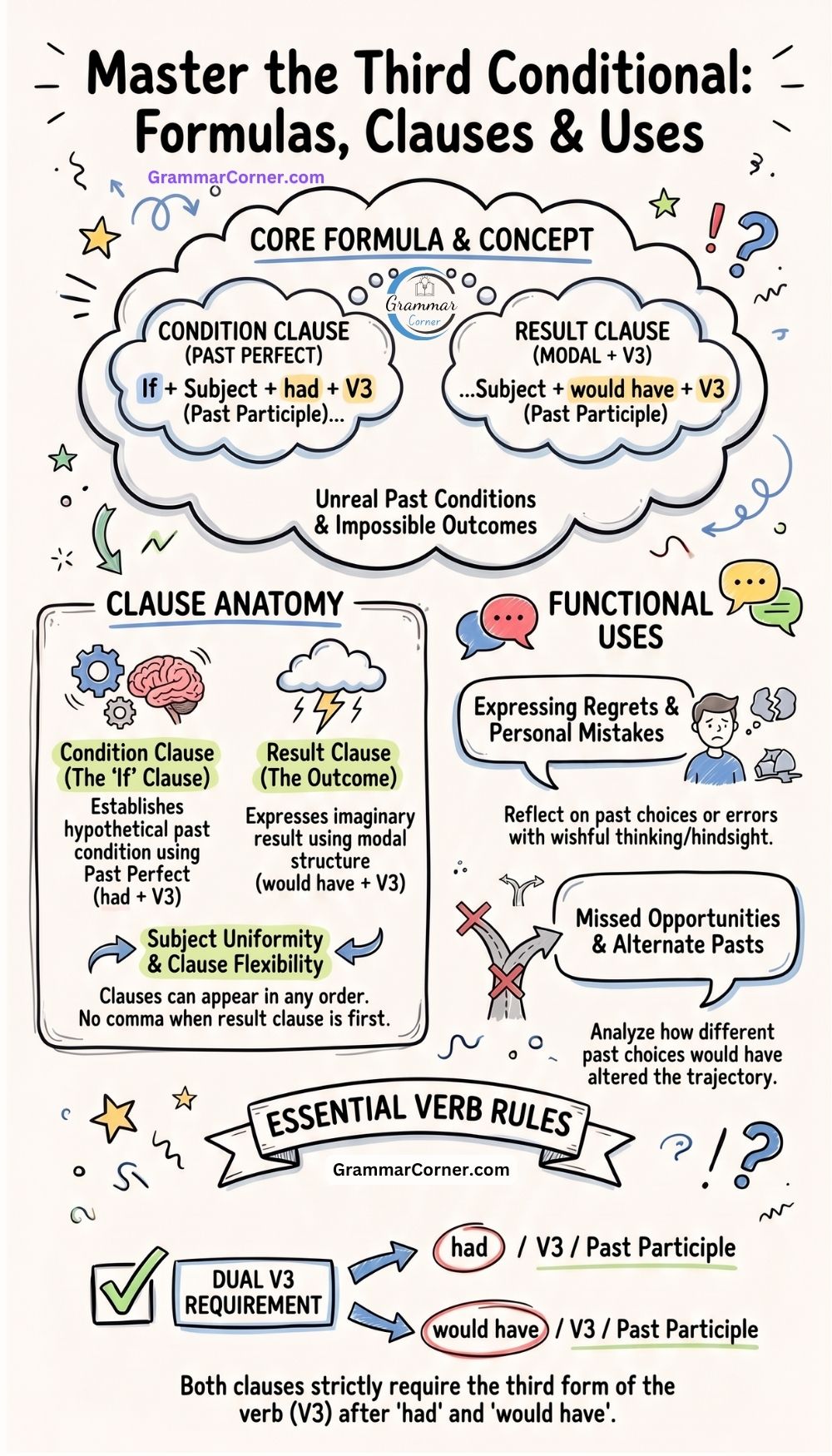
The third conditional (also called the past hypothetical conditional) describes an unreal or impossible situation in the past and imagines how a different course of events would have produced a completely different outcome. Because the past cannot be changed, both the condition and its result are entirely counterfactual.
Common Reasons to Use the Third Conditional
We use the third conditional whenever we look back at finished historical events to reflect, explain, or evaluate choices:
- If I had remembered your birthday, I would have bought you a present.
- If we had left earlier, we would have caught the train.
- If Sara had studied harder, she would have passed the test.
- If they had listened to the teacher, they would not have made that mistake.
Third Conditional Structure & Verb Forms
The third conditional formula requires the past perfect in the condition clause and would have + past participle in the result clause:
Establishes the unreal event that did not take place in the past:
• had worked
• had gone / had seen
• had remembered / had finished
Describes the counterfactual outcome that never occurred:
• would have gone / helped
• would have finished / won
• would have performed better
In “If she had practised, she would have performed better,” part one highlights an unreal past condition (she did not practise), and part two reveals the imagined past result (she did not perform better).
Quick Challenge
Which grammatical formula correctly builds a third conditional sentence? Tap an option.
See the full explanation
Answer: C. If + past perfect, would have + past participle
Grammar breakdown:
- Formula:
If + had + past participle, would have + past participle. - Meaning in Reality: When someone says “If I had studied, I would have passed,” the factual truth is: I did not study, and I did not pass.
- Comparison Summary:
- First conditional =
present simple + will(possible future). - Second conditional =
past simple + would(imaginary present). - Third conditional =
past perfect + would have(counterfactual past).
- First conditional =
When Do We Use the Third Conditional?
The third conditional is used to reflect on completed past situations and imagine alternative outcomes that never actually took place. Because the past is unchangeable, this structure provides a framework for expressing regret, analyzing missteps, explaining outcomes, and evaluating missed opportunities.
➔ The speaker cannot turn back the clock to wake up earlier. The bus has already departed, and the outcome is sealed.
Third Conditional for Regrets vs. Past Mistakes
The third conditional helps us look back at personal choices or actions from two primary angles:
Captures the emotional sentiment: “I wish the past had been different.”
- If I had studied harder, I would have passed the exam.
- If I had saved my money, I would have bought a laptop.
- If I had listened to my parents, I would not have made that mistake.
- If I had remembered the appointment, I would have arrived on time.
Logically connects an error to the alternate consequence that could have occurred:
- If I had checked my work, I would have found the mistake.
- If he had listened carefully, he would not have made the error.
- If we had followed the map, we would not have got lost.
- If she had charged her phone, she would have been able to call.
• Second Conditional: “If I studied, I would pass.” (Hypothetical present advice/habit)
• Third Conditional: “If I had studied, I would have passed.” (Past exam already failed)
Quick Challenge
In the sentence “If I had checked the time, I would not have been late,” what factual reality is implied? Tap an option.
See the full explanation
Answer: B. The person did not check the time and was late.
Grammar breakdown:
- Formula:
If + had + past participle (checked), would not have + past participle (been). - Underlying Reality: Third conditional sentences always convey the exact opposite of what occurred in history (“did not check” ➔ “was late”).
- Usage Context: Suitable strictly for past events that are completely finished and cannot be altered.
Third Conditional for Missed Opportunities
The third conditional provides a precise grammatical structure for discussing opportunities that existed in the past but were never taken. When the chance has vanished, this structure helps us analyze what alternative pathways could have unfolded.
➔ Fact: The speaker did not apply, so the scholarship was never awarded.
➔ Fact: She declined the position and remained in her hometown.
Exploring Alternate Past Scenarios
By pairing past perfect conditions with modal result clauses, the third conditional creates an imaginary “alternate timeline” to evaluate what could have happened under different circumstances:
Analyzing paths that were available but passed over:
- If we had bought the tickets earlier, we could have attended the concert.
- If he had entered the competition, he might have won.
- If I had applied for the job, I might have got it.
Imagining how external factors could have altered history:
- If the team had scored another goal, they would have won.
- If the weather had been sunny, we would have gone to the beach.
When discussing missed chances where the outcome was not guaranteed, native speakers often replace would have with might have (possibility) or could have (ability/permission) to show realistic nuance.
Quick Challenge
Complete the sentence to describe an unchangeable past weather scenario: “If the weather had been sunny, we ______ to the beach.” Tap an option.
See the full explanation
Answer: B. would have gone
Grammar breakdown:
- Formula:
If + Past Perfect (had been), would have + Past Participle (gone). - Meaning in Reality: The weather was not sunny, and the trip to the beach never occurred.
- Missed Opportunity Analysis: In “If I had applied for the job, I might have got it,” the underlying reality is: I did not apply, so I did not get the job.
Past Perfect in the If-Clause
The condition clause of a third conditional sentence always uses the past perfect tense (had + past participle). This establishes that the event belongs to completed history and never actually happened.
A helpful feature of the past perfect in English is that had remains completely uniform across all subjects:
Past Participles in Both Clauses
The third conditional is unique because it requires past participles (V3) in both parts of the sentence:
• had gone
• had eaten
• had written
• had forgotten
• would have seen
• would have received
• would have passed
• would have finished
Common Past Participles Reference Table
Mastering irregular past participles is essential for forming accurate third conditional sentences:
| Base Verb (V1) | Past Simple (V2) | Past Participle (V3) |
|---|---|---|
| go | went | gone |
| eat | ate | eaten |
| see | saw | seen |
| write | wrote | written |
| take | took | taken |
| break | broke | broken |
| speak | spoke | spoken |
| choose | chose | chosen |
| forget | forgot | forgotten |
| make | made | made |
| leave | left | left |
• “If I had gone earlier, I would have seen him.” (gone and seen are both V3 participles).
• “If she had written the letter, he would have received it.” (written and received are both V3 participles).
Quick Challenge
Which verb form correctly completes the third conditional past perfect if-clause: “If she had ______ earlier, she would have caught the bus”? Tap an option.
See the full explanation
Answer: B. left
Grammar breakdown:
- Formula:
If + had + Past Participle (left), would have + Past Participle (caught). - Verb Principal Parts: leave (base) ➔ left (past simple) ➔ left (past participle).
- Past Perfect Rule: Auxiliary had must always be paired directly with the past participle (had studied, had gone, had left).
Would Have + Past Participle
In standard third conditional sentences, the main result clause uses would have + past participle to describe the imagined consequence of an unreal past event.
- would have gone
- would have helped
- would have passed
- would have arrived
- would have won
- would have remembered
✅ Correct: I would have gone.
The verb directly following have must always be the third principal form (past participle).
Could Have and Might Have
Substituting could have or might have in place of would have allows you to communicate different levels of past ability, opportunity, and certainty:
Whether you choose would have, could have, or might have, the following verb must always be a past participle (e.g., given, played, helped, passed).
Quick Challenge
Which of the following result clauses expresses the least certainty about the imagined past outcome? Tap an option.
See the full explanation
Answer: C. I might have passed.
Grammar breakdown:
- Degrees of Certainty:
- would have + V3 = Definite/expected imagined outcome.
- could have + V3 = Capability or opportunity existed.
- might have + V3 = Uncertain or tentative possibility (least certain).
- Past Participle Check: In “If I had known, I would have told you,” told is the correct past participle (V3) of tell.
Negative Third Conditional Sentences
You can make the condition, the result, or both parts of a third conditional negative using had not / hadn’t and would not have / wouldn’t have to imagine how avoiding a past event or mistake would have altered history.
Imagining that an actual past occurrence never happened:
- If I hadn’t forgotten my keys, I would have entered the house.
- If she hadn’t missed the bus, she would have arrived on time.
- If we hadn’t taken the wrong road, we would have reached the village earlier.
Imagining that a negative outcome was avoided:
- If I had studied, I wouldn’t have failed the test.
- If they had left early, they wouldn’t have been late.
- If he had checked the map, he wouldn’t have got lost.
➔ What actually happened in reality: He overslept, and as a result, he missed the bus.
Third Conditional Contractions
In spoken English and informal writing, native speakers frequently contract had to ‘d and would have to ‘d have (or would’ve):
Contracted: “If I’d known, I’d have helped.” (or “I would’ve helped”)
Contracted: “If she’d studied, she’d have passed.”
Decoding the Double “‘d” (Had vs. Would)
Because both had and would contract to ‘d, learners often wonder which word is being used. You can easily determine the meaning by looking at the verb structure that follows:
If you see ‘d + Past Participle inside an if-clause, it is had. If you see ‘d + have + Past Participle in the main clause, it is would.
Quick Challenge
In the sentence “If I’d studied, I’d have passed,” what do the two contracted ‘d forms represent? Tap an option.
See the full explanation
Answer: A. I had / I would
Grammar breakdown:
- Condition Clause: If I’d studied =
If I had studied(past perfect condition). - Main Clause: I’d have passed =
I would have passed(imagined past result). - Negative Reality Check: When both clauses are negative (“If he hadn’t overslept, he wouldn’t have missed the bus”), the historical reality is that he overslept and missed the bus.
Changing the Order of the Clauses
Just like other conditionals, the clauses in a third conditional sentence can appear in either order without altering the core meaning. The only key difference is punctuation: condition-first sentences require a comma, while result-first sentences omit it.
✅ “If I had studied, I would have passed.”
✅ “I would have passed if I had studied.”
Third Conditional Questions
Use third conditional questions to ask others to imagine alternative past outcomes, choices, and reactions to completed events:
- What would you have done if you had been there?
- What would have happened if we had missed the train?
- Would you have helped me if I had asked?
- Where would you have gone if you had won the competition?
Third Conditional for Criticism and Explaining Past Results
Beyond expressing personal regret, the third conditional serves two major conversational functions:
Points out how a different past action could have avoided an error:
- “If you had listened to me, you wouldn’t have made that mistake.”
- “If you had checked your work, you would have noticed the error.”
Neutral, factual explanations of why an event occurred:
- “If we had taken the earlier train, we would have arrived before lunch.” (Explains why they arrived late).
- “If she had brought her umbrella, she would not have got wet.” (Explains why she got wet).
• Second: “What would you do if you won?” (Imaginary present/future choice)
• Third: “What would you have done if you had won?” (Imagined past alternative)
Quick Challenge
Which sentence uses the third conditional to express past criticism or complaint? Tap an option.
See the full explanation
Answer: B. If you had checked your work, you would not have made that mistake.
Grammar breakdown:
- Formula:
If + had + past participle (checked), would not have + past participle (made). - Communicative Tone: Used to point out past carelessness or offer constructive criticism about what could have prevented the mistake.
- Underlying Reality:
- “If they had left earlier, they would have arrived on time” explains the fact that they did not leave earlier and were late.
Third Conditional and Real Past Events
At the core of the third conditional lies a direct contrast between historical reality and an imagined alternative. Because it reconstructs past situations that never occurred, it is often called the unreal past conditional.
- I did not take an umbrella.
- I got wet.
- I did not study ➔ I failed.
- “If I had taken an umbrella…”
- “…I would not have got wet.”
- “If I had studied ➔ I would have passed.”
Third Conditional vs. Second Conditional
While both conditionals deal with unreal or hypothetical situations, their timeframes are completely distinct:
“If I had more money, I would travel more.”
➔ Refers to my financial situation right now: I do not have enough money today.
“If I had had more money, I would have travelled more.”
➔ Looks back at a completed historical window: I did not have enough money in the past.
In sentences like “If I had had more time, I would have read more,” the first had is the auxiliary verb for the past perfect, and the second had is the past participle (V3) of the main verb have. While it looks unusual, it is 100% grammatically correct when forming past counterfactuals for verbs of possession.
Quick Challenge
Which sentence refers specifically to an unreal situation in the past rather than the present? Tap an option.
See the full explanation
Answer: B. If I had had more time, I would have studied more.
Grammar breakdown:
- Tense & Timeframe:
- “If I had…” (Past Simple) = Second Conditional (talking about present time).
- “If I had had…” (Past Perfect) = Third Conditional (talking about past time).
- Underlying Reality: In “If we had left earlier, we would have caught the train,” the factual truth is that we did not leave early, so we did not catch the train.
Third Conditional vs. First Conditional
The contrast between the first and third conditionals lies in whether the event can still happen. The first conditional looks forward to an open future opportunity, while the third conditional looks back at a closed, unalterable past.
The study session has not occurred yet, and passing the upcoming exam remains an achievable possibility.
The exam is already over, the studying did not happen, and the final grade cannot be changed.
Third Conditional vs. Zero Conditional
The difference between the zero and third conditionals comes down to universal scientific laws versus specific counterfactual events:
“If you heat ice, it melts.”
➔ Expresses a constant scientific truth and repeated physical law without reference to a single isolated moment.
“If I had left the ice outside, it would have melted.”
➔ Explores a particular, hypothetical situation in the past that did not actually take place (the ice was kept indoors).
• First: “If you heat the ice, it will melt.” (Specific real future test)
• Third: “If you had left the ice outside, it would have melted.” (Unreal past event)
Quick Challenge
Which sentence represents a third conditional describing an unreal past scenario? Tap an option.
See the full explanation
Answer: C. If you had left the ice outside, it would have melted.
Grammar breakdown:
- Formula:
If + Past Perfect (had left), would have + Past Participle (melted). - Distinctions:
- Zero Conditional: “If you heat ice, it melts” ➔ Present Simple + Present Simple (timeless fact).
- First Conditional: “If I study tonight, I will pass” ➔ Present Simple + Will (future possibility).
- Third Conditional: “If I had studied, I would have passed” ➔ Past Perfect + Would Have (unreal past).
Mixed Conditionals: Past Condition with Present Result
A mixed conditional links an unreal past condition (from the third conditional) to an imagined ongoing present consequence (from the second conditional). It allows us to examine how a past decision or event directly impacts our current reality.
Uses the past perfect to describe an unreal or unfulfilled historical event:
- “If I had studied medicine…”
- “If she had accepted the job…”
Uses would + base verb to describe an unreal current state:
- “…I would be a doctor now.”
- “…she would live in London now.”
Reality vs. Imagined Mixed Reality
Comparing the underlying historical facts with the imagined present state highlights why this blend of timeframes is so useful:
• Past Reality: I did not study medicine in university.
• Present Reality: I am not a doctor today.
• Sentence: “If she had accepted the job, she would live in London now.”
• Past Reality: She declined the job offer in the past.
• Present Reality: She does not live in London right now.
Look for time markers like now, today, or currently in the result clause paired with would + base verb. If the condition uses had + past participle, it is a mixed conditional linking past choices to present consequences.
Quick Challenge
Which sentence features a past unreal condition connected directly to an imagined present result? Tap an option.
See the full explanation
Answer: C. If I had studied medicine, I would be a doctor now.
Grammar breakdown:
- Structure:
If + Past Perfect (had studied), would + Base Verb (be) + now. - Time Blend:
- If I had studied medicine… ➔ Unreal past action (Third Conditional condition).
- …I would be a doctor now. ➔ Imagined present state (Second Conditional result).
- Standard Third Comparison: A standard third conditional would be: “If I had studied medicine, I would have graduated with honors” (past condition ➔ past result).
Common Mistakes with the Third Conditional
Because the third conditional combines complex auxiliary chains (had + V3 and would have + V3), learners frequently encounter errors involving modal placement, dropped auxiliaries, past simple vs. past participle confusion, and conditional mixing.
✅ Correct: If I had studied, I would have passed.
✅ Correct: If I had gone earlier, I would have arrived on time.
✅ Correct: If I had studied, I would have passed.
✅ Correct: If I had studied yesterday, I would have passed.
✅ Correct: I would have gone.
✅ Correct: If I had studied harder, I would have passed the exam.
Before finalizing your sentence, verify both ends: If-clause = had + V3 (never would). Result clause = would + have + V3 (never drop have, never use past simple).
Quick Challenge
Which option correctly fixes all grammatical errors in the sentence: “If she would have left earlier, she would caught the bus”? Tap an option.
See the full explanation
Answer: B. If she had left earlier, she would have caught the bus.
Grammar breakdown of errors fixed:
- If-Clause Correction: Replace would have left with the past perfect had left (If she had left earlier).
- Result Clause Correction: Restore the missing auxiliary have between would and the past participle caught (she would have caught the bus).
How to Identify the Third Conditional
To determine whether a sentence is a third conditional, apply this 4-step diagnostic checklist. If the sentence reflects on a completed past timeframe, describes an event that never actually occurred, and follows the had + V3 and would have + V3 formula, it is a third conditional.
Look for completed, finished past events rather than ongoing habits or future plans.
Verify if the condition is counterfactual (it never took place in real history).
Look for past perfect verbs: had studied, had gone, had seen, had left.
Look for modal perfect structures: would have passed, would have helped, could have won.
• Second Conditional: “If we left early, we would arrive on time.” (Imagined present/future)
• Third Conditional: “If we had left earlier, we would have arrived on time.” (Unreal finished past)
Quick Challenge
Identify the conditional type: “If we had left earlier, we would have arrived on time.” Tap an option.
See the full explanation
Answer: C. Third conditional
Grammar breakdown:
- Structural Formula:
If + Past Perfect (had left), would have + Past Participle (arrived). - Factual Reality: The speakers did not leave early and did not arrive on time.
- Key Diagnostic: The combination of had + V3 in the condition and would have + V3 in the result exclusively marks the Third Conditional.
Practice Exercises on the Third Conditional
Solidify your understanding of the third conditional (If + had + V3, would / could / might have + V3) across 9 targeted practice modules: verb conjugations, multiple choice, modal substitutions, error identification, reality decoding, conditional identification, sentence matching, open response writing, and story-based application.
Show Answers for Exercise 1
2. If she had left earlier, she would have caught the bus.
3. If we had taken a taxi, we would have arrived earlier.
4. If he had listened, he would have understood the lesson.
5. If they had practised more, they could have won.
6. If I had known, I would have helped you.
A. would pass B. would have passed C. will pass
A. had left B. left C. would leave
A. will B. would C. are
A. would B. will C. did
A. would B. will C. did
Show Answers for Exercise 2
2. A. had left (Past perfect condition)
3. B. would (Modal auxiliary)
4. A. would (Modal auxiliary)
5. A. would (Negative modal auxiliary)
Show Sample Modal Answers
2. could have (past ability / capability)
3. would have (certain outcome)
4. might have (uncertain possibility)
5. would have (expected result)
Show Corrected Sentences
2. had went ➔ If she had gone earlier, she would have caught the bus.
3. would told ➔ If I had known, I would have told you.
4. studied ➔ If they had studied harder, they would have passed.
5. would understand ➔ If he had listened, he would have understood the lesson.
6. Sentence 6 is fully correct as written.
➔ Fact: I did not take an umbrella, so I got wet.
➔ Fact: She did not study hard enough, so she did not pass.
➔ Fact: We did not leave early enough, so we missed the train.
➔ Fact: He did not remember my birthday, so he did not call me.
1. If I had studied harder,
2. If she had taken an umbrella,
3. If we had left earlier,
4. If he had charged his phone,
A. he would have been able to call us.
B. I would have passed the test.
C. she would not have got wet.
D. we would have caught the train.
Show Matching Answers
2 ➔ C (taken umbrella ➔ not got wet)
3 ➔ D (left earlier ➔ caught the train)
4 ➔ A (charged phone ➔ able to call us)
Show Sample Completions
2. …I would have got better marks.
3. …I would have called her.
4. …I would have bought a new bicycle.
5. …I would not have got wet.
6. …I would have arrived on time.
Show Story Chain Answers
• If he had woken up earlier, he would have caught the bus.
• If he had caught the bus, he would have arrived on time.
• If he had arrived on time, he could have played the whole match.
Quick Challenge
In the sentence “If Ali had brought his football boots, he could have played,” what factually happened in reality? Tap an option.
See the full explanation
Answer: B. Ali did not bring his boots, so he could not play.
Grammar breakdown:
- Formula:
If + had + past participle (brought), could have + past participle (played). - Past Ability Nuance: Using could have highlights that the capability/opportunity to play existed, but was lost because the condition was unfulfilled.
- Core Takeaway: Third conditional statements always express past, unchangeable facts in reverse.
Frequently Asked Questions About the Third Conditional
Explore direct, comprehensive answers to the most common questions regarding the third conditional, covering its grammatical formula, the reason for past perfect verbs, modal alternatives (could have, might have), clause inversion, and four-way conditional comparisons.
had + past participle) establishes that the condition belongs to completed, unalterable history. The modal perfect (would have + past participle) demonstrates that the imagined outcome is also placed in the past.
- could have (Ability / Possibility): “If I had taken my car, I could have driven you home.”
- might have (Uncertain Outcome): “If I had called her, she might have helped me.”
- Do not put would have in the if-clause (Use “If I had known…” not “If I would have known…”).
- Do not use the past simple (studied) for an unreal past event (Use past perfect: “If I had studied…”).
had + past participle strictly belongs to the condition (if-clause), while would have + past participle belongs exclusively to the imagined result.
- Contractions: “If I‘d known, I‘d have helped.” (‘d in condition = had; ‘d in result = would).
- Order: “I would have passed if I had studied.” (No comma needed when result comes first).
Third Conditional Quick Reference
| Feature | Third Conditional Rule / Structure |
|---|---|
| Main Use | Unreal, counterfactual, or imagined past situations |
| Timeframe | Completed past |
| If-Clause Form | Past Perfect |
| Past Perfect Structure | had + past participle (V3) |
| Result Clause Form | would have + past participle (V3) |
| Other Result Modals | could have (past ability), might have (uncertain possibility) |
| Negative Forms | had not / hadn't | would not have / wouldn't have |
| Question Pattern | Would + Subject + have + past participle + if + Past Perfect? |
| Standard Example | If I had studied, I would have passed. |
| Core Takeaway | A different past condition could have produced a different past outcome. |
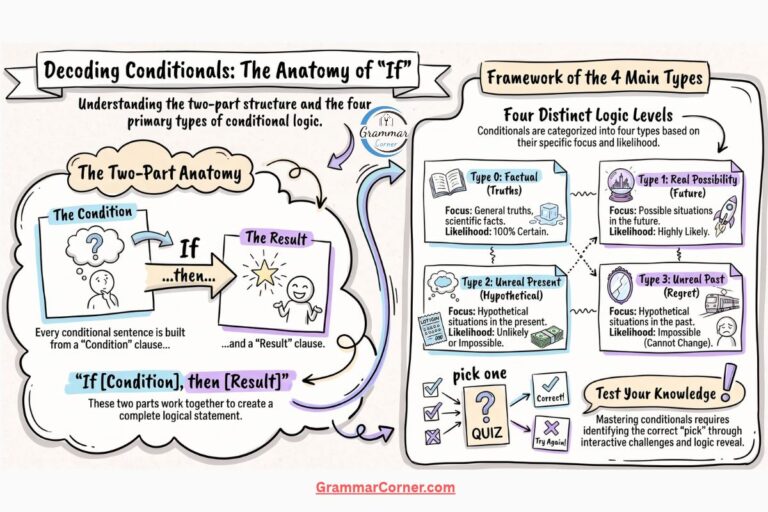
Third Conditional vs. Other Conditionals (Full Timeline)
Compare all four conditional types side-by-side to master how English handles reality and time:
| Conditional | Main Idea | Example Sentence |
|---|---|---|
| Zero | General truth / universal physical law | If you heat ice, it melts. |
| First | Realistic future possibility | If I study, I will pass. |
| Second | Imaginary / unlikely present or future | If I studied more, I would improve. |
| Third | Unreal / counterfactual finished past | If I had studied, I would have passed. |
The third conditional is the only conditional that looks backward into completed history. It takes you to a closed door in the past and asks you to imagine what would have occurred if you had unlocked it.
Quick Challenge
Which option correctly summarizes the difference between the Second and Third conditionals? Tap an option.
See the full explanation
Answer: B. Second conditional is for unreal present/future; Third conditional is for unreal past.
Grammar breakdown:
- Second Conditional:
If + Past Simple, would + Base Verb➔ Imagining something untrue about the present (“If I had time now, I would read”). - Third Conditional:
If + Past Perfect, would have + Past Participle➔ Imagining an alternate history for a finished past event (“If I had had time yesterday, I would have read”). - Timeline Anchor: Zero = general truth, First = future possibility, Second = imaginary present, Third = unalterable past.