Second Conditional (Structure, Rules and Examples)
What Is the Second Conditional?
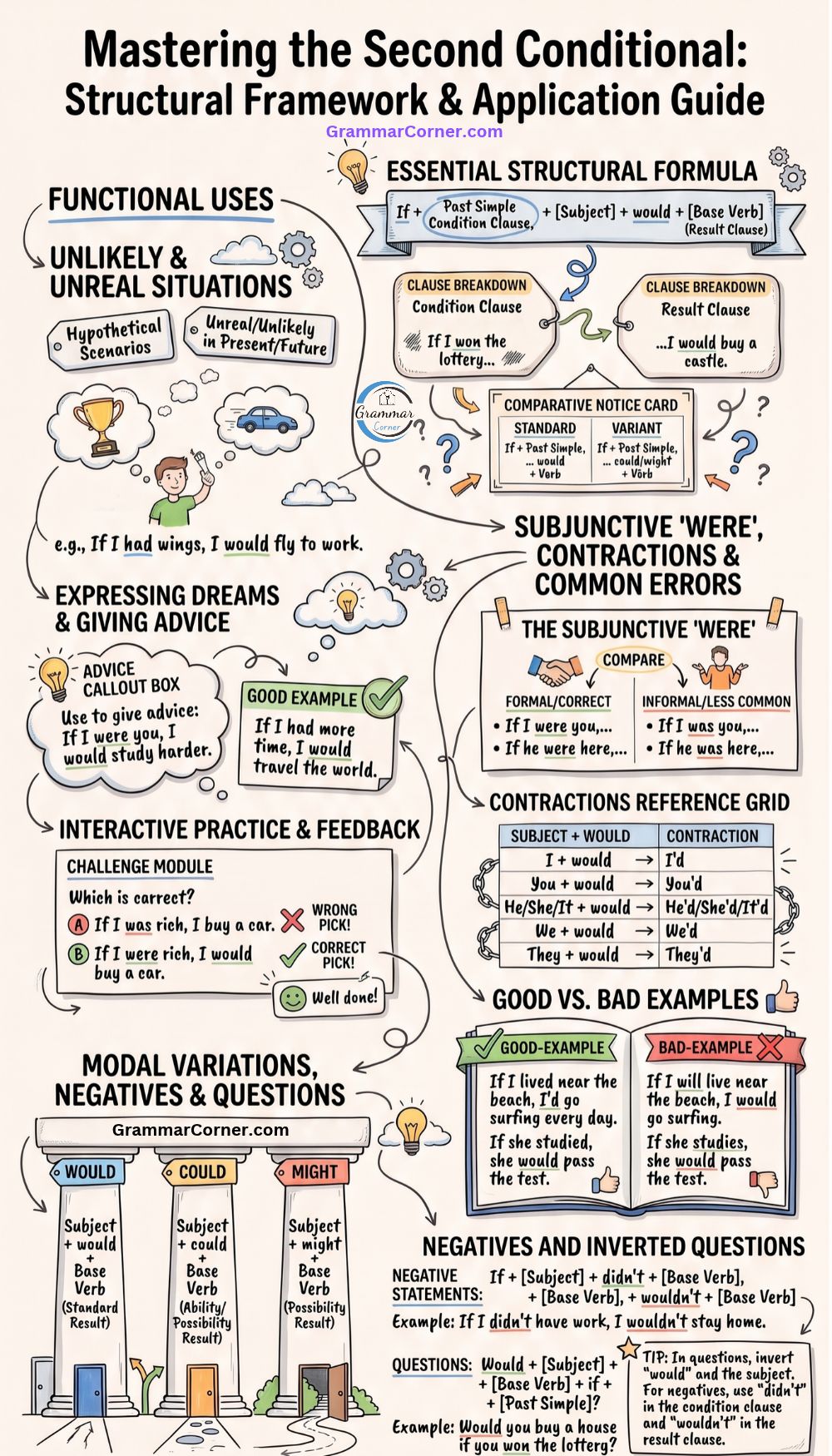
The second conditional is used to talk about situations that are imaginary, highly unlikely, or completely contrary to present reality. It allows speakers to explore hypothetical scenarios, express wishes, offer advice, and imagine alternative outcomes.
Common Uses of the Second Conditional
The second conditional is built around one guiding concept: “Imagine this situation—what would happen?” It adapts to a wide variety of communicative goals:
Structure of the Second Conditional
The standard formula links a hypothetical past-tense condition to an imagined result using would:
Presents the imaginary, counterfactual, or unlikely condition. The past simple tense indicates psychological distance from reality rather than past time:
• “If I were invisible”
• “If she knew the answer”
Presents the imagined consequence that would occur if the unreal condition were true:
• “I would explore the city.”
• “she would tell us.”
You can reverse the clauses without changing the meaning: “I would buy a new laptop if I had more money.” Remember that when the main clause comes first, no comma is needed.
Quick Challenge
Which option correctly completes the standard second conditional grammatical pattern? Tap an option.
See the full explanation
Answer: B. past simple, would
Grammar breakdown:
- Formula:
If + Past Simple (had / lived / were), would + Base Verb (fly / swim / buy). - Function: Establishes a hypothetical or unreal scenario in the present/future.
- Sentence Identification: In “If I were invisible, I would explore the city,” the condition is imaginary (Second Conditional), unlike “If it rains, I will stay home” (First Conditional) or “If water freezes, it becomes ice” (Zero Conditional).
When Do We Use the Second Conditional?
The second conditional steps away from present reality to explore hypothetical worlds, unlikely future possibilities, impossible abilities, and counterfactual circumstances. Whether a situation is completely impossible or merely improbable, this structure allows us to explore imagined outcomes.
Unlikely Future Situations vs. Unreal Present Situations
The second conditional operates across two primary time dimensions:
Events that could theoretically happen later, but are improbable:
- If I won the lottery, I would travel around the world.
- If I became famous, I would write a book.
- If our school won the national competition, we would celebrate.
- If I met my favourite actor, I would ask for an autograph.
- If I found a treasure chest, I would share it with my family.
Circumstances that are contrary to current facts right now:
- If I had a pet, I would play with it every day. (I don’t have a pet now)
- If I lived in London, I would visit museums. (I don’t live in London)
- If I had more free time, I would learn Spanish.
- If she knew the answer, she would tell us.
- If we lived closer to school, we would walk there.
We use the past simple (had, lived, knew, won) in the if-clause not because the action happened in the past, but because English uses past verb forms to signal psychological distance from reality (hypothetical or counterfactual statements).
Quick Challenge
What does the sentence “If I had a bicycle, I would ride it to school” imply about the speaker’s current situation? Tap your answer.
See the full explanation
Answer: B. The speaker does not currently have a bicycle.
Grammar breakdown:
- Formula:
If + Past Simple (had), would + Base Verb (would ride). - Counterfactual Present Meaning: The second conditional expresses an unreal present state. Saying “If I had a bicycle” indicates that in actual reality, the speaker lacks one right now.
- Distinctions:
- “If I finish school, I will go home” = First Conditional (realistic future).
- “If I won a million dollars, I would buy a house” = Second Conditional (unlikely future).
- “If water freezes, it becomes ice” = Zero Conditional (universal fact).
Second Conditional for Dreams and Imagination
The second conditional is the ideal grammar structure for talking about dreams, fantasies, and hypothetical superpowers. It frees the speaker from current reality to explore what they would do if they possessed special abilities, immense wealth, or extraordinary opportunities.
Imagining abilities outside natural human limits:
- If I could fly, I would travel everywhere.
- If I were invisible, I would explore the whole city.
- If I lived on the moon, I would look at Earth every night.
Envisioning grand goals and unique meetings:
- If I had a million dollars, I would build a big library.
- If I could meet any famous person, I would meet my favourite author.
Second Conditional for Giving Advice
One of the most natural and widely used formulas for giving polite advice in English is:
The speaker is not literally the listener; they are placing themselves in the other person’s shoes: “If I were in your exact situation, this is what I would do.”
In formal and standard English, the subjunctive were is used with all subjects (I, he, she, it) in hypothetical conditions. While “If I was you” appears in casual conversation, “If I were you” is preferred in writing, tests, and professional contexts.
Quick Challenge
Complete the advice using standard second conditional grammar: “If I were you, I ______ study for the test.” Tap an option.
See the full explanation
Answer: B. would
Grammar breakdown:
- Advice Formula:
If I were you, I would + Base Verb (study). - Function: Offers a recommendation by imagining oneself in the listener’s position.
- Imaginary Dreams Review: When expressing hypothetical wishes or special powers,
If + past form (had / could fly), would + base verballows open-ended creative expression (e.g., “If I could fly, I would visit many countries”).
Why Do We Say “If I Were”? (The Subjunctive Were)
The verb be behaves uniquely in the second conditional. In formal writing and standard English grammar, were is used across all grammatical subjects (I, he, she, it, we, they) to signal that a situation is purely hypothetical or contrary to present facts.
While casual speech frequently uses was (e.g., “If I was rich…”), were remains the standard, universally accepted form for academic writing, official exams, and grammar tests.
Second Conditional with “Would” + Base Verb
The main result clause of a second conditional sentence pairs the modal auxiliary would directly with the base form (bare infinitive) of the verb:
- I would travel.
- She would help.
- They would come.
- We would buy it.
❌ She would goes. ➔ Keep the base form (go).
❌ I would bought. ➔ Avoid past tense after would.
Contractions with “Would” (‘d)
In spoken English and informal writing, would readily contracts into ‘d when attached to personal subject pronouns:
- If I were rich, I’d travel the world.
- If she knew the answer, she’d tell us.
- If we had more time, we’d stay longer.
Quick Challenge
Which sentence correctly applies standard subjunctive grammar and modal verb formatting? Tap an option.
See the full explanation
Answer: B. If I were rich, I would buy a car.
Grammar breakdown:
- Subjunctive Were: Standard hypothetical conditions take were (e.g., If I were you / If I were rich).
- Base Verb Rule: Modals like would must be followed directly by the base infinitive verb (buy), never past forms (bought) or gerunds (buying).
- Contraction Insight: In natural conversation, “If I were rich, I’d buy a car” contracts I would to I’d.
Second Conditional with “Could” and “Might”
While would presents a definite imagined consequence, substituting could or might in the main result clause allows you to adjust the level of certainty or focus on hypothetical capability and permission.
Second Conditional in Negative Sentences
You can make the condition, the result, or both clauses negative depending on the meaning you want to express:
- If I didn’t have homework, I would play football.
- If she didn’t live so far away, she would visit us.
- If we didn’t need money, we would travel more.
- If I had more money, I wouldn’t worry so much.
- If she knew the answer, she wouldn’t ask you.
- If I were you, I wouldn’t do that.
Second Conditional Questions
Use second conditional questions to prompt others about imaginary choices, hypothetical reactions, and dreams:
- What would you do if you won the lottery?
- Would you travel if you had enough money?
- Where would you live if you could choose any country?
- Would you buy a car if you were rich?
- What would you eat if you could choose any meal?
Never put would or wouldn’t inside the opening condition clause. Write ✅ If I didn’t have homework, I would play instead of ❌ If I wouldn’t have homework…
Quick Challenge
Which sentence correctly forms a second conditional question about an imaginary scenario? Tap an option.
See the full explanation
Answer: A. What would you do if you won the lottery?
Grammar breakdown:
- Question Formula:
What + would + Subject (you) + Base Verb (do) + if + Past Simple (won)? - Negative Clause Check: In negative forms, use didn’t + base verb in the condition (If I didn’t have…) and wouldn’t + base verb in the result (I wouldn’t stay home).
- Modal Nuance Review: Would expresses a definite choice, could shows ability/possibility, and might indicates a weaker, less certain possibility.
Answering Second Conditional Questions
When replying to second conditional questions about hypothetical dreams or unreal situations, you can respond using a complete sentence, a contracted short response (I’d… / I wouldn’t…), or a concise yes/no modal answer.
Replying to open-ended scenarios:
Using modal short answers in conversation:
Changing the Order of the Clauses
A second conditional sentence can start with either the condition (if-clause) or the main result clause without changing the fundamental meaning:
✅ “If I had more money, I would buy a new laptop.”
✅ “I would buy a new laptop if I had more money.”
Second Conditional with “Unless”
Unless introduces a negative condition in hypothetical situations and functions as the equivalent of if not:
➔ Means: “I wouldn’t go if you didn’t come with me.”
➔ Means: She would not buy it if the price remained high.
Because unless already carries a negative meaning, adding didn’t creates an incorrect double negative:
✅ Clear & Correct: I wouldn’t go unless you came.
Always place a comma between clauses when the condition opens the sentence (“If I had more time, I would read more books”). When the clauses are flipped, drop the comma entirely.
Quick Challenge
Which sentence uses clear, grammatically sound second conditional structure with “unless” without creating a double negative? Tap an option.
See the full explanation
Answer: A. I wouldn’t go unless you came.
Grammar breakdown:
- Unless Function: Unless carries inherent negative meaning (if not), so the following verb remains affirmative in the past simple (came / were).
- Clause Order Rule: When the if/unless clause comes first, use a comma (“If I had more time, I would read more books”); when the main clause comes first, omit the comma.
- Short Answers: Conversational replies naturally use contracted modals (“I’d buy a house” or “Yes, I would”).
Second Conditional with “Even If”
Using even if intensifies the condition by emphasizing that the outcome or decision would remain completely unchanged, regardless of whether that extreme hypothetical scenario became reality.
➔ Gaining immense wealth would not alter the speaker’s frugal buying habits.
➔ Having endless leisure time would still not lead to spending all day in front of a screen.
Second Conditional and Imagination Words
To spark creative discussions or explore hypothetical scenarios in conversation, the second conditional often pairs with introductory imaginative markers:
- Imagine you were invisible. What would you do?
- Suppose you had one million dollars. How would you spend it?
- If I could choose any job, I would become a writer.
Second Conditional vs. First Conditional
While both conditionals can refer to future events, they reflect fundamentally different perspectives on perceived likelihood and reality:
The speaker treats securing the position as an open, realistic probability.
• “If I have enough money, I will buy a bicycle.”
Represents an actual future purchase plan.
The speaker is simply daydreaming or feels less confident about getting hired.
• “If I had enough money, I would buy a bicycle.”
Implies the speaker lacks the funds right now.
The grammar shifts based on how achievable the speaker views the condition. If you see a situation as attainable, use If + Present, will (First Conditional). If it feels improbable, distant, or counter to current facts, use If + Past, would (Second Conditional).
Quick Challenge
Which sentence conveys that getting a new bike is less likely or purely hypothetical in the speaker’s current situation? Tap an option.
See the full explanation
Answer: B. If I got a new bike, I would ride it every day.
Grammar breakdown:
- Formula:
If + Past Simple (got), would + Base Verb (would ride). - Likelihood Distinction: The second conditional marks psychological distance from reality, indicating that the speaker does not expect to acquire a bike soon.
- Connector Nuances:
- Even if emphasizes an unyielding outcome regardless of the condition.
- Suppose and Imagine serve as conversational starters for open hypothetical inquiries.
Second Conditional vs. Zero Conditional
The contrast between the zero and second conditionals comes down to routine reality versus pure imagination. While the zero conditional describes universal facts and predictable physiological habits, the second conditional invents hypothetical, extraordinary scenarios.
Describes an ordinary, repeated physical reaction that happens regularly.
• “If you heat water, it boils.”
A universal law of physics.
Imagines an extreme, hypothetical event rather than a regular occurrence.
• “If I had wings, I would fly.”
An impossible fantasy.
Second Conditional vs. Third Conditional
This comparison hinges on timeframe and counterfactuality:
“If I had more time, I would learn French.”
➔ Refers to my current lifestyle and present schedule: I do not have enough time right now.
“If I had had more time, I would have learned French.”
➔ Looks back at a completed historical window in the past that did not happen.
• Third: “If I had had more time, I would have read more.” (Talking about a past period, like last year).
Enhancing the Second Conditional with Adverbs
You can insert adverbs between would and the base verb to express precise degrees of certainty, confidence, or hesitation regarding your imagined outcome:
“If I won, I would certainly celebrate.”
“If I were you, I would never do that.”
Place the adverb directly between the modal auxiliary and the main verb: would + adverb + base verb (e.g., would definitely help, would probably go, would never accept).
Quick Challenge
Which sentence conveys a strong, confident belief in the imagined outcome? Tap an option.
See the full explanation
Answer: B. If I were rich, I would definitely travel.
Grammar breakdown:
- Adverb Placement: The adverb definitely sits right between the modal auxiliary would and the base verb travel to project high certainty.
- Timeframe Contrasts:
- “If I eat too much, I feel sick” = Zero Conditional (general repeated reality).
- “If I had more time, I would read” = Second Conditional (unreal present).
- “If I had had more time, I would have read” = Third Conditional (unreal past).
Common Mistakes with the Second Conditional
Because the second conditional combines a past-tense condition with a modal result clause to talk about hypothetical present or future scenarios, learners frequently make errors involving modal placement, verb forms, and conditional mix-ups.
✅ Correct: If I had more money, I would travel.
✅ Correct: If I were rich, I would travel.
✅ Correct: If I were rich, I would travel.
✅ Correct: If I had money, I would buy a car.
✅ Standard / Formal: If I were you, I would ask the teacher.
✅ Correct: If I had studied harder, I would have passed the exam.
Check both sides of your sentence: If-clause = past simple / were (no would). Result clause = would + base verb (no to, no past tense).
Quick Challenge
Which option correctly fixes all errors in the sentence: “If I would be rich, I will bought a big house”? Tap an option.
See the full explanation
Answer: B. If I were rich, I would buy a big house.
Grammar breakdown of errors fixed:
- Condition Clause: Change would be to the subjunctive past form were (If I were rich).
- Main Clause Modal: Change will to hypothetical would.
- Main Clause Verb Form: Change past form bought to base infinitive buy (would buy).
How to Identify the Second Conditional
To quickly recognize a second conditional sentence, apply a 3-question structural checklist. If the condition represents an imaginary or counterfactual scenario, uses a past-tense verb, and delivers a result with would + base verb, it is a second conditional.
The scenario is contrary to present reality or represents a distant, improbable dream.
Look for past simple verbs or subjunctive forms: had, knew, lived, went, studied, were.
Look for modal constructions like would buy, would travel, would help (or could/might).
Second Conditional in Everyday English
The second conditional is widely used in daily conversation to discuss personal dreams, career paths, travel desires, and practical advice:
• Second: “If I were you, I would study tonight.” (Hypothetical advice)
• Third: “If I had studied, I would have passed.” (Past regret)
Quick Challenge
Which sentence uses the second conditional to give personal advice? Tap an option.
See the full explanation
Answer: A. If I were you, I would study tonight.
Grammar breakdown:
- Formula:
If I were you, I would + Base Verb (study). - Function: Places the speaker in the listener’s position to offer empathetic, direct advice.
- Sentence Identification: In “If Sara had more free time, she would learn another language,” the condition uses past simple (had) and the result uses would learn, making it a Second Conditional sentence.
Practice Exercises on the Second Conditional
Reinforce your mastery of the second conditional (If + Past Simple / Were, would + Base Verb) through 9 comprehensive exercises covering fill-in-the-blanks, multiple choice, modal substitutions (could, might), negative rewrites, error correction, first vs. second comparisons, advice prompts, and reading comprehension.
Show Answers for Exercise 1
2. If she had more free time, she would read more.
3. If he knew the answer, he would tell us.
4. If we lived near the sea, we would swim every day.
5. If I could fly, I would visit many countries.
6. If they won the competition, they would celebrate.
A. have B. had C. will have
A. would play B. will play C. played
A. will call B. would call C. called
A. would visit B. will visit C. visited
A. will talk B. would talk C. talked
Show Answers for Exercise 2
2. A. would play (Hypothetical result)
3. B. would call (Modal result clause)
4. A. would visit (Unreal present result)
5. B. would talk (Advice formula)
Show Modal Guidelines & Answers
1. would (definite choice) / could (ability) / might (possibility)
2. would / could / might
3. could (ability) / would
4. would / could / might
5. would / could / might
Show Sample Negative Answers
2. If she knew the answer, she wouldn’t keep it secret. (or: she wouldn’t tell us)
3. If I were you, I wouldn’t do that.
4. If he had more time, he wouldn’t stay at home. (or: If he didn’t have time, he wouldn’t travel)
Show Corrected Sentences
2. will play ➔ If she were taller, she would play basketball.
3. would bought ➔ If I had more money, I would buy a car.
4. would to study ➔ If I were you, I would study harder.
5. would know ➔ If he knew the answer, he would tell us.
6. will fly ➔ If I had wings, I would fly.
7. would told ➔ If she knew the answer, she would tell us.
Show Sample Answers for Exercise 7
2. If I could choose any country, I would live in Japan.
3. If I had unlimited money, I would buy a large library.
4. If I could fly, I would travel around the world.
5. If money were not important, I would become a teacher.
Show Sample Advice Answers
2. If I were you, I would tell the teacher the truth.
3. If I were you, I would ask the teacher for help.
4. If I were you, I would save some money.
5. If I were you, I would talk to my friend calmly.
Show Story Comprehension Answers
2. Door to the past: She would meet famous people from history.
3. Door to the future: She would see what the world looked like.
4. If invisible: She would explore places that ordinary people could not enter.
Quick Challenge
Which sentence correctly applies second conditional grammar and subjunctive agreement to give advice? Tap an option.
See the full explanation
Answer: B. If I were you, I would talk to the teacher.
Grammar breakdown:
- Formula:
If I were you, I would + Base Verb (talk). - Subjunctive Rule: Were is the standard form for all subjects in hypothetical conditions.
- Modal Auxiliary Rule: Modals like would, could, and might take the bare infinitive (base form) without to.
Frequently Asked Questions About the Second Conditional
Find direct answers to the most common questions regarding the second conditional, including formula breakdowns, the reason for using past tenses for present meaning, subjunctive were rules, and key differences across conditional types.
- Could (Ability / Possibility): “If I had more free time, I could learn French.”
- Might (Uncertain Possibility): “If I had more free time, I might learn French.”
- Do not place would in the if-clause (Use “If I had…” not “If I would have…”).
- Do not use will in the main result clause of a second conditional (Use would).
- Do not add to after would (Use
would + base verb: “I would travel”, not “I would to travel”).
- Inversion: “I would travel if I had more money.” (No comma needed when main clause leads).
- Negative: “If I had more money, I wouldn’t worry.” / “If I were you, I wouldn’t do that.”
- Questions: “What would you do if you won the lottery?”
Second Conditional Quick Reference
| Feature | Second Conditional Rule / Detail |
|---|---|
| Main Use | Imaginary, unlikely, or unreal present/future situations |
| Timeframe | Unreal present or hypothetical future |
| If-Clause Form | Past simple (or subjunctive were) |
| Main Clause Form | would + base verb |
| Basic Formula | If + Past Simple, would + Base Verb |
| Common Fixed Form | If I were you, I would… (giving advice) |
| Other Result Modals | could (ability/possibility), might (uncertain possibility) |
| Negative Result Form | wouldn't + base verb (would not) |
| Question Pattern | Would + Subject + Base Verb + if + Past Simple? |
| Standard Example | If I had more money, I would travel. |
Quick Challenge
Which option correctly applies the second conditional formula for a hypothetical present scenario? Tap an option.
See the full explanation
Answer: B. If I had more money, I would travel.
Grammar breakdown:
- Formula:
If + Past Simple (had), would + Base Verb (travel). - Function: Describes an unreal present situation (the speaker does not currently have enough money).
- Key Takeaways: The past tense indicates psychological distance from reality, were is standard for all subjects, and would stays strictly in the main clause.