Zero Conditionals (Structure, Rules and Examples)
What Is the Zero Conditional?
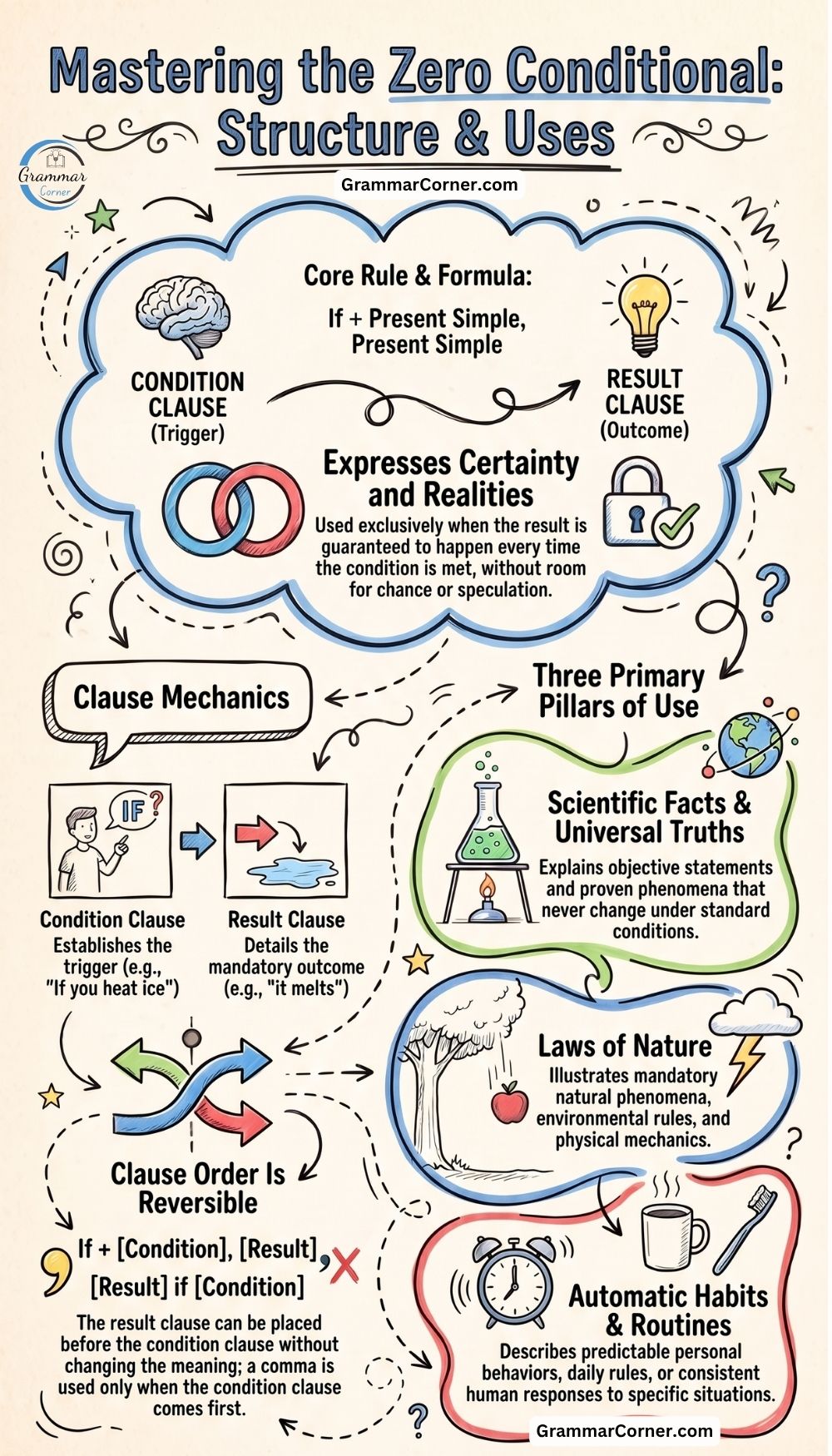
The zero conditional is one of the most straightforward and essential conditional forms in English. We use it to talk about scientific facts, general truths, natural laws, habits, routines, rules, and automatic cause-and-effect situations that consistently produce the exact same outcome.
Basic Formula and Sentence Structure
The zero conditional uses the present simple in both clauses because the outcome is always true:
- If you touch fire, it burns.
- If plants do not get water, they die.
- If you mix red and blue, you get purple.
- If water reaches 100°C, it boils.
- If people eat too much, they feel full.
- If Sara wakes up early, she feels fresh.
- If you finish your work, you can go outside.
- If the sun sets, it gets dark.
The zero conditional provides a clean foundation to describe natural patterns and give straightforward instructions. Remember: because the outcome is guaranteed, never use will in either clause when stating universal facts.
Quick Challenge
Which of the following sentences represents a zero conditional expressing a general truth? Tap an option.
See the full explanation
Answer: B. If you heat ice, it melts.
Grammar breakdown:
- Zero Conditional Rule:
If + Present Simple (heat), Present Simple (melts). - General Truth: It expresses 100% scientific certainty without shifting into future predictions (will) or imaginary scenarios (would).
- Distinction: Choice A is a First Conditional (possible future), while Choice C is a Second Conditional (hypothetical).
Understanding Condition & Result Clauses in the Zero Conditional
Every zero conditional sentence operates through a direct cause-and-effect relationship: a condition clause sets the prerequisite trigger, and a result clause delivers the automatic, inevitable outcome.
Specifies what must happen or be true. It commonly begins with if (or when) and does not need to be a deliberate human action—it can be a natural event or physical state:
• “If children are hungry”
• “If the temperature falls below zero”
Explains what normally happens whenever the condition occurs. It can describe a natural law, rule, habit, biological reaction, or instruction:
• “they often become restless.”
• “water freezes.”
Diverse Types of Results in Action
Because the result is directly tied to the condition, the zero conditional adapts cleanly across multiple everyday situations:
- Natural Laws: “If you freeze water, it becomes ice.”
- Habits & Routines: “If I skip breakfast, I feel hungry before lunch.”
- Social Rules & Traffic Laws: “If the traffic light is red, cars stop.”
- Mechanical Instructions: “If you press this button, the machine starts.”
- Biological Facts: “If a plant does not get enough sunlight, it grows poorly.”
Zero Conditional for General Truths
We use the zero conditional to state universal facts and broad truths rather than isolated, one-time occurrences:
A general truth in English grammar does not have to apply universally to every human on Earth. It can describe an automatic, consistent bodily or psychological reaction for a specific person:
Quick Challenge
Which of the following sentences correctly expresses a general truth using the zero conditional structure? Tap your answer.
See the full explanation
Answer: B. If you do not eat, you become hungry.
Grammar breakdown:
- Structure:
If + Present Simple (do not eat), Present Simple (become). - Function: Expresses an automatic biological fact (a general truth) that happens every time the condition is met.
- Condition vs. Result: In “If you leave milk outside, it goes bad,” “If you leave milk outside” is the condition clause, and “it goes bad” is the result clause.
Zero Conditional: Scientific Facts, Nature, and Daily Routines
Because the zero conditional establishes absolute cause-and-effect certainty, it is the primary grammatical structure used to express unchanging scientific laws, natural phenomena, and reliable personal routines.
Cause-and-effect laws that remain constant:
- If you heat water, it boils.
- If you cool water enough, it freezes.
- If you mix red and blue, you get purple.
- If you drop an object, gravity pulls it down.
Observable cycles and weather patterns:
- If the sun sets, the sky becomes darker.
- If it rains heavily, rivers can rise.
- If temperatures fall below freezing, water turns to ice.
- If strong winds blow, branches move.
A person’s predictable, repeated response:
- If I wake up early, I feel fresh.
- If Sara studies before breakfast, she remembers more.
- If Ali plays football, he sleeps well.
- If I drink tea before bed, I stay awake.
Universal Truths vs. Personal Patterns
Because habits and natural laws occur repeatedly, avoid adding will to the result clause. Stating “If the sun sets, it gets dark” describes an eternal natural truth, whereas “it will get dark” narrows the focus to one specific evening.
Quick Challenge
Which of the following sentences correctly describes a habitual routine using the zero conditional structure? Tap your answer.
See the full explanation
Answer: A. If I wake up early, I feel fresh.
Grammar breakdown:
- Formula:
If + Present Simple (wake up), Present Simple (feel). - Habitual Function: The sentence outlines a predictable personal pattern rather than predicting an isolated future action.
- Contrast: Sentence B is a First Conditional (specific future plan), while Sentence C is a Second Conditional (hypothetical).
Zero Conditional for Rules and Instructions
Beyond stating facts, the zero conditional is widely used to give clear directives, protocols, classroom instructions, and safety rules. In these sentences, the condition sets the trigger, while the result clause uses an imperative verb telling the listener what action to take.
- If the light is red, stop.
- If the door is locked, use the other entrance.
- If the alarm rings, leave the building immediately.
- If you finish your work, put your books away.
- If you need help, ask the teacher.
- If you finish the exercise, check your answers.
- If you do not understand the question, read it again.
- If the computer does not work, tell the technician.
Anatomy: If-Clause vs. Main Clause
Every conditional sentence is structured around two distinct clauses that link an initial trigger to its direct outcome:
Sets the prerequisite circumstance that occurs first.
Delivers the consequence, reaction, or instruction that follows.
Changing Clause Order & Punctuation Rules
You can place either clause first without altering the meaning. However, you must adjust the comma punctuation:
✅ “If you heat water, it boils.”
➔ Place a comma after the opening if-clause to separate it from the main clause.
✅ “Water boils if you heat it.”
➔ When the result comes first, if acts as a natural conjunction—no comma is needed.
Following these punctuation rules makes instructions and technical guidelines much easier to scan and read. Compare: ❌ If you touch fire it burns. vs. ✅ If you touch fire, it burns.
Quick Challenge
Which sentence gives a clear instruction / rule using correct zero conditional punctuation? Tap your answer.
See the full explanation
Answer: A. If the light is red, stop.
Grammar breakdown:
- Imperative Zero Conditional:
If + Present Simple (is red), Imperative (stop)directly gives an order or instruction based on a circumstance. - Punctuation Rule: Because the conditional clause opens the sentence, a comma must separate it from the result clause.
- Reversibility: The same sentence could be written as “Stop if the light is red” without any comma.
Can We Use “When” Instead of “If”?
Yes. In many zero conditional sentences, when freely replaces if because both introduce general, recurring, or predictable situations where the result is guaranteed to occur.
Zero Conditional with “Unless” (If Not)
Unless serves as an alternative connector meaning if… not:
Because unless is inherently negative, do not add not to the clause:
✅ Correct: Unless you water the plant, it dies.
Zero Conditional in Negative Sentences
You can make either the condition clause, the result clause, or both clauses negative using do not / does not in the present simple:
- If you do not water plants, they die.
- If a plant does not get sunlight, it grows poorly.
- If I do not eat breakfast, I feel hungry.
- If the machine does not receive power, it does not work.
- If you do not charge the phone, it does not work.
Using “Can” & Other Modal Verbs in the Zero Conditional
While the standard zero conditional uses present simple verbs in both clauses, the result clause can incorporate modal verbs to express ability, permission, possibility, or advice:
Forming Zero Conditional Questions
Questions in the zero conditional ask about general rules, natural laws, repeated reactions, or established routines:
Quick Challenge
Which of the following questions correctly uses the zero conditional to ask about an automatic general fact? Tap an option.
See the full explanation
Answer: B. What happens if you heat ice?
Grammar breakdown:
- Question Formula:
What happens if + Present Simple (heat)? - Function: Inquires about a permanent cause-and-effect relationship (scientific truth) rather than a future prediction or hypothetical dream.
- Variations: Remember that when replaces if for predictable events, unless means if not, and modal verbs like can and should add nuances of permission and advice.
Zero Conditional vs. First Conditional
Students frequently confuse the zero and first conditionals because both clauses can begin with if. The critical difference lies in the meaning: are you describing an unchanging general fact, or a specific, realistic future scenario?
Describes what generally happens (a regular experience or universal fact).
• “If you heat ice, it melts.” (Universal fact).
Focuses on one particular situation that might happen in the future.
• “If you put this ice in the sun, it will melt.” (A single occurrence).
Zero Conditional vs. Second Conditional
While the zero conditional describes something that is real and generally true, the second conditional describes a scenario that is imaginary, hypothetical, or highly unlikely.
“If I eat too much, I feel sick.”
This describes a real, repeated physical experience.
“If I ate ten cakes, I would feel sick.”
This describes a purely imagined situation (I am not actually eating ten cakes).
“If people do not sleep, they feel tired.”
“If I did not sleep tonight, I would feel tired tomorrow.”
A Simple Diagnostic Test
When you are unsure whether to use the zero or first conditional, pause and ask yourself:
- If it is generally true ➔ “If you drop glass, it breaks.” (Zero)
- If it is one specific future event ➔ “If you drop that glass, it will break.” (First)
Quick Challenge
Apply the simple diagnostic test. Which of the following sentences focuses on one specific future possibility rather than a general fact or an imaginary scenario?
See the full explanation
Answer: B. If I eat spicy food tonight, I will need some water.
Grammar breakdown:
- Choice A (Zero Conditional):
Present Simple + Present Simple. It describes a biological fact or regular habit (Zero = generally). - Choice B (First Conditional):
Present Simple + will + Base Verb. It applies the condition to a specific timeframe (“tonight”) with a likely future result (First = possibly later). - Choice C (Second Conditional):
Past Simple + would + Base Verb. It imagines an unlikely or counterfactual scenario.
Common Mistakes with the Zero Conditional
Because the zero conditional exclusively handles universal facts, repeated habits, and automatic rules, adding modal auxiliaries (will, would) or incorrect past verb forms disrupts its core formula. Avoid these six common errors.
✅ Correct: If you heat water, it boils.
✅ Correct: If you heat ice, it melts.
✅ Correct: If you heat ice, it melts.
✅ Correct: If plants don’t get water, they die.
✅ Correct: If you touch fire, it burns.
✅ Correct: If water reaches 100°C, it boils.
Quick Challenge
Which sentence correctly resolves both the subject-verb agreement and tense consistency to form a standard zero conditional? Tap an option.
See the full explanation
Answer: B. If plants don’t get water, they die.
Grammar breakdown:
- Plural Agreement: Plants is plural, requiring the auxiliary don’t (do not), not doesn’t.
- Zero Conditional Formula:
If + Present Simple (don't get), Present Simple (die). Avoid adding will or would when stating biological truths. - Punctuation Check: The comma after water correctly separates the opening if-clause from the main clause.
Practice Exercises on the Zero Conditional
Test your mastery of the zero conditional (If / When + Present Simple, Present Simple) across sentence identification, verb conjugation, negative forms, connectors, error corrections, and sentence construction.
B. If you heat water, it boils.
C. If I were rich, I would travel.
B. If plants do not get water tomorrow, they will die.
C. If plants had water, they would grow.
B. If I wake up early tomorrow, I will jog.
C. If I woke up early, I would jog.
Show Answers for Exercise 1
heat / boils)2. A (General biological truth:
do not get / die)3. A (Regular routine habit:
wake up / feel)
Show Answers for Exercise 2
2. If you mix red and blue, you get purple.
3. If plants do not get water, they die.
4. If I drink coffee late, I stay awake.
5. If people eat too much, they feel full.
6. If the sun sets, it becomes dark.
Show Answers for Exercise 3
2. If Ali doesn’t sleep enough, he feels tired.
3. If plants don’t get water, they die.
4. If Sara doesn’t study, she does not understand the lesson.
5. If the machine doesn’t receive electricity, it does not work.
Show Answers for Exercise 4
2. If / When (Both work for personal routines)
3. If / When (Both work for biological laws)
4. When (Most natural for predictable natural certainty)
5. If / When (Both work for color mixing laws)
Show Sample Rewrites for Exercise 5
2. You feel tired unless you get enough sleep. (or: Unless you sleep enough, you feel tired.)
3. The phone does not work unless you charge it.
Show Answers for Exercise 6
2. doesn’t ➔ If plants don’t get water, they die.
3. will burns ➔ If you touch fire, it burns.
4. heated ➔ If you heat ice, it melts.
5. will not ➔ If you don’t study, you do not understand the lesson.
6. will get ➔ If you mix red and blue, you get purple.
Show Sample Completions for Exercise 8
2. If I am hungry, I eat something.
3. If it rains, the ground gets wet.
4. If I study every day, I learn more.
5. If I do not sleep enough, I feel tired.
*Any completion using a grammatically sound present simple verb phrase is correct.
Quick Challenge
Which of the following sentences correctly applies the zero conditional formula without modal errors or tense shifts? Tap an option.
See the full explanation
Answer: “If you heat water, it boils.”
Grammar breakdown:
- Formula:
If + Present Simple (heat), Present Simple (boils). - Function: Expresses an unchanging scientific law that is always true whenever the condition is met.
- Punctuation Note: When the if-clause comes first, it is separated by a comma. If reversed (“Water boils if you heat it”), no comma is needed.
Frequently Asked Questions About the Zero Conditional
Find concise, authoritative answers to essential questions regarding the zero conditional formula, punctuation, connectors (when, unless), modal variations, imperative rules, and distinctions from first and second conditionals.
- When: Freely replaces if when introducing predictable, general truths (“When you heat ice, it melts”).
- Unless (= if not): Introduces a negative condition (“Plants die unless they get water” ➔ “if they do not get water”).
- Scientific Facts: “If you freeze water, it becomes ice.”
- Personal Habits: “If I drink coffee at night, I cannot sleep.” (Predictable personal reaction).
- Direct Instructions (Imperatives): “If you need help, ask the teacher.” / “If the alarm rings, leave the building.”
- Condition First (Comma Required): “If you heat water, it boils.”
- Result First (No Comma Needed): “Water boils if you heat it.”
Zero Conditional Quick Reference
| Feature | Zero Conditional Rule / Detail |
|---|---|
| Main Purpose | General truths, scientific facts, habits, rules, and predictable results |
| Typical Timeframe | Present or general time (all time / timeless) |
| Condition Clause | Present simple |
| Result Clause | Present simple (or Imperative / Modal) |
| Basic Formula | If + Present Simple, Present Simple |
| Alternative Marker | When (for predictable truths) |
| Negative Condition | Unless / if ... not |
| Result Variations | Imperatives (instructions) or Modals (can, may, should) |
| Representative Example | If you heat ice, it melts. |
Quick Challenge
Which of the following sentences represents a grammatically sound zero conditional instruction / rule with proper comma punctuation? Tap an option.
See the full explanation
Answer: A. If you need help, ask the teacher.
Grammar breakdown:
- Formula:
If + Present Simple (need), Imperative (ask). - Imperative Function: Direct instructions and classroom rules commonly use the imperative base verb in place of a second subject-verb clause.
- Connector & Punctuation Checks: The opening condition is correctly followed by a comma. In Choice B, unless already means if not and must not contain don’t; in Choice C, will must never appear in the if-clause.