4 Types of Conditionals in English (Rules and Examples)
Introduction to Conditional Sentences
Conditional sentences express the relationship between a specific situation and its resulting outcome. We use them to discuss universal facts, future possibilities, plans, hypothetical scenarios, and counterfactual past events.
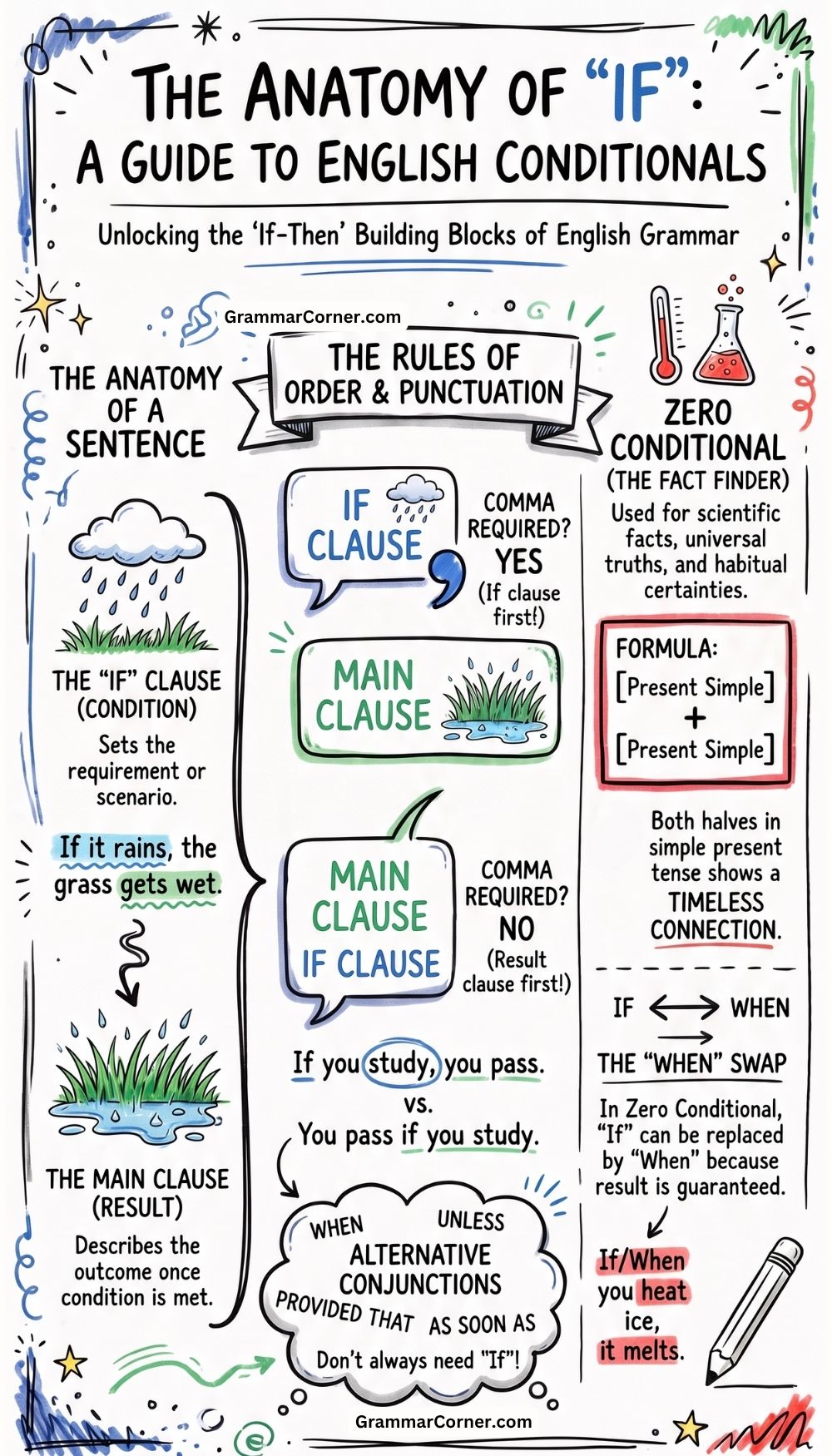
The Anatomy of a Conditional Sentence
Most conditional sentences consist of two complementary parts:
The Four Main Types of Conditional Sentences
Understanding conditionals relies on evaluating two core factors: time and possibility.
Describes scientific facts, habits, and universal rules that are always true whenever the condition occurs.
Talks about realistic situations and likely outcomes in the present or future.
Explores hypothetical, improbable, or imaginary scenarios in the present or future.
Reflects on past situations that did not happen and imagines what the outcome would have been.
English also features mixed conditionals, which combine elements from different conditional structures (such as a past condition with a present result, or a continuing condition with a past result) to link different timeframes.
Quick Summary of Conditional Types
| Conditional Type | Primary Purpose | What It Explores |
|---|---|---|
| Zero Conditional | General Truths & Facts | 100% certainty (cause and effect) |
| First Conditional | Real Future Possibilities | Likely real-world outcomes |
| Second Conditional | Hypothetical / Imaginary | Unlikely or unreal present/future |
| Third Conditional | Unreal Past Situations | Counterfactual past regrets or reflections |
| Mixed Conditionals | Connecting Different Times | Past conditions with present results, and vice versa |
Quick Challenge
In the sentence “If it rains tomorrow, we will stay at home,” which part represents the condition? Tap your answer.
See the full explanation
Answer: “If it rains tomorrow”
Sentence structure breakdown:
- The Condition: “If it rains tomorrow” specifies the circumstance that must occur first.
- The Result: “we will stay at home” indicates what will happen if that condition is met.
- Core Rule: A conditional sentence always pairs a condition (if-clause) with its logical consequence (main clause).
Conditional Sentences with “IF” and the “Main Clause”
Every standard conditional sentence functions through two essential components: the if-clause, which establishes the prerequisite condition, and the main clause, which delivers the outcome or result.
Specifies the scenario, trigger, or event that must happen first.
Explains what happens, will happen, or would happen as a consequence.
Reversing Clause Order & Punctuation Rules
You can reverse the position of the clauses without altering the fundamental meaning of the sentence. However, pay close attention to comma placement:
“If you study hard, you will pass the test.”
➔ Use a comma after the if-clause when it begins the sentence.
“You will pass the test if you study hard.”
➔ No comma is required when the main clause comes first.
Do You Always Need “If”?
While if is the most common conditional marker, English uses several other conjunctions to introduce conditions:
Quick Challenge
In the sentence “If you finish your homework, you can watch television,” which part is the condition? Tap your answer.
See the full explanation
Answer: A. If you finish your homework
Sentence structure breakdown:
- The If-Clause (Condition): “If you finish your homework” states the required situation that must occur first.
- The Main Clause (Result): “you can watch television” states what is allowed or happens as a result.
- Punctuation Note: Because the condition appears at the beginning of the sentence, it is followed by a comma before the main clause.
Overview: The Four Types of Conditionals
The primary difference between the four conditional structures lies in timeframe and degree of possibility. Use this reference table to compare their structures and functions at a glance.
| Conditional Type | Main Use | Basic Structure | Example |
|---|---|---|---|
| Zero | Facts and general truths | If + present, present |
If you heat ice, it melts. |
| First | Real future possibilities | If + present, will + verb |
If it rains, we will stay home. |
| Second | Imaginary or unlikely situations | If + past, would + verb |
If I were rich, I would travel. |
| Third | Unreal past situations | If + past perf., would have + V3 |
If I had studied, I would have passed. |
Zero Conditional: Facts, Rules, and Habits
The zero conditional expresses universal truths, scientific facts, natural laws, rules, routines, and automatic cause-and-effect relationships that produce the same result every time.
- If you heat water, it boils.
- If you mix blue and yellow, you get green.
- If plants do not get water, they die.
- If you touch fire, it burns.
- If the sun sets, it gets dark.
- If I wake up early, I feel fresh.
- If Sara studies in the morning, she remembers more.
- If people eat too much, they feel full.
- If children eat too much candy, they feel sick.
Zero Conditional with “When” vs. First Conditional
Because zero conditionals express universal truths, you can freely replace if with when without altering the meaning:
• First Conditional (Specific Future Event): “If you heat the ice, it will melt.” (Refers to a specific piece of ice in a particular upcoming situation).
Clause Reversal & Punctuation Rules
Just like other conditional forms, you can place the result clause before the condition:
✅ “If you freeze water, it becomes ice.”
✅ “Water becomes ice if you freeze it.”
Quick Challenge
Which sentence correctly uses the zero conditional to describe a general scientific truth with proper punctuation? Tap your answer.
See the full explanation
Answer: “If you heat ice, it melts.”
Grammar breakdown:
- Formula:
If + Present Simple (heat), Present Simple (melts). - Function: Expresses an unchanging scientific truth and physical law.
- Punctuation Rule: When the if-clause begins the sentence, place a comma immediately after it. If reversed (“Ice melts if you heat it”), no comma is used.
First Conditional: Real Future Possibilities
The first conditional is used for realistic, possible situations in the present or future. It indicates that if the condition is fulfilled, the result has a very strong and real chance of happening.
- If it rains, we will stay home.
- If I finish my homework, I will play football.
- If she studies hard, she will pass the test.
- If we leave early, we will catch the bus.
- If they arrive early, we will eat together.
Everyday Applications: Plans & Warnings
We primarily use first conditional sentences when coordinating upcoming plans or issuing realistic warnings:
- If the weather is good, we will go to the park.
- If Dad comes home early, we will eat dinner together.
- If I have enough money, I will buy a new bag.
- If you touch that hot pan, you will burn your hand.
- If you do not hurry, you will miss the bus.
- If you do not study, you will find the test difficult.
The Golden Rule: Never Use “Will” in the If-Clause
Even though the sentence refers entirely to a future situation, the verb in the if-clause must remain in the present simple. Will belongs strictly in the main (result) clause.
Other Modal Verbs in the First Conditional
The result clause does not always require will. You can substitute other modal verbs to express varying degrees of certainty, ability, possibility, or advice:
Quick Challenge
Which of the following sentences correctly applies the first conditional formula and gives advice in the main result clause? Tap your answer.
See the full explanation
Answer: “If you are tired after work, you should rest.”
Grammar breakdown:
- If-Clause Tense: “If you are tired” correctly uses the present simple to set up the condition.
- Modal Shift: Replacing will with should in the result clause transforms the statement from a simple prediction into direct advice.
- Core Takeaway: In the first conditional (
If + Present Simple, Modal + Verb), will marks certainty, may/might indicates possibility, can denotes ability, and should provides guidance.
Second Conditional: Unreal or Unlikely Situations
The second conditional describes situations that are imaginary, contrary to present reality, or highly improbable in the present or future. It explores “what if” scenarios rather than realistic expectations.
- If I were rich, I would travel around the world.
- If I had a flying car, I would visit many countries.
- If she knew the answer, she would tell us.
- If we lived near the sea, we would swim every day.
Everyday Applications: Dreams, Wishes & Advice
- If I had a million dollars, I would build a school.
- If I could fly, I would travel everywhere.
- If I lived in London, I would visit the museums every weekend.
- If I were you, I would study harder.
- If I were you, I would talk to your teacher.
- If I were you, I would save some money.
- If I were you, I would apologise.
In standard formal English, the subjunctive form were is used for all subjects (I, he, she, it) in unreal or hypothetical conditional clauses:
• “If he were taller, he could play basketball.”
• “If they were ready, we would leave.”
Second Conditional vs. First Conditional
“If I save enough money, I will buy a bicycle.” / “If I win the competition, I will buy a laptop.”
“If I had a million dollars, I would buy a bicycle factory.” / “If I won a million dollars, I would buy a laptop.”
Third Conditional: Unreal Past Situations
The third conditional reflects on past events that did not occur and imagines what the outcome would have been. Because the past is finished, the condition can never be changed. It is frequently used for regrets, missed opportunities, and past reflections.
- If she had left earlier, she would have caught the bus.
- If we had studied the map, we would not have gotten lost.
- If he had listened to his teacher, he would have avoided the mistake.
- If I had known, I would have helped.
- If they had left early, they would have arrived on time.
Using “Could Have” and “Might Have” in the Third Conditional
Substituting would have with other past modals allows you to express possibility or ability in counterfactual past situations:
Quick Challenge
Which of the following sentences correctly expresses an unreal past situation with possibility/uncertainty using the third conditional? Tap your answer.
See the full explanation
Answer: “If they had practised more, they might have won the match.”
Grammar breakdown:
- Past Perfect Condition: “If they had practised” (
had + past participle) sets up the counterfactual past condition. - Modal Result: “might have won” (
might have + past participle) expresses a possible, but uncertain, imagined outcome in the past. - Second vs. Third Conditional: Second conditional talks about imaginary present/future states (
If + Past Simple, would + Verb), while Third conditional reflects on unchangeable past events (If + Past Perfect, would have + V3).
Second Conditional vs. Third Conditional
Both the second and third conditionals describe unreal (counterfactual) situations, but they apply to entirely different timeframes.
Unreal or hypothetical current state:
• “If I had more free time, I would learn French.” (Current lack of time).
Unreal past situation that is over and unchangeable:
• “If I had had more free time last year, I would have learned French.”
Mixed Conditionals: Bridging Different Times
When a condition in one timeframe produces a result in another timeframe, we use a mixed conditional. Two patterns are especially prevalent in English:
An alternate past event alters a current present state:
- “If I had studied medicine, I would be a doctor now.”
- “If she had taken that job, she would live in London now.”
A continuous, permanent personality trait or present state explains a past outcome:
- “If I were more organised, I would have finished the project yesterday.”
- “If he were more careful, he would not have broken the glass.”
Using “Unless” in Conditional Sentences
Unless serves as an alternative connector meaning if not:
Because unless already contains a negative meaning (if not), do not add a negative auxiliary inside the clause:
✅ Correct: Unless you study, you will fail. (Or: If you do not study, you will fail.)
“If” vs. “When” in Conditional Sentences
While both words introduce situations, they express different levels of certainty:
Used when the event may or may not occur:
Used for expected events or universal facts:
• “When water reaches 100°C, it boils.”
Conditional Sentences Without “If”
English offers several alternative expressions to introduce conditions with specialized nuances:
- You can go outside as long as you finish your homework.
- You can borrow my book provided that you return it tomorrow.
- Take an umbrella in case it rains.
- You will not pass unless you study.
Clause Order & Punctuation Rules
Across all conditional types, clause order can be reversed with no shift in fundamental meaning:
✅ “If you study, you will pass.” / “If I finish early, I will call you.”
✅ “You will pass if you study.” / “I will call you if I finish early.”
Quick Challenge
Which of the following sentences correctly demonstrates a mixed conditional connecting a counterfactual past action to a present result? Tap your answer.
See the full explanation
Answer: “If I had studied medicine, I would be a doctor now.”
Grammar breakdown:
- Mixed Conditional Structure:
If + Past Perfect (had studied), would + Base Verb (be ... now). - Time Bridge: Connects an unreal past choice (not studying medicine years ago) directly to a present reality (not being a doctor currently).
- Connector Checks: Remember that unless means if not and must not contain double negatives, and clauses starting with if require a comma before the main clause.
Common Conditional Mistakes to Avoid
Because conditional sentences pair complex tense combinations across two separate clauses, errors frequently occur in auxiliary placement, verb forms, and subjunctive agreements. Master these seven critical corrections.
✅ Correct: If I see him, I will tell him.
✅ Correct: If I had known, I would have helped.
✅ Correct: If I had studied, I would have passed.
would have + V3):
✅ Correct: If I had studied, I would have passed the test.
✅ Correct: If it rains, we will stay home.
✅ Standard Form: If I were you…
✅ Correct: If I had studied, I would have passed.
How to Choose the Correct Conditional
When deciding which conditional structure to use, ask two fundamental diagnostic questions:
- Is it a universal/general truth?
- Is it a real upcoming future event?
- Is it an imaginary present or hypothetical future?
- Is it a finished past situation?
- 100% Certain Fact ➔ Zero Conditional
- Real / Possible Outcome ➔ First Conditional
- Unlikely / Imagined Scenario ➔ Second Conditional
- Counterfactual Past (Did not happen) ➔ Third Conditional
Diagnostic Reference Table
| Target Situation | Conditional Type | Example |
|---|---|---|
| General Fact / Universal Truth | Zero | If you drop glass, it breaks. |
| Real Future Possibility | First | If it rains, I will take an umbrella. |
| Imaginary / Unlikely Present or Future | Second | If I were invisible, I would explore the city. |
| Unreal Past Situation (Regret / Reflection) | Third | If I had left earlier, I would have caught the bus. |
| Different Time Periods Combined | Mixed | If I had studied medicine, I would be a doctor now. |
Quick Challenge
Identify which conditional structure is used in the sentence: “If I had more free time, I would learn another language.” Tap your answer.
See the full explanation
Answer: C. Second conditional
Structure and meaning analysis:
- Clause Breakdown: “If I had more free time” (
Past Simple: had) + “I would learn another language” (would + base verb: learn). - Function: Describes an unreal present state (the speaker does not have free time right now, but is imagining what they would do).
- Mistake Check: Notice that would is never used in the if-clause (avoid “If I would have more time”), and will is avoided for purely hypothetical scenarios.
Conditional Sentences in Everyday English
Conditionals are far more than academic grammar formulas—native speakers use them continuously in everyday communication to plan, advise, promise, speculate, and express regrets.
Comprehensive Practice Exercises
Work through each exercise on your own to test your conditional mastery, then expand the answer drop-downs to verify your solutions and review grammatical explanations.
Show Answers for Exercise 1
2. First Conditional (Real future possibility)
3. Second Conditional (Imaginary present state)
4. Third Conditional (Unreal past event)
5. Zero Conditional (Biological rule)
6. First Conditional (Future plan/promise)
7. Second Conditional (Hypothetical condition)
8. Third Conditional (Past missed opportunity)
If + Present Simple, will + Base Verb:Show Answers for Exercise 2
2. If I study hard, I will pass the test.
3. If Sara comes early, we will eat together.
4. If you hurry, you will catch the bus.
5. If they save money, they will buy a new computer.
If + Past Simple, would + Base Verb:Show Answers for Exercise 3
2. If she had more time, she would read more books.
3. If we lived near the sea, we would swim every day.
4. If Ali knew the answer, he would tell us.
5. If I could fly, I would travel everywhere.
If + had + V3, would have + V3:Show Answers for Exercise 4
2. If she had left earlier, she would have caught the bus.
3. If they had practised, they would have won the match.
4. If we had known, we would have helped you.
5. If he had listened, he would have avoided the mistake.
A. boils | B. will boil | C. would boil
A. watch | B. will watch | C. would watch
A. will go | B. would go | C. went
A. will pass | B. would pass | C. would have passed
Show Answers for Exercise 5
2. B. will watch (First conditional future plan)
3. B. would go (Second conditional imaginary desire)
4. C. would have passed (Third conditional past outcome)
Show Answers for Exercise 6
2. would be ➔ If I were rich, I would buy a house.
3. had study ➔ If I had studied, I would have passed.
4. was ➔ If I were you, I would apologise.
5. rains we ➔ If it rains, we will stay home. (comma required)
6. would catch ➔ If I had left earlier, I would have caught the bus.
Show Sample Completions for Exercise 7
2. If it rains tomorrow, I will stay home. (will + Base Verb)
3. If I were a bird, I would fly across the sea. (would + Base Verb)
4. If I had studied harder, I would have passed the test. (would have + V3)
5. If you heat ice, it melts. (Present Simple)
Show Detailed Paragraph Breakdown
- “If I have free time tomorrow, I will visit my friend.” ➔ First Conditional (Realistic future possibility).
- “If I visit him, we will play football.” ➔ First Conditional (Future plan based on condition).
- “If I were rich, I would build a large football ground.” ➔ Second Conditional (Imaginary current desire / hypothetical state).
- “If I had played football professionally, I would be a famous player now.” ➔ Mixed Conditional (Unreal past career choice linked to present celebrity status).
Quick Challenge
Which conditional structure is traditionally and most effectively used in everyday English to give advice to someone facing a dilemma? Tap your answer.
See the full explanation
Answer: C. Second conditional
Summary of advice constructions:
- The Advice Pattern: “If I were you, I would [base verb]…” uses the hypothetical subjunctive (Second Conditional) to offer friendly guidance.
- Examples: “If I were you, I would talk to the manager.” / “If I were you, I would take a break.”
- Core takeaway: While the first conditional can provide advice via modal verbs (“If you are tired, you should rest”), the classic advisory idiom itself is built entirely on the second conditional framework.
Frequently Asked Questions About Conditionals
Explore direct answers to the most common questions regarding conditional types, modal usage (will/would), subjunctive forms (were), connector alternatives (unless/when), and clause order rules.
Associate each type with its core conceptual trigger:
- Zero Conditional ➔ General truths, natural laws, and repeated routines (“If you heat water, it boils.”).
- First Conditional ➔ Real, probable future situations and plans (“If it rains tomorrow, I will stay home.”).
- Second Conditional ➔ Imaginary, hypothetical present/future states (“If I were rich, I would travel the world.”).
- Third Conditional ➔ Counterfactual past situations and regrets (“If I had studied, I would have passed.”).
- Mixed Conditional ➔ Combines different timeframes (“If I had studied medicine, I would be a doctor now.”).
- If-clause first (Comma needed): “If it rains, we will stay home.”
- Main clause first (No comma needed): “We will stay home if it rains.”
- Unless = If not: “Unless you hurry, you will miss the bus” means “If you do not hurry…”.
- When = Certain / Expected: “When you heat ice, it melts” indicates a natural certainty.
- If = Possible / Uncertain: “If it rains tomorrow, we will stay home” indicates an uncertain condition.
Conditional Sentences: Quick Reference Chart
| Type | Main Use | If-Clause | Result Clause | Example |
|---|---|---|---|---|
| Zero | Facts / General Truths | Present simple |
Present simple |
If you heat ice, it melts. |
| First | Real Future Possibility | Present simple |
will + base verb |
If it rains, I will stay home. |
| Second | Imaginary / Unlikely | Past simple (were) |
would + base verb |
If I were rich, I would travel. |
| Third | Unreal Past Event | Past perfect (had+V3) |
would have + V3 |
If I had studied, I would have passed. |
| Mixed | Different Time Periods | Past perf. / Past simple |
would + V1 / would have+V3 |
If I had studied medicine, I would be a doctor now. |
Quick Challenge
Which of the following sentences follows the correct modal and clause-order grammar across all conditional rules? Tap your answer.
See the full explanation
Answer: “If I see Sara tomorrow, I will invite her to the party.”
Grammar rule review:
- First Conditional Rule:
If + Present Simple (see), will + Base Verb (will invite). Will is never placed in the if-clause. - Third Conditional Rule: The condition clause requires
had + past participle(“If I had studied…”), not would have. - Unless Rule: Unless already means if not, so avoid adding don’t/doesn’t to the clause.