Staccato Sentences (Definition, Structure, Examples) | Comprehensive Guide
What Are Staccato Sentences?
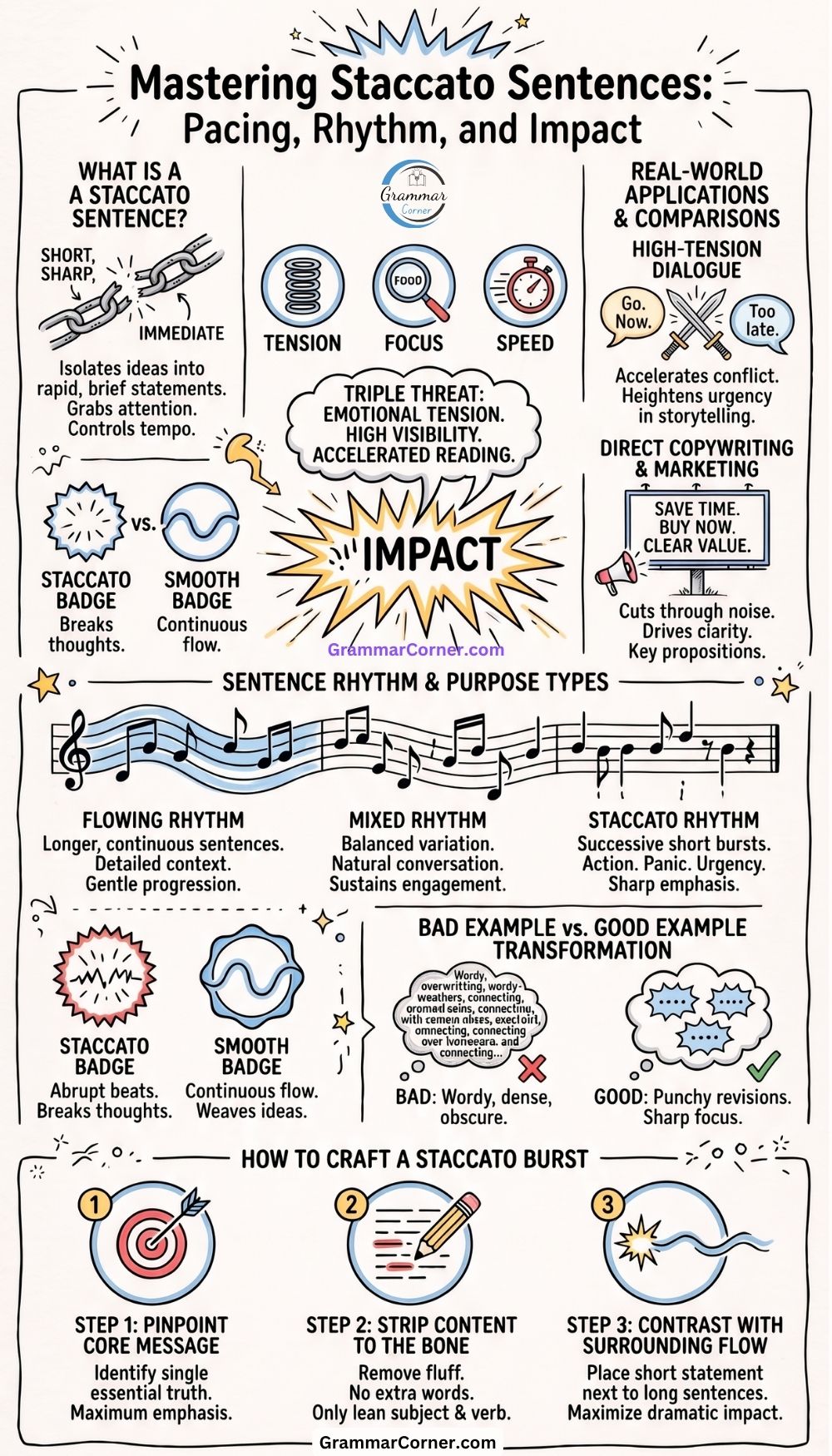
Staccato sentences are short, sharply separated sentences placed close together to establish a distinct rhythm, build intense dramatic emphasis, or evoke a strong emotional effect.
The Rhythm in Action
Notice the immediate sensory impact of this sequence:
Notice how these sentences feel on the page:
- The vocabulary is simple and stripped down.
- The sentences are brief and punchy.
- Each full stop forces a deliberate pause before the next beat arrives.
This abrupt pacing makes the prose feel quick, tense, and laser-focused—the signature hallmark of the staccato style.
When Should Writers Use Staccato Sentences?
Borrowed from the musical term staccato (meaning detached or sharply disconnected beats), this stylistic technique is especially powerful when crafting specific emotional tones:
Comparing Staccato vs. Flowing Structures
Examine how breaking actions into individual sentences fundamentally alters narrative energy:
“The door opened. He looked up. He froze.”
Each sentence isolates a single action. The periods act as hard visual and mental breaks, producing an abrupt, tense, and cinematic atmosphere.
“When the door opened, he looked up and immediately froze.”
Fully grammatical and natural, but smooth and fluid. The actions connect seamlessly rather than hitting the reader in rapid succession.
✨ Quick Challenge
Which passage demonstrates the staccato sentence style to create rapid pacing, tension, or urgency? Tap your answer.
See the full answer
Answer: “The lights went out. The phone rang. He hesitated.”
The staccato style relies on specific structural characteristics:
- Short, separate sentences: Each individual action gets its own full stop (period).
- Minimal connector words: Avoids conjunctions (like because, although, and) that smooth out transitions.
- Dramatic rhythm: Forces deliberate, rapid pauses to heighten suspense, urgency, or sudden realization.
Are Staccato Sentences Always Complete Sentences?
A staccato passage may contain fully grammatical, complete sentences, deliberate stylistic fragments, or even single-word utterances depending on the narrative rhythm and intent.
Consider this example:
• “The lights went out” and “He waited” are complete independent sentences.
• “Silence.” is a one-word fragment used intentionally to produce a sharp dramatic punch.
Comparing Complete vs. Fragmented Staccato Styles
Every clause is a fully formed, grammatically complete sentence with a subject and verb.
The trailing elements are fragments that amplify suspense and tension.
Staccato Sentences vs. Short Sentences
While both techniques use few words, their core function and rhythmic impact differ:
- Short Sentence: Simply a standalone sentence with a low word count (e.g., “The boy smiled.”).
- Staccato Sentence: A short sentence specifically built into a sequence that generates a rapid, clipped, or detached beat.
Feature Comparison: Short vs. Staccato Sentences
| Feature | Short Sentence | Staccato Sentence |
|---|---|---|
| Usually brief in length? | Yes | Yes |
| Can stand alone? | Yes | Often (or as part of a beat) |
| Creates a clipped rhythm? | Not necessarily | Usually |
| Used for intense emphasis? | Sometimes | Frequently |
| Requires a sequence of short units? | No | Creates a stronger cumulative effect |
| Can include intentional fragments? | Not necessarily | Sometimes |
| Common in dramatic narrative writing? | Sometimes | Yes |
How Do Staccato Sentences Affect Writing?
Staccato structures alter reader perception by breaking information down into rapid, distinct beats:
Pacing Comparison in Action
“The storm grew stronger as the wind shook the windows and rain struck the roof.”
Provides a smooth, uninterrupted atmospheric description.
“The wind rose. The windows shook. Rain hammered the roof.”
Forces the reader to experience each sensory impact as an isolated, immediate event.
What Is the Main Purpose of Staccato Sentences?
Staccato sentences are a deliberate rhetorical and stylistic tool. To be effective, they should be used with intentional purpose:
Isolates an idea so it commands full focus.
Delays revelation and makes the reader anticipate each step.
Drives momentum by chaining quick, kinetic actions.
Mirrors the stunned, fragmented nature of a sudden reaction.
Adds force and finality to anger, determination, or panic.
Presents direct instructions that are clean and scannable.
Staccato Sentences and Reading Pace
Sentence length fundamentally controls reader pacing. Notice the distinct rhythm of each style:
Writing Styles at a Glance
| Writing Style | Typical Rhythm | Common Effect |
|---|---|---|
| Long flowing sentences | Smooth and continuous | Reflection, context, or detailed description |
| Mixed sentence lengths | Varied and flexible | Natural, balanced narrative flow |
| Staccato sentences | Short, sharp, and interrupted | Urgency, tension, and hard emphasis |
Staccato Sentences vs. Flowing Sentences
Strong writing rarely relies entirely on one pattern. A long sentence establishes rich setting and context, while an abrupt staccato line cuts through to focus immediate attention:
The opening complex sentence immerses the reader in the atmosphere. The trailing staccato burst snaps attention straight into the action.
Why Mixing Sentence Lengths Works
- If every sentence is long, the writing feels heavy and exhausting.
- If every sentence is short, the writing feels robotic and mechanical.
- Varying between long, medium, and short constructs keeps the rhythm alive and gives isolated short lines tremendous impact.
Where Are Staccato Sentences Used?
Staccato Sentences in Fiction
Fiction authors deploy staccato passages during high-stakes emotional beats, heated arguments, moments of fear, and sudden realizations:
Staccato Sentences in Action Scenes
Action beats move too quickly for long, multi-clause descriptions. Short bursts mirror physical movement directly:
Each clause frames a single kinetic event as it occurs.
Staccato Sentences in Real-World Contexts
Beyond creative fiction, short and sharply defined sentences play a major stylistic role across various forms of communication:
Captures real speech when characters are angry, terrified, or surprised.
Repeated parallel units make key arguments powerful and memorable.
Delivers instant energy and maximum recall using punchy imperatives.
Conveys rapidly unfolding developments without heavy syntax.
Staccato Sentences in Online Writing
Digital formats—such as blog posts, newsletters, user instructions, and UI copy—rely heavily on brief structures to boost readability:
Important Note: While concise phrasing makes copy effortless to scan, informational content still requires sufficient detail. Brevity should enhance clarity, not replace explanation.
How to Write Effective Staccato Sentences
Crafting impactful staccato prose involves more than simply chopping a long sentence into fragments. Follow this 5-step refinement workflow:
Beats: (1) The man entered → (2) Everyone stopped talking → (3) They looked at him.
If every sentence shares an identical word count, the cadence becomes monotonous. Ensure the pauses land squarely on the most impactful moments.
How Punctuation Creates a Staccato Effect
Punctuation serves as the conductor for your prose rhythm. In staccato writing, punctuation marks act as hard stops that force the reader to reset their internal tempo.
The primary tool for staccato rhythm. They force complete stops.
Adds intense emotional energy. Caution: Overuse makes text feel erratic.
Creates short, inquisitive bursts of thought or internal panic.
Provides an abrupt, sharp interruption within a single line.
Word Choice: Precision Over Padded Prose
Because staccato sentences leave no room for fluff, your verb selection must do the heavy lifting. Every word must be highly descriptive and efficient.
| Weak/Wordy Phrasing | Precise Staccato Verb |
|---|---|
| Walked quickly | Hurried |
| Looked quickly | Glanced |
| Moved suddenly | Jerked |
| Shouted loudly | Yelled |
| Ran quickly | Sprinted |
Staccato Sentences vs. Sentence Fragments
A common misconception is that staccato writing requires fragments. While fragments can add drama, they are not mandatory for a staccato effect.
| Grammatically Complete Style | Experimental Fragment Style |
|---|---|
| “He opened the door. He looked outside. He saw nobody. He stepped forward.” | “He opened the door. Looked outside. Nothing. Nobody. Just darkness.” |
| Benefit: Fully standard; safe for any context. | Benefit: Higher dramatic intensity; rhythmic control. |
Common Mistakes When Using Staccato Sentences
Monotony kills tension. A string of 20 short sentences sounds robotic and mechanical.
Don’t break phrases just for the sake of brevity if the break destroys the logic.
Ensure that your “clipped” style isn’t just an accidental failure to use subjects or verbs.
Staccato writing should feel controlled, not like the author is out of breath.
Technical writing needs connected reasoning. Explaining “why” takes flow; staccato writing focuses on “what.”
When Should You Avoid Staccato Sentences?
While staccato phrasing is exceptional for drama and speed, it falls short when a reader needs continuous, analytical context. Avoid relying on staccato bursts when:
“The company changed its policy. Employees complained. Managers responded.”
Gives isolated facts but hides the underlying cause and effect.
“After the company changed its policy, several employees complained, prompting managers to review the decision.”
Seamlessly clarifies the sequence and motivation behind the response.
How to Balance Staccato and Long Sentences
Writing succeeds when rhythm is treated as dynamic music rather than a static formula. Long sentences set the stage; short sentences ignite the spark:
• Sentence 1 (Long): Immerses the reader in atmospheric background.
• Sentences 2 & 3 (Staccato): Sharply heighten internal suspense.
• Sentence 4 (Medium): Smoothly transitions into the next beat of action.
Varying clause lengths prevents your prose from feeling either overly dense or mechanically robotic.
Before and After: Transforming Prose Rhythm
Example 1: The Chasing Ball
The meaning remains identical, but the pacing shifts into immediate, high-stakes urgency.
Example 2: The Empty House
Staccato Sentences for Different Tones
Varying punctuation and focus allows staccato construction to evoke a wide array of emotional states:
| Intended Tone | Example Passage | Emotional Effect |
|---|---|---|
| Suspense | The door opened. Nobody entered. | Builds anticipation and uncertainty |
| Fear | He heard footsteps. Closer. | Induces immediate anxiety and panic |
| Excitement | The gates opened. The crowd erupted. | Injects kinetic burst of energy |
| Anger | Enough. No more excuses. | Delivers uncompromising force |
| Confidence | We trained. We prepared. We won. | Projects steady determination |
| Surprise | She opened the box. A ring. | Highlights the moment of discovery |
| Urgency | Call him. Now. | Commands immediate action |
| Sadness | He waited. She never came. | Leaves lingering emotional weight |
Staccato Sentences Across Different Writing Mediums
| Type of Writing | How Staccato Sentences Help |
|---|---|
| Fiction & Novels | Controls narrative pacing and heightens emotional turning points. |
| Mystery & Thrillers | Deliberately delays reveals to keep readers in suspense. |
| Action Sequences | Mirrors rapid physical movement without complex syntactic drag. |
| Dialogue | Reflects authentic, breathy human speech during stress or surprise. |
| Speeches & Rhetoric | Creates powerful, rhythmic soundbites that audiences remember. |
| Advertising & Copy | Delivers punchy, commanding value propositions. |
| Journalism | Conveys unfolding, breaking-news developments with speed. |
| Instructions & Guides | Isolates individual procedural steps for zero ambiguity. |
| Blogging & Web Copy | Boosts scannability and maintains mobile reader engagement. |
| Poetry | Shapes meter, visual breath marks, and emphatic cadence. |
| Academic Writing | Can deliver a strong concluding punch, but should be used sparingly. |
✨ Quick Challenge
In which writing scenario is it least appropriate to rely on continuous, rapid staccato sentences? Tap your answer.
See the full answer
Answer: A detailed scientific explanation of a multi-step chemical reaction
Understanding when to balance sentence lengths:
- Complex Processes & Arguments: Require connected, multi-clause structures (using because, while, which, resulting in) to demonstrate exact causal, temporal, and logical relationships. Continuous staccato obscures these links.
- Action, Drama & Slogans: Thrive on short, punchy staccato sentences because speed, impact, and emotional rhythm take precedence over analytical nuance.
Staccato Sentences in Specialized Formats
Adjusting sentence brevity allows writers to cater directly to the reading constraints of specific mediums:
Separates sequential steps to eliminate procedural errors.
Leverages line breaks and single-word units for visceral rhythm.
Wind.
Darkness.
Then—
morning.
Captures skimmers through punchy, bite-sized value hooks.
Brevity vs. Clarity in Instructions
Over-shortening instructional text removes context and confuses readers. Always balance speed with necessary operational details:
How to Edit Your Writing for a Staccato Effect
If a draft feels slow, heavy, or sluggish, use this 7-step editorial framework to introduce a controlled staccato tempo:
A Quick Staccato Editing Checklist
Practice Exercises
Exercise 1: Identify the Staccato Passage
Which passage uses staccato sentence structure more effectively?
Exercise 2: Create a Staccato Version
Original Sentence:
“The runner saw the finish line ahead and increased his speed because he knew that another runner was close behind him.”
“The finish line appeared. He sped up. Someone was behind him. Close. He pushed harder.”
Meaningful breaks reflect the runner’s physical strain and rapid focus.
Exercise 3: Avoid Overuse
Which version sounds more natural and engaging?
Exercise 4: Complete Sentence or Intentional Fragment?
Identify whether each creative staccato beat is a complete sentence or an intentional fragment:
| Staccato Element | Classification |
|---|---|
| The lights went out. | Complete sentence (Subject + finite verb) |
| Suddenly. | Intentional fragment (Standalone adverb) |
| He stopped. | Complete sentence |
| No sound. | Intentional fragment (Noun phrase lacking a verb) |
| She opened the window. | Complete sentence |
| Nothing outside. | Intentional fragment (Elliptical phrase) |
| The room was empty. | Complete sentence |
Practice Exercise 5: Improve the Rhythm
When every sentence is short, the writing sounds repetitive and mechanical rather than dramatic. Examine how combining routine actions into longer clauses gives the final staccato line maximum punch:
Why it works: The earlier compound and complex sentences build a steady, flowing rhythm, allowing the final, isolated staccato sentence (“It barked.”) to deliver full narrative impact.
Staccato Sentences: Quick Reference Table
Keep these core definitions, use cases, and rules handy when editing your prose:
| Question | Answer / Guideline |
|---|---|
| What are staccato sentences? | Short, sharply separated sentences used to create a particular rhythm, urgency, or emphasis. |
| Are they always complete sentences? | No. Creative writing may deliberately incorporate intentional fragments for dramatic effect. |
| Are all short sentences staccato? | No. Staccato refers specifically to the detached, clipped rhythm and sequence, not length alone. |
| What effects do they create? | Emphasis, urgency, suspense, excitement, surprise, shock, or emotional intensity. |
| Where are they commonly used? | Fiction, action scenes, dialogue, speeches, advertising, journalism, and online copy. |
| Should they be used everywhere? | No. Excessive use leads to choppy, exhausting, and monotonous prose. |
| Can they be used in formal writing? | Yes, but sparingly and with complete sentences rather than fragments. |
| What is the best way to use them? | Place them strategically where an abrupt pause, realization, or emphasis is needed. |
| Do they require special punctuation? | No. Standard punctuation is used—chiefly periods to create definitive stops. |
| Are staccato sentences the same as fragments? | No. A staccato sentence can be 100% grammatically complete. |
Frequently Asked Questions About Staccato Sentences