Compound Sentences (Structure, Formula & Examples)
What Is a Compound Sentence?
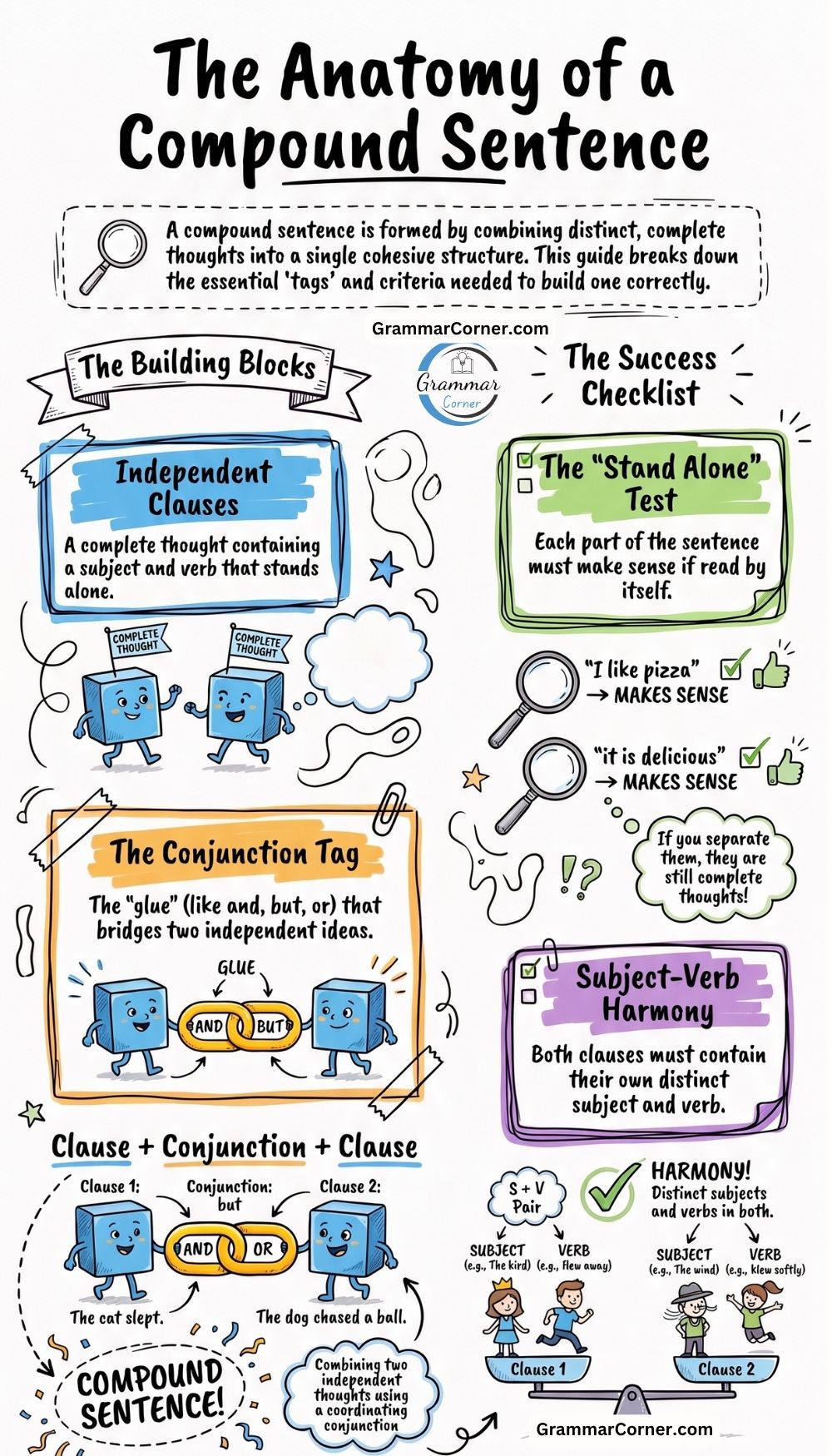
A compound sentence contains two or more independent clauses joined together into a single sentence. The clauses are commonly connected with a coordinating conjunction, though a semicolon can also link two closely related independent clauses.
This sentence links two complete thoughts: “The weather improved” and “The children went outside.” Either statement could stand alone as a complete sentence.
A compound sentence does more than simply contain two verbs or two subjects—it must connect two or more fully functional independent clauses.
What Makes a Sentence Compound?
A sentence is classified as compound when it satisfies three essential requirements:
- ✓ Contains at least two independent clauses.
- ✓ Establishes a clear grammatical connection between those clauses.
- ✓ Uses an appropriate coordinating conjunction, a semicolon, or another valid joining method.
Example Breakdown
Independent Clauses:
- 1. Anna finished her assignment.
- 2. She forgot to submit it.
The coordinating conjunction “but” connects these two equal ideas while signaling a contrast between them.
Key Takeaway: In a compound sentence, both sides of the connector have equal grammatical weight and could survive as standalone sentences.
✨ Quick Challenge
Which of the following examples is a true compound sentence containing two distinct independent clauses joined by a coordinating conjunction? Tap your answer.
See the full answer
Answer: “Marcus drafted the financial report, and Elena submitted it to the director.”
Breakdown of why it is a compound sentence:
- Clause 1 (Independent): Marcus drafted the financial report (Subject: Marcus | Verb: drafted)
- Connector: , and (Comma + FANBOYS coordinating conjunction)
- Clause 2 (Independent): Elena submitted it to the director (Subject: Elena | Verb: submitted)
- Key Difference: Both clauses have their own unique subjects and predicates and can stand alone as complete sentences.
Compound Sentence Structure and Formula
The core rule of a compound sentence is that both joined clauses must remain independent. If one part cannot stand alone as a complete sentence, the structure is not a standard compound sentence.
Links two complete thoughts using a comma followed by a conjunction (such as so, and, or but).
Links two closely related thoughts directly using a semicolon, omitting the conjunction.
Compound Sentence Structure at a Glance
| Structure | Formula | Example |
|---|---|---|
| With coordinating conjunction | IC + comma + conjunction + IC |
I called him, but he did not answer. |
| With semicolon | IC + semicolon + IC |
I called him; he did not answer. |
| With conjunctive adverb | IC + semicolon + adverb + comma + IC |
I called him; however, he did not answer. |
*IC = Independent Clause
What Is an Independent Clause?
An independent clause contains both a subject and a predicate, expressing a complete thought. Because it is complete, it has full grammatical weight and can stand alone as a simple sentence.
Consider these two standalone independent clauses:
- “The students finished their project.”
- “The teacher checked their work.”
When appropriately joined using a comma and a coordinating conjunction, they form a unified compound sentence:
A Simple Test for an Independent Clause
If you’re unsure whether a group of words is an independent clause, isolate it from the rest of the sentence and ask yourself this single question:
“Can this group of words stand alone and make complete sense?”
It expresses a complete thought and forms a valid sentence. It is an independent clause.
It leaves the reader waiting for necessary information. It is a dependent clause.
Applying this test makes identifying valid compound sentences quick and reliable.
How to Join Independent Clauses in a Compound Sentence
There are three primary ways to connect independent clauses to form a compound sentence: coordinating conjunctions, semicolons, and conjunctive adverbs. Choosing the right connector ensures clear logic and correct punctuation.
1. Using Coordinating Conjunctions
Coordinating conjunctions connect elements of equal grammatical importance. When one joins two independent clauses, it creates a compound sentence.
The coordinating conjunction but connects two standalone independent clauses.
The FANBOYS Conjunctions at a Glance
| Conjunction | Common Function | Example |
|---|---|---|
| For | Reason | The road was blocked, for an accident had occurred. |
| And | Addition | Sara cooked dinner, and her brother washed the dishes. |
| Nor | Negative alternative | He did not call, nor did he send a message. |
| But | Contrast | I wanted to stay, but I had to leave. |
| Or | Alternative | You can take the bus, or you can walk. |
| Yet | Unexpected contrast | The task was difficult, yet she completed it. |
| So | Result | The shop was closed, so we returned home. |
Note: Selecting a conjunction purely because it “sounds right” can alter the intended relationship. Always match the conjunction to the logical link between ideas.
2. Using a Semicolon
A semicolon can directly join two closely related independent clauses without needing a coordinating conjunction.
• Clause 1: The store was crowded.
• Clause 2: We decided to return later.
The semicolon signals that these two independent thoughts are directly connected in logic.
Important: Never use a semicolon simply because a sentence is long. Both sides must be fully independent clauses.
3. Using Conjunctive Adverbs
Transition words such as however, therefore, meanwhile, instead, moreover, consequently, and otherwise can express specific relationships between independent clauses.
Because conjunctive adverbs are not coordinating conjunctions, they require a specific punctuation formula when connecting clauses:
Key Takeaway: Pay close attention to punctuation—using a comma instead of a semicolon before a conjunctive adverb leads to a run-on sentence known as a comma splice.
Compound Sentence Punctuation
Correct punctuation is essential when forming compound sentences. Proper mark placement keeps clauses grammatically separate and clearly conveys their logical connection.
1. Comma Before a Coordinating Conjunction
When a coordinating conjunction (FANBOYS) joins two independent clauses, place a comma immediately before the conjunction.
The comma cleanly separates two complete, standalone thoughts.
Watch Out for Compound Predicates!
Do not add a comma simply because you see the word and. If the verbs share the same subject, it is a single sentence with a compound verb, not a compound sentence.
No comma is needed here because “opened” and “turned” share the single subject (Sarah).
2. Semicolon Between Independent Clauses
A semicolon can link two closely related independent clauses without any conjunction.
Both sides can stand independently as complete sentences.
Rule: Never use a semicolon between an independent clause and a dependent clause. “Because we could not cross” cannot stand alone.
3. Semicolon With a Conjunctive Adverb
When using a transition word (such as however, therefore, or instead) to connect two independent clauses, follow this strict formula:
More Examples:
- The train was delayed; therefore, we arrived late.
- The restaurant was full; instead, we ate at a nearby café.
Compound Sentence Examples
Here are several reference examples grouped by how their independent clauses are connected:
1. Joined with FANBOYS Conjunctions
- The sun disappeared, and the temperature dropped.
- I wanted to call her, but I did not have her number.
- You can stay here, or you can come with us.
- He was tired, yet he continued working.
- The road was closed, so we changed our route.
2. Joined with Semicolons
- The library was closed; we went to the café instead.
- The children were excited; the parents were exhausted.
- The first plan failed; the team developed another one.
3. Joined with Conjunctive Adverbs
- The evidence looked convincing; however, the judge requested more information.
- The weather was poor; therefore, the event was postponed.
- The main road was busy; meanwhile, the side street remained quiet.
How to Identify a Compound Sentence
A coordinating conjunction alone does not guarantee a sentence is compound—conjunctions can also connect single words, phrases, or compound verbs. Follow this step-by-step process to verify the sentence structure accurately:
Process in Action
“The teacher explained the lesson, and the students took notes.”
Separated Clauses:
- Clause 1: “The teacher explained the lesson.” (Complete standalone sentence)
- Clause 2: “The students took notes.” (Complete standalone sentence)
Conclusion: Both clauses are independent and joined by a comma + conjunction. The sentence is compound.
Compound Sentence vs. Other Sentence Types
Understanding how compound sentences compare to other structural types prevents common grammar mistakes.
| Sentence Type | Independent Clauses | Dependent Clauses |
|---|---|---|
| Simple | 1 | 0 |
| Compound | 2 or more | 0 |
| Complex | 1 | 1 or more |
| Compound-Complex | 2 or more | 1 or more |
1. Compound vs. Simple Sentence
“The children played outside.” — (1 independent clause)
Compound“The children played outside, and their parents watched them.” — (2 independent clauses)
2. Compound vs. Complex Sentence
“The rain stopped, and the players returned.” — (2 independent clauses)
Complex“The players returned when the rain stopped.” — (1 independent clause + 1 dependent clause)
Note: “when the rain stopped” cannot stand alone and depends on the main clause.3. Compound vs. Compound-Complex Sentence
“When the rain stopped, the players returned to the field, and the spectators cheered.”
• the players returned to the field → Independent clause
• and the spectators cheered → Independent clause
Combining at least two independent clauses with at least one dependent clause forms a compound-complex sentence.
Compound Sentence vs. Compound Predicate
Understanding the difference between a compound sentence and a sentence with a compound predicate is one of the most critical distinctions in English grammar.
- Compound Sentence: Contains two or more independent clauses (each with its own subject and verb).
- Compound Predicate: Contains two or more verbs or verb phrases that share the same single subject.
Comparing the Two Structures
“Maria washed the dishes and cleaned the kitchen.”
This sentence has one subject (Maria) performing two verbs (washed and cleaned). Because it has only one subject-verb set, it remains a simple sentence.
“Maria washed the dishes, and her brother cleaned the kitchen.”
This sentence contains two independent clauses with distinct subjects: 1. Maria washed the dishes, and 2. Her brother cleaned the kitchen.
Side-by-Side Summary
| Sentence | Structure | Type |
|---|---|---|
| Maria washed the dishes and cleaned the kitchen. | One subject + two verbs | Simple |
| Maria washed the dishes, and her brother cleaned the kitchen. | Two independent clauses | Compound |
Note: The conjunction and appears in both sentences, but the grammatical structure is fundamentally different.
When Should You Use Compound Sentences?
Compound sentences are most effective when linking two closely related thoughts to clarify their relationship for the reader.
“The store sells fresh bread, and it also makes cakes.”
The second clause seamlessly expands on information related to the same place.
“I wanted to attend the event, but I had another appointment.”
The conjunction but establishes a direct contrast between desire and availability.
“The roads were icy, so the school closed early.”
The second clause presents the direct outcome or result of the first clause.
“You can take the train, or you can drive.”
The two clauses present equal choices or possibilities.
Improving Sentence Variety and Rhythm
Writing made entirely of short, simple sentences can sound choppy and repetitive. Combining closely related statements improves readability and flow.
❌ Choppy (All Simple Sentences):
“The shop opened. Customers entered. The staff became busy. The manager called for help.”
✅ Smooth & Connected (Compound Structure):
“The shop opened, and customers entered, so the staff quickly became busy.”
Writing Tip: Avoid merging sentences just to make them longer. Only combine clauses when doing so provides useful logic or context for your reader.
✨ Quick Challenge
Which of the following examples is a simple sentence with a compound predicate (rather than a compound sentence)? Tap your answer.
See the full answer
Answer: “The engineer analyzed the blueprints and ordered the construction materials.”
Distinguishing compound predicates from compound sentences:
- Compound Predicate (Simple Sentence): One subject (The engineer) shares multiple verbs (analyzed and ordered). No comma is used before and because the second part is not an independent clause.
- Compound Sentence: Joins two complete independent clauses, each with its own explicit subject and verb (e.g., “The engineer analyzed…, and the contractor ordered…”).
Common Mistakes With Compound Sentences
Avoiding these five common punctuation and structural errors will make your written compound sentences grammatically sound and easy to follow.
A comma alone is not strong enough to connect two independent clauses.
If the verbs share the same subject, it is a single clause with a compound predicate—not a compound sentence.
Semicolons can only connect two independent clauses.
Conjunctions can join words, phrases, or clauses. Look for independent clauses on both sides.
This is a simple sentence. And connects two noun objects, not two independent clauses.
While a compound sentence can contain more than two independent clauses, chaining too many together creates a run-on rhythm that exhausts the reader. When ideas become complex or numerous, break them into separate sentences.
How to Combine Two Simple Sentences Into a Compound Sentence
Two related simple sentences can easily be combined into a cohesive compound sentence by choosing the right joining method based on their logical relationship.
Simple Sentences: “The shop was crowded.” + “We waited outside.”
The second clause is a direct outcome of the first, so so works naturally:
Simple Sentences: “I wanted to buy the book.” + “The bookstore had sold its last copy.”
The relationship is one of contrast, so but is the correct fit:
Choose the Conjunction Based on Meaning
Never pick a conjunction purely because it can grammatically fit. Choose one that conveys the exact logic you intend to express:
| Intended Relationship | Target Conjunction | Primary Purpose |
|---|---|---|
| Addition | and |
Connecting related facts or events |
| Contrast | but / yet |
Highlighting differences or surprises |
| Alternative | or / nor |
Presenting choices or negative options |
| Reason | for |
Explaining the cause behind an action |
| Result | so |
Showing direct outcomes or consequences |
Takeaway: Selecting conjunctions intentionally creates clear, effective compound sentences rather than merely stringing unrelated thoughts together.
Compound Sentence Practice
Read through the sample sentences below and try to identify which ones are compound sentences. Pay attention to the conjunctions and punctuation connecting the clauses.
- The lights went out, so everyone became quiet.
- Ahmed washed the car and cleaned the garage.
- The train was late; we waited on the platform.
- She wanted to join us, but she had to work.
- The teacher smiled and opened the book.
- You can call me, or you can send a message.
- Because it was raining, we stayed indoors.
- The restaurant was crowded; however, we found a table.
Practice Answer Key
Check your answers against the detailed breakdown below to see how each sentence is structured:
| No. | Compound? | Explanation |
|---|---|---|
| 1 | Yes | Two independent clauses joined by so. |
| 2 | No | One subject with a compound predicate (two verbs sharing one subject). |
| 3 | Yes | Two independent clauses joined by a semicolon. |
| 4 | Yes | Two independent clauses joined by but. |
| 5 | No | One subject with two verbs (simple sentence). |
| 6 | Yes | Two independent clauses joined by or. |
| 7 | No | One dependent clause + one independent clause (complex sentence). |
| 8 | Yes | Two independent clauses joined by a semicolon and conjunctive adverb (however). |
Frequently Asked Questions About Compound Sentences
A compound sentence contains two or more independent clauses joined in a grammatically appropriate way, most commonly with a coordinating conjunction or a semicolon.
The seven coordinating conjunctions are for, and, nor, but, or, yet, and so. You can remember them easily using the familiar mnemonic FANBOYS.
No. Independent clauses can be linked using a semicolon without a conjunction. However, when a coordinating conjunction joins two independent clauses, a comma is normally placed before the conjunction.
Yes. A compound sentence can contain three or more independent clauses, provided every clause is properly joined with conjunctions or semicolons.
Yes. A semicolon can independently link two closely related independent clauses without needing a coordinating conjunction.
No. The word and can join individual words, phrases, or verbs without forming a compound sentence. For instance: “Sara washed the dishes and cleaned the table.” This is a simple sentence with a compound predicate, not a compound sentence.
A compound sentence contains at least two independent clauses. A complex sentence contains one independent clause paired with at least one dependent clause.
A compound sentence consists of two or more independent clauses with no dependent clauses. A compound-complex sentence contains at least two independent clauses and at least one dependent clause.
Find the clauses first. If you can break the sentence down into two or more complete stand-alone sentences, and those independent clauses are appropriately joined, the sentence is compound.