Adverbs That Start With X (Common & Adverb To Describe A Person)
X is one of the rarest starting letters in English, so you won’t find many adverbs that begin with it.
The few that exist are worth knowing, though — they turn up in scientific, technical, and formal writing.
Adverbs that start with X are adverbs whose spelling begins with the letter X. They modify verbs, adjectives, other adverbs, or whole sentences by describing how, to what extent, or under what conditions something happens.
Quick Challenge
Which of the following is a real X-adverb?
Show the answer
✅ Answer: A. xenophobically
It means in a way that shows fear or dislike of people from other countries or cultures. The other three options are nouns, not adverbs.
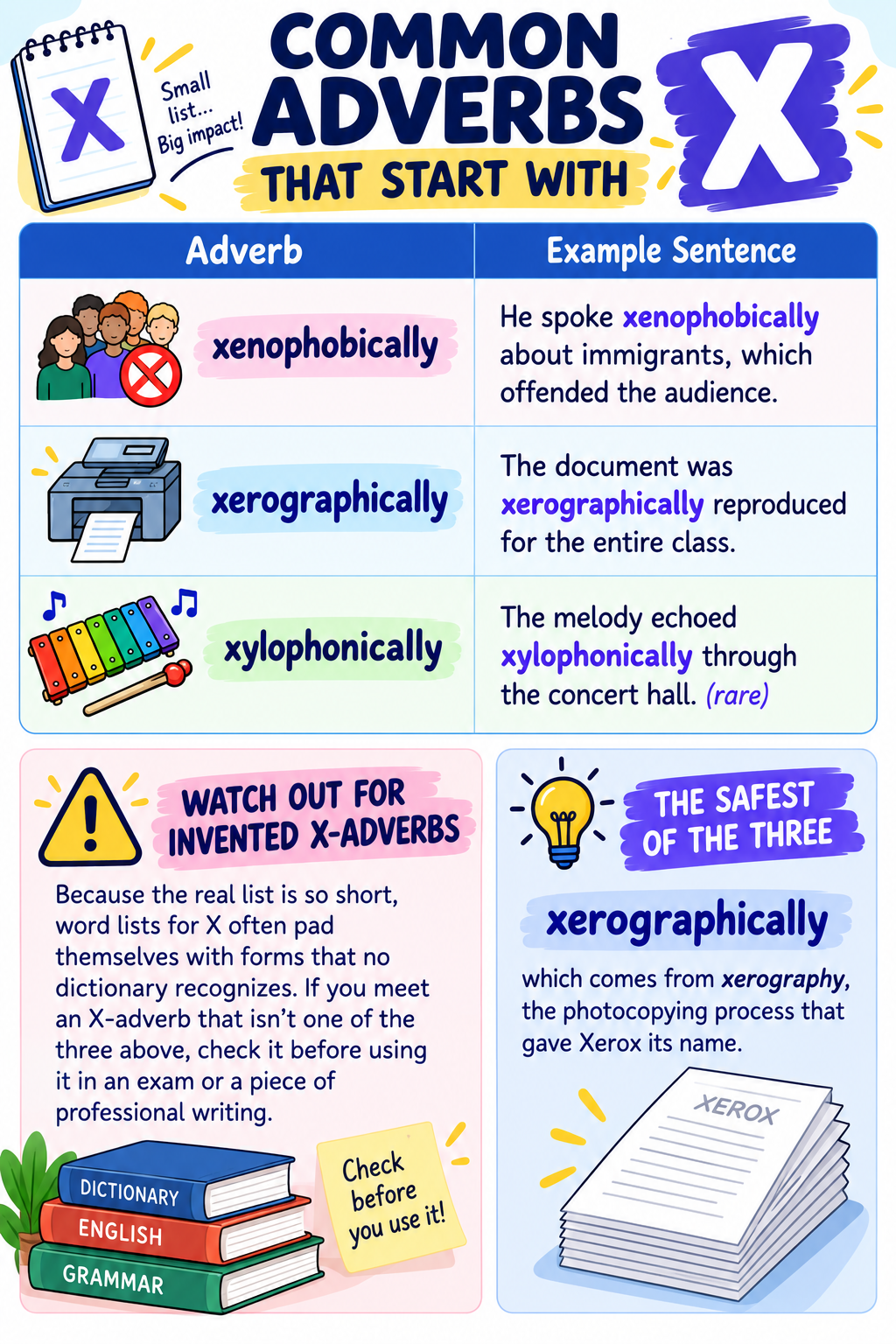
Because X is one of the least productive initial letters in English, there are very few genuine adverbs that begin with it. The lists below include only standard, dictionary-recognized words — no invented forms.
Common Adverbs That Start with X
| Adverb | Example Sentence |
|---|---|
| xenophobically | He spoke xenophobically about immigrants, which offended the audience. |
| xerographically | The document was xerographically reproduced for the entire class. |
| xylophonically | The melody echoed xylophonically through the concert hall. (rare) |
Watch Out for Invented X-Adverbs
Because the real list is so short, word lists for X often pad themselves with forms that no dictionary recognizes. If you meet an X-adverb that isn’t one of the three above, check it before using it in an exam or a piece of professional writing.
The safest of the three is xerographically, which comes from xerography, the photocopying process that gave Xerox its name.
Positive Adverbs That Start with X
There Aren’t Any
Standard English has no widely accepted positive adverb beginning with X. The handful that exist are technical, descriptive, or context-specific rather than complimentary.
If you need to praise something and want the letter X, the honest answer is to use a phrase instead — or simply reach for a stronger word from another letter.
Adverbs That Start with X to Describe a Person
Only one X-adverb describes a person’s behaviour at all.
In a way that shows fear or dislike of people from other countries or cultures.
Use it with care. This word reports prejudice — it belongs in news writing, essays, and discussions about attitudes, not in a character description you intend as neutral.
Common Mistakes with W-Adverbs
These six trip up learners and native speakers alike. Each one turns on a single letter or a single space.
-
Using Whole Instead of Wholly
✕Incorrect: I whole agree with your conclusion.
✓Correct: I wholly agree with your conclusion.
Why? Whole is an adjective — the whole class. Wholly is the adverb meaning completely. Note the spelling: the e disappears, so it’s wholly, not wholely.
-
Hyphenating Well Before and After a Noun
✕Incorrect: She handed in a well written essay.
✓Correct: She handed in a well-written essay.
✓Correct: The essay was well written.
Why? When well plus a participle sits in front of a noun, the pair is hyphenated: a well-known author, a well-behaved dog. After the noun, no hyphen is needed.
-
Using Worst Where You Need Worse
✕Incorrect: He performed worst than he did last year.
✓Correct: He performed worse than he did last year.
Why? Worse compares two things and pairs with than. Worst is the bottom of three or more: He performed worst of all the finalists.
-
Confusing Wistfully with Wishfully
✕Incorrect: She looked wishfully at her old school photograph.
✓Correct: She looked wistfully at her old school photograph.
Why? Wistfully means with a gentle sadness about something lost or past — the right word for an old photograph. Wishfully means hoping for something that probably isn’t true, which is why wishful thinking is a criticism.
-
Confusing Warily with Wearily
✕Incorrect: The hikers moved wearily past the sleeping dog.
✓Correct: The hikers moved warily past the sleeping dog.
Why? Warily means cautiously — watching for danger. Wearily means tiredly. One letter apart, and only one of them explains why you’d tiptoe past a dog.
-
Writing Worldwide as Two Words
✕Incorrect: The video was shared world wide within hours.
✓Correct: The video was shared worldwide within hours.
Why? Worldwide is one word as both adverb and adjective. The same closed spelling applies to nationwide and countrywide.
Practice with W-Adverbs
Exercise 1: Fill in the Blanks
Type the right word in each gap. Each one is used once.
- Word bank
- warily
- wearily
- wholly
- worldwide
- wistfully
-
The hikers moved past the sleeping dog.
-
After the long shift she sighed and sat down.
-
I agree with your conclusion.
-
The video was shared within hours.
-
He gazed at his old school photograph.
Exercise 2: Match the Adverb with Its Meaning
Pick the meaning that belongs to each adverb.
-
Warily
-
Wearily
-
Wholly
-
Wistfully
-
Worldwide
Exercise 3: Tap the Adverb
One word in each sentence is the W-adverb. Tap it.
-
Find the adverb:
-
Find the adverb:
-
Find the adverb:
-
Find the adverb:
Exercise 4: Choose the Correct Form
Tap the version that belongs in each sentence.
-
He performed __________ than he did last year.
-
She handed in a __________ essay.
-
She looked __________ at her old school photograph.
-
The cat crept __________ toward the open door.
-
The song became popular __________ in a single week.
Show the answer key
Exercise 1: Fill in the Blanks
- warily
- wearily
- wholly
- worldwide
- wistfully
Exercise 2: Match the Adverb with Its Meaning
- Warily → C (With caution)
- Wearily → A (In a tired way)
- Wholly → B (Completely)
- Wistfully → D (With a sad longing)
- Worldwide → E (Across the whole world)
Exercise 3: Tap the Adverb
- wisely
- weekly
- wholeheartedly
- watchfully
Exercise 4: Choose the Correct Form
- worse
- well-written
- wistfully
- warily
- worldwide
Frequently Asked Questions
What are adverbs that start with X?
Adverbs that start with X are adverbs whose spelling begins with the letter X. They modify verbs, adjectives, other adverbs, or entire sentences by describing how an action is performed or under what conditions it occurs.
Are there many adverbs that start with X?
No. X is one of the rarest starting letters in English, so there are only a handful of recognized X-adverbs. Most are technical, scientific, or uncommon in everyday conversation.
What are some examples of X-adverbs?
Some recognized X-adverbs include:
- Xenophobically
- Xerographically
- Xylophonically (rare)
These words are used in specific contexts rather than in everyday speech.
Are there any positive adverbs that start with X?
No. Standard English does not have any widely accepted positive adverbs beginning with X. Most X-adverbs are descriptive or technical rather than expressing positive qualities.
Are there any five-letter adverbs that start with X?
No. There are no standard English adverbs that are exactly five letters long and begin with X.
Why are X-adverbs so uncommon?
Most English words beginning with X come from Greek or scientific terminology. As a result, very few have developed into commonly used adverbs.
Is xenophobically a common adverb?
No. Xenophobically is a valid adverb, but it is uncommon and is mainly used in discussions about prejudice, social issues, or cultural attitudes.
Can I use X-adverbs in everyday writing?
Generally, no. Most X-adverbs are too specialized for everyday communication. In most situations, more familiar adverbs such as carefully, clearly, or politely are better choices.
How can I remember the few X-adverbs?
Since there are only a few, try learning them by their subject area:
- Xenophobically – social attitudes
- Xerographically – photocopying or printing
- Xylophonically – music and sound
Grouping them by context makes them easier to remember and use correctly.
See also: