Adverbs That Start With I (Common, Positive & Descriptive Adverbs)
The letter I begins a lot of useful adverbs — the kind that make English more accurate and more expressive at the same time.
Adverbs beginning with I give more information about an action or about a whole sentence. They can show how, when, where, or how much something happens:
- immediately
- indeed
- independently
- intentionally
Quick Challenge
Fill in the blank with the correct I-adverb:
Please reply __________ after receiving this important email.
Show the answer
✅ Correct answer: B. immediately
Explanation: Immediately is the correct adverb because it describes when the action should happen. Immediate is an adjective, immediacy is a noun, and impatient is an adjective.
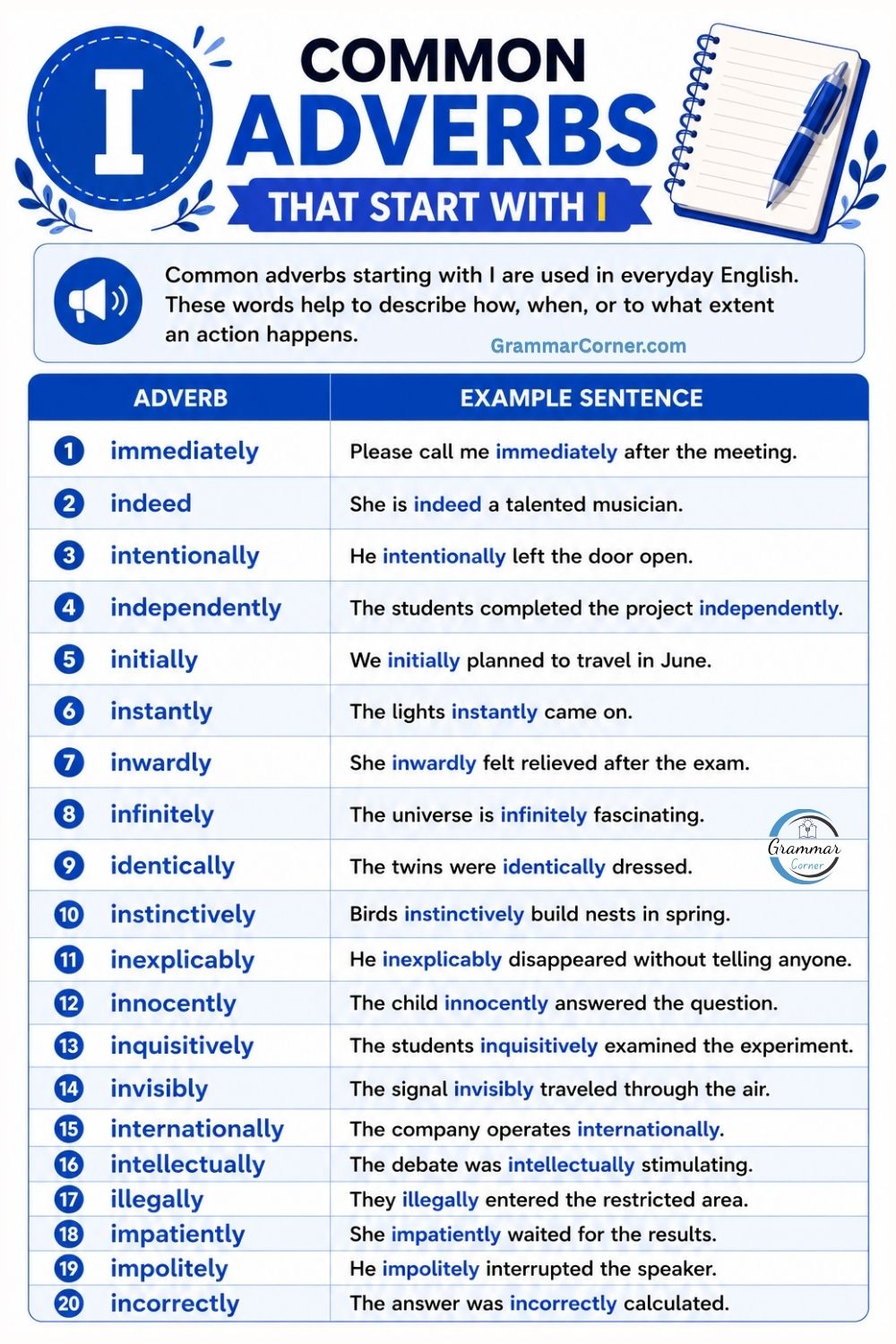
Common Adverbs That Start with I
| Adverb | Example Sentence |
|---|---|
| immediately | Please call me immediately after the meeting. |
| indeed | She is indeed a talented musician. |
| intentionally | He intentionally left the door open. |
| independently | The students completed the project independently. |
| initially | We initially planned to travel in June. |
| instantly | The lights instantly came on. |
| inwardly | She inwardly felt relieved after the exam. |
| infinitely | The universe is infinitely fascinating. |
| identically | The twins were identically dressed. |
| instinctively | Birds instinctively build nests in spring. |
| inexplicably | He inexplicably disappeared without telling anyone. |
| innocently | The child innocently answered the question. |
| inquisitively | The students inquisitively examined the experiment. |
| invisibly | The signal invisibly traveled through the air. |
| internationally | The company operates internationally. |
| intellectually | The debate was intellectually stimulating. |
| illegally | They illegally entered the restricted area. |
| impatiently | She impatiently waited for the results. |
| impolitely | He impolitely interrupted the speaker. |
| incorrectly | The answer was incorrectly calculated. |
| indirectly | She indirectly suggested a different solution. |
| individually | Each participant was individually interviewed. |
| inevitably | Mistakes inevitably happen during learning. |
| informally | The manager spoke informally with the staff. |
| inward | Please move inward to make room for others. |
| irritably | He irritably answered the phone. |
| irresponsibly | They irresponsibly ignored the warning signs. |
| intentionally | She intentionally avoided the argument. |
| instinctively | The goalkeeper instinctively caught the ball. |
| imperfectly | The machine worked imperfectly after the repair. |
| impossibly | The puzzle seemed impossibly difficult. |
| incompletely | The report was incompletely filled out. |
| inadequately | The problem was inadequately addressed. |
| increasingly | The weather is becoming increasingly warm. |
| independently | She lives independently in her own apartment. |
| immediately | The doctor immediately treated the patient. |
| inwardly | He inwardly questioned the decision. |
| irreversibly | The habitat was irreversibly damaged. |
| ironically | Ironically, the expert made the simplest mistake. |
| insistently | The child insistently asked for another story. |
Positive Adverbs That Start with I
| Adverb | Example Sentence |
|---|---|
| Positive impressively | She impressively solved every math problem. |
| Positive inspirationally | The coach spoke inspirationally before the match. |
| Positive inspiringly | The teacher inspiringly encouraged every student. |
| Positive ingeniously | The engineer ingeniously solved the design problem. |
| Positive insightfully | He insightfully explained the poem's meaning. |
| Positive intelligently | She intelligently answered every interview question. |
| Positive impeccably | The room was impeccably organized. |
| Positive impartially | The judge impartially considered both sides. |
| Positive impeccably | The musician performed impeccably throughout the concert. |
| Positive industriously | The students industriously prepared for the exams. |
| Positive inclusively | The teacher inclusively involved every student in the discussion. |
| Positive innovatively | The company innovatively developed a new learning app. |
| Positive interestingly | Interestingly, the experiment produced unexpected results. |
| Positive ideally | Ideally, everyone should arrive on time. |
| Positive importantly | Importantly, every student should review the lesson. |
| Positive intuitively | She intuitively understood the instructions. |
| Positive irreproachably | The officer irreproachably carried out his duties. |
| Positive immaculately | The classroom was immaculately clean before the inspection. |
| Positive influentially | The scientist influentially shaped modern research. |
| Positive incorruptibly | The leader incorruptibly served the community. |
3-Letter Adverbs That Start with I
Very few standard English adverbs begin with I and contain exactly three letters. There are two, and both are so ordinary that people forget they’re adverbs at all.
| Adverb | Meaning | Example Sentence |
|---|---|---|
| ill | Badly or poorly | She never speaks ill of her colleagues. |
| in | Inside, or toward the inside | Please come in and take a seat. |
Why These Two Are Easy to Miss
Ill is usually learned as an adjective meaning unwell, so its adverb use slips past learners. It means badly, and it survives mostly in fixed phrases: speak ill of someone, ill-prepared, we can ill afford it.
In is an adverb only when nothing follows it. Compare Please come in (adverb — it tells us where) with She walked in the garden (preposition — it introduces the noun garden).
If a three-letter I-word turns up on some other list, check it carefully. It’s usually an abbreviation, an archaic form, or a different part of speech altogether.
Descriptive Adverbs That Start with I
These I-adverbs describe how, when, where, or to what extent an action happens. They make sentences more detailed and precise.
| Adverb | Meaning | Example Sentence |
|---|---|---|
| identically | In exactly the same way | The twins were identically dressed. |
| illegally | Against the law | They illegally entered the property. |
| immediately | Without delay | Please reply immediately. |
| imperfectly | Not completely or accurately | The machine worked imperfectly. |
| impatiently | In an impatient manner | He impatiently waited outside. |
| impolitely | Without good manners | She impolitely interrupted the speaker. |
| impossibly | To an extreme degree | The puzzle seemed impossibly difficult. |
| incorrectly | In a wrong way | The question was answered incorrectly. |
| increasingly | More and more | The weather is becoming increasingly warm. |
| indeed | In fact; truly | She is indeed an excellent teacher. |
| independently | Without help from others | The students worked independently. |
| indirectly | In a roundabout way | He indirectly suggested a solution. |
| individually | One by one | Each student was individually assessed. |
| inevitably | Unavoidably | Mistakes inevitably occur while learning. |
| inexplicably | In a way that cannot be explained | He inexplicably disappeared. |
| infinitely | Without limits; extremely | The universe is infinitely complex. |
| informally | In a relaxed or casual way | The manager spoke informally with the team. |
| initially | At the beginning | We initially planned to leave early. |
| innocently | Without guilt or harmful intent | The child innocently smiled. |
| inquisitively | With curiosity | She inquisitively examined the model. |
| insistently | In a persistent manner | The child insistently asked another question. |
| instantly | At once | The lights instantly turned on. |
| instinctively | Naturally, without conscious thought | Birds instinctively migrate south. |
| intellectually | Using reason or knowledge | The lecture was intellectually challenging. |
| intentionally | On purpose | He intentionally avoided the question. |
| internationally | Across many countries | The company operates internationally. |
| invisibly | In a way that cannot be seen | The signal traveled invisibly through the air. |
| inwardly | In one’s thoughts or feelings | She inwardly felt relieved. |
| ironically | In an unexpected or opposite way | Ironically, the expert made the mistake. |
| irresponsibly | Without proper care | They irresponsibly ignored the warning. |
| irritably | In an annoyed manner | He irritably answered the phone. |
Quick Tip: The In- Prefix Doesn’t Always Mean “Not”
Many words above start with in- or im- meaning not: incorrectly, impatiently, invisibly, imperfectly.
But the same prefix can mean into or toward, and sometimes it’s just part of the root. Inquisitively, instinctively, and intentionally have no hidden negative in them, so don’t assume the opposite meaning from the spelling alone.
Adverbs That Start with I to Describe a Person
These I-adverbs describe how a person behaves, speaks, thinks, or performs an action.
| Adverb | What It Describes | Example Sentence |
|---|---|---|
| impartially | Fair behavior | The judge impartially listened to both sides. |
| impatiently | Impatient behavior | He impatiently waited for the bus. |
| impeccably | Excellent performance | She impeccably completed the presentation. |
| impolitely | Rude behavior | The customer impolitely interrupted the cashier. |
| increasingly | Gradual change in behavior | He became increasingly confident with practice. |
| indeed | Emphasizing a statement | She is indeed a talented artist. |
| independently | Self-reliant behavior | He independently completed the assignment. |
| individually | Personal actions | The coach individually thanked each player. |
| industriously | Hard-working behavior | The students industriously prepared for the examination. |
| informally | Casual communication | The manager informally greeted the new employees. |
| innocently | Innocent behavior | The child innocently answered the teacher’s question. |
| inquisitively | Curious behavior | She inquisitively looked at the science experiment. |
| insightfully | Wise observations | She insightfully explained the novel’s theme. |
| instantly | Quick reactions | He instantly recognized his former teacher. |
| instinctively | Natural reactions | The goalkeeper instinctively caught the ball. |
| intellectually | Thinking or reasoning | She intellectually approached the complex problem. |
| intelligently | Smart decision-making | He intelligently solved the difficult puzzle. |
| intentionally | Deliberate actions | She intentionally helped the new student. |
| inwardly | Hidden thoughts or feelings | He inwardly questioned the decision. |
| irritably | Annoyed behavior | She irritably replied to the repeated questions. |
Common Mistakes When Using I-Adverbs
1. Using an Adjective Instead of an Adverb
❌ She gave an immediate replied to the email.
✅ She replied immediately to the email.
Why? Immediately is an adverb that describes when she replied. Immediate is an adjective that describes a noun.
2. Confusing Independent with Independently
❌ The students worked independent on the project.
✅ The students worked independently on the project.
Why? Independently modifies the verb worked. Independent is an adjective describing a person or thing.
3. Confusing Intentional with Intentionally
❌ He intentional ignored the warning.
✅ He intentionally ignored the warning.
Why? Use intentionally to describe how he ignored the warning. Intentional is an adjective.
4. Confusing Immediate with Immediately
❌ Please come immediate after class.
✅ Please come immediately after class.
Why? Immediately is the correct adverb because it modifies the verb come.
5. Using Incorrect Instead of Incorrectly
❌ She answered the question incorrect.
✅ She answered the question incorrectly.
Why? Incorrectly is an adverb describing how she answered. Incorrect is an adjective.
6. Confusing Impatient with Impatiently
❌ He impatient waited for the results.
✅ He impatiently waited for the results.
Why? Use impatiently to modify the verb waited. Impatient describes a person’s state, not the action.
7. Confusing Illegal with Illegally
❌ They illegal entered the building.
✅ They illegally entered the building.
Why? Illegally is the adverb that explains how they entered the building.
8. Using Individual Instead of Individually
❌ Each student was individual interviewed.
✅ Each student was individually interviewed.
Why? Individually describes how each student was interviewed. Individual is an adjective or noun.
9. Confusing Innocent with Innocently
❌ The child innocent smiled at the teacher.
✅ The child innocently smiled at the teacher.
Why? Innocently modifies the verb smiled. Innocent is an adjective.
10. Misusing Indeed
❌ Indeed she is runs every morning.
✅ Indeed, she runs every morning.
Why? Indeed is commonly used to emphasize a statement and should be placed naturally in the sentence. A comma is often used when it begins a sentence.
Practice Exercises
Strengthen your understanding of adverbs that start with I by working through the activities below.
Exercise 1: Fill in the Blanks
Complete each sentence using the correct I-adverb from the word bank.
- Word bank
- immediately
- independently
- intentionally
- instantly
- innocently
- increasingly
- impatiently
- incorrectly
-
The students completed the assignment .
-
Please call me if you have any questions.
-
The child denied breaking the toy.
-
He pressed the emergency button.
-
She waited for the interview to begin.
-
The weather is becoming warmer.
-
The answer was written on the worksheet.
-
The lights turned on after the power returned.
Exercise 2: Choose the Correct Adverb
Tap the best answer for each sentence.
-
The manager __________ explained the new policy.
-
The students worked __________ without any help.
-
Please respond __________ to this urgent message.
-
The twins were __________ dressed for the performance.
-
The child __________ looked at the magician’s trick.
Exercise 3: Match the Adverb with Its Meaning
Pick the meaning that belongs to each adverb.
-
Immediately
-
Independently
-
Innocently
-
Instantly
-
Intentionally
Exercise 4: Choose the Best I-Adverb
Tap the adverb that fits each sentence.
-
The scientist solved the problem __________.
-
The child asked questions __________.
-
The company now sells its products __________.
-
The goalkeeper reacted __________ and caught the ball.
Exercise 5: Rewrite the Sentence
Replace the highlighted phrase with a single I-adverb, then open the answer key to compare.
- She replied without delay.
- He completed the task without help from others.
- The child smiled without guilt or dishonesty.
- They acted on purpose.
- The lights turned on at once.
Show the answer key
Exercise 1: Fill in the Blanks
- independently
- immediately
- innocently
- intentionally
- impatiently
- increasingly
- incorrectly
- instantly
Exercise 2: Choose the Correct Adverb
- B. intentionally
- B. independently
- B. immediately
- B. identically
- B. inquisitively
Exercise 3: Match the Adverb with Its Meaning
- Immediately → B
- Independently → A
- Innocently → C
- Instantly → D
- Intentionally → E
Exercise 4: Choose the Best I-Adverb
- A. intelligently
- A. inquisitively
- A. internationally
- A. instinctively
Exercise 5: Rewrite the Sentence (sample answers)
- She replied immediately.
- He completed the task independently.
- The child smiled innocently.
- They acted intentionally.
- The lights turned on instantly.
Frequently Asked Questions
What are adverbs that start with I?
Adverbs that start with I are adverbs beginning with the letter I that modify a verb, adjective, another adverb, or an entire sentence. They explain how, when, where, or to what extent something happens. Examples include immediately, indeed, independently, and instantly.
What are some common I-adverbs?
Some common ones are immediately, incorrectly, indeed, independently, individually, inevitably, initially, instantly, intentionally, and internationally.
Which I-adverbs describe how an action happens?
Many I-adverbs describe manner, including impatiently, independently, innocently, inquisitively, insightfully, instinctively, intelligently, and intentionally.
What is the difference between immediate and immediately?
Immediate is an adjective that describes a noun, while immediately is an adverb that describes a verb.
Adjective: The manager requested an immediate response.
Adverb: Please respond immediately.
What is the difference between independent and independently?
Independent is an adjective that describes a person or thing, while independently is an adverb that describes how an action is performed.
Adjective: She is an independent learner.
Adverb: She completed the assignment independently.
Can I-adverbs describe a person’s behavior?
Yes. Adverbs such as impatiently, independently, innocently, inquisitively, intelligently, and intentionally describe how a person thinks, acts, or responds.
See also: