Asterisk (*) Rules and Examples
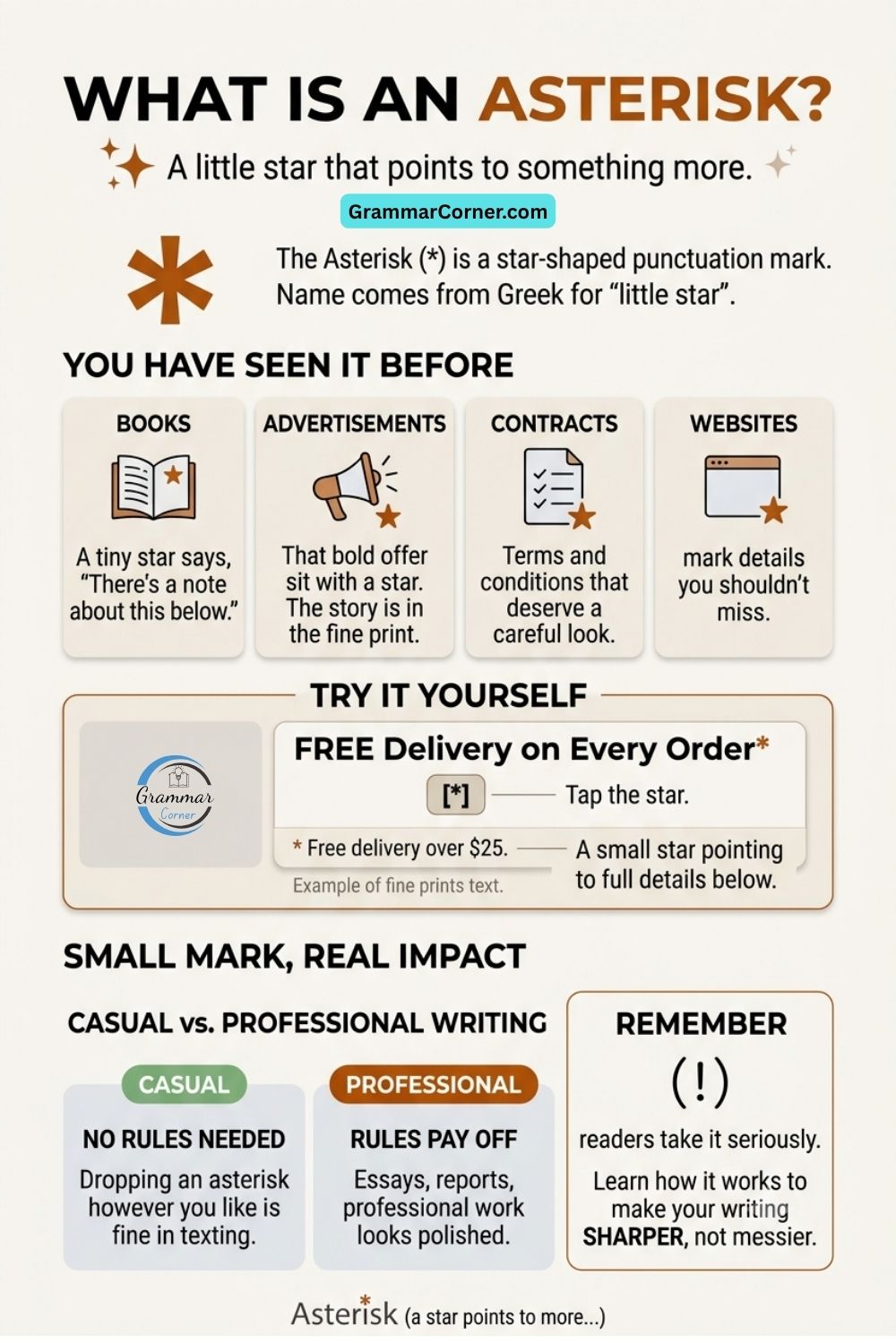
What Is an Asterisk?
The asterisk (*) is a small, star-shaped punctuation mark that shows up in all kinds of writing. Its name even comes from a Greek word meaning little star — and that is exactly what it looks like.
You have seen it before
Even if you have never studied the asterisk, you have almost certainly met it. It appears in books, advertisements, contracts, and websites — often as a signal that points you to a footnote or an extra detail somewhere else on the page.
- Books A tiny star beside a word quietly says, “There’s a note about this below.”
- Advertisements That bold offer with a star next to it? The full story sits in the fine print.
- Contracts Asterisks flag terms and conditions that deserve a careful second look.
- Websites Online forms and pages use it to mark details you shouldn’t miss.
Try it yourself
* Free delivery applies to orders over $25.
Tap the star to see where it leads.
That’s the asterisk doing its everyday work — a small star up top pointing to the full detail below. You’ve been reading asterisks for years without thinking about it.
Small mark, real impact
Although the asterisk is tiny, it does several useful jobs, and using it accurately makes your writing clearer and more precise. The catch? Most people use it without ever learning the rules behind it.
Casual chat No rules needed
Texting a friend? Dropping an asterisk however you like is perfectly fine. Nobody is grading your group chat.
School · Work · Audience Rules pay off
Writing an essay, a report, or anything people will judge? Using the asterisk correctly makes your work look polished and professional.
Remember: the asterisk may be one of the smallest marks on your keyboard, but readers take it seriously. Learn how it works, and this little star will make your writing sharper — not messier.
Why Is the Asterisk Important?
You might wonder why such a small symbol deserves a whole guide. The answer is simple: the asterisk (*) quietly solves one of writing’s most common problems — how to add extra information without cluttering the main sentence.
Imagine you’re writing about a product that’s on sale, but the discount only applies on weekends. You could squeeze that detail into the middle of your sentence, but it would turn a short, punchy line into a long, clumsy one. Instead, you place an asterisk after the price and explain the condition below. Your main sentence stays clean, and the reader still gets the full story.
Try it yourself:
Our winter jackets are now just $49, but only if you buy them on a Saturday or a Sunday, because the discount does not apply on weekdays.
*Offer valid on weekends only.
The highlighted part is doing too much work inside the sentence. Tap the second button to move it into a note.
Five Reasons the Asterisk Matters
-
1. It keeps writing tidy
Extra details move into a note at the bottom instead of crowding your sentences. The main text stays short, clear, and easy to read.
-
2. It flags important conditions
Advertisers rely on it to point readers toward terms and disclaimers. When you see “Free delivery*”, that little star is telling you to check the fine print.
-
3. It organizes references
Academic and formal writing use the asterisk to link a point in the text to a footnote, so readers can find the source or extra explanation without losing their place.
-
4. It softens sensitive words
Writers use asterisks to hide letters in words they’d rather not spell out fully. The reader understands the meaning, but the word never appears on the page in full.
-
5. It helps in plain-text writing
In emails and chat messages, you often can’t use bold or italics. Asterisks step in — wrapping a word adds emphasis, and a quick starred word fixes a typo in your previous message.
That was a *fantastic* idea.
We should meat at 3 p.m. → *meet
Keyboard and Symbol Details
Before we look at what the asterisk can do, here is everything you need to know about the symbol itself — what it’s called, where it lives on your keyboard, and how computers identify it.
| Detail | Information |
|---|---|
| Symbol | * |
| Name | Asterisk |
| Keyboard (standard) | Shift + 8 (top number row) |
| Numeric keypad | The dedicated * key |
| Unicode | U+002A (ASTERISK) |
| HTML entity | * or * |
On most keyboards, you make an asterisk by holding Shift and pressing the 8 key. If you’re on a full-size keyboard, there’s an even easier route: the number pad has its own dedicated asterisk key.
Try it: tap Shift, then tap 8. Tap 8 on its own to see the difference.
Good to know: fine printing sometimes uses a raised, decorative version of the asterisk, but for everyday writing, the standard * from your keyboard is all you’ll ever need.
3. Main Functions of the Asterisk
The asterisk wears many hats. One little star handles footnotes, fine print, censored words, emphasis, typo fixes, and more. Let’s go through each of its main jobs one at a time, with examples along the way.
3.1 Pointing to Footnotes and Notes
This is the asterisk’s oldest and most formal job. You place an asterisk after a word or sentence to signal that a note is waiting at the bottom of the page or just below the text.
The museum is open every day except Monday.*
*It is also closed on national holidays.
The star links the sentence to its note. When a page has only one or two notes, writers often prefer the asterisk to numbers — it’s quick, quiet, and easy to spot.
Note: when a page has many footnotes, most style guides (including Chicago and APA) recommend numbered footnotes instead. Save the asterisk for pages with just one or two notes.
3.2 Marking Disclaimers in Ads and Fine Print
Advertisers love the asterisk. They use it to point from an eye-catching claim to the fine print that limits it.
Free shipping on all orders!*
*Free shipping applies to orders over $50 within the country only.
Win a brand-new car!*
*No purchase necessary. See official rules for details.
The asterisk lets the big, bold promise shine while the conditions wait quietly below. That’s why smart readers always look for the little star before getting too excited.
3.3 Hiding or Softening Words
Writers use asterisks to replace letters in words they’d rather not spell out fully. This is common for strong language, sensitive words, and private information.
He was so angry he shouted, “What the h*ll is going on?”
Please keep your password secret. Mine is p*******d.
The asterisks stand in for the missing letters, so the reader gets the idea without seeing every letter spelled out.
3.4 Adding Emphasis in Plain Text
In places where you can’t make text bold or italic — like plain emails, text messages, or chat apps — people wrap a word in asterisks to stress it.
I *never* said that.
Please send the report *today*, not tomorrow.
Some apps even turn *word* into bold or italic text automatically. But even when they don’t, readers instantly understand the asterisks as a sign of emphasis.
3.5 Correcting Typos in Messages
In casual texting and chatting, people put an asterisk before a corrected word to fix a mistake from an earlier message.
The second message, starting with an asterisk, quietly says, “I meant library.” It’s an informal habit — no style guide requires it — but almost everyone online understands it.
3.6 Marking Items in Lists (Plain Text)
When writing simple lists in plain text, some people use the asterisk as a bullet point.
You’ll see this in plain-text notes and in a writing format called Markdown, where an asterisk at the start of a line automatically creates a bullet point.
3.7 Showing Actions in Roleplay and Chat
In online games, forums, and roleplay chats, people place actions between asterisks to describe what a character is doing.
This is purely informal — you’d never use it in an essay — but it’s a widely recognized style online.
3.8 Standing for “Multiply” and Wildcards
Outside of normal writing, the asterisk takes on technical jobs. In math and computing, it means multiply: 5 * 3 means five times three. In searches and computing, it often works as a wildcard, meaning “anything can go here”: searching cat* might find cat, cats, and category.
Remember: you won’t use these technical meanings in essays, but it’s good to know they exist — so you’re not confused when you see them.*
*See what we did there?
4. Rules for Using the Asterisk
Now that you know what the asterisk does, here are the practical rules for using it correctly. Follow these, and your asterisks will always look clean and professional.
Place the Asterisk Directly After the Word, With No Space
The asterisk hugs the word it points to. Never leave a space before it.
Put the Asterisk After Punctuation, Not Before
When the marked word ends a sentence, the asterisk goes after the period, comma, or other punctuation mark.
Try It: Where Does the Asterisk Go?
Tap one of the dashed spots below to place the asterisk in this sentence.
Prices may change without notice.
Match Every Asterisk With a Note
An asterisk in the text must have a partner note. A lonely asterisk with no matching explanation only confuses readers.
Membership is free.*
the pair, connected
*Free for the first year.
Start the Note With the Same Asterisk
The note that explains the mark should begin with an asterisk too, so readers instantly see the pair.
Use One Asterisk for One Note per Page
If a page has a single note, one asterisk is all you need. Traditionally, a second note on the same page gets two asterisks, and a third gets three.
But once you need several notes, that stack of stars becomes hard to count at a glance — switch to numbers instead.
For Emphasis, Wrap the Word on Both Sides
When you use asterisks to stress a word in plain text, put one on each side, snug against the word — no spaces in between.
Keep It Consistent
If you choose one style — say, asterisks for emphasis — use it the same way throughout your document. Mixing styles at random looks careless and makes your writing harder to follow.
Remember
- The asterisk hugs the word — no space before it.
- It sits after the punctuation at the end of a sentence.
- Every asterisk needs a matching note that starts with the same mark.
Section 5
Common Mistakes With the Asterisk
Beginners and ESL learners tend to trip over the same asterisk habits again and again. The good news? Every one of them is easy to fix once you can spot it. Here are the seven most frequent slips, with a quick fix for each.
Adding a Space Before the Asterisk
Some learners leave a gap between the word and the star. The asterisk should sit right against the word it belongs to, with no space in between.
Free delivery *
Free delivery*
Fix: Delete the space. The star hugs the word: word*.
Forgetting the Matching Note
A writer adds an asterisk to a claim, then never explains it. The reader scans the page for the note… and finds nothing. An asterisk is a promise, and a missing note is a broken promise.
Fix: Always pair the asterisk in the text with a note below. Simple rule: no note, no asterisk.
Try it: keep the promise
This little advert has an asterisk but no explanation. Tap the button to add the missing note and complete the pair.
Broken promise: the asterisk points to a note that doesn’t exist.
Overusing Asterisks for Emphasis
Some writers wrap asterisks around half the sentence, hoping it will sound forceful. It does the opposite. When everything is stressed, nothing stands out, and the writing feels shouty instead of strong.
You *really* *must* *not* be *late* *again*.
You really must not be late *again*.
Fix: Emphasize only the one or two words that truly matter.
Using Asterisk Emphasis in Formal Papers
Writing *important* in a school essay looks out of place. Asterisk emphasis belongs to plain-text spaces like chat and comment sections. Formal writing prefers italics.
This evidence is *important* to the argument.
This evidence is important to the argument.
Fix: Switch to italics (or bold), which every word processor supports.
Confusing the Asterisk With Look-Alike Symbols
The asterisk has a few cousins that beginners mix up: the raised dot, the multiplication sign, and the number sign (also called the pound or hash sign). Here they are side by side.
Fix: The asterisk is the little star you type with Shift + 8.
Placing the Asterisk Before the Punctuation
Writing notice*. instead of notice.* is a small slip, but a very common one. The full stop (period) finishes the sentence first; the star comes after it.
Read the full notice*.
Read the full notice.*
Fix: In most everyday writing, place the asterisk after the closing punctuation.
Using Roleplay Asterisks Everywhere
Learners who picked up English in chats and games sometimes carry action-asterisks into serious writing — even a job application. *smiles* is friendly in a group chat, but far too casual for professional messages.
I would love to join your team. *smiles*
See you all at 6! *waves*
Fix: Save action-asterisks for informal chats only.
6. Practice Exercises
Time to test yourself. Work through each part on your own first, then tap Show answer to check your work. Every answer comes with a short explanation, so you’ll know exactly why it’s right.
day.*), it always needs a matching note, and emphasis asterisks hug the word snugly on both sides (*today*).
Fill in the Blanks
Choose the correct placement or use of the asterisk in each sentence.
1.Our gym is open 24 hours a day.___ Add the correct mark and a matching note.
Our gym is open 24 hours a day.*
*Access after midnight requires a member key card.
The asterisk follows the period, and the note below explains the condition.
2.Please send the file today. Add emphasis marks to stress the key word.
Please send the file *today*.
One asterisk on each side of the word stresses it in plain text.
3.I meant to type “recieve.” The correction line should read: ___receive.
*receive
The correction line starts with an asterisk placed directly before the fixed word.
4.Free membership this month!___ Add the mark that points to a disclaimer.
Free membership this month!*
*New members only.
The asterisk sits right after the exclamation mark and points readers to the disclaimer below.
Multiple Choice
Tap the answer you think is correct. You’ll get instant feedback — and you can keep trying until you find it.
1.Where does the asterisk go when it marks the end of a sentence?
day.*2.Which situation is best for an asterisk?
3.What should always accompany an asterisk in the text?
4.In plain-text email, how do you emphasize a word with asterisks?
Error Correction
Each sentence below uses the asterisk incorrectly. Find the mistake, decide how to fix it, then check your answer.
1.The warranty is valid for one year *.
WrongThe warranty is valid for one year *.
RightThe warranty is valid for one year.*
Remove the space and attach the asterisk right after the period. Add a note if the asterisk points to one.
2.Results were strong* but incomplete.
WrongResults were strong* but incomplete.
RightResults were strong,* but incomplete.
Move the asterisk so it follows the punctuation, and pair it with a note.
3.This is * absolutely * essential.
WrongThis is * absolutely * essential.
RightThis is *absolutely* essential.
Remove the spaces inside the emphasis marks so they hug the word.
4.Members get a discount* (with no note anywhere)
WrongMembers get a discount* — with no note anywhere
RightMembers get a discount.*
*Discount applies to annual plans only.
The asterisk was pointing at nothing. Add the missing note so readers get the full story.
Sentence Rewriting
Rewrite each sentence so the asterisk is used correctly, adding a note where needed.
1.Our tour includes lunch* and it’s very cheap.
Our tour includes lunch.*
*Lunch is a light sandwich and drink.
The extra detail moves into a note instead of cluttering the sentence.
2.Please arrive *on * time.
Please arrive *on time*.
The emphasis marks wrap the whole phrase snugly — no stray spaces, no split phrase.
3.All sales final*
All sales final.*
*No refunds or exchanges.
The sentence gains its period, and the asterisk gains a matching explanation.
See also:
- Full Stop Rules and Examples
- Em Dash Rules and Examples
- Em Dash Vs. Semicolon
- Apostrophe Vs. Comma
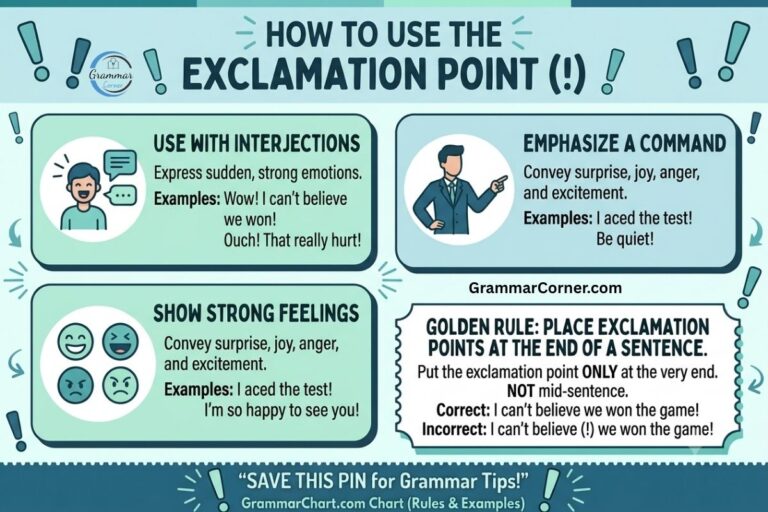
- Exclamation Marks Rules and Examples
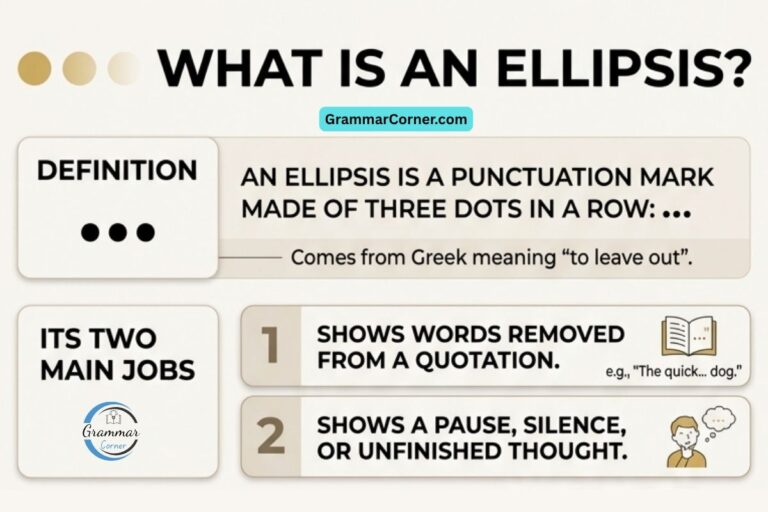
- What Does Ellipses (…) Mean?
- Punctuate the following sentences