Relative Clauses (Rules and Examples)
What Is a Relative Clause?
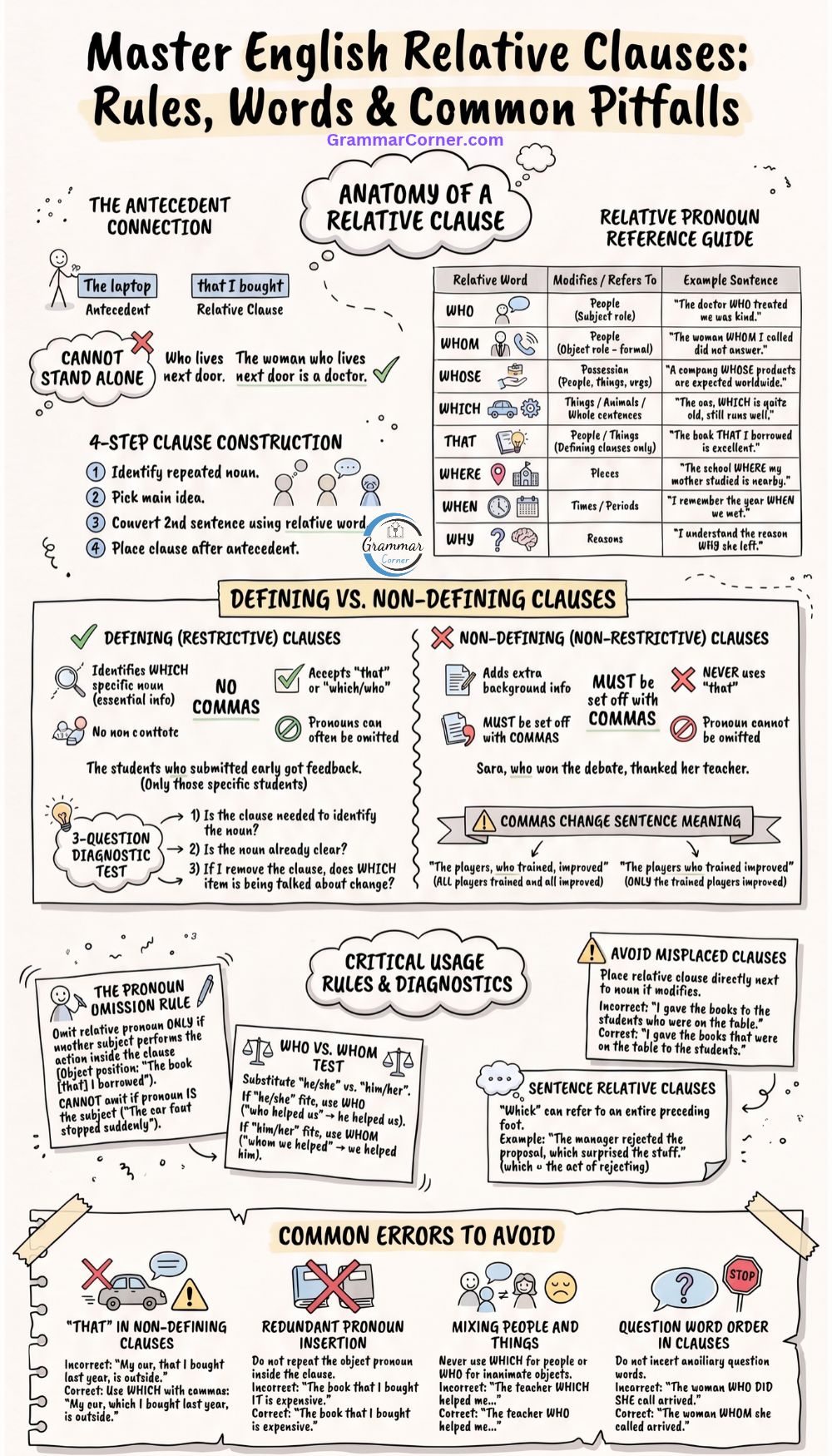
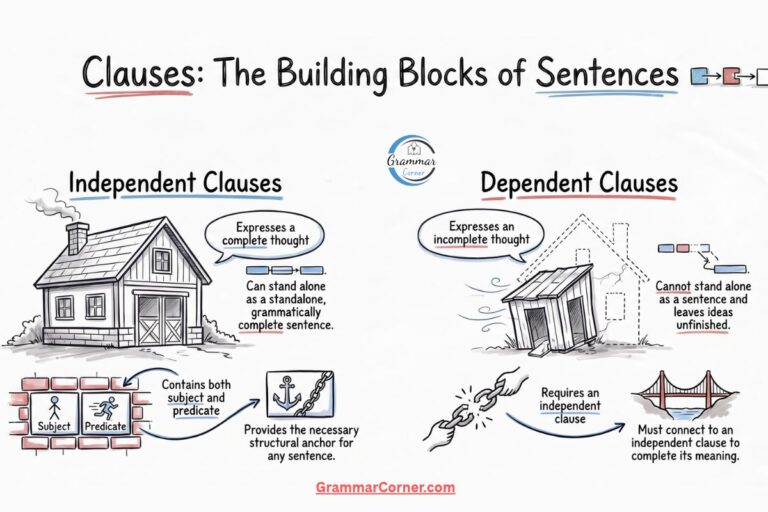
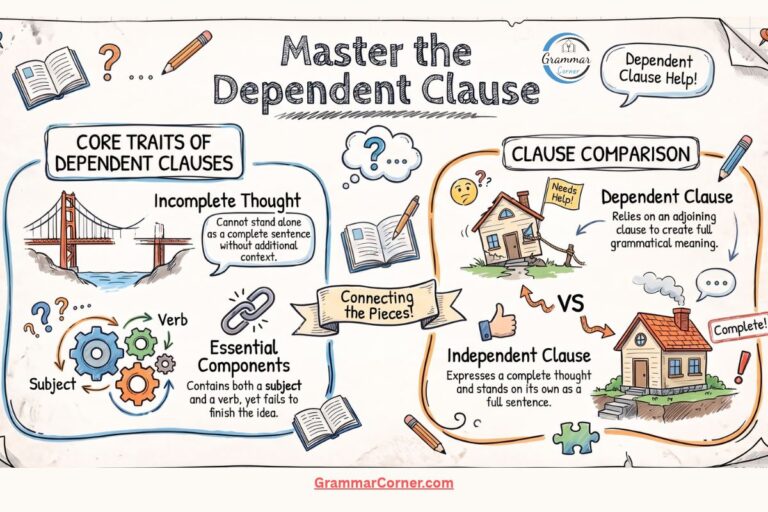
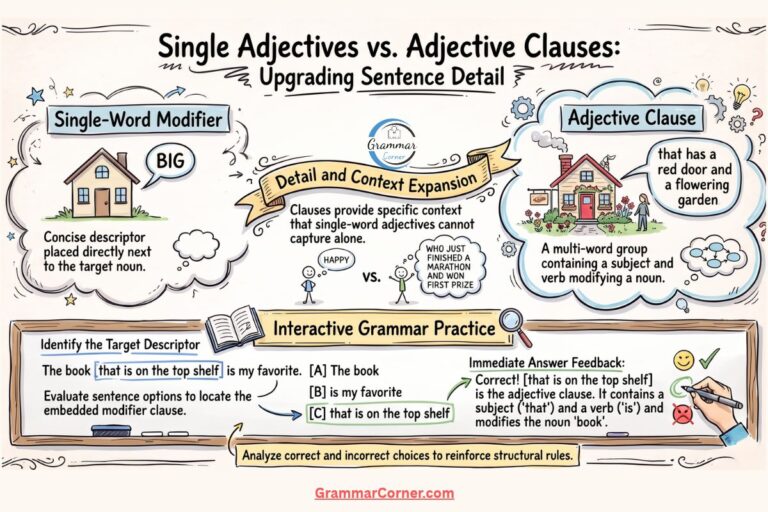
A relative clause is a dependent clause that gives information about a noun or pronoun in a sentence. It helps us identify people and things, add descriptions, combine ideas, and avoid a string of short sentences.
Compare:
“I met a woman. She teaches at the university.”
How a Relative Clause Works
Consider another example:
“The woman who lives next door is a doctor.”
The relative clause is who lives next door. It describes the woman.
The noun being described is called the antecedent:
• who lives next door = relative clause
• who = relative word (pronoun)
• lives = verb
Relative Clauses Cannot Stand Alone
A relative clause cannot normally stand alone as a complete sentence:
It needs something to relate to.
That connection between the clause and the noun is the central idea behind relative clauses.
✨ Quick Challenge
In the sentence “The laptop that I bought yesterday works perfectly,” which part is the antecedent modified by the relative clause? Tap your answer.
See the full answer
Answer: “The laptop”
The antecedent is the specific noun or pronoun to which the relative clause refers and attaches:
- The laptop = Antecedent (the noun receiving description)
- that I bought yesterday = Relative Clause (identifying which laptop)
- that = Relative pronoun
- works perfectly = Main predicate
Why Do We Use Relative Clauses?
Without relative clauses, writing can become repetitive:
“I have a neighbor. He owns a bakery. He opens the bakery at six. He lives across the street.”
Relative clauses are useful when you want to:
- identify a particular person or thing
- describe someone or something
- add background information
- combine closely related ideas
- avoid repeating nouns and pronouns
- make sentences more varied
- give precise information without creating another sentence
Types of Relative Clauses
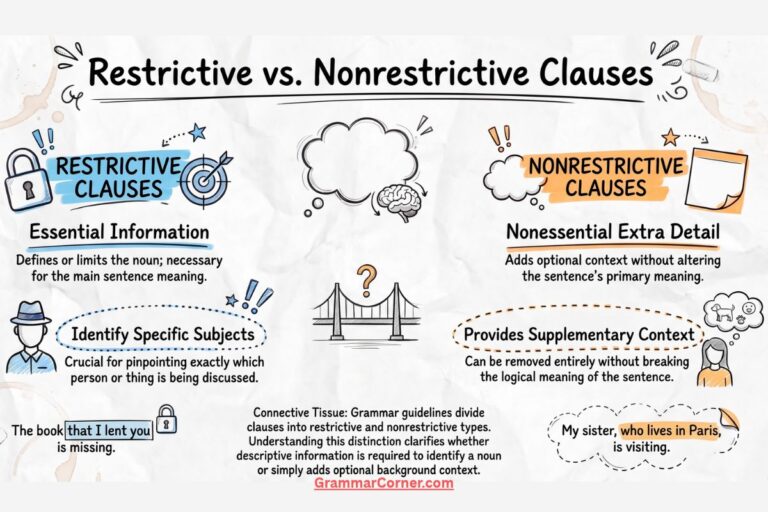
Relative clauses are traditionally divided into two broad types:
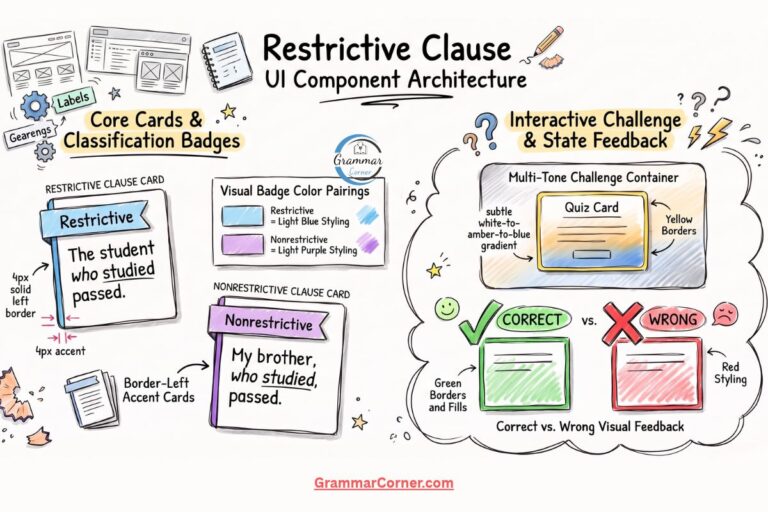
- Defining relative clauses (restrictive)
- Non-defining relative clauses (non-restrictive)
The difference is based on the role of the information. A defining clause helps the reader identify the noun, while a non-defining clause adds information about a noun that is already identified.
| Defining Relative Clause | Non-Defining Relative Clause |
|---|---|
| Identifies or narrows the noun | Adds extra information |
| Information is important to the intended identification | Information is additional |
| Usually no commas | Set off with commas |
| that can be used | that is not normally used |
| Relative pronoun can sometimes be omitted | Relative pronoun is normally retained |
The distinction becomes much clearer with examples.
Defining Relative Clauses: Which One?
Consider:
“The students who submitted the project early received feedback first.”
• The clause who submitted the project early identifies the particular students being discussed.
• That makes it a defining relative clause.
Another example:
“The restaurant that serves vegetarian food is on the corner.”
• Without it: “The restaurant is on the corner.” (The reader may not know which restaurant the writer means.)
More Examples
- The employee who handles the accounts is away today.
- I need the document that contains the final figures.
- The shoes which I ordered online have arrived.
- The house where my grandparents lived has been sold.
In each case, the relative clause helps narrow down the noun.
Non-Defining Relative Clauses: What Else?
Now look at:
“My brother, who works in Qatar, is coming home next month.”
The words my brother already identify the person. We do not need who works in Qatar to know which brother is being discussed. The clause simply gives us another fact.
• Remove the clause: “My brother is coming home next month.” (The main identification remains intact.)
More Examples
- Sara, who won the debate, thanked her teacher.
- Our old house, which was built in 1950, has been renovated.
- Islamabad, which is the capital of Pakistan, has many government buildings.
The commas signal that the information is additional.
Defining vs. Non-Defining: The Meaning Can Change
The difference is sometimes much more than a punctuation issue. Compare:
The commas change how the reader understands the relationship between the noun and the clause.
A Useful Comparison
| Sentence | What the Relative Clause Does |
|---|---|
| The players who trained regularly improved quickly. | Identifies which players |
| The players, who trained regularly, improved quickly. | Adds information about the players |
| The book that has a blue cover is mine. | Identifies the book |
| My book, which has a blue cover, is on the desk. | Adds information about my book |
Relative Pronouns: The Words That Connect the Clause
Relative clauses commonly begin with a relative pronoun or another relative word. The most familiar relative pronouns are:
Other words such as where, when, and why can also introduce relative clauses.
Relative Word Guide
| Relative Word | Typical Use | Example |
|---|---|---|
| who | People | The woman who called is my aunt. |
| whom | People as objects, especially formal | The man whom I interviewed was helpful. |
| whose | Possession | The student whose phone rang apologized. |
| which | Things and animals; especially non-defining clauses | The car, which is quite old, still runs well. |
| that | People or things in defining clauses | The book that I borrowed is excellent. |
| where | Places | The village where he grew up is beautiful. |
| when | Times | I remember the year when we met. |
| why | Reasons | I understand the reason why she left. |
The choice depends on what the relative word refers to and what grammatical role it has inside the clause.
“Who” for People
Use who when the relative pronoun refers to a person and functions as the subject of the relative clause:
“The doctor who treated me was very kind.”
• Here, who is the subject of treated.
Another example:
“I spoke to a teacher who works at the college.”
The teacher performs the action of works.
“Whom” for People as Objects
Whom is traditionally used when the person is the object of the relative clause:
“The woman whom I called did not answer.”
• he / she ➔ who
• him / her ➔ whom
Compare
In everyday English, who is very commonly used instead of whom, especially in conversation.
Relative Clauses With “Where”
Where can introduce a relative clause connected to a place:
The version with where is generally more natural in ordinary English.
Relative Clauses With “When”
When can refer to a time or period:
- I remember the year when we moved here.
- That was the moment when everything changed.
The relative clause tells us what happened during that time.
In many cases, when can be omitted:
“I remember the year we moved here.”
The meaning remains clear.
Relative Clauses With “Why”
Why can be used after a noun referring to a reason:
“I understand the reason why she left.”
However, the sentence can often be simplified:
That last sentence is especially interesting because why she left is no longer modifying a noun. It functions as a noun clause (the object of understand).
This shows again why you should identify a clause by its function, not simply by the word that introduces it.
Relative Clauses and Noun Clauses: Do Not Confuse Them
These two types of clauses can look very similar. Compare:
A Quick Comparison
| Noun Clause | Relative Clause |
|---|---|
| Functions like a noun | Modifies a noun |
| May be the subject or object | Gives information about an antecedent |
| I know what she wants. | I know the person who wants it. |
| What he said was surprising. | The statement that he made was surprising. |
Ask: Is the clause replacing a noun, or describing a noun that is already there?
- If it replaces the noun ➔ It is likely a noun clause.
- If it describes a noun already present ➔ It is likely a relative clause.
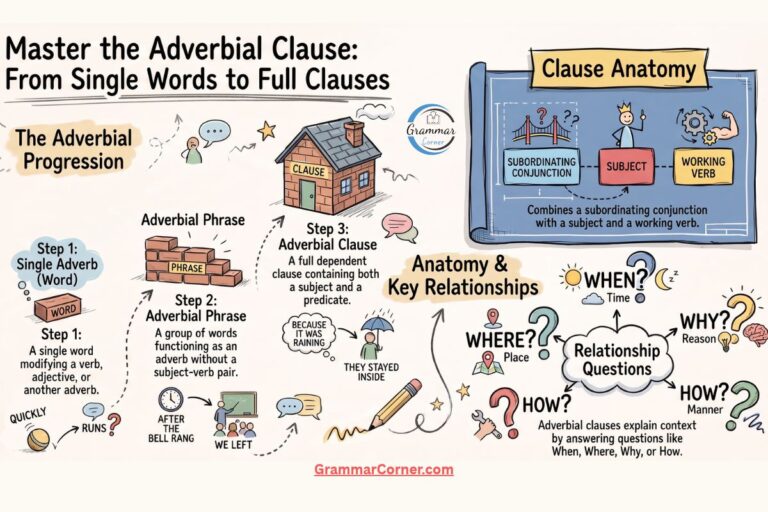
Relative Clauses vs. Adverb Clauses
Relative clauses and adverb clauses also have different jobs:
Here, when we met describes the day. It is a relative clause.
Here, when we met tells us when the action happened. It functions adverbially.
Side-by-Side Comparison
| Relative Clause | Adverb Clause |
|---|---|
| I remember the day when we met. | When we met, we talked for hours. |
| This is the place where they stayed. | We waited where they told us to wait. |
| I understand the reason why he left. | He left because he was tired. |
The same introductory words can sometimes appear in different clause structures.
Relative Clauses After People, Places, and Things
Relative clauses can describe almost any noun category:
The key is not the type of noun alone. It is the relationship between the noun and the relative clause.
Relative Clauses With “Whose”
Because whose expresses possession, it is especially useful when two sentences contain a repeated possessive idea. Consider:
➔ Combined: “I met a student whose father is a pilot.”
➔ Combined: “We visited a house whose roof had been damaged.”
Examples
- The girl whose phone was lost reported it.
- I spoke to a man whose brother works abroad.
- They bought a company whose products are exported worldwide.
The Relative Clause Does Not Always Come Immediately After the Subject
A relative clause can modify a noun appearing in different positions across the sentence:
The important point is that the relative clause normally comes close to the noun it modifies. This keeps the relationship clear.
Avoid Misplaced Relative Clauses
A relative clause should clearly refer to the noun you intend. Consider:
Grammatically, who were on the table appears to describe students, which creates a strange meaning.
Keeping the relative clause close to its antecedent usually prevents confusion.
Relative Clauses Can Combine More Than Two Ideas
Relative clauses are particularly useful when several related facts need to appear in one sentence.
“We visited a museum. The museum opened in 1890. It contains rare manuscripts.”
Be careful not to make every sentence extremely long. A relative clause is useful when the ideas belong closely together; otherwise, separate sentences may be clearer.
When a Relative Clause Makes Writing Better
Relative clauses are helpful when they create a clear relationship between two ideas:
“I spoke to a teacher. The teacher teaches English. The teacher has worked there for ten years.”
When a Relative Clause Makes Writing Worse
Not every pair of sentences needs to be joined. For example:
Common Mistakes With Relative Clauses
A Quick Test for Defining or Non-Defining Clauses
When you are unsure about commas, ask three questions:
• If the noun remains clearly identified and the clause merely adds information ➔ The clause is likely non-defining.
A Quick Test for Omitting the Relative Pronoun
Ask: Who or what performs the action inside the relative clause?
“The book that I borrowed is interesting.”
Who borrowed it? I did. So that is the object and can be omitted:
“The book that fell from the shelf is damaged.”
What fell? The book. So that is the subject and cannot be omitted:
• Relative pronoun itself is the subject ➔ Keep it in the sentence.
Relative Clauses in Formal and Informal English
English offers more than one grammatical option in several relative-clause structures. Compare:
Likewise:
“The report that we discussed was useful.”
This is perfectly natural in ordinary English. Formal writing does not always require complicated relative structures.
Relative Clauses With “What”
A common mistake is assuming that what works like which or that in an ordinary relative clause. Traditional grammar does not normally use what after an antecedent noun in this way.
Here, what you want is a noun clause (object of know).
Here, that you want is a relative clause describing the thing.
For standard English, use that, which, or another appropriate relative structure instead.
Advanced Point: Relative Clauses With “Whoever” and “Whatever”
Some relative-like structures begin with whoever, whatever, or whichever:
- Whoever wins the competition will receive a scholarship.
- Choose whichever option seems best.
These structures can function as noun-like units in the larger sentence rather than behaving exactly like ordinary adjective clauses. For learners, the important point is that -ever words often introduce a broader meaning such as “any person who” or “anything that.”
Advanced Point: Sentence Relative Clauses
Most relative clauses describe a particular noun:
“The car, which is very old, still runs.”
But which can sometimes refer to the entire preceding statement:
“The manager rejected the proposal, which surprised the staff.”
Here, the relative clause is commenting on the preceding event rather than simply describing the proposal.
Relative Clause Examples by Function
| Purpose | Example |
|---|---|
| Identify a person | The doctor who treated me was excellent. |
| Identify a thing | The file that contains the report is missing. |
| Describe a person | Sara, who teaches science, won an award. |
| Describe a thing | The bridge, which was built decades ago, is still in use. |
| Show possession | The student whose bag was stolen reported it. |
| Refer to a place | The village where I grew up is peaceful. |
| Refer to a time | I remember the year when we moved. |
| Comment on an idea | The team withdrew, which shocked the supporters. |
✨ Quick Challenge
In the sentence “The flight was canceled at the last minute, which caused significant inconvenience,” what does the relative clause comment on? Tap your answer.
See the full answer
Answer: It functions as a sentence relative clause commenting on the entire preceding event.
In a sentence relative clause, the relative pronoun which does not refer to a single noun antecedent. Instead, it refers back to the entire situation or fact expressed in the preceding main clause (that the flight was canceled at the last minute), allowing the writer to comment on the whole event smoothly.
Practice: Find the Relative Clause
Identify the relative clause in each sentence:
- The woman who owns the shop lives nearby.
- I found the documents that you requested.
- My uncle, who lives in Peshawar, is visiting us.
- The house where they grew up has been demolished.
- The student whose laptop was stolen reported the incident.
- I remember the day when we first met.
- The company changed its policy, which caused confusion.
| No. | Relative Clause |
|---|---|
| 1 | who owns the shop |
| 2 | that you requested |
| 3 | who lives in Peshawar |
| 4 | where they grew up |
| 5 | whose laptop was stolen |
| 6 | when we first met |
| 7 | which caused confusion |
Practice: Defining or Non-Defining?
Decide whether each relative clause is defining or non-defining:
- The employees who work remotely attend the online meeting.
- My employees, who work remotely, attend the online meeting.
- The laptop that has a cracked screen belongs to me.
- My laptop, which has a cracked screen, belongs to me.
- The woman who won the award is my neighbor.
- Maria, who won the award, is my neighbor.
| No. | Type | Reason |
|---|---|---|
| 1 | Defining | Identifies which employees |
| 2 | Non-defining | Adds information about the employees |
| 3 | Defining | Identifies which laptop |
| 4 | Non-defining | The laptop is already identified |
| 5 | Defining | Identifies which woman |
| 6 | Non-defining | Maria is already identified |
Practice: Can the Relative Pronoun Be Omitted?
Decide whether the relative pronoun can be removed:
Practice: Correct the Errors
How to Build a Relative Clause Step by Step
Suppose you have these two separate sentences:
• “The woman owns a publishing company.”
This is one of the easiest ways to begin creating natural relative clauses yourself.
How to Combine Sentences With a Relative Clause
• He designs buildings.
• The camera has a powerful lens.
• Her students won several awards.
• My father was born there.
• We moved that year.
Frequently Asked Questions
• “The woman whom I called…” (Object)
However, which can also occur in defining clauses, particularly in British English and some formal styles.
It cannot normally be omitted when it is the subject:
❌ Incorrect: “The man called me.”
In sentences such as “I know what she wants,” the entire what she wants unit functions as a noun clause.