Adverbial Clauses (10 Types Explained With Examples)
What Is an Adverbial Clause?
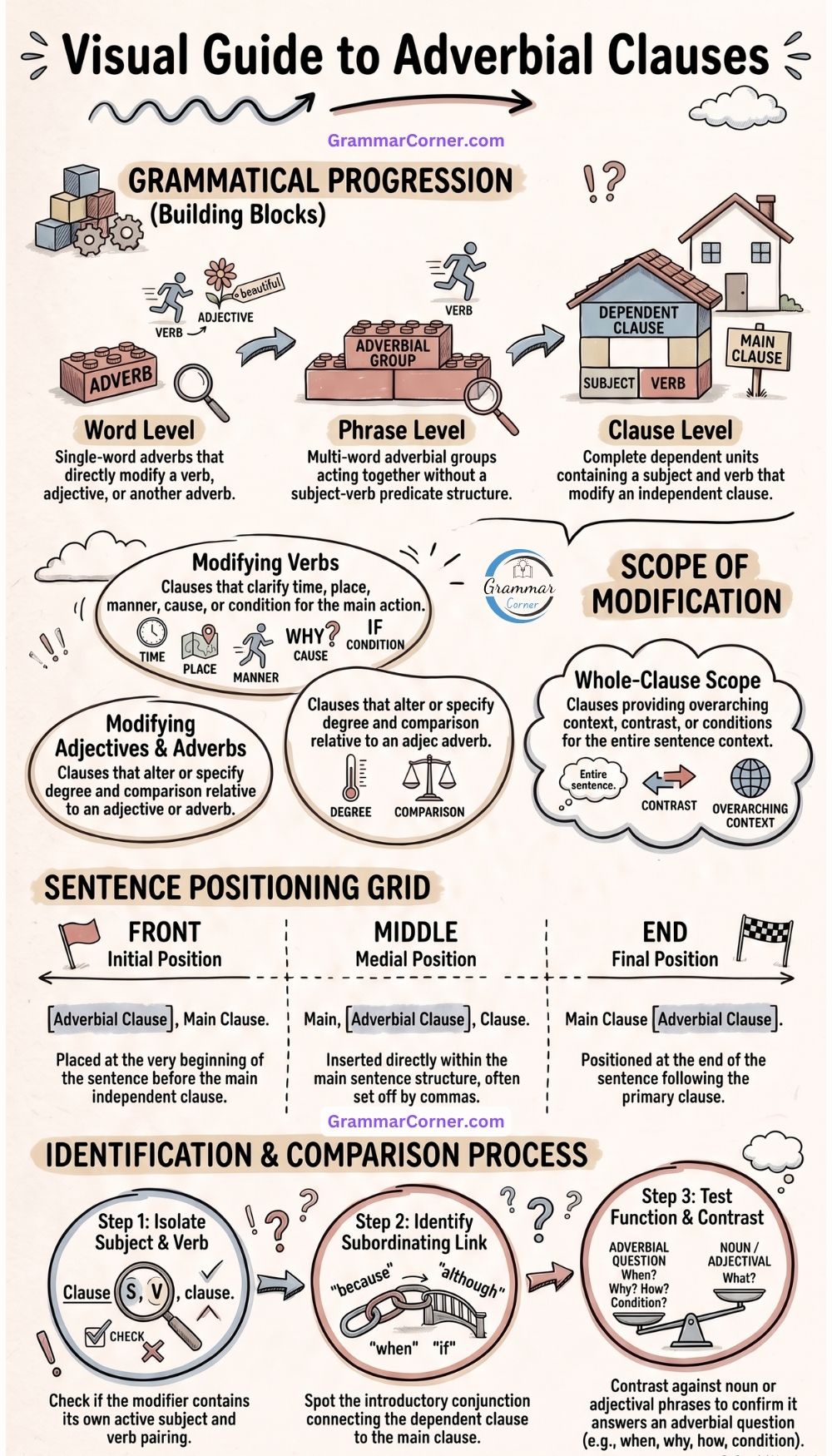
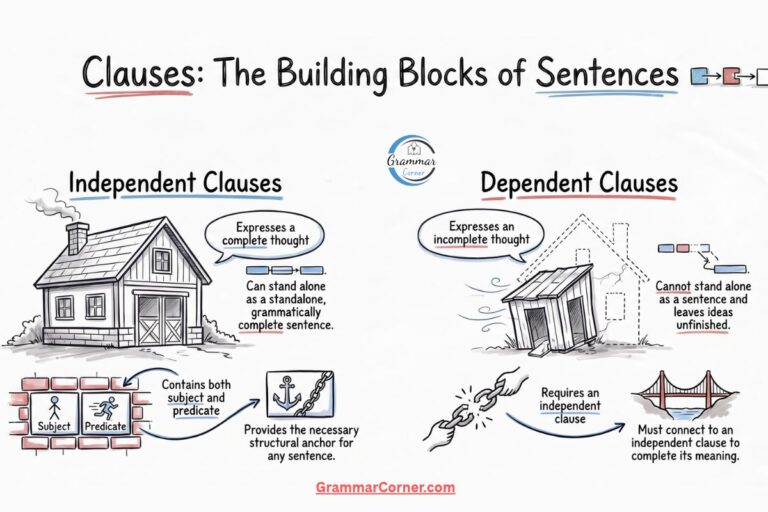
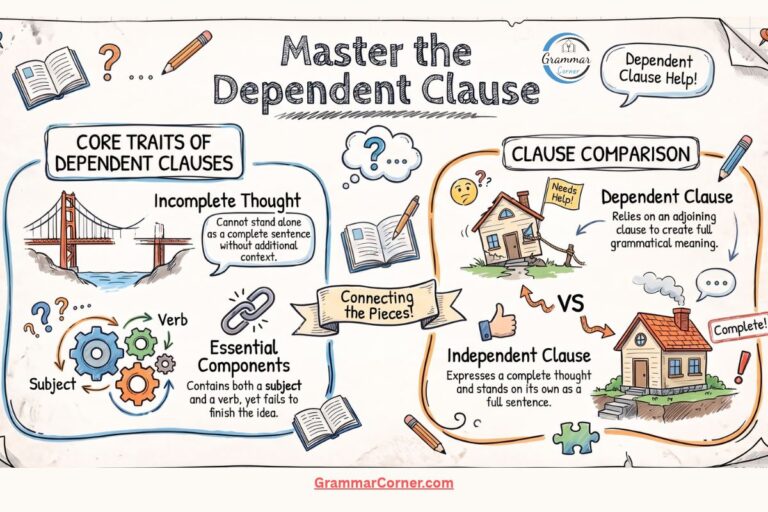
An adverbial clause is a dependent clause that functions just like an adverb by modifying an action (verb), a descriptive quality (adjective), an adverb, or the meaning of another entire clause.
While basic adverbs often answer the question how, an adverbial clause goes much further by explaining the complete situational context surrounding an event:
From Word to Phrase to Clause: The Descriptive Progression
Notice how we can expand the modifier to add greater narrative precision:
How Adverbial Clauses Are Built?
Instead of writing multiple short, disconnected sentences, adverbial clauses allow writers to establish direct cause-and-effect relationships within a single sentence:
✨ Quick Challenge
Three of these options represent adverbial clauses modifying an action. One is an adverbial phrase (lacks a subject and finite verb). Tap the phrase that doesn’t belong.
See the full answer
Answer: “before sunset”
Understanding the distinction between phrases and clauses:
- Adverbial Phrase: “before sunset” is a prepositional phrase functioning adverbially, but it does not contain a subject-plus-verb combination.
- Adverbial Clauses: The other three options (“before the sun disappeared”, “because the storm became stronger”, and “although the rain was heavy”) each contain both a subject and a verb introduced by a subordinating conjunction.
Why Is It Called an “Adverbial” Clause?
The term adverbial describes what the clause does rather than how it looks. It functions just like an ordinary adverb by supplying contextual information about an action, state, or circumstance:
“She spoke quietly.”
“She spoke in a quiet voice.”
“She spoke as though she were afraid.”
While the grammatical forms differ, their communicative job is identical: each answers how or in what manner she spoke.
Comparing the Three Adverbial Forms
| Form | Example Sentence | Information Provided |
|---|---|---|
| Adverb | She arrived early. | When (Time) |
| Adverbial phrase | She arrived before noon. | When (Time) |
| Adverbial clause | She arrived before the meeting began. | When (Time) |
Key Takeaway: The defining feature of the adverbial clause is that it contains its own distinct subject (the meeting) and verb (began).
What Does an Adverbial Clause Modify?
Although traditionally taught as modifying verbs, adverbial clauses actually perform a much wider range of grammatical duties. They can modify:
What Are the Main Types of Adverbial Clauses?
Adverbial clauses express a rich variety of logical relationships between ideas. Below is a quick-reference chart organized by purpose:
| Clause Type | Question Answered | Common Subordinating Introducers |
|---|---|---|
| Time | When? | when, while, before, after, until, once, as soon as |
| Place | Where? | where, wherever |
| Reason | Why? | because, since, as |
| Condition | Under what condition? | if, unless, provided that, as long as |
| Contrast / Concession | Despite what? | although, though, even though, while |
| Purpose | For what goal? | so that, in order that |
| Result | With what outcome? | so… that, such… that |
| Manner | How? | as, as if, as though |
| Comparison | Compared with what? | than, as… as |
| Degree | To what extent? | than, as… as, so… that |
1. Adverbial Clauses of Time
An adverbial clause of time tells us when an action happens, happened, or will happen.
Common subordinating words include:
- When the guests arrived, we served dinner.
- We waited until the rain stopped.
- After she finished her assignment, she went for a walk.
Time Clauses With Future Meaning
One common mistake is using will in the time clause when talking about the future. Usually, English uses the present tense in the time clause even though the meaning is future.
- We will start after everyone arrives.
- She will send the report when she finishes it.
2. Adverbial Clauses of Place
An adverbial clause of place tells us where an action occurs.
Common introducers include:
- Sit where you can see the screen.
- We followed the road wherever it led.
- The children played where the grass was dry.
Where vs. Wherever
Where generally refers to a particular place or location:
We stopped where the road ended.
Wherever suggests any place or every place that meets the condition:
You can sit wherever you like.
| Word | General Meaning | Example |
|---|---|---|
| where | A particular place | Stay where you are. |
| wherever | Any place / every suitable place | Follow me wherever I go. |
3. Adverbial Clauses of Reason
An adverbial clause of reason explains why something happens.
Common subordinators include:
- We canceled the picnic because the weather was bad.
- Since the road was blocked, we took another route.
- As everyone was ready, we began the meeting.
Because, Since, and As
All three can introduce reasons, but they are not always equally natural in every context.
- Because usually gives a direct and clear reason:
We stayed home because it was raining. - Since can introduce a reason that the speaker treats as already known or obvious:
Since you are here, we can begin. - As can also introduce a reason and is common in formal or written English:
As the shop was closed, we returned the next morning.
For clear explanations, because is often the safest choice.
4. Adverbial Clauses of Condition
A conditional clause states a condition that affects what happens in the main clause.
Common expressions include:
- If you need help, call me.
- We will go outside if the weather improves.
- You cannot enter unless you have permission.
If and Unless
If introduces a condition: If you study, you will improve.
Unless means approximately if not: You will not improve unless you study.
Types of Conditional Meaning
Conditional clauses can be used with different verb patterns to express different kinds of situations:
| Conditional Pattern | Main Use | Example |
|---|---|---|
If + present, present |
General truth | If you heat ice, it melts. |
If + present, will + verb |
Real future possibility | If it rains, we will stay home. |
If + past, would + verb |
Hypothetical situation | If I had more time, I would travel. |
If + past perfect, would have + participle |
Unreal past | If she had left earlier, she would have caught the train. |
The conditional clause is not merely about the word if. The verb forms help show how real, possible, hypothetical, or unreal the condition is.
5. Adverbial Clauses of Contrast and Concession
These clauses show that one fact is true despite another fact.
Common subordinators include:
- Although the road was difficult, they continued the journey.
- She went to work even though she felt tired.
- While I understand your concern, I disagree with the conclusion.
Although vs. Even Though
Both introduce contrast.
- Although: Although the task was difficult, we completed it.
- Even though gives stronger emphasis to the contrast:
Even though the task was extremely difficult, we completed it.
Although vs. Even If
These are not interchangeable.
- Although introduces a fact:
Although he was tired, he continued working. (He really was tired.) - Even if introduces a possible or hypothetical condition:
Even if he is tired, he will continue working. (His being tired is presented as a possibility or condition.)
6. Adverbial Clauses of Purpose
An adverbial clause of purpose explains why an action is performed in terms of the intended result.
Common expressions include:
- She spoke quietly so that the baby would not wake up.
- He left early so that he could avoid the traffic.
- The instructions were repeated so that everyone could understand them.
Purpose vs. Reason
These two are easy to confuse.
- Reason clause: Explains why something happened.
We stayed home because it was raining. - Purpose clause: Explains what someone intended to achieve.
We stayed home so that we could finish the project.
7. Adverbial Clauses of Result
A result clause shows the consequence of an action, condition, or degree.
Common patterns include:
- The road was so slippery that several cars slowed down.
- It was such a difficult problem that nobody solved it quickly.
- She spoke so quietly that I could barely hear her.
So vs. Such
Use so before an adjective or adverb: The film was so interesting that we watched it twice.
Use such before a noun phrase: It was such an interesting film that we watched it twice.
| Pattern | Example |
|---|---|
so + adjective + that |
It was so cold that we stayed inside. |
so + adverb + that |
He drove so carefully that everyone felt safe. |
such + adjective + noun + that |
It was such a cold day that we stayed inside. |
such + noun + that |
It was such a surprise that everyone was speechless. |
8. Adverbial Clauses of Manner
A manner clause tells us how something happens or how one action compares with another.
Common expressions include:
- Do it as I showed you.
- He talks as though he knows everything.
- She behaved as if nothing had happened.
As If and As Though
These expressions can introduce an imagined or apparently true manner:
- He looked at me as if he had seen a ghost.
- She spoke as though she knew the answer.
The clause does not necessarily mean that the situation is actually true. It describes how something appears or seems.
9. Adverbial Clauses of Comparison
Comparison clauses show how one person, thing, action, or quality compares with another.
Common patterns include:
- She works harder than I do.
- He is as careful as his brother is.
- The new system is more efficient than the old one was.
Sometimes part of the clause is omitted because the meaning is obvious:
She is taller than I am.
In less formal everyday English, speakers may say:
She is taller than me.
The choice between forms depends on grammatical role, context, and style.
10. Adverbial Clauses of Degree
A degree clause indicates how much or to what extent something is true. Degree is often expressed through comparison or result structures.
- The box was so heavy that I could not lift it.
- The river is wider than I expected.
- He was as nervous as I had imagined.
Degree clauses often overlap with comparison and result structures, so their classification depends on what relationship the writer wants to emphasize.
How to Identify an Adverbial Clause
Finding an adverbial clause becomes easier when you follow a few steps.
In after the meeting ended:
• the meeting = subject
• ended = verb
Therefore, it is a clause rather than a phrase.
It tells us when we went to the restaurant.
The clause gives information about the action went.
Therefore: After the meeting ended = adverbial clause of time.
A Four-Question Identification Test
When you see a dependent clause, ask:
If no, it is not a clause.
If yes, continue.
If yes, it is likely adverbial.
If it modifies a noun, it is more likely an adjective/relative clause.
This last question is especially useful because adjective clauses and adverbial clauses are often confused.
Adverbial Clause vs. Adverbial Phrase
An adverbial phrase can perform a similar function to an adverbial clause, but it does not contain its own subject–verb combination.
➔ After lunch = adverbial phrase
➔ After the guests had left = adverbial clause
Side-by-Side Comparison
| Adverb | Adverbial Phrase | Adverbial Clause |
|---|---|---|
| yesterday | after lunch | after the guests had left |
| outside | near the station | where the station used to be |
| quickly | with great care | as carefully as she could |
| later | after the meeting | after the meeting ended |
| silently | without making a sound | although nobody asked him to |
The important test is simple:
- No subject–verb combination: after lunch → phrase
- Subject + verb: after lunch ended → clause
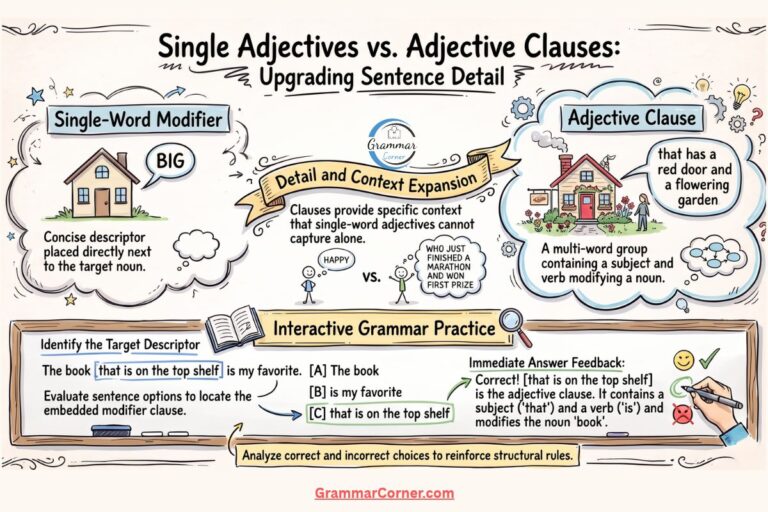
Adverbial Clause vs. Adjective Clause
Both are dependent clauses, but they perform different jobs:
- An adjective clause modifies a noun or pronoun.
- An adverbial clause gives information about an action, circumstance, or relationship.
Here, where we met describes place. ➔ Adjective clause
Here, the clause tells us where we sat. ➔ Adverbial clause
Quick Comparison
| Feature | Adjective Clause | Adverbial Clause |
|---|---|---|
| Function | Modifies a noun/pronoun | Adds information about an action or circumstance |
| Position | Often follows a noun | May appear before or after the main clause |
| Questions Answered | Which one? / What kind? | When? Where? Why? How? Under what condition? |
| Example | The house where she lives | She lives wherever she finds work |
Adverbial Clause vs. Noun Clause
A noun clause performs a noun-like function, whereas an adverbial clause provides information about another part of the sentence.
Where she lives is the object of know. ➔ Noun clause
Wherever she finds work tells us where she lives. ➔ Adverbial clause
A Useful Comparison of the Three Types
| Clause Type | Function | Example |
|---|---|---|
| Noun clause | Acts as a noun | I know what he wants. |
| Adjective clause | Describes a noun | The man who called left. |
| Adverbial clause | Adds information about an action/circumstance | He left because he was tired. |
Where Can an Adverbial Clause Appear?
An adverbial clause can appear at different positions in a sentence. The three useful patterns are:
✨ Quick Challenge
In which sentence does the highlighted clause function as an adverbial clause (modifying an action/verb) rather than an adjective or noun clause?
See the full answer
Answer: “We sat where the view was better.”
Distinguishing dependent clauses that begin with where:
- Adverbial Clause: In “We sat where the view was better,” the clause has no noun antecedent; it tells where the action of sitting took place (modifying the verb).
- Adjective (Relative) Clause: In “the restaurant where we met” and “the town where she grew up,” the clause follows and describes a specific noun antecedent (restaurant / town).
- Noun Clause: In “Nobody knows where he hid the keys,” the clause acts as the direct object of the verb knows (“Nobody knows it”).
Adverbial Clause at the Beginning
When an adverbial clause comes before the main clause, a comma is normally used to separate it from the independent clause.
- Because the road was flooded, we turned back.
- Although she was tired, she continued working.
- When the bell rang, the students left.
The comma helps the reader recognize where the introductory clause ends.
Adverbial Clause at the End
When the adverbial clause follows the main clause, a comma is often unnecessary.
- We turned back because the road was flooded.
- She continued working although she was tired.
- The students left when the bell rang.
The absence of a comma is particularly common when the clause is closely connected to the main idea.
Adverbial Clause in the Middle
An adverbial clause can sometimes be inserted into the middle of a sentence. When it is clearly parenthetical or interruptive, commas are used around it.
- The students, although they were tired, continued studying.
- The manager, because the deadline had changed, called another meeting.
However, not every clause placed between other sentence elements should automatically be surrounded by commas. The punctuation should reflect the grammatical relationship and intended meaning.
Commas With Adverbial Clauses
Comma rules are often taught too simply. A useful starting rule is:
Introductory adverbial clause → comma
If you need anything, call me.
But the reverse is not always “Adverbial clause at the end → no comma.” That is a strong general tendency, especially when the clause is closely connected to the main clause:
Call me if you need anything.
However, punctuation can change when the clause is parenthetical, strongly separated, or when a comma helps prevent ambiguity.
Punctuation Guide
| Position | Typical Punctuation | Example |
|---|---|---|
| Beginning | Comma usually used | When she arrived, we started. |
| End | Comma often omitted | We started when she arrived. |
| Middle, parenthetical | Commas usually used | We, when the time came, acted quickly. |
| End with special emphasis/clarification | Context may justify comma | He left, although nobody asked him to. |
The important point is that comma placement should not be treated as a mechanical rule based only on position.
How to Combine Sentences With Adverbial Clauses
One of the best ways to understand adverbial clauses is to use them to combine short sentences.
Or: We went outside after the rain stopped.
Sentence-Combining Patterns
| Relationship | Two Short Sentences | Combined Sentence |
|---|---|---|
| Time | The class ended. We left. | When the class ended, we left. |
| Reason | It was raining. We stayed inside. | We stayed inside because it was raining. |
| Condition | You finish early. You can leave. | If you finish early, you can leave. |
| Contrast | She was tired. She continued. | Although she was tired, she continued. |
| Purpose | He whispered. He did not want to wake the baby. | He whispered so that he would not wake the baby. |
Common Subordinating Conjunctions for Adverbial Clauses
Subordinating conjunctions are important because they connect the dependent clause to the main clause and signal the relationship between them.
Adverbial Clause Formula
There is no single formula that fits every adverbial clause, but the following patterns cover many common constructions.
The exact structure varies according to the relationship being expressed.
Common Mistakes With Adverbial Clauses
• After the meeting ended ➔ adverbial clause (subject: the meeting, verb: ended)
Here, when we first met describes day ➔ relative/adjective clause.
Here, when the meeting ended tells us when we left ➔ adverbial clause.
Unless already carries the meaning of a negative condition.
Adverbial Clauses and Sentence Variety
Adverbial clauses can make writing more varied without simply making sentences longer for the sake of length.
• because they had practiced thoroughly ➔ reason
This is the real value of adverbial clauses: they help writers show how ideas relate to one another, rather than simply placing facts next to each other.
How to Choose the Right Adverbial Clause
When writing, begin with the relationship you want to express. Ask yourself:
This approach is more useful than memorizing long lists of conjunctions without understanding their meanings.
A Quick Adverbial Clause Identification Chart
| Ask This Question | If the Clause Answers It… | Likely Type |
|---|---|---|
| When did it happen? | Time | Time clause |
| Where did it happen? | Location | Place clause |
| Why did it happen? | Cause/reason | Reason clause |
| Under what condition? | Condition | Conditional clause |
| Despite what? | Contrast | Concession clause |
| For what purpose? | Intended goal | Purpose clause |
| With what result? | Consequence | Result clause |
| How? | Manner | Manner clause |
| Compared with what? | Comparison | Comparison clause |
| To what extent? | Degree | Degree clause |
Examples of Adverbial Clauses
Here are examples covering the major patterns:
Practice Exercises: Adverbial Clauses
Practice Exercise 1: Identify the Adverbial Clause
Identify the adverbial clause in each sentence:
- When the rain stopped, the children went outside.
- We canceled the trip because the road was closed.
- If you need assistance, ask the receptionist.
- Although he was nervous, he gave an excellent presentation.
- She saved money so that she could buy a new computer.
- We stayed there until the manager returned.
- Sit wherever you can see the screen.
- He behaved as though nothing had happened.
- The test was so difficult that many students needed extra time.
- She works faster than I do.
Practice Exercise 2: Phrase or Adverbial Clause?
Decide whether the bold part is an adverbial phrase or an adverbial clause:
- We met after lunch.
- We met after the guests had left.
- She worked with great concentration.
- She worked as carefully as her teacher had shown her.
- They waited until sunset.
- They waited until the sun disappeared.
- He went home because of the rain.
- He went home because the rain became heavier.
The deciding factor is the presence of a subject–verb relationship.
Practice Exercise 3: Choose the Correct Subordinator
Choose the best word or expression to complete each sentence:
- ______ the weather improves, we will play outside.
- We waited ______ the bus arrived.
- She stayed home ______ she was feeling sick.
- ______ he was tired, he continued working.
- I will help you ______ you follow the instructions.
- He whispered ______ the baby would not wake up.
Other answers may sometimes be possible depending on the intended meaning.
Practice Exercise 4: Correct the Errors
Identify the error and read the correction below:
This is grammatically possible, but if the intended meaning is that heavy traffic caused the early departure, use:
Practice Exercise 5: Combine the Sentences
Combine each pair using an appropriate adverbial clause:
Frequently Asked Questions About Adverbial Clauses
The sentence contains two adverbial clauses: