Adjectival Phrases (Types, Functions and Examples) | How to Identify Adjectival Phrases?
What Is an Adjectival Phrase?
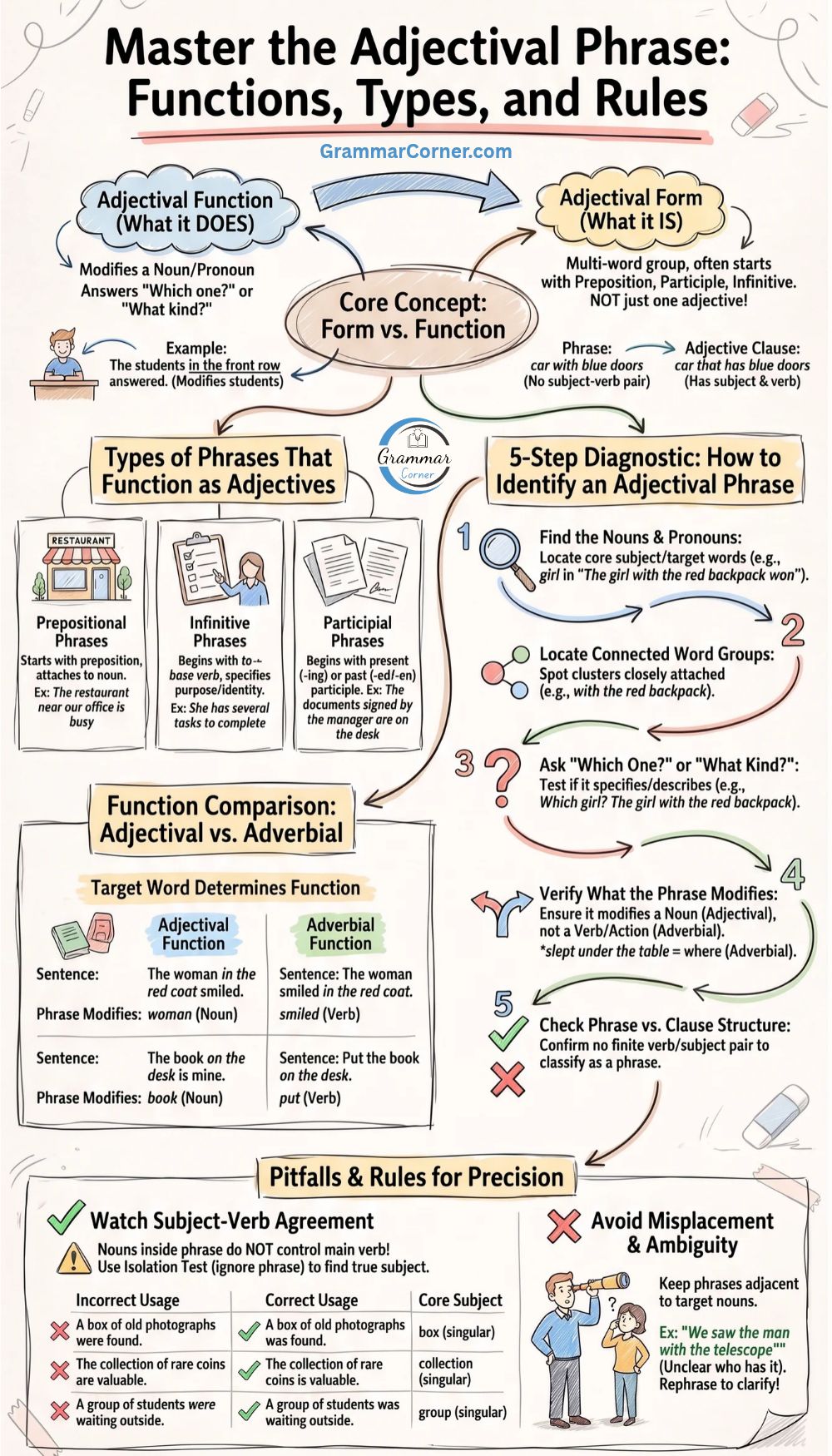
An adjectival phrase is a group of words that functions like an adjective because it modifies or describes a noun or pronoun.
Consider this sentence:
“The students in the front row answered the question.”
The phrase in the front row specifies which students answered. It therefore performs an adjectival function.
Notice something important: in the front row does not contain an adjective. It is structurally a prepositional phrase used functionally to describe the noun students.
A phrase can have one grammatical form (like prepositional or infinitive) while performing another function. A prepositional phrase, for example, can act as an adjective in one sentence and as an adverb in another.
More Examples of Adjectival Phrases
The phrase near the lake describes house, telling us exactly which house is for sale.
The infinitive phrase to sit on describes chair by specifying the intended purpose or kind of chair needed.
An adjectival phrase does not have to begin with an adjective. In fact, many adjectival phrases begin with a preposition or an infinitive.
✨ Quick Challenge
Three of these sentences contain an adjectival phrase modifying a noun. One contains an adverbial phrase modifying a verb. Tap the one that doesn’t belong.
See the full answer
Answer: “The children ran across the field.”
An adjectival phrase functions to describe or identify a noun or pronoun (answering questions like Which one? or What kind?):
- near the lake modifies house (Adjectival)
- with the red cover modifies book (Adjectival)
- in the front row modifies students (Adjectival)
In contrast, in “The children ran across the field,” the phrase across the field modifies the verb ran by indicating where the action took place, making it an adverbial phrase.
What Does an Adjectival Phrase Modify?
An adjectival phrase normally modifies or describes a noun or pronoun:
| Sentence | Adjectival Phrase | Word Modified |
|---|---|---|
| The man with the black hat waved at us. | with the black hat | man |
| We visited the village near the mountains. | near the mountains | village |
| She bought a book to read on the train. | to read on the train | book |
| The children playing in the garden are my cousins. | playing in the garden | children |
| I spoke to the woman from Canada. | from Canada | woman |
Where Does an Adjectival Phrase Appear?
An adjectival phrase commonly appears immediately after the noun it modifies:
“The man with the umbrella is my uncle.”
Its position can vary slightly, especially when the phrase is part of a larger noun phrase structure:
“The man standing near the gate is my uncle.”
Here, standing near the gate follows the noun man and remains directly attached to it.
The important point is not simply where the phrase sits in the sentence—its grammatical relationship with the noun is what determines its adjectival function.
Adjectival Phrase vs. Adjective Phrase
While these terms are sometimes treated as synonyms, making a distinction between form and function is useful:
Side-by-Side Comparison
| Feature | Adjective Phrase | Adjectival Phrase |
|---|---|---|
| Main idea | A phrase built around an adjective | A phrase functioning like an adjective |
| Contains a head adjective? | Yes | Not necessarily |
| Example | very expensive | in the red box |
| What does it modify? | Usually a noun/pronoun or acts as complement | Usually a noun/pronoun |
| Possible form | Adjective + modifiers / complements | Prepositional, infinitive, participial phrase |
How to Identify an Adjectival Phrase
Follow these five practical diagnostic steps:
• In “The girl with the red backpack won the prize,” the primary noun is girl.
• “with the red backpack” gives additional detail directly tied to girl.
➔ Answer: The girl with the red backpack.
Because it specifies the noun, it has an adjectival function.
• “The cat under the table is mine.” ➔ Identifies which cat (modifies noun cat) = Adjectival
• “The students who are in the library are studying.” ➔ Clause (contains subject who and verb are)
Types of Phrases That Can Function as Adjectives
An adjectival function is not limited to a single structural phrase type. Several kinds of grammatical phrases can describe or narrow nouns.
Prepositional Phrases Used as Adjectives
A prepositional phrase begins with a preposition and can modify a noun directly:
Infinitive Phrases Used as Adjectives
An infinitive phrase begins with to + base verb and can describe a noun by specifying purpose or identity:
- “She has several tasks to complete.” ➔ Describes tasks by identifying which tasks.
- “We need a place to stay overnight.” ➔ Tells what kind of place is needed.
Participial Phrases Used as Adjectives
Participial phrases begin with a present (-ing) or past participle (-ed/-en) and describe nouns:
- “The students waiting outside the office looked nervous.” ➔ Describes students.
- “The documents signed by the manager are on the desk.” ➔ Describes documents.
Participial phrases are concise alternatives to full relative clauses (e.g., who were waiting / that were signed).
Examples of Adjectival Phrases
| Sentence | Adjectival Phrase | Modified Noun |
|---|---|---|
| The woman with the green scarf is my teacher. | with the green scarf | woman |
| We stayed at a hotel near the airport. | near the airport | hotel |
| I need something to write with. | to write with | something |
| The boys playing football live next door. | playing football | boys |
| The painting above the fireplace is very old. | above the fireplace | painting |
| She adopted a dog from the local shelter. | from the local shelter | dog |
| The students waiting for the bus were tired. | waiting for the bus | students |
| He found a book about ancient Egypt. | about ancient Egypt | book |
Adjectival Phrase vs. Adjective vs. Adjective Clause
These three structures all describe nouns, but they differ in grammatical construction:
Side-by-Side Structural Comparison
| Structure | Example | What It Contains |
|---|---|---|
| Adjective | blue car | One adjective |
| Adjectival phrase | car with blue doors | A phrase functioning adjectivally |
| Adjective clause | car that has blue doors | Subject + finite verb |
✨ Quick Challenge
Three of these four sentences contain an adjectival phrase modifying a noun. One contains an infinitive phrase of purpose (adverbial). Tap the one that doesn’t belong.
See the full answer
Answer: “She went to the library to study.”
In “She went to the library to study,” the infinitive phrase to study answers the question “Why did she go?” and modifies the verb went (adverbial function of purpose).
In contrast, the other three options all modify nouns directly:
- signed by the manager modifies documents (Participial Phrase ➔ Adjectival)
- with the green scarf modifies woman (Prepositional Phrase ➔ Adjectival)
- to stay overnight modifies place (Infinitive Phrase ➔ Adjectival)
Adjectival Phrases Before and After Nouns
Most adjectival phrases appear directly after the noun they modify:
“The students from Class 8 joined the competition.”
However, the critical issue is not simply placement order—the phrase must connect unambiguously to its intended noun:
“The man standing at the door is my neighbor.”
The phrase clearly modifies man. If an adjectival phrase is placed too far from its target noun, the sentence risks becoming distorted or confusing.
Adjectival Phrases and Subject-Verb Agreement
The object or noun inside an adjectival phrase does not control the verb of the main clause.
“A box of old photographs was found in the attic.”
The grammatical subject is box (singular), not photographs (plural). Therefore, the correct verb form is was, not were.
Subject-Verb Agreement Comparison
| Incorrect | Correct |
|---|---|
| ❌ A box of old photographs were found. | ✅ A box of old photographs was found. |
| ❌ The collection of rare coins are valuable. | ✅ The collection of rare coins is valuable. |
| ❌ A group of students were waiting outside. | ✅ A group of students was waiting outside. |
Temporarily remove the prepositional modifier to verify the core sentence skeleton:
Adjectival Phrase Placement and Ambiguity
An adjectival phrase must sit close enough to its target noun that readers do not misunderstand the relationship:
• ✅ Option A: “We saw the man who was holding the telescope.”
• ✅ Option B: “Using a telescope, we saw the man.”
• ✅ Option A: “She photographed the children who were near the fountain.”
• ✅ Option B: “Near the fountain, she photographed the children.”
The original phrasing may be grammatically permissible, but ambiguous placement introduces unnecessary interpretation friction.
Adjectival Phrase vs. Adverbial Phrase
A single prepositional phrase can serve an adjectival or adverbial role depending entirely on what it modifies:
Side-by-Side Function Table
| Sentence | Phrase | Modifies | Function |
|---|---|---|---|
| The woman in the red coat smiled. | in the red coat | woman | Adjectival |
| The woman smiled in the red coat. | in the red coat | smiled | Adverbial |
| The book on the desk is mine. | on the desk | book | Adjectival |
| Put the book on the desk. | on the desk | put | Adverbial |
Always locate the exact target word the phrase describes. If it modifies a noun or pronoun, it performs an adjectival function; if it modifies a verb, adjective, or whole clause, it performs an adverbial function.
Why Are Adjectival Phrases Important?
Adjectival phrases make sentences significantly more informative without forcing the writer to use a separate sentence for every detail:
“I met a woman.”
Adjectival phrases help you:
They are essential across descriptive, academic, narrative, and explanatory writing.
Common Mistakes with Adjectival Phrases
A prepositional phrase is not automatically adjectival—its function depends entirely on what it modifies:
• “The children in the garden were laughing.” ➔ Tells which children = Adjectival
• “The man with his son smiled.” ➔ Adjectival phrase (a prepositional phrase performing an adjectival role).
A modifying phrase must maintain a direct, clear connection to the word it describes. Poorly positioned modifiers create confusion and disrupt reading flow.
If a phrase could reasonably modify two different parts of the sentence, rewrite it immediately. Clear phrasing removes reader guesswork.
Adjectival Phrase Identification Practice
Identify the adjectival phrase in each sentence and determine the noun it modifies:
- The woman with the silver necklace entered the room.
- We visited a village near the river.
- The students waiting outside the classroom were noisy.
- I need a pen to write with.
- The painting above the fireplace belongs to my grandfather.
- The man from our neighborhood won the award.
- She bought a dress for the wedding.
- The children playing in the yard are my cousins.
| No. | Adjectival Phrase | Modified Noun |
|---|---|---|
| 1 | with the silver necklace | woman |
| 2 | near the river | village |
| 3 | waiting outside the classroom | students |
| 4 | to write with | pen |
| 5 | above the fireplace | painting |
| 6 | from our neighborhood | man |
| 7 | for the wedding | dress |
| 8 | playing in the yard | children |
Adjectival Phrase or Not?
Decide whether the phrase in each sentence is functioning adjectivally or adverbially:
- The dog under the table is sleeping.
- The dog is sleeping under the table.
- The woman in the blue dress is my aunt.
- The woman waited in the blue room.
- We found the books on the top shelf.
- We placed the books on the top shelf.
| No. | Function | Reason |
|---|---|---|
| 1 | Adjectival | Describes the noun dog (identifies which dog). |
| 2 | Adverbial | Tells where sleeping occurs (modifies verb). |
| 3 | Adjectival | Describes the noun woman. |
| 4 | Adverbial | Tells where the action waited took place. |
| 5 | Adjectival | Describes the noun books (identifies which books). |
| 6 | Adverbial | Tells where the books were placed (modifies action). |
Frequently Asked Questions About Adjectival Phrases
The phrase with the red backpack is adjectival because it describes the noun boy.
The prepositional phrase on the corner describes house.
The infinitive phrase to read modifies books.