Adverbs That Start With E (Common, Positive & Descriptive Adverbs)
Adverbs that start with E turn up everywhere — school writing, everyday conversation, news articles, and storytelling.
Words like easily, early, eventually, and equally help you explain actions more clearly and make your sentences sound natural.
An adverb is a word that modifies a verb, an adjective, another adverb, or sometimes an entire sentence. Adverbs that start with E are simply adverbs whose first letter is E, and they add detail by showing how, when, where, or to what extent something happens:
- early
- easily
- equally
- especially
- eventually
- everywhere
Quick Challenge
Choose the correct E-adverb to complete the sentence:
She solved the math problem __________ because she had practiced many times.
Show the answer
✅ Answer: B. easily
Explanation: Easily tells how she solved the problem. It describes the manner of the action, which makes it the correct adverb for this sentence.
Common Adverbs That Start with E
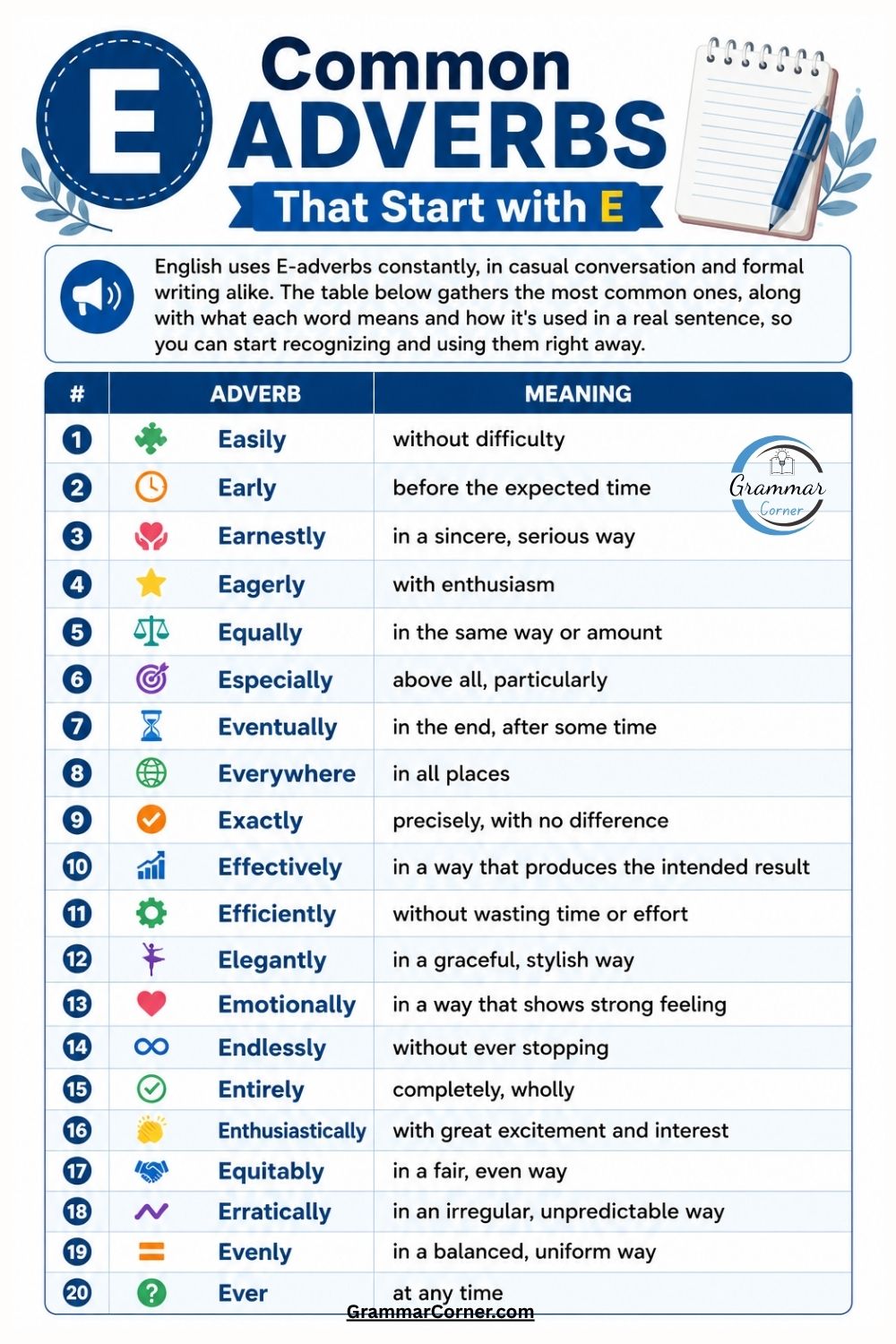
English uses E-adverbs constantly, in casual conversation and formal writing alike. The table below gathers the most common ones, along with what each word means and how it’s used in a real sentence, so you can start recognizing and using them right away.
| Adverb | Meaning | Example Sentence |
|---|---|---|
| Easily | without difficulty | She easily completed the puzzle. |
| Early | before the expected time | We arrived early for the meeting. |
| Earnestly | in a sincere, serious way | He earnestly apologized for the mistake. |
| Eagerly | with enthusiasm | The children eagerly opened their gifts. |
| Equally | in the same way or amount | The teacher treated every student equally. |
| Especially | above all, particularly | I especially enjoy reading history books. |
| Eventually | in the end, after some time | They eventually reached the mountain peak. |
| Everywhere | in all places | Wildflowers were blooming everywhere. |
| Exactly | precisely, with no difference | Please follow the instructions exactly. |
| Effectively | in a way that produces the intended result | She managed the project effectively. |
| Efficiently | without wasting time or effort | The new machine works efficiently. |
| Elegantly | in a graceful, stylish way | The dancer moved elegantly across the stage. |
| Emotionally | in a way that shows strong feeling | He reacted emotionally to the news. |
| Endlessly | without ever stopping | The river seemed to flow endlessly. |
| Entirely | completely, wholly | I entirely agree with your opinion. |
| Enthusiastically | with great excitement and interest | The audience enthusiastically applauded the performance. |
| Equitably | in a fair, even way | The resources were distributed equitably. |
| Erratically | in an irregular, unpredictable way | The old engine ran erratically. |
| Evenly | in a balanced, uniform way | Spread the butter evenly on the bread. |
| Ever | at any time | Have you ever visited Japan? |
| Evermore | forever, always | They remained evermore grateful for the help. |
| Evidently | clearly, obviously | She evidently understood the lesson. |
| Explicitly | clearly and directly, leaving no doubt | The rules were explicitly explained. |
| Exceedingly | to a very great extent | The task was exceedingly difficult. |
| Exceptionally | unusually well, to an outstanding degree | She performed exceptionally well in the competition. |
| Exclusively | only, for one group or purpose | This offer is available exclusively to members. |
| Exponentially | at an increasingly rapid rate | Online sales increased exponentially last year. |
| Extensively | over a large area or in great detail | The topic has been extensively researched. |
| Externally | on or from the outside | The building was externally renovated. |
| Extraordinarily | remarkably, to an unusual degree | He is extraordinarily talented. |
| Extremely | to a very high degree | It was extremely cold this morning. |
| Elsewhere | in or to another place | She decided to study elsewhere. |
| Eastward | toward the east | The birds flew eastward before sunset. |
| Eastwards | toward the east | They walked eastwards along the river. |
| Even | used to stress something surprising | He didn’t even say goodbye. |
| Enough | to the necessary degree | Are you old enough to drive? |
| Everlastingly | lasting forever | The monument stands everlastingly in memory of the heroes. |
| Ecstatically | with intense joy or excitement | The fans celebrated ecstatically after the victory. |
| Economically | in a way that saves money or resources | The family lived economically to save money. |
| Electrically | by means of electricity | The doors open electrically. |
| Ethically | in a morally right way | The company operates ethically. |
| Experimentally | as a trial or test | The medicine was tested experimentally. |
| Excitedly | with eager enthusiasm | The children excitedly shared their news. |
| Expressly | specifically, for a particular purpose | The letter was written expressly for you. |
| Expertly | with great skill | The carpenter expertly repaired the table. |
| Excusably | in a way that can be forgiven | She was excusably upset after the incident. |
| Exasperatingly | in a way that causes great irritation | The printer exasperatingly stopped working again. |
| Expectantly | with hope or anticipation | The crowd waited expectantly for the announcement. |
| Even-handedly | fairly, treating everyone the same | The referee handled the match even-handedly. |
| Exhaustively | thoroughly, covering every detail | The report examines the issue exhaustively. |
Quick Practice: Fill in the Blank
The choir sang so that the whole audience jumped to its feet. (Hint: shows great excitement and interest.)
Answer: enthusiastically — “The choir sang so enthusiastically that the whole audience jumped to its feet.”
Positive Adverbs That Start with E
These E-adverbs carry a positive charge — they describe confidence, fairness, enthusiasm, skill, and success. That makes them especially handy in descriptive writing, academic work, and anything professional, where you want to praise effort or describe something being done well.
| Adverb | Meaning | Example Sentence |
|---|---|---|
| Easily | without difficulty | She easily solved the difficult equation. |
| Eagerly | with enthusiasm | The students eagerly joined the science activity. |
| Earnestly | in a sincere, serious way | He earnestly worked toward his goal. |
| Effectively | in a way that produces the intended result | The team effectively completed the project. |
| Efficiently | without wasting time or effort | She efficiently organized the classroom. |
| Elegantly | in a graceful, stylish way | The pianist played elegantly throughout the concert. |
| Equally | in the same way or amount | Everyone was treated equally and respectfully. |
| Equitably | in a fair, even way | The prizes were distributed equitably among the winners. |
| Especially | above all, particularly | I especially appreciate your kindness. |
| Enthusiastically | with great excitement and interest | The volunteers enthusiastically supported the event. |
| Entirely | completely, wholly | I am entirely satisfied with the results. |
| Exactly | precisely, with no difference | She followed the recipe exactly. |
| Exceptionally | unusually well, to an outstanding degree | He performed exceptionally well in the exam. |
| Exceedingly | to a very great extent | The audience found the presentation exceedingly helpful. |
| Extensively | over a large area or in great detail | The researchers extensively studied the topic. |
| Expertly | with great skill | The chef expertly prepared the meal. |
| Explicitly | clearly and directly, leaving no doubt | The teacher explicitly explained every step. |
| Extraordinarily | remarkably, to an unusual degree | She is extraordinarily creative. |
| Extremely | to a very high degree | The volunteers were extremely helpful. |
| Evenly | in a balanced, uniform way | Divide the work evenly among the group. |
| Ethically | in a morally right way | The organization operates ethically in every project. |
| Economically | in a way that saves money or resources | They managed their budget economically and wisely. |
| Ecstatically | with intense joy or excitement | The athletes celebrated ecstatically after winning the championship. |
| Evidently | clearly, obviously | She evidently understood the assignment well. |
| Even-handedly | fairly, treating everyone the same | The principal resolved the disagreement even-handedly. |
| Expressly | specifically, for a particular purpose | The scholarship was created expressly to support deserving students. |
| Expectantly | with hope or anticipation | The children waited expectantly for the school trip. |
| Evermore | forever, always | The community remained evermore thankful for the support. |
| Ever | at any time | We will always remember those who ever encouraged us. |
| Elsewhere | in or to another place | She found new learning opportunities elsewhere. |
Word Spotlight: Even-handedly
This one is built from three pieces stacked together — even + handed + -ly — literally meaning to act with a “steady hand.” It describes treating every person or side the same way, without favoritism, and shows up most in formal contexts: referees, judges, teachers, and journalists are the kinds of people you’ll usually see described as acting even-handedly.
5-Letter Adverbs That Start with E
Short adverbs are easy to remember and turn up constantly in everyday English. With E, though, the five-letter list is remarkably short — one word carries it.
| Adverb | Example Sentence |
|---|---|
| Early | We arrived early to get good seats. |
Words That Almost Make the List
Several E-adverbs get counted here by mistake. Check the letters:
- Evenly and enough are both genuine adverbs, but each has six letters — Spread the seeds evenly, Are you strong enough to lift the box?
- Even is a real adverb with only four letters, as in The second attempt was even better.
- Evens has five letters, but in modern English it belongs to betting and sport as a noun or adjective, not an adverb.
Most of the useful E-adverbs are simply longer words: easily, exactly, and equally all run past five letters.
Descriptive Adverbs That Start with E
Descriptive adverbs explain how, to what extent, or in what manner an action happens. These E-adverbs make speaking and writing more vivid and precise.
| Adverb | Meaning | Example Sentence |
|---|---|---|
| Eagerly | With excitement or enthusiasm | The students eagerly answered the questions. |
| Earnestly | In a sincere way | She earnestly requested another chance. |
| Easily | Without difficulty | She easily solved the puzzle. |
| Ecstatically | With great joy | The children celebrated ecstatically. |
| Effectively | In a successful manner | The medicine worked effectively. |
| Efficiently | In an organized and effective way | He efficiently completed the assignment. |
| Elegantly | In a graceful manner | The dancer moved elegantly across the stage. |
| Emotionally | With strong feelings | He spoke emotionally about the event. |
| Enthusiastically | With great enthusiasm | The crowd enthusiastically cheered the team. |
| Entirely | Completely | I entirely agree with your opinion. |
| Equally | In the same degree | The prize was shared equally. |
| Erratically | In an unpredictable manner | The vehicle moved erratically. |
| Evenly | In a balanced manner | Spread the paint evenly over the wall. |
| Exactly | With complete accuracy | Follow the instructions exactly. |
| Exceedingly | To a very great extent | The task was exceedingly difficult. |
| Exceptionally | To an unusual degree | She performed exceptionally well. |
| Expertly | With great skill | The mechanic expertly repaired the engine. |
| Explicitly | Clearly and directly | The teacher explicitly explained the rules. |
| Extensively | In great detail or over a large area | The topic has been extensively researched. |
| Extremely | To a very high degree | The weather was extremely hot. |
Where These Words Sit in a Sentence
Most of the words above describe a verb and can follow it comfortably: she solved it easily, he repaired the engine expertly.
Four of them behave differently. Exceedingly, exceptionally, extremely, and entirely strengthen an adjective or another adverb instead, so they go directly in front of the word they boost: exceedingly difficult, exceptionally well, extremely hot, entirely different.
Adverbs That Start with E to Describe a Person
These E-adverbs describe how a person behaves, speaks, works, reacts, or performs an action, which makes them useful for character descriptions, storytelling, and everyday communication.
| Adverb | How It Describes a Person | Example Sentence |
|---|---|---|
| Eagerly | Shows enthusiasm | She eagerly volunteered to help. |
| Earnestly | Shows sincerity | He earnestly apologized for his mistake. |
| Easily | Shows effortlessness | She easily mastered the new software. |
| Ecstatically | Shows great happiness | The winner smiled ecstatically after the announcement. |
| Effectively | Shows competence | She effectively led the discussion. |
| Efficiently | Shows productivity | He efficiently managed the project. |
| Elegantly | Shows grace | The speaker elegantly presented her ideas. |
| Emotionally | Shows deep feelings | She emotionally thanked the audience. |
| Enthusiastically | Shows excitement | The coach enthusiastically encouraged the team. |
| Entirely | Shows complete commitment | He was entirely focused on the task. |
| Equally | Shows fairness | He treated everyone equally. |
| Ethically | Shows moral behavior | The lawyer acted ethically throughout the case. |
| Even-handedly | Shows fairness and impartiality | The judge ruled even-handedly. |
| Exactly | Shows precision | She followed the instructions exactly. |
| Exceedingly | Shows a high degree | He was exceedingly polite to every guest. |
| Exceptionally | Shows outstanding ability | She handled the difficult situation exceptionally well. |
| Expertly | Shows skill | He expertly solved the technical problem. |
| Explicitly | Shows clarity | The manager explicitly explained the expectations. |
| Extensively | Shows thoroughness | She extensively prepared for the interview. |
| Extremely | Shows intensity | She was extremely patient with the children. |
Adverbs That Start with E to Describe a Person
E-adverbs are especially useful when you’re describing a person — not just what they did, but how they did it. The words below show up constantly in character descriptions, storytelling, and everyday conversation about people.
| Adverb | How It Describes a Person | Example Sentence |
|---|---|---|
| Eagerly | Shows enthusiasm | She eagerly volunteered to help. |
| Earnestly | Shows sincerity | He earnestly apologized for his mistake. |
| Easily | Shows effortlessness | She easily mastered the new software. |
| Elegantly | Shows grace | The speaker elegantly presented her ideas. |
| Efficiently | Shows productivity | He efficiently managed the project. |
| Effectively | Shows competence | She effectively led the discussion. |
| Equally | Shows fairness | He treated everyone equally. |
| Emotionally | Shows deep feelings | She emotionally thanked the audience. |
| Enthusiastically | Shows excitement | The coach enthusiastically encouraged the team. |
| Exactly | Shows precision | She followed the instructions exactly. |
| Expertly | Shows skill | He expertly solved the technical problem. |
| Explicitly | Shows clarity | The manager explicitly explained the expectations. |
| Exceptionally | Shows outstanding ability | She exceptionally handled the difficult situation. |
| Exceedingly | Shows a high degree | He was exceedingly polite to every guest. |
| Extensively | Shows thoroughness | She extensively prepared for the interview. |
| Entirely | Shows complete commitment | He was entirely focused on the task. |
| Extremely | Shows intensity | She was extremely patient with the children. |
| Ethically | Shows moral behavior | The lawyer acted ethically throughout the case. |
| Even-handedly | Shows fairness and impartiality | The judge ruled even-handedly. |
| Ecstatically | Shows great happiness | The winner smiled ecstatically after the announcement. |
Real-Life Example
Picture a coworker who earnestly apologizes after missing a deadline — not a quick “sorry,” but a sincere acknowledgment of the impact and a real plan to fix it. That’s what earnestly adds to a sentence: it tells the reader the feeling behind the action was genuine, not just polite words.
Common Mistakes When Using E-Adverbs
Even confident English speakers slip up with E-adverbs sometimes. The mistakes below cover the ones that come up most — reaching for an adjective when an adverb is needed, mixing up similar-looking words, and putting an adverb in the wrong spot in the sentence.
-
1. Using an Adjective Instead of an Adverb
She speaks elegant.
She speaks elegantly.
Why? Elegant is an adjective that describes a noun, while elegantly is the adverb that describes how she speaks.
-
2. Confusing Easy and Easily
He finished the test easy.
He finished the test easily.
Why? Use easily to describe a verb. Easy is an adjective, not an adverb.
-
3. Mixing Up Especially and Specially
I bought this gift especially for baking.
I bought this gift specially for baking.
Why? Specially means for a particular purpose, while especially means particularly or above all.
-
4. Using Early Incorrectly
She arrived earlier than yesterday early.
She arrived earlier than yesterday.
Why? Do not use early and its comparative earlier together in the same comparison.
-
5. Confusing Eventually with Possibly Soon
I’ll eventually call you in five minutes.
I’ll call you in five minutes.
I eventually found my lost keys.
Why? Eventually means after a long time or after several events, not very soon.
-
6. Using Everywhere as an Adjective
There were everywhere flowers.
There were flowers everywhere.
Why? Everywhere is an adverb of place. It usually comes after the verb or at the end of the sentence.
-
7. Using Exactly in the Wrong Position
Exactly I understand your point.
I understand your point exactly.
That’s exactly what I meant.
Why? Place exactly close to the word or idea it modifies.
Practice Exercises
Test your understanding of E-adverbs with these quick activities.
Exercise 1: Fill in the Blanks
Choose the best E-adverb from the word bank and type it into each gap.
- Word bank
- easily
- early
- eagerly
- exactly
- eventually
-
We arrived to avoid the traffic.
-
She answered the teacher’s question .
-
Please follow the instructions .
-
After several attempts, they solved the problem.
-
The child opened the birthday present.
Exercise 2: Choose the Correct Adverb
Tap the correct answer for each sentence.
-
She completed the project ________.
-
The students listened ________ to the guest speaker.
-
The instructions were followed ________.
-
The team worked ________ and finished ahead of schedule.
-
The toys were scattered ________ across the room.
Exercise 3: Match the Adverb with Its Meaning
Pick the meaning that belongs to each adverb.
-
Easily
-
Eventually
-
Exactly
-
Eagerly
-
Equally
Exercise 4: Correct the Mistake
Rewrite each sentence correctly, then open the answer key to compare.
- She sings elegant.
- He solved the puzzle easy.
- They reached the station eventually in two minutes.
- Spread the butter equally on the toast.
- The children was eagerly waiting.
Exercise 5: Write Your Own Sentences
Write one sentence using each of these adverbs:
- easily
- especially
- exactly
- efficiently
- eventually
Challenge: Try to use each adverb in a different type of sentence. That’s what shows you how E-adverbs work in real communication.
Show the answer key
Exercise 1: Fill in the Blanks
- early
- easily
- exactly
- eventually
- eagerly
Exercise 2: Choose the Correct Adverb
- B. elegantly
- A. enthusiastically
- B. exactly
- A. efficiently
- B. everywhere
Exercise 3: Match the Adverb with Its Meaning
- Easily → B
- Eventually → C
- Exactly → D
- Eagerly → A
- Equally → E
Exercise 4: Correct the Mistake
- She sings elegantly.
- He solved the puzzle easily.
- They reached the station in two minutes. (Remove eventually — it means “after a long time,” not “soon.”)
- Spread the butter evenly on the toast. (Equally divides between people or portions; evenly spreads something smoothly.)
- The children were eagerly waiting.
Frequently Asked Questions
What are adverbs that start with E?
Adverbs that start with E are words beginning with the letter E that modify verbs, adjectives, other adverbs, or entire sentences. Examples include easily, early, exactly, especially, and eventually.
Which are the most common E-adverbs in English?
Some of the most frequently used are early, easily, effectively, efficiently, equally, especially, eventually, everywhere, exactly, and extremely. All of them are common in both spoken and written English.
How can I identify an adverb that starts with E?
Check whether the word begins with E and describes how, when, where, or to what extent something happens. In “She answered easily,” the word easily explains how she answered.
What is the difference between effectively and efficiently?
Effectively means achieving the desired result, while efficiently means doing something in a way that saves time, effort, or resources. A person can work efficiently, effectively, or both.
See also: