Adverbs That Start With C (Common, Positive & Descriptive Adverbs)
Clear communication often depends on the small words that show how, when, where, or to what degree something happens.
Adverbs that start with C make writing more vivid — there’s a real difference between saying someone spoke, and saying they spoke calmly, worked carefully, or arrived correctly prepared.
Adverbs that start with C are simply adverbs whose first letter is C. They tell us how, when, where, or to what extent an action happens, and they add precision and detail to a sentence:
- calmly
- carefully
- clearly
- completely
- correctly
Quick Challenge
Choose the correct adverb to complete the sentence:
She packed her suitcase __________ so she wouldn’t forget anything.
Show the answer
Answer: B. carefully ✅
Explanation: Carefully is the correct adverb because it describes how she packed her suitcase. Cheap is an adjective and courage is a noun, so neither can do that job. Calmly could fit some situations, but carefully best matches the idea of avoiding forgotten items.
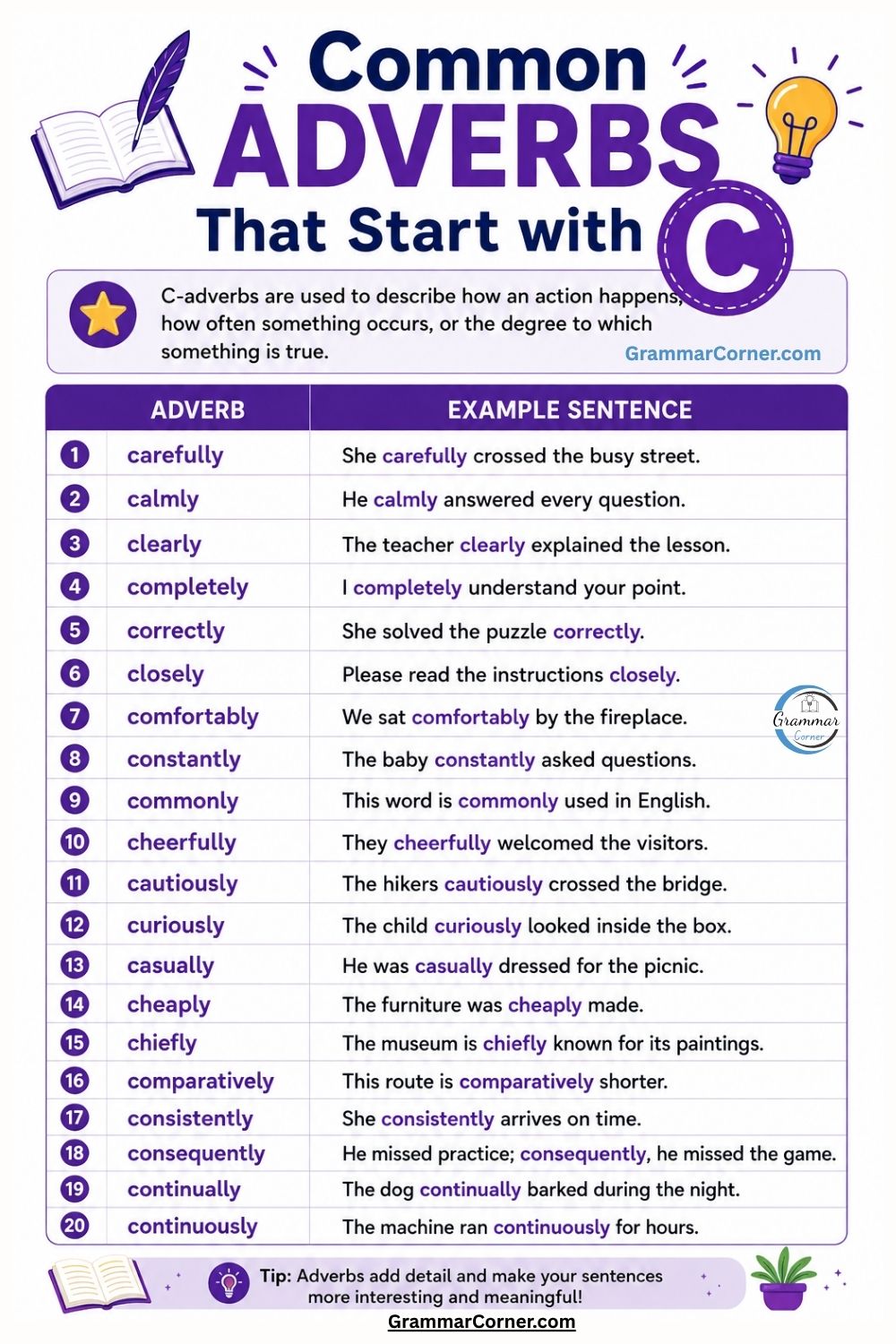
Common Adverbs That Start with C
| Adverb | Example Sentence |
|---|---|
| carefully | She carefully crossed the busy street. |
| calmly | He calmly answered every question. |
| clearly | The teacher clearly explained the lesson. |
| completely | I completely understand your point. |
| correctly | She solved the puzzle correctly. |
| closely | Please read the instructions closely. |
| comfortably | We sat comfortably by the fireplace. |
| constantly | The baby constantly asked questions. |
| commonly | This word is commonly used in English. |
| cheerfully | They cheerfully welcomed the visitors. |
| cautiously | The hikers cautiously crossed the bridge. |
| curiously | The child curiously looked inside the box. |
| casually | He was casually dressed for the picnic. |
| cheaply | The furniture was cheaply made. |
| chiefly | The museum is chiefly known for its paintings. |
| comparatively | This route is comparatively shorter. |
| consistently | She consistently arrives on time. |
| consequently | He missed practice; consequently, he missed the game. |
| continually | The dog continually barked during the night. |
| continuously | The machine ran continuously for hours. |
| conveniently | The store is conveniently located downtown. |
| confidently | She confidently presented her project. |
| consciously | He consciously avoided unhealthy snacks. |
| correctively | The coach spoke correctively after the mistake. |
| courageously | The firefighter courageously entered the building. |
| craftily | The fox craftily escaped the trap. |
| crosswise | Lay the boards crosswise on the frame. |
| clockwise | Turn the knob clockwise to tighten it. |
| counterclockwise | Rotate the lid counterclockwise to open it. |
| covertly | They covertly observed the meeting. |
| coyly | She coyly smiled at the compliment. |
| cruelly | The bully cruelly mocked the new student. |
| critically | The engineer critically examined the design. |
| crossly | He crossly replied to the interruption. |
| correctively | The editor corrected the article correctively and politely. |
| conditionally | The offer was conditionally approved. |
| concurrently | The two events occurred concurrently. |
| customarily | They customarily meet every Friday. |
| conclusively | The evidence conclusively proved the case. |
| collectively | The team collectively made the decision. |
| coincidentally | We coincidentally met at the airport. |
| compassionately | The nurse compassionately comforted the patient. |
| competently | She competently managed the project. |
| creatively | The artist creatively used recycled materials. |
| critically | Scientists critically evaluated the results. |
| categorically | He categorically denied the accusation. |
| centrally | The hotel is centrally located. |
| civilly | They spoke civilly despite their disagreement. |
| charitably | She charitably donated food to the shelter. |
| carefully | Always handle glass carefully. |
| curtly | He curtly ended the conversation. |
Positive Adverbs That Start with C
| Adverb | Example Sentence |
|---|---|
| calmly | She calmly handled the emergency. |
| carefully | He carefully painted the artwork. |
| clearly | The speaker clearly expressed her ideas. |
| cheerfully | They cheerfully greeted every guest. |
| comfortably | We traveled comfortably on the train. |
| confidently | She confidently answered the interview questions. |
| compassionately | The doctor compassionately listened to the patient. |
| competently | He competently completed the difficult task. |
| creatively | The students creatively solved the problem. |
| conscientiously | She conscientiously completed every assignment. |
| consistently | They consistently delivered excellent service. |
| courageously | The climber courageously reached the summit. |
| correctly | You correctly identified the answer. |
| conveniently | The library is conveniently located nearby. |
| charitably | The community charitably supported families in need. |
| civilly | Everyone discussed the issue civilly. |
| courteously | The receptionist courteously welcomed visitors. |
| cleverly | She cleverly found a simple solution. |
| closely | The partners worked closely together. |
| completely | He completely trusted his teammates. |
| constructively | The manager gave constructively helpful feedback. |
| cooperatively | The children cooperatively cleaned the classroom. |
| considerately | She considerately held the door open. |
| comfortingly | The teacher comfortingly reassured the nervous student. |
| commendably | The volunteers commendably served the community. |
| competitively | The athletes competed competitively yet respectfully. |
| conclusively | The scientist conclusively demonstrated the results. |
| capably | She capably led the entire project. |
| constantly | He constantly encouraged his friends. |
| carefully | They carefully protected the historical artifacts. |
Three-Letter Adverbs That Start with C
Standard English has almost no three-letter adverbs beginning with C. The following are the only commonly cited examples.
| Adverb | Example Sentence |
|---|---|
| coy (literary adverbial use) | She smiled coy instead of speaking. |
| ca. (abbreviation of circa, meaning “approximately”) | The manuscript dates to ca. 1700. |
Note: There are no widely accepted, standalone three-letter -ly adverbs beginning with C, making this one of the shortest adverb lists in English.
Descriptive Adverbs That Start with C
- calmly
- carefully
- clearly
- cheerfully
- comfortably
- confidently
- compassionately
- competently
- creatively
- conscientiously
- consistently
- correctly
- courageously
- curiously
- cautiously
- casually
- closely
- completely
- constantly
- continually
- continuously
- conveniently
- comparatively
- commonly
- chiefly
- constructively
- cooperatively
- considerately
- comfortingly
- commendably
- charitably
- courteously
- cleverly
- critically
- categorically
- civilly
- capably
- crossly
- coyly
- craftily
Adverbs That Start with C to Describe a Person
- calmly
- carefully
- cheerfully
- clearly
- confidently
- compassionately
- competently
- conscientiously
- consistently
- courageously
- courteously
- considerately
- cooperatively
- creatively
- cleverly
- capably
- charitably
- civilly
- comfortingly
- curiously
- cautiously
- casually
- coyly
- craftily
- commendably
- constructively
- correctly
- closely
- comparatively
- constantly
Common Mistakes When Using C-Adverbs
Learning adverbs that start with C is easier when you know the mistakes to avoid. Here are some common errors English learners make.
-
1. Using an Adjective Instead of an Adverb
✗ She sings careful.
✓ She sings carefully.
Why? Careful is an adjective that describes a noun, while carefully is the adverb that describes how she sings.
-
2. Confusing Calm with Calmly
✗ He answered the question calm.
✓ He answered the question calmly.
Why? Use calmly to describe how an action is performed. Calm is an adjective.
-
3. Using Clear Instead of Clearly
✗ Please speak clear.
✓ Please speak clearly.
Why? The verb speak needs an adverb to describe the manner of speaking.
-
4. Confusing Close and Closely
✗ Listen close to the instructions.
✓ Listen closely to the instructions.
Why? Closely means “with careful attention.” Close usually refers to distance or location.
-
5. Mixing Up Continuous and Continuously
✗ The machine worked continuous.
✓ The machine worked continuously.
Why? Continuous is an adjective. Continuously is the adverb describing how the machine worked.
-
6. Confusing Correct and Correctly
✗ She answered the question correct.
✓ She answered the question correctly.
Why? The verb answered should be modified by the adverb correctly.
-
7. Using Comfortable Instead of Comfortably
✗ We sat comfortable.
✓ We sat comfortably.
Why? Comfortably describes how you sat, so an adverb is required.
-
8. Confusing Carefully and Carelessly
✗ He handled the glass carelessly, so it did not break.
✓ He handled the glass carefully, so it did not break.
Why? The sentence describes safe handling, so carefully is the logical choice.
-
9. Using Two Adverbs Incorrectly
✗ She spoke very clearlyly.
✓ She spoke very clearly.
Why? Clearly is already an adverb. Never add another -ly to it.
-
10. Choosing the Wrong C-Adverb
✗ He carefully solved the problem, so everyone could understand him.
✓ He clearly explained the solution, so everyone could understand him.
Why? Carefully means with caution, while clearly means in a way that is easy to understand.
Practice Exercises
Exercise 1: Fill in the Blanks
Choose the correct C-adverb from the word bank and type it into each gap.
- Word bank
- carefully
- calmly
- clearly
- confidently
- comfortably
-
Please read the instructions before starting.
-
She answered every question during the interview.
-
The teacher explained the lesson .
-
We sat on the soft sofa.
-
The firefighter acted during the rescue.
Exercise 2: Choose the Correct Adverb
Each pair gives you an adjective and an adverb. Tap the one the sentence needs.
-
He drove __________.
-
The speaker talked __________.
-
She smiled __________.
-
The nurse spoke __________.
-
They worked __________.
Exercise 3: Match the Adverb with Its Meaning
Pick the meaning that belongs to each adverb.
-
Calmly
-
Carefully
-
Clearly
-
Confidently
-
Compassionately
Exercise 4: Find and Correct the Mistake
Type the corrected adverb for each sentence.
-
She completed the task careful. →
-
He spoke clear. →
-
We waited patient and calm. →
-
The students listened close. →
-
They worked consistent all year. →
Exercise 5: Write Your Own Sentence
Write one sentence using each of these adverbs: carefully, calmly, clearly, cheerfully, and confidently.
Example: She confidently presented her science project to the class.
Show the answer key
Exercise 1: Fill in the Blanks
- carefully
- confidently
- clearly
- comfortably
- calmly
Exercise 2: Choose the Correct Adverb
- carefully
- clearly
- cheerfully
- compassionately
- consistently
Exercise 3: Match the Adverb with Its Meaning
- Calmly → C (Without panic)
- Carefully → D (With great attention)
- Clearly → A (In an easy-to-understand way)
- Confidently → B (With confidence)
- Compassionately → E (With kindness and sympathy)
Exercise 4: Find and Correct the Mistake
- carefully
- clearly
- patiently and calmly
- closely
- consistently
Frequently Asked Questions
What are the most common C-adverbs?
Some of the most common C-adverbs are calmly, carefully, cautiously, cheerfully, clearly, closely, comfortably, completely, confidently, and correctly.
Which C-adverbs describe how someone does something?
Many C-adverbs describe manner, including calmly, carefully, cautiously, cheerfully, compassionately, confidently, courteously, and creatively.
What are positive adverbs that start with C?
Positive C-adverbs include carefully, cheerfully, compassionately, confidently, considerately, courageously, courteously, and creatively, because they express favorable actions or attitudes.
Are there many three-letter adverbs that start with C?
No. Standard English has very few three-letter adverbs beginning with C. Most C-adverbs are longer words, such as clearly and carefully.
What is the difference between careful and carefully?
Careful is an adjective that describes a noun, while carefully is an adverb that describes a verb.
Adjective: She is a careful driver.
Adverb: She drives carefully.
What is the difference between clear and clearly?
Clear is an adjective, whereas clearly is an adverb.
Adjective: The instructions are clear.
Adverb: The teacher explained the lesson clearly.
How can I identify an adverb that starts with C?
Check whether the word begins with C and modifies a verb, adjective, or another adverb by answering questions such as how, when, where, or to what extent.
Do all C-adverbs end in -ly?
No. Many do, such as carefully and completely, but not every adverb ends in -ly. Some have irregular forms, and others are used adverbially without the -ly ending.
See also: