Adverbs That Start With U (Common, Positive & Descriptive Adverbs)
Adverbs that start with U are simply adverbs beginning with the letter U.
They make sentences more precise by describing how an action happens, when or where it occurs, how often it takes place, or the degree to which something is true.
- usually — in most cases; most of the time
- urgently — in a way that requires immediate attention
- unexpectedly — in a surprising or unplanned way
- upstairs — to or on a higher floor
- unnecessarily — in a way that is not needed or required
Quick Challenge
Choose the correct U-adverb to complete the sentence:
We _______ walk to school together on Fridays.
Show the answer
✅ Answer: A. usually
Usually is a frequency adverb, so it tells us how often something happens. The other three describe place (upstairs), manner (urgently), or fairness (unfairly), so none of them fits the sentence naturally.
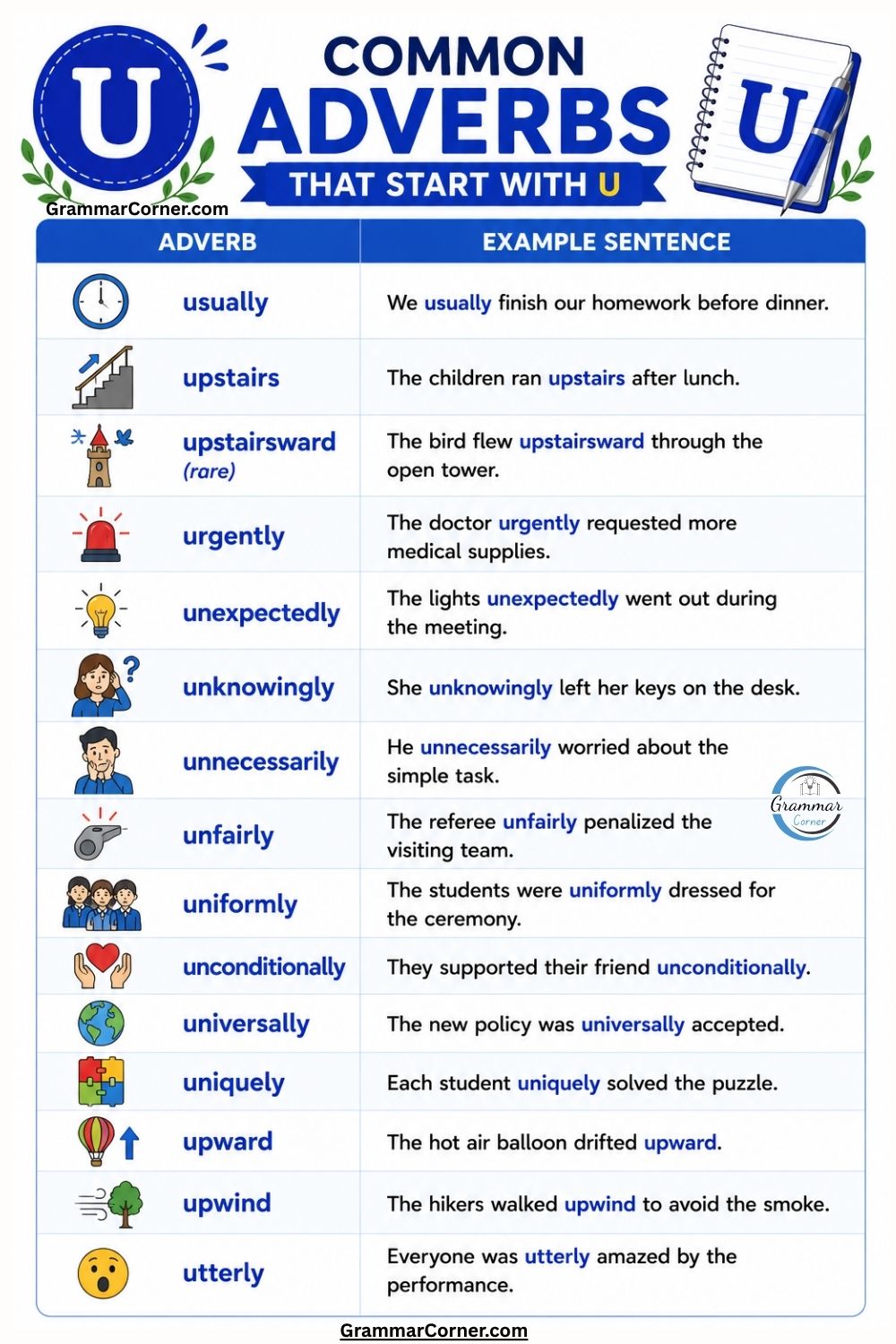
Common Adverbs That Start with U
| Adverb | Example Sentence |
|---|---|
| usually | We usually finish our homework before dinner. |
| upstairs | The children ran upstairs after lunch. |
| upstairsward (rare) | The bird flew upstairsward through the open tower. |
| urgently | The doctor urgently requested more medical supplies. |
| unexpectedly | The lights unexpectedly went out during the meeting. |
| unknowingly | She unknowingly left her keys on the desk. |
| unnecessarily | He unnecessarily worried about the simple task. |
| unfairly | The referee unfairly penalized the visiting team. |
| uniformly | The students were uniformly dressed for the ceremony. |
| unconditionally | They supported their friend unconditionally. |
| universally | The new policy was universally accepted. |
| uniquely | Each student uniquely solved the puzzle. |
| upward | The hot air balloon drifted upward. |
| upwind | The hikers walked upwind to avoid the smoke. |
| utterly | Everyone was utterly amazed by the performance. |
Positive Adverbs That Start with U
| Adverb | Example Sentence |
|---|---|
| unanimously | The committee unanimously approved the proposal. |
| unashamedly | She unashamedly celebrated her hard-earned success. |
| unceasingly | The volunteers worked unceasingly to help the community. |
| uncommonly | He was uncommonly kind to every new student. |
| uncomplainingly | She uncomplainingly cared for her injured neighbor. |
| undeniably | The team’s effort was undeniably impressive. |
| understandably | The audience understandably applauded the inspiring speech. |
| undoubtedly | She will undoubtedly achieve her goals through dedication. |
| unequivocally | The principal unequivocally praised the students’ honesty. |
| unfailingly | He unfailingly greets everyone with a smile. |
| unhesitatingly | She unhesitatingly offered help to the lost traveler. |
| unmistakably | The baby’s laughter was unmistakably joyful. |
| unreservedly | The coach unreservedly congratulated the winning team. |
| unselfishly | They unselfishly shared their supplies with others. |
| upliftingly | The choir sang upliftingly throughout the celebration. |
Five-Letter Adverbs That Start with U
| Adverb | Example Sentence |
|---|---|
| Under | The cat hid under the table. |
| Until | Please wait until the teacher arrives. |
Descriptive Adverbs That Start with U
These U-adverbs describe how, when, or to what extent an action happens.
| Adverb | Meaning | Example |
|---|---|---|
| Usually | Most of the time; normally | She usually walks to work. |
| Urgently | In a way that needs immediate attention | He urgently needed the documents signed. |
| Unexpectedly | In a way that was not predicted | The results came in unexpectedly quickly. |
| Unknowingly | Without being aware | She unknowingly gave away the surprise. |
| Unnecessarily | Without real need | He apologized unnecessarily for a small delay. |
| Unfairly | Not in a just or equal way | The referee treated one team unfairly. |
| Uniformly | In a consistent, unvarying way | The paint was applied uniformly across the wall. |
| Uniquely | In a way that is one of a kind | The building was uniquely designed for the site. |
| Universally | By everyone, everywhere | The rule is universally accepted. |
| Unconditionally | Without any conditions or limits | She loved her children unconditionally. |
| Utterly | Completely, totally | The plan was utterly ruined by the storm. |
| Understandably | In a way that makes sense given the circumstances | She was understandably upset about the delay. |
| Undoubtedly | Without any doubt | He is undoubtedly the best candidate. |
| Unequivocally | In a clear, unambiguous way | She unequivocally denied the accusation. |
| Unmistakably | In a way that cannot be confused with anything else | The smell was unmistakably smoke. |
| Unselfishly | Without thinking of oneself first | He unselfishly gave up his seat. |
| Unhesitatingly | Without pausing or doubting | She unhesitatingly agreed to help. |
| Unreservedly | Completely, without holding back | He apologized unreservedly for the mistake. |
| Unceasingly | Without ever stopping | The rain fell unceasingly all week. |
| Unfailingly | Always, without exception | He was unfailingly polite to everyone. |
| Uncommonly | Not often; unusually | The weather was uncommonly warm for winter. |
| Upward | Toward a higher position | The balloon drifted upward. |
| Upwind | Toward the direction the wind is blowing from | The hikers stayed upwind of the campfire smoke. |
| Upstairs | To or on a higher floor | She went upstairs to get her jacket. |
| Upliftingly | In a way that inspires or encourages | The coach spoke upliftingly before the final match. |
Adverbs That Start with U to Describe a Person
These adverbs describe how a person behaves, communicates, or carries themselves in a given situation.
| Adverb | How It Describes a Person | Example |
|---|---|---|
| Unselfishly | Shows generosity | He unselfishly shared his lunch with a classmate. |
| Unhesitatingly | Shows confidence and readiness | She unhesitatingly volunteered for the difficult task. |
| Unreservedly | Shows full sincerity | He apologized unreservedly for his mistake. |
| Understandably | Shows a reasonable, relatable reaction | She was understandably nervous before her first speech. |
| Undoubtedly | Shows clear, recognized ability | He is undoubtedly the most experienced person on the team. |
| Unfailingly | Shows consistent reliability | She is unfailingly punctual for every meeting. |
| Uncomplainingly | Shows patience and quiet endurance | He worked uncomplainingly through the long shift. |
| Unequivocally | Shows firmness and clarity | She unequivocally stood by her decision. |
| Unknowingly | Shows innocent involvement | He unknowingly offended his coworker with the joke. |
| Unfairly | Shows mistreatment of someone | She felt she had been judged unfairly. |
| Uniquely | Shows individuality | He uniquely approaches every problem with humor. |
| Unconditionally | Shows unwavering support | She supported her sister unconditionally throughout the difficult year. |
| Unashamedly | Shows open confidence without embarrassment | He unashamedly admitted he still loved cartoons as an adult. |
| Uncommonly | Shows a rare, standout quality | She was uncommonly calm during the crisis. |
| Upliftingly | Shows encouraging, positive influence | He spoke upliftingly to the team after the loss. |
| Urgently | Shows a sense of pressing need | She urgently requested help for her injured coworker. |
| Utterly | Shows total commitment or emotion | He was utterly devoted to his students. |
| Unexpectedly | Shows a surprising side of someone | She unexpectedly stepped in to defend the new intern. |
| Universally | Shows widespread respect or likability | He is universally respected by his colleagues. |
| Uniformly | Shows consistency in how someone treats others | She treats every client uniformly, regardless of budget. |
Common Mistakes When Using U-Adverbs
-
Using Normally Where It Contradicts the Sentence
✕Incorrect: I usually don’t eat spicy food, but today is normally different.
✓Correct: I don’t usually eat spicy food, but today is different.
Why? Normally means in most cases — so today is normally different says the exception is the rule, which cancels itself out. If a day is unlike the others, it’s simply different.
-
Using Upstairs with an Unnecessary Preposition
✕Incorrect: She went to upstairs after dinner.
✓Correct: She went upstairs after dinner.
Why? Upstairs already carries the direction, so it needs no to. The same is true of downstairs, outside, home, and abroad: we went home, not we went to home.
-
Using Unexpectedly for Something That Was Planned
✕Incorrect: The meeting unexpectedly started at 9:00 because that was the scheduled time.
✓Correct: The meeting started at 9:00 as scheduled.
✓Correct: The meeting unexpectedly started thirty minutes early.
Why? Unexpectedly means nobody saw it coming. An event that happened exactly as planned is the opposite of unexpected.
-
Using Urgently When There Is No Urgency
✕Incorrect: She urgently drank a glass of water after lunch.
✓Correct: She calmly drank a glass of water after lunch.
✓Correct: She urgently called the doctor after the accident.
Why? Urgently belongs to actions that can’t wait. Attached to something ordinary, it sounds either alarming or accidental.
-
Confusing Unfair with Unfairly
✕Incorrect: The player was unfairly during the match.
✓Correct: The player was unfair during the match.
✓Correct: The player behaved unfairly during the match.
Why? The two fixes work differently, and the verb decides which one you need.
After a linking verb like was, use the adjective — it describes the player. With an action verb like behaved, played, or treated, use the adverb — it describes what was done.
-
Using Utterly with the Wrong Kind of Adjective
✕Incorrect: She was utterly happy about the surprise.
✓Correct: She was extremely happy about the surprise.
✓Correct: She was utterly exhausted after the marathon.
Why? Utterly goes with absolute adjectives — ones that can’t be measured in degrees: exhausted, impossible, ridiculous, silent. Happy comes in degrees, so it takes very or extremely instead.
Practice Exercises
Exercise 1: Fill in the Blanks
Choose the correct U-adverb from the word bank. Each word is used once.
- Word bank
- usually
- urgently
- unexpectedly
- upstairs
- unfairly
-
We visit our grandparents every Sunday.
-
The teacher called the principal after the emergency.
-
The power went out during the storm.
-
My brother ran to get his backpack.
-
The referee awarded the penalty to the wrong team.
Exercise 2: Choose the Correct Adverb
Tap the adverb that fits each sentence.
-
We __________ eat breakfast before school.
-
The firefighter reacted __________ to save the child.
-
The balloon floated __________ into the sky.
-
The audience __________ applauded the amazing performance.
Exercise 3: Find the Mistake
Rewrite each sentence correctly, then open the answer key to compare.
- She walked to upstairs after dinner.
- We urgently go to school every morning.
- The game was planned, but it started unexpectedly at the scheduled time.
- He was unfairly to his teammates.
Exercise 4: Write Your Own Sentence
Use each adverb in a meaningful sentence:
- usually
- unexpectedly
- unconditionally
- uniquely
- urgently
Sample: She unexpectedly won first prize in the science competition.
Show the answer key
Exercise 1: Fill in the Blanks
- usually
- urgently
- unexpectedly
- upstairs
- unfairly
Exercise 2: Choose the Correct Adverb
- b) usually
- a) urgently
- a) upward
- b) unanimously
Exercise 3: Find the Mistake
- She walked upstairs after dinner.
- We usually go to school every morning.
- The game started on time, as scheduled.
- He was unfair to his teammates. (or: He behaved unfairly toward his teammates.)
Frequently Asked Questions
What are adverbs that start with U?
Adverbs that start with U are adverbs whose spelling begins with the letter U. They modify verbs, adjectives, other adverbs, or entire sentences by showing how, when, where, how often, or to what degree something happens.
What are the most common U-adverbs?
Some common U-adverbs include usually, urgently, unexpectedly, upstairs, upward, unfairly, unknowingly, uniquely, universally, and utterly.
Which U-adverb shows frequency?
Usually is the most common U-adverb that expresses frequency. It tells how often an action happens.
Example: She usually reads before bedtime.
Which U-adverbs describe manner?
Many U-adverbs describe how an action happens. Examples include urgently, unfairly, unexpectedly, unselfishly, unhesitatingly, and uniformly.
Is "upstairs" an adverb?
Yes. Upstairs is an adverb when it tells where someone goes or is located.
Example: They went upstairs after dinner.
Is "under" always an adverb?
No. Under can be an adverb, preposition, or adjective, depending on how it is used.
- Adverb: The rope was hanging under.
- Preposition: The shoes are under the bed.
What is the difference between "usually" and "normally"?
Both describe actions that happen most of the time. However, usually is more common in everyday English, while normally is often used in more formal contexts or to describe what is typical under normal conditions.
Are there many adverbs that start with U?
No. Compared with letters like S, R, or T, English has relatively few adverbs beginning with U, but many of them are useful in both speaking and writing.
See also: