Noun Clauses (Structure, Rules and Examples)
What Is a Noun Clause?
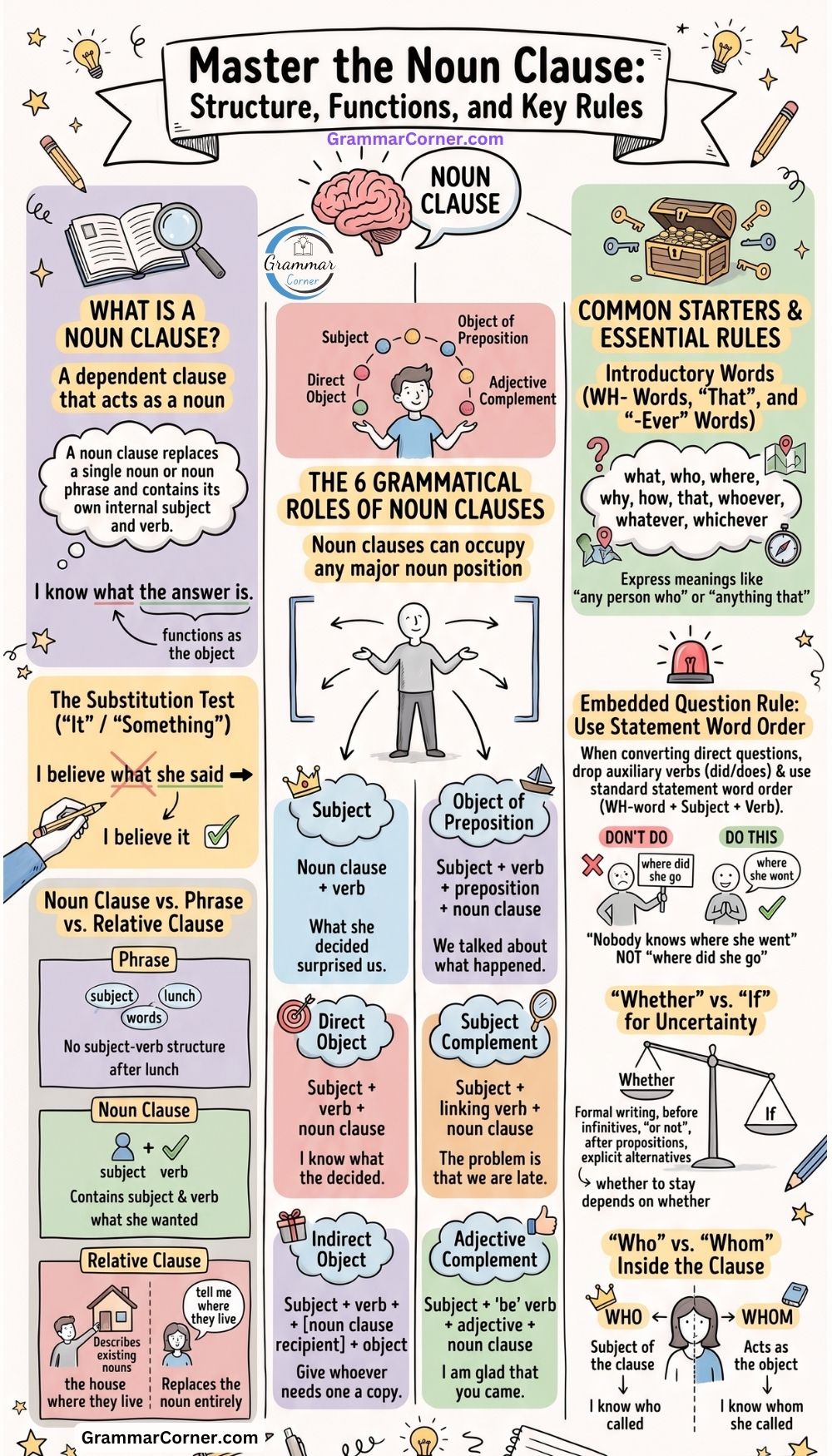
A noun clause is a dependent clause that functions as a noun. A sentence does not always use a single word as its subject, object, or complement.
Consider these two sentences:
That larger group of words is a noun clause.
How Noun Clauses Start
Noun clauses look like questions because they often begin with words such as:
They may also begin with:
But inside a sentence, they do not behave like ordinary questions. They function as nouns.
Internal Structure of a Noun Clause
Like other clauses, it contains its own subject and verb:
“I remember what she said.”
• said = verb
The entire clause functions as the object of remember.
The Substitution Test
You can replace it with a simple noun or pronoun:
That substitution gives us a useful clue that what she said is working as a noun.
✨ Quick Challenge
Three of these four sentences contain a noun clause (can be substituted with “it” or “something”). One contains an adverbial clause telling when. Tap the sentence that doesn’t belong.
See the full answer
Answer: “We left the theater when the movie ended.”
A noun clause acts as a noun within the sentence and can typically be replaced with the pronoun it or something:
- “I believe what she said.” ➔ I believe it. (Direct Object)
- “Nobody knows where he went.” ➔ Nobody knows it. (Direct Object)
- “She understands that honesty is important.” ➔ She understands it. (Direct Object)
In contrast, in “We left the theater when the movie ended,” the clause when the movie ended modifies the verb left by specifying when the action took place, making it an adverbial clause of time.
A Noun Clause Is Not Just Any Group of Words
A phrase can act like a noun, but it is not necessarily a noun clause. Compare:
This is a phrase.
This is a clause because it contains a subject-verb structure.
The important difference is that a noun clause contains its own clause structure.
| Example | Type | Reason |
|---|---|---|
| the old house | Noun phrase | No separate subject-verb structure |
| after lunch | Prepositional phrase | No clause |
| what she wanted | Noun clause | Contains subject and verb |
| where they live | Noun clause | Contains subject and verb |
| to finish the work | Infinitive phrase | Not a noun clause |
| that he was late | Noun clause | Contains subject and verb |
Where Can a Noun Clause Appear?
A noun clause can occupy several positions in a sentence because nouns themselves have several grammatical roles. The most important ones are:
Noun Clause as the Subject
A noun clause can come at the beginning of a sentence and act as its subject:
“What you said hurt my feelings.”
• The entire clause is the subject.
Another example:
“Why she left remains a mystery.”
The noun clause why she left is the subject of remains.
More Examples
- Where we stay is not important.
- How the machine works is difficult to explain.
- Who will lead the team has not been decided.
The subject can therefore be much longer than a single noun.
Why Subject Noun Clauses Can Feel Difficult
A sentence such as:
“What the manager decided was unexpected.”
may initially confuse learners because the sentence begins with what. They may think the sentence is asking a question. It is not.
The clause what the manager decided is the subject. The sentence means:
“The thing that the manager decided was unexpected.”
A useful habit is to temporarily replace the noun clause with something:
Noun Clause as a Direct Object
This is one of the most common uses:
“I know what you mean.”
• Know what? ➔ what you mean
• The noun clause is the direct object.
- We discovered where the keys were hidden.
- She explained why the schedule had changed.
- They remember what happened that evening.
- I don’t understand how this device works.
In each sentence, the noun clause answers the question what?
The Hidden Question Trick
Here is an easy way to avoid mistakes. Start with the direct question:
“Where is Sara?”
Now ask yourself: What do I want to say about this question?
You might write:
“I don’t know where Sara is.”
The subject comes before the verb.
“Whether” and “If” in Noun Clauses
Use whether or if when the noun clause expresses uncertainty or an alternative:
- I don’t know whether she will attend.
- I don’t know if she will attend.
Both are common in many situations. However, whether is often the better choice in formal writing and is necessary in some structures, especially when alternatives are explicitly presented:
- We need to decide whether to stay or leave.
- The question is whether the plan will work.
“Whether” vs. “If”
Although they can overlap, they are not completely interchangeable:
| Situation | Better Choice |
|---|---|
| Everyday uncertainty | if / whether |
| Formal writing | whether is often preferred |
| “or not” immediately after the word | whether |
| Before an infinitive | whether |
| Explicit alternatives | whether |
| After a preposition | whether |
Examples:
- We are unsure whether to leave now.
- It depends on whether they agree.
- I don’t know whether or not he will come.
In these cases, whether is the natural choice.
Noun Clauses With “Who,” “Whom,” and “Whoever”
These forms can cause confusion because the clause itself can have a grammatical role while the opening word has another role inside the clause. Consider:
“I don’t know who called.”
Here, who is the subject of called.
Now:
“I don’t know whom she called.”
Here, she is the subject and whom is the object of called.
Compare
| Sentence | Role of the WH-word |
|---|---|
| I know who called. | Subject |
| I know whom she called. | Object |
| Ask who wants coffee. | Subject |
| Ask whom they invited. | Object |
In everyday English, who is widely used in places where traditional formal grammar would use whom. In formal writing, however, the distinction can still matter.
“Whoever,” “Whatever,” and Other -Ever Words
Noun clauses can also begin with words ending in -ever. Common examples include:
- Whoever finishes first can leave.
- Choose whatever you like.
- I’ll support whichever option you choose.
- Whatever happens will be dealt with later.
These words often carry a meaning such as any person who, anything that, or any choice that.
✨ Quick Challenge
Which of the following sentences correctly converts the direct question “Where did she go?” into an embedded noun clause with standard statement word order? Tap your answer.
See the full answer
Answer: “Nobody knows where she went.”
When turning a direct question into an embedded noun clause:
- Drop the dummy auxiliary verb did.
- Use standard statement word order: WH-word + Subject + Verb (where + she + went).
- ❌ “Nobody knows where did she go.” (Question order error)
- ✅ “Nobody knows where she went.” (Correct noun clause)
Noun Clauses in Academic and Formal Writing
Noun clauses are particularly useful when discussing:
- Researchers examined whether the treatment was effective.
- The results show that the method can reduce errors.
- It remains unclear why the results differed.
- What the study reveals is important for future research.
These structures allow complex ideas to fit naturally into a sentence without turning every thought into a separate sentence.
A Practical Noun Clause Pattern Chart
| Function | Common Pattern | Example |
|---|---|---|
| Subject | Noun clause + verb | What she decided surprised us. |
| Direct object | Subject + verb + noun clause | I know what she decided. |
| Indirect object | Subject + verb + person noun clause + object | Give whoever needs one a copy. |
| Object of preposition | Subject + verb + preposition + noun clause | We talked about what happened. |
| Subject complement | Subject + linking verb + noun clause | The problem is that we are late. |
| Adjective complement | Subject + be + adjective + noun clause | I am glad that you came. |
Noun Clause Examples at a Glance
Here are examples of the major patterns in one place:
Seeing the same type of clause in different positions makes the concept much easier to recognize.
Practice Exercises
Practice: Identify the Noun Clause
Find the noun clause in each sentence:
- What you choose is entirely up to you.
- I don’t remember where I put the documents.
- She explained why the machine stopped.
- We are uncertain about whether the plan will work.
- Whoever solves the puzzle will receive a prize.
- The question is whether they will agree.
- Tell me what you saw.
- I am pleased that you enjoyed the lesson.
| No. | Noun Clause | Function |
|---|---|---|
| 1 | What you choose | Subject |
| 2 | where I put the documents | Direct object |
| 3 | why the machine stopped | Direct object |
| 4 | whether the plan will work | Object of preposition |
| 5 | Whoever solves the puzzle | Subject |
| 6 | whether they will agree | Subject complement |
| 7 | what you saw | Direct object |
| 8 | that you enjoyed the lesson | Adjective complement |
Practice: Correct the Noun Clauses
Correct each sentence below:
Practice: Noun Clause or Relative Clause?
Identify the type of clause in each sentence:
- I know what she bought.
- The dress that she bought is expensive.
- Tell me where they live.
- The house where they live is very old.
- Nobody knows who broke the window.
- The boy who broke the window apologized.
| No. | Type | Why? |
|---|---|---|
| 1 | Noun clause | It is the object of know |
| 2 | Relative clause | It describes dress |
| 3 | Noun clause | It is the object of tell |
| 4 | Relative clause | It describes house |
| 5 | Noun clause | It is the object of knows |
| 6 | Relative clause | It describes boy |
This is an excellent distinction to master because the same introductory word can appear in both structures.
Frequently Asked Questions About Noun Clauses
• “I think he is right.”
Noun Clause: Quick Reference
| Question | Answer |
|---|---|
| What is it? | A dependent clause functioning as a noun |
| What does it contain? | Its own subject and verb |
| Can it be a subject? | Yes |
| Can it be a direct object? | Yes |
| Can it be an indirect object? | Yes |
| Can it follow a preposition? | Yes |
| Can it be a subject complement? | Yes |
| Common starters | that, what, who, where, when, why, how, whether, if |
| Does it normally stand alone? | No |
| Does it normally need commas? | No |
| Does an embedded question use question word order? | No |
| Can “that” sometimes be omitted? | Yes |
| Can it be confused with a relative clause? | Yes |
| Best identification method | Find its grammatical function |