Comma vs Apostrophe (Key Differences)
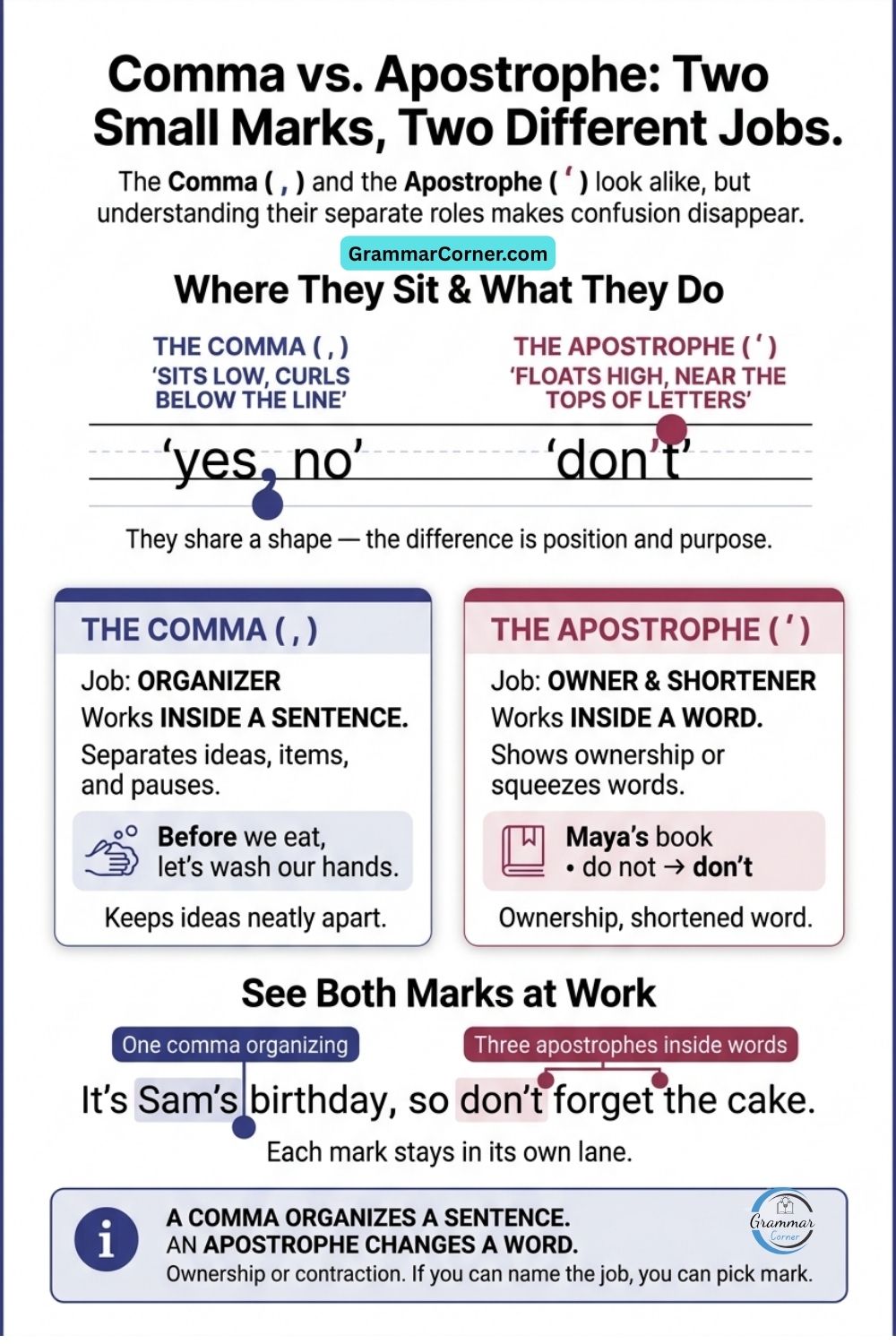
Comma vs. Apostrophe: Two Small Marks, Two Different Jobs
Small marks can carry big meaning. The comma ( , ) and the apostrophe ( ‘ ) are two of the smallest symbols in English, yet they do completely different jobs. Many students, ESL learners, and even busy writers mix them up because the two marks look a little alike on the page.
Once you understand what each mark is for, the confusion disappears. A comma helps you organize ideas inside a sentence, while an apostrophe shows ownership or squeezes two words into one.
Job: organizer
The Comma ( , )
Works inside a sentence. It separates ideas, items, and pauses so the reader doesn’t get lost.
Before we eat, let’s wash our hands. The comma keeps the two ideas neatly apart.
Job: owner & shortener
The Apostrophe ( ‘ )
Works inside a word. It shows that something belongs to someone, or that two words have been squeezed into one.
Maya‘s book • do not → don‘t Ownership in the first, a shortened word in the second.
See Both Marks at Work
This one sentence uses both marks. Tap a button to light up each mark and watch it do its job.
It‘s Sam‘s birthday, so don‘t forget the cake.
When to Use a Comma
Commas turn up in more places than any other punctuation mark. The good news? Almost every comma you will ever write falls into one of the six situations below.
-
To separate items in a list
I need bread, milk, eggs, and cheese.
Each comma keeps the items apart, so the reader can take in the list at a glance.
Style note: The comma before and is called the serial comma (or Oxford comma). It is standard in most American English style guides, while British English usually leaves it out. Both are correct — just choose one style and stick with it.
-
After an introductory word or phrase
After lunch, we went for a walk.
The comma signals that the opening phrase has ended and the main idea is about to begin.
-
To join two complete sentences with a connecting word (and, but, or, so, yet)
She wanted to go outside, but it started to rain.
Each side of the comma could stand alone as a full sentence. The comma plus the connecting word glues the two ideas together.
-
To set off the name of the person you’re speaking to
Thanks for your help, Daniel.
This is called direct address. The comma separates the message itself from the name of the person receiving it.
-
In dates and addresses
We moved on June 5, 2024, to Lahore, Pakistan.
Commas break long strings of information into clear, readable chunks — day from year, city from country.
Style note: American English writes dates as June 5, 2024 — with a comma before and after the year mid-sentence. British English usually writes 5 June 2024, which needs no commas at all.
-
To add extra, non-essential information
My brother, who lives in Karachi, is visiting us.
The part between the commas is a bonus detail. You could lift it out, and the sentence would still make complete sense.
Try the removal test
My brother, who lives in Karachi, is visiting us.
✓ Still a complete sentence — that’s how you know the information between the commas was extra.
Remember: a comma marks a small, organizing pause. It keeps apart items in a list, an opening phrase, two joined sentences, the name of the person you’re addressing, the parts of a date or address, and any extra information a sentence could live without.
When to Use an Apostrophe
Good news: the apostrophe has fewer jobs than the comma, which makes it easier to master. It really only does two things — it shows ownership and it marks missing letters. Let’s look at each use.
-
Use 1 · Ownership
One owner (singular possession)
When something belongs to one person or thing, add an apostrophe plus s.
This is Ali’s bike.
The ’s tells the reader the bike belongs to Ali.
-
Use 2 · Ownership
More than one owner (plural possession)
When the owners are plural and the word already ends in s, place the apostrophe after the s.
The students’ desks were clean.
The desks belong to all the students, so the apostrophe sits after the final s.
-
Use 3 · Missing letters
Contractions (shortened word pairs)
When two words squeeze into one, the apostrophe marks the exact spot where letters were removed.
I am → I’m · they are → they’re · cannot → can’t
Think of the apostrophe as a tiny flag saying, “Some letters used to live here.”
-
Use 4 · Ownership
Irregular plurals (plurals that don’t end in s)
Words like children, men, and people are plural but don’t end in s. Treat them like Use 1: add apostrophe plus s.
The children’s toys are in the box.
Because children doesn’t end in s, it takes ’s — not childrens’.
A quick map of the three ownership patterns.
Remember
To choose the right pattern, ask one question first: who is the owner? If the owner is one person or an irregular plural, add ’s. If the owner is a plural word that already ends in s, just add the apostrophe after it.
Try it: the contraction machine
Tap a word pair and watch the apostrophe take the place of the missing letters.
The apostrophe replaces the missing letter a: I am → I’m.
Common mistake: apostrophes don’t make plurals
Never use an apostrophe just to show “more than one.” Apple’s does not mean several apples — it means something belongs to an apple!
I bought three apple’s. (incorrect)
I bought three apples. (correct)
To make a regular word plural, simply add s — no apostrophe needed.
Side-by-Side Examples
Sometimes the fastest way to learn the difference between two punctuation marks is to watch them work in almost identical sentences. Below, each pair puts a comma sentence right next to an apostrophe sentence. Notice how the comma always works between words, while the apostrophe always works inside a word.
Extra detail vs. ownership
Comma
My friends, Sana and Omar, came over.
The pair of commas sets off the friends’ names as extra detail. Lift out “Sana and Omar” and the sentence still works.
Apostrophe
My friend’s house is nearby.
The apostrophe shows ownership: the house belongs to one friend.
Joining thoughts vs. joining words
Comma
We can leave now, or we can wait.
The comma (together with “or”) joins two complete thoughts into one smooth sentence.
Apostrophe
We can’t leave yet.
The apostrophe forms the contraction can’t, squeezing “cannot” into one word. It stands in for the missing letters.
An opening word vs. a shortened word
Comma
Yes, that answer is correct.
The comma follows the introductory word “Yes,” giving the sentence a natural pause before the main idea.
Apostrophe
That’s the correct answer.
That’s is short for “that is.” The apostrophe marks where the letter i dropped out.
Non-essential detail vs. one owner
Comma
The dogs, both puppies, were playing.
The commas add non-essential detail. “Both puppies” is bonus information — remove it and the sentence still makes sense.
Apostrophe
The dog’s tail was wagging.
The apostrophe shows possession again: the tail belongs to one dog.
Common Mistakes
Even careful writers slip up with these two little marks. Here are the six mix-ups that appear most often — and the quick fix for each one.
The comma splice
CommaA comma splice happens when you join two complete sentences with nothing but a comma.
❌ WrongIt was late, we went home.
✅ CorrectIt was late, so we went home.
Why: two complete sentences need a connecting word (like so, and, or but) or a stronger punctuation mark — a comma alone can’t hold them together.
Try it — repair the splice
It was late, we went home.
❌ Comma splice — not fixed yetMissing the list comma
Comma❌ WrongI invited Sara Ahmed and Bilal.
✅ CorrectI invited Sara, Ahmed, and Bilal.
Why: without commas, the reader can’t tell whether “Sara Ahmed” is one person or two. The commas make each name stand on its own.
Mixing up its and it’s
Apostrophe❌ WrongThe cat licked it’s paw.
✅ CorrectThe cat licked its paw.
Why: it’s is only ever short for it is or it has. When “it” owns something, use its — no apostrophe. Quick test: say the sentence with “it is.” If it sounds wrong (“The cat licked it is paw”), you need its.
An apostrophe in a plain plural
Apostrophe❌ WrongWe sell fresh banana’s.
✅ CorrectWe sell fresh bananas.
Why: an apostrophe shows possession or marks missing letters — it never means “more than one.” To make most words plural, just add s.
The wrong side of the s for group owners
Apostrophe❌ WrongThe teacher’s lounge was full of teacher’s.
✅ CorrectThe teachers’ lounge was full of teachers.
Why: when the owners are a group whose name already ends in s (the teachers), the apostrophe goes after the s: teachers’ lounge. And the plain plural at the end — teachers — needs no apostrophe at all.
Confusing your and you’re
Apostrophe❌ WrongYour welcome to join us.
✅ CorrectYou’re welcome to join us.
Why: you’re is short for you are; your shows ownership (your book). If “you are” fits the sentence, the apostrophe belongs there.
Remember
Two habits prevent almost every mistake above: a comma alone can never join two complete sentences, and an apostrophe never makes a word plural.
Comma vs. Apostrophe at a Glance
Here’s the whole comparison in one place, side by side.
| Feature | Comma ( , ) | Apostrophe ( ’ ) |
|---|---|---|
| Purpose | Separates and organizes the parts of a sentence | Shows possession or forms contractions |
| Main function | Creates pauses and keeps meaning clear | Shows ownership or replaces missing letters |
| Common uses | Lists, joining clauses, after introductory phrases, direct address, dates and addresses | Possessives (Sara’s book), contractions (can’t, it’s) |
| Example | I bought apples, pears, and grapes. | That’s Maria’s car. |
| Common mistakes | Splicing two sentences with only a comma; forgetting commas in a list | Confusing its with it’s; adding an apostrophe to a plain plural |
Related Posts
- Full Stop Rules and Examples
- Em Dash Rules and Examples
- Em Dash Vs. Semicolon
- Exclamation Marks Rules and Examples
Frequently Asked Questions
Do a comma and an apostrophe ever do the same job?
No. They never overlap. A comma organizes a sentence, and an apostrophe shows ownership or forms a contraction.
Can a comma and an apostrophe appear in the same sentence?
Yes, and it happens all the time. Example: That's Amir's book, and it's brand new. Here you can see both marks doing their own jobs.
How do I know if I should use it's or its?
Try replacing the word with "it is." If the sentence still makes sense, use it's. If not, use its.
Do I add an apostrophe to make a word plural?
No. Plurals almost never take an apostrophe. Write cars, not car's, when you mean more than one.
Where does the apostrophe go for a name that ends in s, like James?
Both James's book and James' book are accepted. Many style guides prefer James's because it matches how we say it out loud.
Is a comma always needed before "and" in a list?
It's optional and depends on the style you follow. The comma before the final "and" (the serial comma) can prevent confusion, so many teachers recommend using it.