Semicolon Rules: How and When to Use a Semicolon [;] (A Complete Guide)
A semicolon (;) is a punctuation mark that separates two main clauses in a single sentence. It signals a closer connection between the clauses than a period could provide.
Semicolons are also used between items in a series or list, especially when the items contain internal punctuation.
Why Are Semicolons Confusing?
Semicolons perform a valid role when used intentionally between independent clauses and complex list items. Still, a few features make the semicolon confusing for writers:
- It serves multiple purposes — the semicolon connects two independent clauses, separates items in a complex list, or links correlated clauses. This versatility often feels ambiguous.
- It sits between a comma and a period — semicolons separate ideas more distinctly than commas but with less finality than a period.
- It overlaps with commas — writers sometimes force commas into places where semicolons belong, which blurs the semicolon's purpose.
- It is rare — because semicolons appear infrequently, they feel unfamiliar. A little deliberate practice fixes that quickly.
Connect Independent Clauses
The most common use of the semicolon is to join two related independent clauses in one sentence. Each clause could stand alone as a complete sentence; the semicolon simply removes the "speed bump" a period would create.
- Use a semicolon only between independent clauses (complete sentences).
- The clauses should be closely related in theme or meaning.
- Do not use a semicolon between entirely unrelated ideas.
- Do not capitalize the word after a semicolon (unless it's a proper noun like London or I).
It was serious? she broke a toe.
Use Semicolons with Conjunctive Adverbs
When a conjunctive adverb such as however, therefore, moreover, consequently, or as a result connects two independent clauses, place a semicolon before the adverb and a comma after it.
- Semicolons pair naturally with conjunctive adverbs between independent clauses.
- Make sure the adverb really is connecting two complete sentences.
- Avoid overusing conjunctive adverbs; they quickly sound redundant.
The flu outbreak has caused low staffing? as a result, the deadline will be extended.
Separate List Items That Contain Commas
In a normal list, commas separate the items. But when the items already contain commas, commas alone create an unwieldy, confusing pile-up. Semicolons act as "super-commas" that outrank the smaller ones and keep each item distinct.
- Semicolons prevent ambiguity when commas already appear inside list items.
- Not every item needs an internal comma — one is enough to justify semicolons throughout.
- If the list gets truly complicated, consider bullet points instead.
I will contact Matt, the baker? Simon, the butcher? and Janet, the lawyer.
Before a Conjunction Joining Comma-Filled Clauses
Normally, two independent clauses joined by a conjunction (and, but, or, so) take a comma before the conjunction. But when the clauses themselves are crowded with commas, you may upgrade that comma to a semicolon so readers can see the main break clearly.
- This is a somewhat old-fashioned but fully correct practice — use it when it genuinely helps readers.
- If neither clause contains commas, a plain comma before the conjunction is the standard choice.
Common Mistake: Never Introduce a List with a Semicolon
Many writers reach for a semicolon to introduce a list. That job belongs to the colon. A semicolon separates equal parts; it does not announce what comes next.
This also applies to bulleted lists — the lead-in line ends with a colon, never a semicolon.
The printing set is missing the following characters? Q, R, K, and the question mark.
Using Semicolons in Compound Sentences
Semicolons create logical connections between two independent clauses in one sentence — without needing a conjunction like "and":
This structure elegantly connects related ideas. Three quick tests tell you a semicolon will work well:
- Cause and effect: if you could join the sentences with "because" or "as," a semicolon fits. — I am glad I ignored good advice; it led me to my most valuable mistakes.
- Deliberate parallel structure: — You don't pay taxes; they take taxes.
- Could be joined by ", but" / ", so" / ", for": — Go not to the elves for counsel; they will say both no and yes.
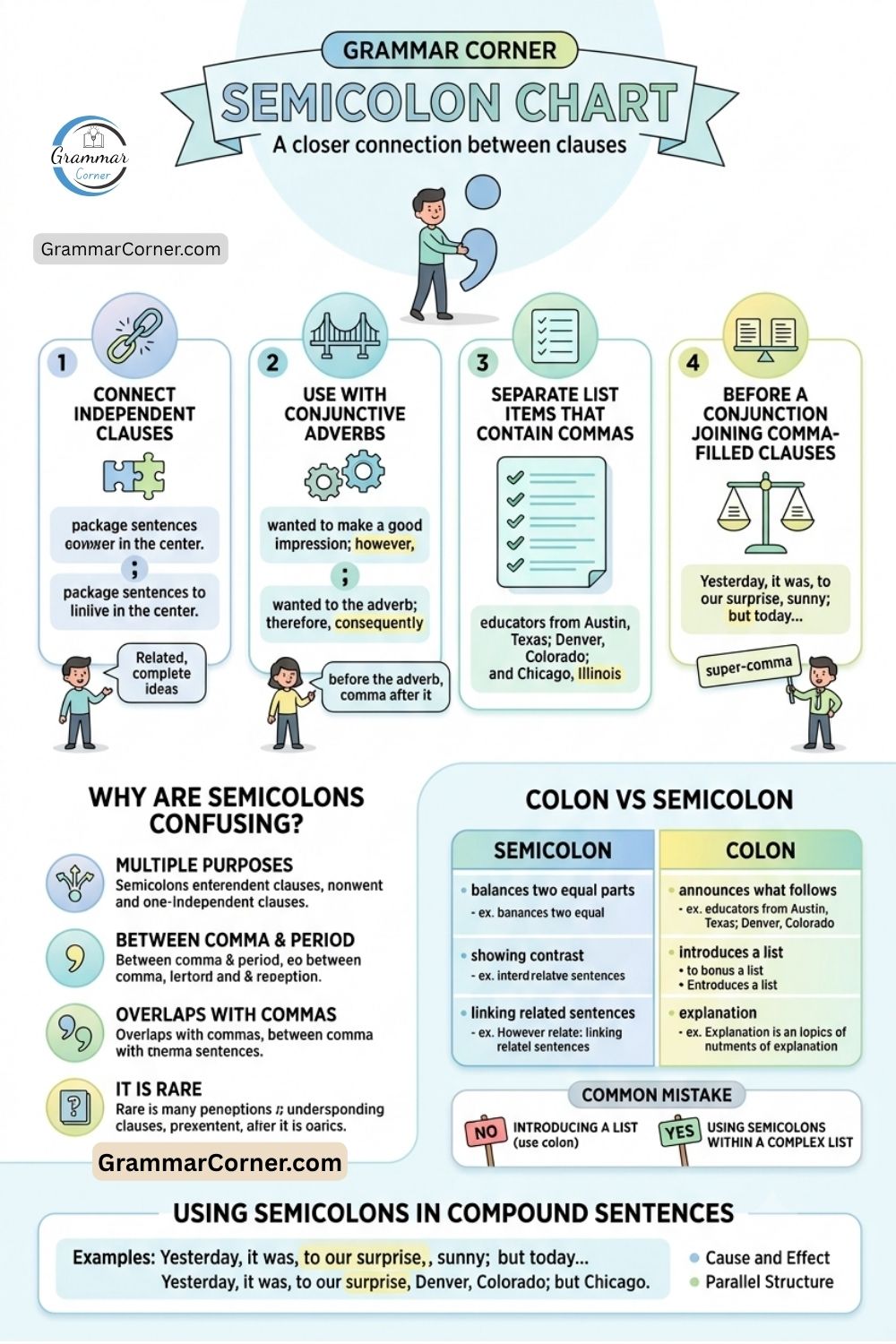
Semicolon Chart
This infographic summarizes all four semicolon rules — pin it, save it, or share it:
Colon vs. Semicolon
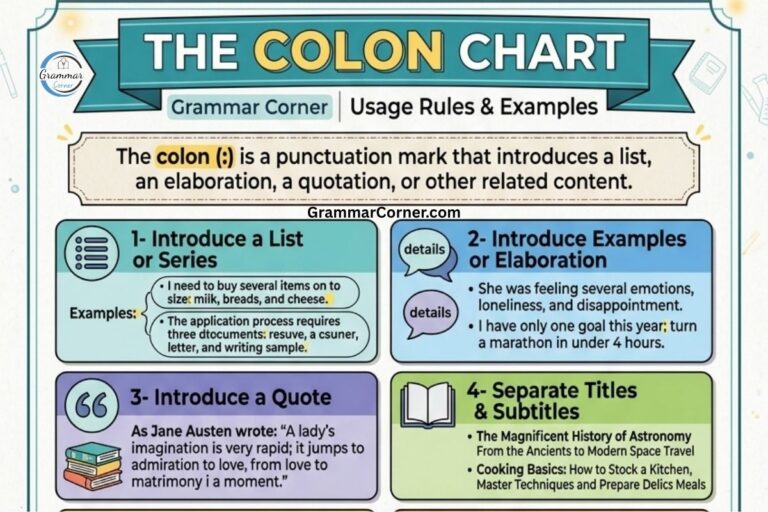
The quickest way to keep them straight: a semicolon balances two equal parts, while a colon announces what follows.
| Semicolon ( ; ) | Colon ( : ) |
|---|---|
| Joins two independent clauses that are closely related in thought | Introduces a list, explanation, quotation, or example after an independent clause |
| Connects two independent clauses not joined by a conjunction | Draws attention to the information that follows |
| Separates items in a complex list when commas could cause confusion | Implies "as follows" or "here is" |
| Used between clauses linked by transitional words like however, therefore, moreover | Follows a complete clause; capitalization of the next word varies by style guide |
| Uses: showing contrast, linking related sentences, avoiding comma confusion | Uses: before a list, before a quotation, to introduce an explanation |
| Example: I love summer; however, winter has its perks as well. | Example: I have three goals: to exercise daily, eat healthy, and save money. |
Semicolon vs. Comma
One crucial difference: a comma cannot join two independent clauses without a conjunction. A comma in that position creates a comma splice — two sentences incorrectly fused. The semicolon avoids the splice by separating the clauses appropriately.
One more difference worth knowing: in American style, commas go inside closing quotation marks, while semicolons go outside:
So semicolons and commas serve distinct purposes; learning the guidelines for each prevents errors.
Interactive Quiz: Test Your Semicolon Skills
Answer all 8 questions. You'll get instant feedback and a score at the end.
1. Which sentence uses the semicolon correctly?
A semicolon joins two complete sentences. "Although it rained" is a fragment, and semicolons never introduce lists.
2. Fill the blank: I wanted to join the volleyball team ___ however, I missed tryouts.
Before a conjunctive adverb like "however" joining two independent clauses, use a semicolon. A comma would create a comma splice.
3. Which list needs semicolons?
The third list's items contain internal commas (name, title), so semicolons are needed: "Dr. Lee, a surgeon; Ms. Cruz, a nurse; and Mr. Ford, a paramedic."
4. True or false: a semicolon can introduce a list.
Correct answer: False. Semicolons separate; colons introduce. "I need three things: rope, tape, and glue."
5. Identify the error: "It was freezing, however, we still enjoyed it."
"However" joins two independent clauses here, so it needs a semicolon before it: "It was freezing; however, we still enjoyed it."
6. Should the word after a semicolon be capitalized?
The clause after a semicolon continues the same sentence, so it stays lowercase: "She loves autumn; the colors calm her."
7. Which sentence contains a comma splice?
Two independent clauses joined by only a comma = comma splice. Fix it with a semicolon, a period, or a conjunction.
8. Fill the blank: I have three goals ___ to exercise daily, eat healthy, and save money.
"I have three goals" is a complete clause announcing a list — exactly what a colon is for.
Semicolon FAQs
When is it appropriate to use a semicolon?
What is the difference between a semicolon and a comma?
Is a semicolon interchangeable with a period?
Can a sentence start with a semicolon?
Can a semicolon introduce a list?
Are semicolons obsolete?
Key Points to Remember
- A semicolon joins two complete, related sentences — never a fragment to a sentence.
- Use a semicolon before however/therefore/moreover, and a comma after.
- In lists whose items contain commas, semicolons act as super-commas between the items.
- Never introduce a list with a semicolon — that's the colon's job.
- Don't overuse semicolons; if in doubt, a period always works.
Check also: