Non Action Verbs | Stative Verbs (Rules & Examples)
What Are Non-Action Verbs?
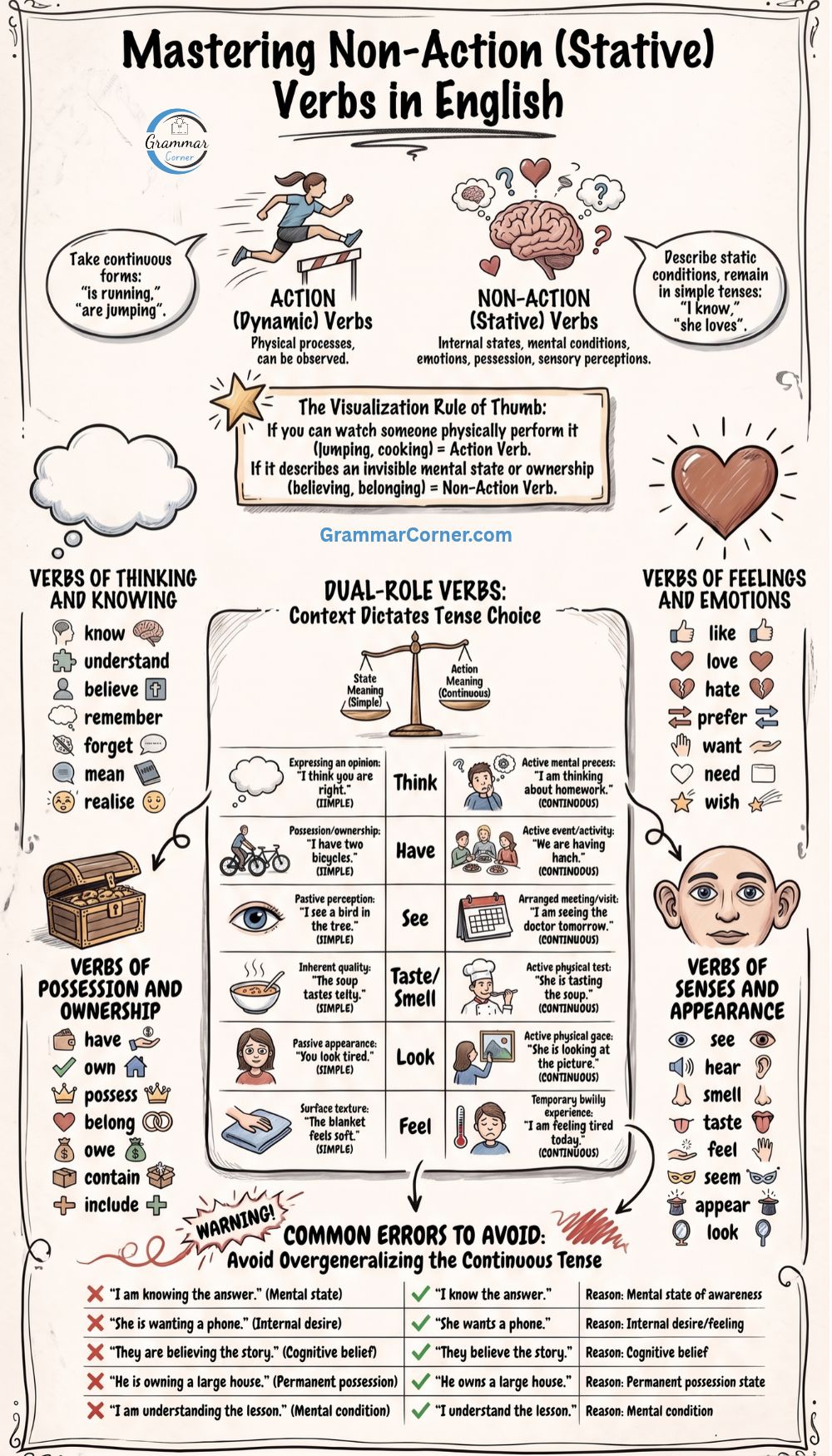
A non-action verb describes a state, feeling, thought, condition, possession, or sense rather than a physical activity. Because they do not portray activities that can be watched happening in real time, they are also widely known as stative verbs.
- I know the answer.
- She likes chocolate.
- They own a house.
- This bag belongs to me.
In their normal states, these verbs do not take continuous endings:
• ❌ She is liking chocolate.
• ❌ They are owning a house.
Why Are They Called Stative Verbs?
Understanding non-action verbs is especially critical when mastering the present continuous tense. Consider these additional sentences:
If a verb expresses a state of being, thinking, feeling, or owning rather than an active physical movement, keep it in the simple tense rather than adding -ing.
Quick Challenge
Which sentence contains a non-action (stative) verb? Tap an option.
See the full explanation
Answer: B. Tom knows the answer.
Grammar breakdown:
- Non-Action (Stative): Knows describes a mental condition or state of awareness, making is knowing ungrammatical.
- Action Verb: Running is a dynamic physical activity that naturally takes continuous forms (is running).
Non-Action Verbs vs. Action Verbs
The clearest way to master non-action verbs is to contrast them directly with action verbs. While action verbs describe dynamic activities and processes, non-action verbs focus purely on static conditions and internal states.
Common action verbs:
• The children are playing football.
• I am writing a letter.
Common non-action verbs:
• She likes ice cream.
• They own a car.
• This book belongs to me.
• Non-Action Verbs: Describe static conditions and are normally restricted from continuous tenses in their everyday meanings.
If you can watch someone physically perform the verb (like jumping or writing), it is an action verb. If it describes an internal state of mind or ownership (like knowing or owning), it is a non-action verb.
Quick Challenge
Which verb describes an active physical movement? Tap an option.
See the full explanation
Answer: C. jump
Grammar breakdown:
- Action Verb: Jump describes a dynamic physical activity that can be observed happening in real time (and takes continuous forms like is jumping).
- Non-Action Verbs: Know and love describe internal mental and emotional states.
Why Are Non-Action Verbs Important?
Non-action verbs are foundational to everyday English. We rely on them constantly when expressing thoughts, feelings, desires, knowledge, possession, perceptions, and beliefs. They become especially critical when learning how to form continuous tenses.
Reading is a physical activity, so continuous forms are natural:
Because know describes a mental state rather than an activity:
• ❌ I am knowing the answer.
Main Categories of Non-Action Verbs
Non-action verbs are easier to master when organized by the specific type of state they represent (such as thinking, feelings, possession, and senses).
These verbs describe mental conditions, cognitive awareness, and memory:
• She understands the lesson.
• He believes your story.
• I remember your name.
• We agree with you.
Verbs of thinking and knowing (like know and believe) capture permanent mental stances rather than physical tasks, keeping them firmly in the simple present tense.
Quick Challenge
Which sentence correctly uses a non-action verb of thinking? Tap an option.
See the full explanation
Answer: B. She knows the answer.
Grammar breakdown:
- Mental State: Know is a stative verb of thinking and knowing that does not take the -ing suffix in normal contexts.
- Group Categorization: Verbs like know, understand, and believe belong to the thinking and knowing category.
Verbs of Feelings, Emotions, Possession, and Ownership
Non-action verbs frequently describe internal emotional states or relationships of ownership. Because feelings and possession represent enduring conditions rather than active tasks, they normally remain in simple tenses.
Common emotion and desire verbs:
• She loves her family.
• They hate loud noises.
• He prefers tea.
• We want some water.
Common possession verbs:
• She owns a small shop.
• This house belongs to my uncle.
• The box contains old books.
• The price includes breakfast.
• ❌ She is owning a car. ➔ ✅ She owns a car.
Never use continuous -ing forms with verbs of emotion (like love or hate) or possession (like own or belong) when speaking about general states.
Quick Challenge
Which sentence correctly uses a verb of possession in standard English? Tap an option.
See the full explanation
Answer: B. She owns a car.
Grammar breakdown:
- Possession State: Own is a stative verb indicating ownership, which is a permanent condition rather than a temporary activity.
- Tense Choice: Use the simple present tense (owns) instead of the present continuous (is owning).
Verbs of the Senses and Appearance
Sensory and descriptive verbs capture what we experience through our perceptions and how things appear. While many function as strict non-action states, several possess unique exceptions where they can also describe deliberate physical activities.
Common perception verbs:
• I hear music.
• The soup smells delicious.
• This cake tastes sweet.
• The blanket feels soft.
Common descriptive verbs:
• He seems happy.
• This idea sounds good.
• This shirt fits me.
Non-Action Verbs and the Continuous Tense
A foundational rule in English grammar is that non-action verbs are normally restricted from continuous tenses when carrying their default state meanings.
| Non-Action Verb | Correct Simple Form Example |
|---|---|
| know | I know the answer. |
| like | She likes pizza. |
| believe | They believe him. |
| own | He owns a car. |
| understand | We understand the lesson. |
| want | I want some water. |
While action verbs (like eating or running) describe temporary activities happening right now, non-action verbs (like knowing or understanding) describe enduring mental states that require simple tenses.
Quick Challenge
Which sentence correctly uses a non-action verb in its standard state form? Tap an option.
See the full explanation
Answer: B. We understand the lesson.
Grammar breakdown:
- State Verb: Understand describes a mental condition rather than an ongoing physical activity.
- Correct Tense: Stative verbs take simple present tenses for general states, making are understanding grammatically incorrect in standard usage.
Common Non-Action Verbs That Usually Avoid -ing
While non-action verbs cover diverse semantic areas, mastering key examples across major categories helps build strong grammatical intuition.
- know
- understand
- believe
- remember
- forget
- mean
- realise
- like
- love
- hate
- prefer
- want
- need
- wish
- have
- own
- belong
- possess
- see
- hear
- seem
- resemble
- appear
These verbs are not absolute; many can take continuous forms when their meaning shifts. Always focus on the contextual meaning of the verb within the sentence rather than relying on a rigid “never use -ing” rule.
Non-Action Verbs That Can Also Be Action Verbs
One of the most fascinating aspects of English grammar is that certain verbs can function as stative states in one sentence and dynamic activities in another, depending entirely on context.
When think means “to have an opinion”:
When thinking describes an ongoing mental task:
Quick Challenge
Which sentence describes an active mental process using the continuous form? Tap an option.
See the full explanation
Answer: B. I am thinking about the problem.
Grammar breakdown:
- Active Process: When think represents an ongoing cognitive activity (pondering a problem), it acts as a dynamic verb and accepts -ing.
- Static Opinion: When think means “to have an opinion,” it remains a stative verb in the simple present.
Verbs That Play a Dual Role (State vs. Action)
Many common English verbs can operate as non-action (stative) states in one context while functioning as dynamic action activities in another. Analyzing these dual-role verbs helps clarify when continuous -ing forms are appropriate.
Shifting between opinions and mental processes:
• I am thinking about the question. (Action: considering)
Shifting between ownership and experiences:
• We are having lunch. (Action: event/activity)
• She is having a shower.
Shifting between sight and scheduled meetings:
• I am seeing the doctor tomorrow. (Action: arranged visit)
Shifting between touch texture and bodily states:
• I am feeling tired today. (Action/Experience: temporary condition)
Taste and Smell: Quality vs. Active Testing
Sensory verbs like taste and smell change behavior entirely depending on whether they describe an inherent item quality or an intentional action.
When perception verbs describe passive qualities or involuntary states, keep them simple. When they describe deliberate actions, visits, or testing processes, continuous forms become fully correct.
Quick Challenge
Which sentence describes an active physical testing process rather than an inherent quality? Tap an option.
See the full explanation
Answer: B. She is tasting the soup.
Grammar breakdown:
- Active Testing: When taste or smell acts as a deliberate verb of action (testing food), it takes continuous forms like is tasting.
- Inherent Quality: When describing how food naturally tastes or smells, it functions as a stative verb in the simple present.
The Verb “Look”: State vs. Action
Like many sensory words, the verb look can shift between a non-action state (meaning “to appear”) and a dynamic physical action (meaning “to direct one’s eyes toward something”).
When look means “to appear”:
When look describes actively directing gaze:
• Gaze (Action): Functions as a dynamic action verb that can take continuous forms (like is looking) when someone actively focuses their vision.
If the subject is passively giving off an appearance (“You look great”), keep it simple. If the subject is actively moving their eyes toward an object (“He is looking at the screen”), use the continuous action form.
Quick Challenge
Which sentence uses look as a dynamic physical action? Tap an option.
See the full explanation
Answer: B. You are looking at the painting.
Grammar breakdown:
- Active Gaze: When look involves intentionally directing vision toward an object, it acts as an action verb and accepts continuous forms (are looking).
- Appearance State: When look means “to appear,” it acts as a stative verb.
How to Know Whether a Verb Is Action or Non-Action
While no single test covers every exception, learners can easily determine verb types by asking two guiding questions: Is this describing an active process or a static state? Can I visualize someone performing this as a physical activity right now?
Compare active tasks to emotional opinions:
• She likes dinner. (Liking = feeling / opinion state)
Can you picture someone doing it right now?
• ❌ He is knowing the answer. (State: invisible mental condition)
Common Mistakes with Non-Action Verbs
English learners frequently overgeneralize the present continuous formula (am/is/are + verb-ing), leading to common errors when applying continuous endings to stative verbs. Review these 5 major mistakes:
✅ Correct: I know the answer.
✅ Correct: She wants a new phone.
✅ Correct: They believe the story.
✅ Correct: He owns a large house.
✅ Correct: I understand the question.
Never apply continuous -ing forms to verbs that describe static mental, emotional, or ownership conditions when speaking generally.
Quick Challenge
Correct this sentence: She is knowing the answer. Tap the correct option below.
See the full explanation
Answer: A. She knows the answer.
Grammar breakdown:
- Stative Verb Rule: Know is a non-action verb expressing mental awareness, which must be kept in the simple present tense (knows).
- Avoiding Continuous Traps: Do not attach -ing or auxiliary verbs like is to non-action verbs in standard state contexts.
Exceptions: When Non-Action Verbs Can Use -ing
It is a mistake to treat the rule as absolute (i.e., “stative verbs can never take -ing”). Many non-action verbs take continuous forms when their core meaning shifts from a static condition to a temporary experience, activity, or event.
• I am thinking about the problem. (Active consideration)
• ❌ We are having two dogs.
• We are having dinner. (Active event / meal)
Non-Action Verbs Across Different Tenses
Non-action verbs are not restricted to the present tense. They function seamlessly across past, present, and future tenses whenever the timeline fits the meaning, without automatically turning into continuous forms.
Comprehensive Non-Action Verbs Reference Table
A master categorization guide of common stative verbs across different semantic groups:
| Category | Common Non-Action Verbs |
|---|---|
| Thinking | know, believe, understand, remember, forget, mean |
| Feelings | like, love, hate, prefer, want, need, wish |
| Possession | have, own, possess, belong, owe |
| Senses | see, hear, smell, taste, feel |
| Appearance | seem, appear, resemble, look, sound |
| Relationships | depend, matter, fit, suit, match |
| Description | contain, include, consist, involve |
Learn stative verbs by category, but always evaluate the specific meaning of the verb within its sentence context before applying a continuous -ing ending.
Quick Challenge
Which word does not belong to the non-action (stative) verb group? Tap an option.
See the full explanation
Answer: C. jump
Grammar breakdown:
- Action Verb: Jump describes a dynamic physical movement that naturally takes continuous forms (is jumping).
- Stative Verbs: Love and own describe emotional feelings and possession, making them classic non-action verbs.
Non-Action Verbs in Everyday Sentences
Non-action verbs form the backbone of everyday conversation. We use them naturally across all forms of communication to articulate knowledge, beliefs, emotions, ownership, and perceptions.
Whenever you express what you know, feel, or own, rely on simple present tenses with these stative verbs to sound natural and grammatically correct.
Quick Challenge
Find the non-action verb in this sentence: “My brother knows the answer.” Tap an option.
See the full explanation
Answer: B. knows
Grammar breakdown:
- Stative Verb Identification: Knows describes a permanent mental condition rather than a physical activity.
- Sentence Structure: In “My brother knows the answer”, brother is the subject noun, knows is the verb, and answer is the object noun.
Practice Exercises on Non-Action Verbs
Test your mastery of non-action (stative) verbs and their dual-role action counterparts across 5 comprehensive practice exercises covering verb categorization, tense selection, error correction, and contextual exceptions.
Classify each verb as A (action verb) or N (non-action/stative verb):
- run
- know
- love
- swim
- own
- write
- believe
- jump
- understand
- play
Check Exercise 1 Answers
- A (Action)
- N (Non-Action)
- N (Non-Action)
- A (Action)
- N (Non-Action)
- A (Action)
- N (Non-Action)
- A (Action)
- N (Non-Action)
- A (Action)
Check Exercise 2 Answers
- A. know (Stative verb of mental state)
- A. likes (Stative verb of feeling)
- B. are playing (Dynamic action happening right now)
- A. owns (Stative verb of possession)
- B. are having (Active event/meal exception)
Identify and correct the stative verb error in each sentence:
Check Exercise 3 Answers
- I know the answer.
- She likes this book.
- He owns a car.
- We believe you.
- They understand the lesson.
- I think you are right. (When expressing an opinion)
- She has two brothers. (When expressing possession)
Choose the correct sentence where the continuous form is grammatically valid:
- A. I am knowing him.
- B. I am thinking about him.
- A. We are having lunch.
- B. We are having two cars.
- A. She is looking at the picture.
- B. She is looking tired.
- A. He is smelling the flowers.
- B. The flowers are smelling beautiful.
Check Exercise 4 Answers
- B (Thinking represents an active mental process here)
- A (Having lunch describes an active event/meal)
- A (Looking at describes actively directing gaze)
- A (Smelling describes active sniffing; flowers smell beautiful as a static quality)
Use the correct simple or continuous form of the verb in brackets based on the context:
Check Exercise 5 Answers
- know (Stative mental state)
- likes (Stative feeling)
- own (Stative possession)
- are having (Active meal event)
- is thinking (Active mental consideration process)
- tastes (Inherent flavor quality state)
- is looking (Active physical gaze)
Whenever you encounter a stative verb in these exercises, ask yourself whether it describes a permanent condition or a temporary activity before deciding on the tense.
Quick Challenge
Which sentence correctly uses a non-action verb in its standard state form? Tap an option.
See the full explanation
Answer: B. I know the answer.
Grammar breakdown:
- Stative Verb Tense: Non-action verbs expressing mental states (like know) take the simple present tense for general facts.
- Avoiding -ing: Avoid attaching continuous endings to stative verbs when describing permanent states.
Practice: Can the Verb Use the Continuous Form?
Evaluate each sentence as written and determine whether it correctly uses or restricts the continuous -ing form based on its underlying verb meaning.
| Sentence | Can Use Continuous? |
|---|---|
| I am knowing the answer. | No |
| I am writing a letter. | Yes |
| She likes apples. | Yes (Simple present is correct) |
| She is liking apples. | No |
| We are having lunch. | Yes (Active event exception) |
| They are owning a house. | No |
| He is thinking about his homework. | Yes (Active mental process) |
| I believe you. | Yes (Simple present is correct) |
| She is looking at the picture. | Yes (Active physical gaze) |
| The soup tastes good. | Yes (Simple quality state) |
Frequently Asked Questions About Non-Action Verbs
- Think: Non-action for opinions (“I think this is good”); action when considering (“I am thinking about it”).
- Have: Non-action for possession (“I have a bicycle”); action for events (“I am having lunch”).
- See: Non-action for perception (“I see a bird”); action for meetings (“I am seeing the doctor tomorrow”).
- Feel: Action for temporary conditions (“I am feeling tired today”); non-action for textures (“The material feels soft”).
- Love: Standard learner English uses the simple form (“I love this song”), though informal modern speech occasionally uses “I’m loving this!” for strong current reactions.
Non-Action Verbs Quick Reference Chart
A master reference guide categorizing common non-action verbs with standard example sentences:
| Category | Examples | Example Sentence |
|---|---|---|
| Thinking | know, believe, understand | I know the answer. |
| Feelings | like, love, hate, prefer | She likes music. |
| Possession | have, own, belong | They own a house. |
| Senses | see, hear, smell, taste | The soup tastes good. |
| Appearance | seem, appear, look | He seems tired. |
| Relationships | fit, suit, match, depend | This shirt fits me. |
Stative and non-action verbs refer to the same grammatical group. Group them by category and evaluate context before applying continuous endings.
Quick Challenge
Which sentence correctly uses a non-action verb in its standard state form? Tap an option.
See the full explanation
Answer: B. He owns a house.
Grammar breakdown:
- Possession State: Own expresses ownership, which is a permanent stative condition rather than a temporary action.
- Simple Tense Rule: Stative verbs take simple present tenses when describing general states.