Subordinate Clauses (Structure, Rules & Examples)
What Is a Subordinate Clause?
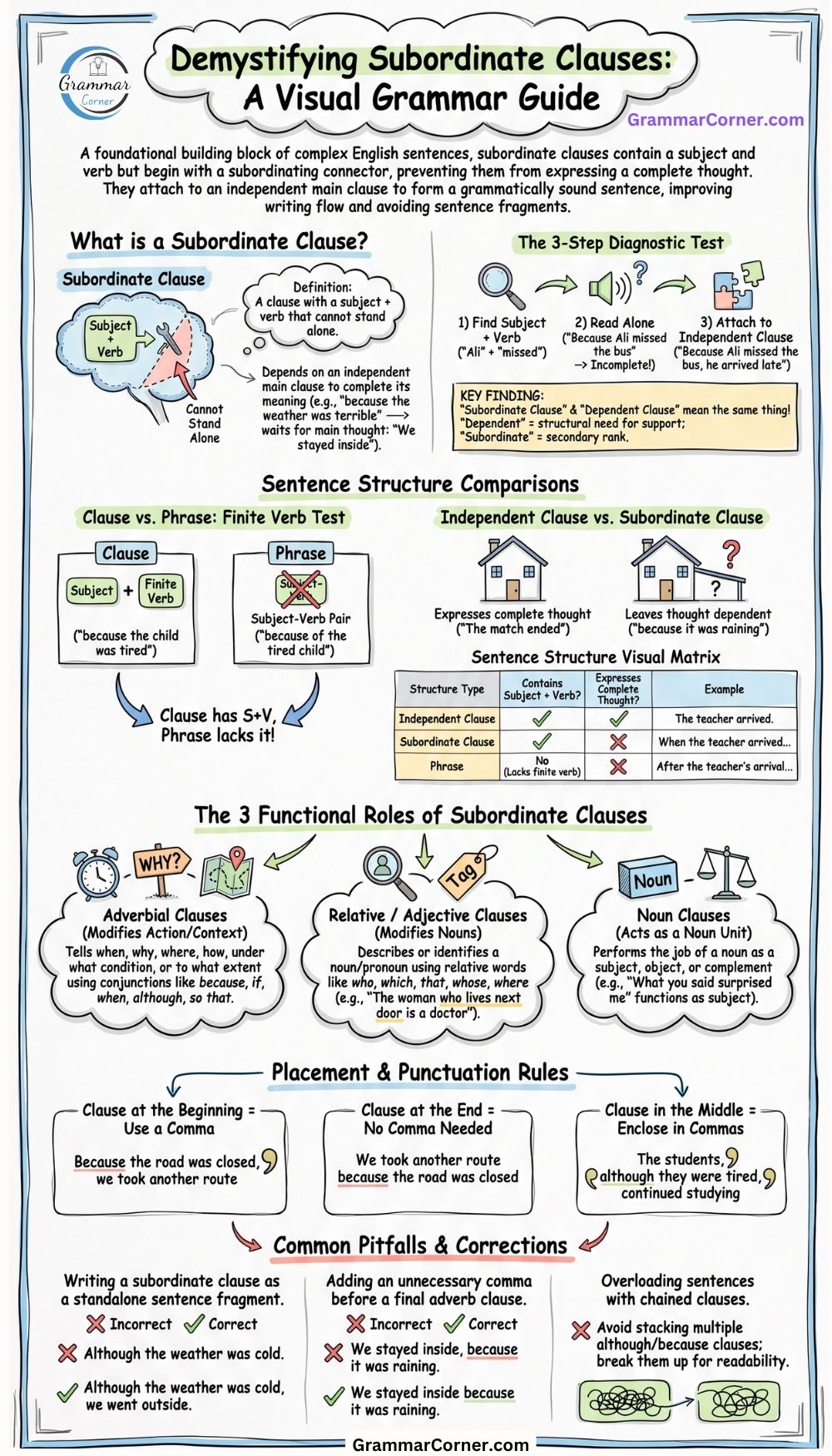
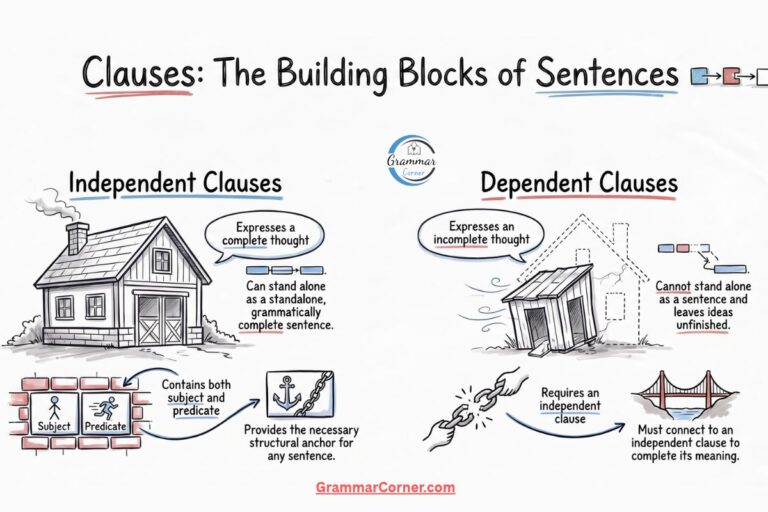
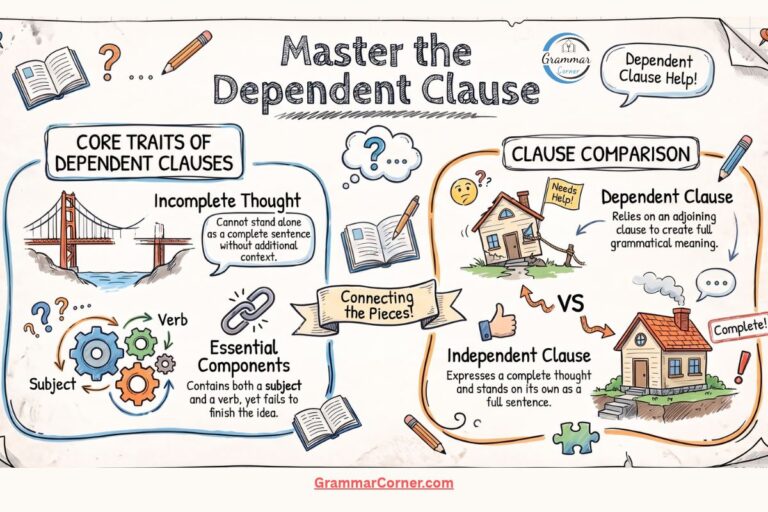
A subordinate clause (or dependent clause) is a group of words containing a subject and a verb that does not normally express a complete thought on its own. A sentence does not always give all of its information in one equally important piece.
Consider this sentence:
“We stayed inside because the weather was terrible.”
What Subordinate Clauses Do
Subordinate clauses are everywhere in English. They perform essential communicative functions:
- They tell us when, why, where, how, under what condition, or to what extent something happens.
- They can describe a noun (acting as an adjective).
- They can perform the entire job of a noun (acting as a subject or object).
A subordinate clause is not defined simply by its length or by the presence of a particular word. Its real identity comes from the job it performs and its relationship with the main clause.
Anatomy of a Subordinate Clause
Look at the example below:
“Although the road was flooded, we continued our journey.”
• Subject: the road
• Verb: was
The clause leaves the reader waiting: “Although the road was flooded… what happened?”
Together, the subordinate clause and the main clause form a complete, cohesive sentence.
✨ Quick Challenge
Three of these four word groups are subordinate (dependent) clauses. One is an independent main clause that can stand alone. Tap the one that doesn’t belong.
See the full answer
Answer: “we continued our journey”
A subordinate clause contains a subject and a verb but starts with a subordinating connector (such as because, although, or when), leaving the meaning dependent on a main clause.
In contrast, “we continued our journey” expresses a complete, freestanding thought without any subordinating element, making it an independent (main) clause.
Subordinate Clause and Dependent Clause Mean the Same Thing
You may see two different terms used for the same grammatical structure:
- subordinate clause
- dependent clause
In most school and general grammar contexts, these terms are interchangeable.
- The word dependent emphasizes that the clause depends on another part of the sentence.
- The word subordinate emphasizes that the clause has a secondary grammatical relationship to the main clause.
So these two descriptions mean essentially the exact same thing:
- “Because it was raining” is a dependent clause.
- “Because it was raining” is a subordinate clause.
First Understand What Makes a Clause a Clause
Before identifying a subordinate clause, it helps to understand the definition of a clause. A clause normally contains a subject and a verb.
• Verb: cried
➔ Can stand alone
• Verb: cried
➔ Cannot stand alone
Both are clauses because both contain a subject and a verb. The difference lies entirely in their grammatical completeness.
Clause vs. Phrase
Do not confuse a subordinate clause with a phrase:
| Clause | Phrase |
|---|---|
| Contains a subject and a verb | Does not contain both a subject and a finite verb |
| because the child was tired | because of the tired child |
| when the teacher arrived | after the teacher’s arrival |
| although she was nervous | despite her nervousness |
A phrase may perform a similar descriptive or adverbial function, but it is not a clause.
The Easiest Way to Recognize a Subordinate Clause
Use this simple three-step diagnostic test:
• Verb: missed
➔ Confirmed: It is a clause.
• Does it feel complete? No. We naturally expect more information.
Subordinate Clause vs. Independent Clause
The distinction is easiest when placing the two side by side:
| Independent Clause | Subordinate Clause |
|---|---|
| Can stand alone | Cannot normally stand alone |
| Expresses a complete thought | Leaves the thought dependent on another clause |
| Can be a complete sentence | Usually forms part of a larger sentence |
| “The match ended.” | “because it was raining” |
Look at the combined sentence:
“The match ended because it was raining.”
• “because it was raining” ➔ Subordinate clause
The two clauses have different levels of grammatical independence, but both contribute vital meaning to the complete sentence.
What Does a Subordinate Clause Do?
A subordinate clause can perform several different structural jobs. The three broad functions most useful for learners are:
A noun clause, relative clause, or adverb clause is also a subordinate clause whenever it is grammatically dependent on an independent clause.
What Is a Subordinate Clause?
A subordinate clause (or dependent clause) is a group of words containing a subject and a verb that does not normally express a complete thought on its own. A sentence does not always give all of its information in one equally important piece.
Consider this sentence:
“We stayed inside because the weather was terrible.”
What Subordinate Clauses Do
Subordinate clauses are everywhere in English. They perform essential communicative functions:
- They tell us when, why, where, how, under what condition, or to what extent something happens.
- They can describe a noun (acting as an adjective).
- They can perform the entire job of a noun (acting as a subject or object).
A subordinate clause is not defined simply by its length or by the presence of a particular word. Its real identity comes from the job it performs and its relationship with the main clause.
Anatomy of a Subordinate Clause
Look at the example below:
“Although the road was flooded, we continued our journey.”
• Subject: the road
• Verb: was
The clause leaves the reader waiting: “Although the road was flooded… what happened?”
Together, the subordinate clause and the main clause form a complete, cohesive sentence.
✨ Quick Challenge
In the sentence “We stayed inside because the weather was terrible,” what makes the highlighted part a subordinate clause? Tap the best explanation.
See the full answer
Answer: It has a subject and verb, but cannot stand alone as a complete thought.
A subordinate clause contains both a subject (the weather) and a finite verb (was), but because it begins with a subordinating connector (because), it expresses an incomplete relationship and depends upon the main clause (We stayed inside) for full meaning.
Subordinate Clauses of Purpose
Purpose clauses explain why an action is performed with a particular goal or intention in mind. Common conjunctions include:
- She whispered so that nobody would hear her.
- We left early so that we could avoid the traffic.
The main clause gives the action, while the subordinate clause provides its intended purpose.
Subordinate Clauses of Result
A result clause expresses what happens as a direct consequence or outcome of an intensity or quality described in the main clause. Common structures include:
- The box was so heavy that I could not lift it.
- It was such a difficult question that nobody answered it.
Here, the subordinate clause expresses the direct result of the degree or quality in the main clause.
Subordinate Clauses of Comparison
Comparison clauses show a relationship or degree of comparison between two elements. Common structures include:
- My sister is taller than I am.
- He runs faster than his brother does.
- She behaves as though she owns the place.
The exact grammatical analysis varies with the structure, but the subordinate portion always depends on the surrounding matrix sentence.
Noun Subordinate Clauses
A noun clause is another type of subordinate clause. Instead of describing a noun or modifying an action, it performs a noun-like role in the sentence:
Common Roles of Noun Clauses
| Role | Example |
|---|---|
| Subject | What he decided remains unclear. |
| Object | I know what he decided. |
| Subject complement | The problem is that we are late. |
| Object of a preposition | We talked about what happened. |
Relative or Adjective Subordinate Clauses
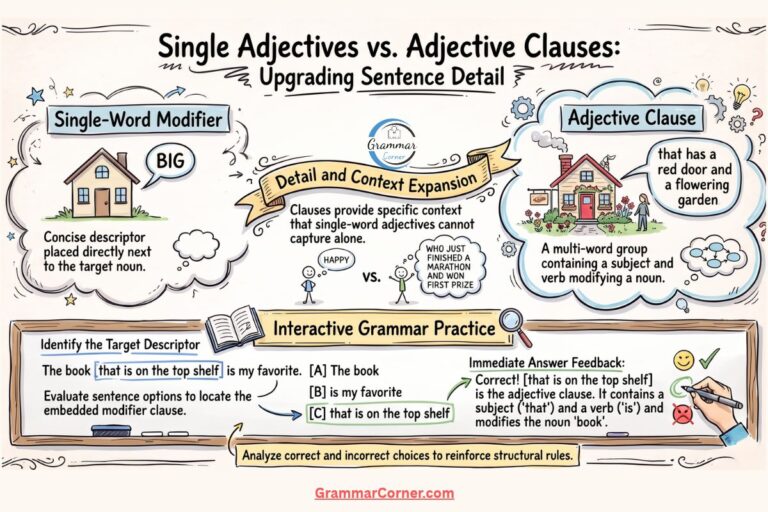
A relative clause is also subordinate when it depends on a noun in the larger sentence:
The clause who lives next door describes the woman.
The clause that you were looking for identifies the document.
Relative clauses can therefore be understood as subordinate clauses that perform an adjective-like job.
Subordinating Conjunctions: The Words That Create Dependence
Many subordinate clauses begin with a subordinating conjunction. These words establish a specific semantic and syntactic relationship with the independent clause:
| Meaning | Common Words |
|---|---|
| Time | when, while, before, after, until, once, whenever |
| Reason | because, since, as |
| Condition | if, unless, provided that, as long as |
| Contrast | although, though, even though, whereas |
| Purpose | so that, in order that |
| Place | where, wherever |
| Manner | as, as if, as though |
| Comparison | than, as … as |
The conjunction itself does not make the words a subordinate clause in isolation; the entire clause becomes subordinate because of the dependent relationship established by the conjunction.
Relative Words Can Also Introduce Subordinate Clauses
Not every subordinate clause begins with a traditional subordinating conjunction. Relative words introduce subordinate clauses as well:
The word who connects the subordinate clause to student.
Here, whichever option costs less functions as a noun-like unit (object of choose).
When identifying subordinate clauses, do not look only for words such as because, although, or if—relative pronouns and interrogative words introduce them frequently too.
Subordinate Clause at the Beginning of a Sentence
A subordinate clause can come before the independent clause:
“Because the road was closed, we took another route.”
When an introductory adverbial subordinate clause comes first, a comma is commonly used to separate it from the main clause.
- Although she was tired, she continued working.
- When the meeting ended, everyone left quickly.
- If you need help, call me.
Subordinate Clause at the End of a Sentence
The same subordinate clause can often move to the end:
- We took another route because the road was closed.
- She continued working although she was tired.
- Call me if you need help.
For ordinary adverbial clauses placed after the independent clause, a comma is generally unnecessary.
Compare the Two Positions
The grammatical relationship remains the same. Only the information order and punctuation change.
A Useful Comma Rule
• Independent clause first ➔ No comma is normally needed before the subordinate clause.
| Position | Example |
|---|---|
| Subordinate clause first | When the class ended, the students left. |
| Subordinate clause second | The students left when the class ended. |
| Subordinate clause first | Although he was nervous, he gave the speech. |
| Subordinate clause second | He gave the speech although he was nervous. |
This rule mainly applies to adverbial subordinate clauses. Relative clauses follow distinct punctuation rules based on whether they are restrictive or non-restrictive.
When a Subordinate Clause Comes in the Middle
Sometimes a subordinate clause appears inside another sentence position:
“The students, although they were tired, continued studying.”
Because it interrupts the main structure and supplies parenthetical or additional information, commas mark its boundaries on both sides.
Punctuation always depends on the clause’s function and whether the information is essential. Do not add commas simply because a clause happens to be long.
Subordinate Clause vs. Relative Clause
These terms overlap, which can cause confusion:
- Subordinate clause = The broad umbrella category for all dependent clauses.
- Relative clause = One specific type within that category that modifies a noun or pronoun.
This is a subordinate adverb clause.
This is a relative clause, and it is also a subordinate clause.
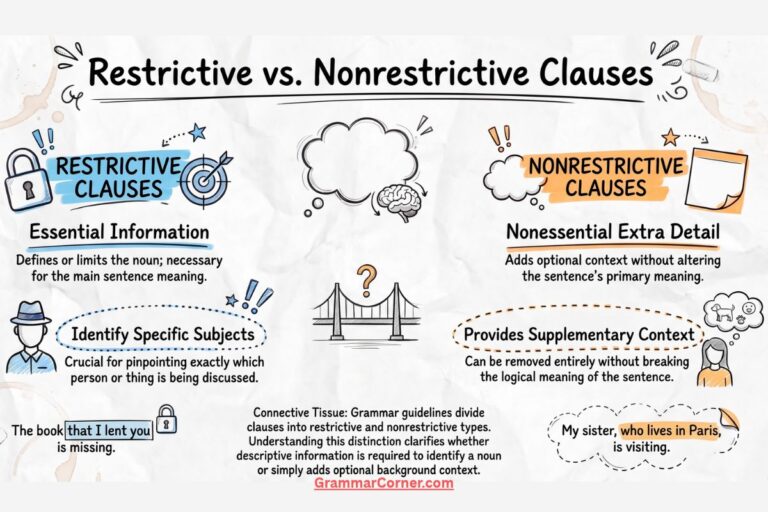
Subordinate Clause vs. Restrictive Clause
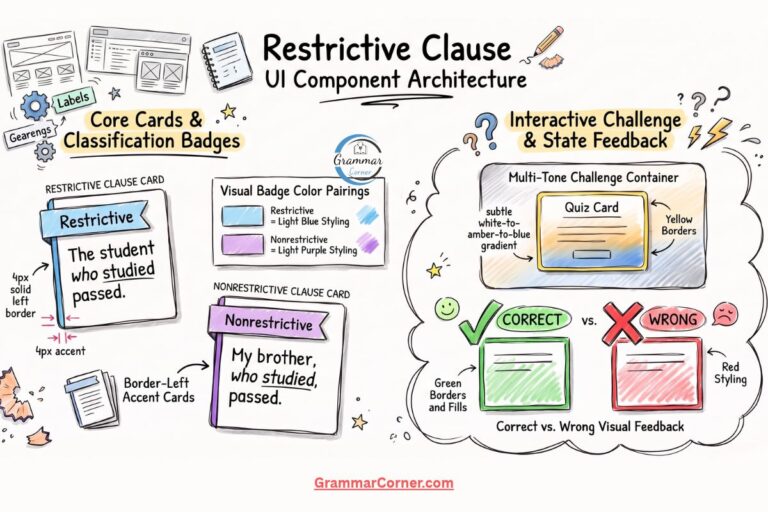
A similar hierarchical relationship exists with restrictive clauses. A restrictive clause is usually a type of relative clause that identifies or narrows a noun:
“The students who completed the project received certificates.”
The clause who completed the project is simultaneously:
Understanding the Terminology Hierarchy
| Term | What It Tells You |
|---|---|
| Subordinate clause | Its grammatical dependence on another clause |
| Relative clause | Its job of modifying a noun or pronoun |
| Restrictive clause | Its essential role in identifying or limiting the noun |
Understanding this hierarchy prevents grammatical descriptions from seeming contradictory.
Subordinate Clause vs. Phrase
Compare these two closely related structures:
Subordinate clause: contains a subject + verb (the child + was).
Prepositional phrase: contains no finite verb unit.
Side-by-Side Comparison
| Subordinate Clause | Phrase |
|---|---|
| because the child was tired | because of his tiredness |
| when the teacher arrived | after the teacher’s arrival |
| although she was nervous | despite her nervousness |
The two structures express similar meanings, but they are grammatically distinct.
Subordinate Clauses in Complex Sentences
A sentence containing one independent clause and at least one subordinate clause is called a complex sentence:
“When the rain stopped, we went outside.”
Subordinate Clauses in Compound-Complex Sentences
A sentence can contain more than one independent clause along with one or more subordinate clauses:
• we went outside ➔ Independent clause #1
• the children played in the garden ➔ Independent clause #2 (joined by and)
This combination of multiple main clauses with at least one dependent clause creates a compound-complex sentence.
One Sentence Can Contain More Than One Subordinate Clause
English allows several subordinate clauses to appear in the same sentence:
“When the manager arrived, he spoke to the employees who had stayed late because the project was urgent.”
• “who had stayed late” ➔ Relative clause (Modifies employees)
• “because the project was urgent” ➔ Adverbial subordinate clause (Reason)
This may look complex at first, but identifying each clause by its functional job makes multi-layered sentences easy to parse.
Why Writers Use Subordinate Clauses
Subordinate clauses allow writers to establish explicit relationships between ideas. Compare:
“The shop closed. It was late. We went home.”
The ideas are understandable, but their relationships are not strongly expressed.
Subordinate clauses can establish:
- • Cause
- • Time
- • Condition
- • Contrast
- • Purpose
- • Place
- • Comparison
- • Explanation
- • Identification
Subordinate Clauses Can Show Which Idea Is More Important
Subordination allows a writer to weight facts hierarchically rather than placing them on equal footing:
“The road was flooded, and we turned back.”
Both facts share equal grammatical prominence.
How to Avoid Overusing Subordinate Clauses
Subordinate clauses are useful, but chaining too many into one sentence makes writing exhausting to follow. Consider:
“Although the weather was bad, and although the roads were crowded, because the driver had already booked the tickets, we decided that although it might be uncomfortable, we should continue the journey.”
Common Mistakes With Subordinate Clauses
• “I remember the time when the bell rang.” ➔ Relative clause modifying time.
How to Identify a Subordinate Clause in Any Sentence
• If yes ➔ Independent clause.
• If no ➔ Subordinate clause.
Worked Example: Analyze the Whole Sentence
Consider this multi-clause sentence:
“Although the road was narrow, the driver continued because he knew the area well.”
There are three distinct parts to identify:
• Cannot stand alone.
➔ Type: Subordinate adverbial clause of contrast
• Expresses a complete thought.
➔ Type: Independent clause
• Cannot stand alone.
➔ Type: Subordinate adverbial clause of reason
This structural method works reliably even when a sentence contains multiple embedded clauses.
A Handy List of Subordinating Words
Here is a practical list organized by meaning rather than as one long unstructured collection:
| Relationship | Subordinating Words and Phrases |
|---|---|
| Time | after, before, when, whenever, while, until, since, once, as soon as, by the time |
| Cause | because, since, as |
| Condition | if, unless, provided that, as long as, even if, in case |
| Contrast | although, though, even though, whereas, while |
| Purpose | so that, in order that |
| Place | where, wherever |
| Manner | as, as if, as though |
| Comparison | than, as … as |
| Result | so … that, such … that |
Some words have more than one function depending on context. For example, since can refer to time or reason:
• “Since you are here, let’s begin.” ➔ Reason
Subordinate Clause Examples With Their Functions
| Sentence | Subordinate Clause | Function |
|---|---|---|
| When the lights went out, everyone became quiet. | When the lights went out | Time |
| We left early because traffic was heavy. | because traffic was heavy | Reason |
| If the weather improves, we will go hiking. | If the weather improves | Condition |
| She continued working although she was tired. | although she was tired | Contrast |
| We whispered so that the baby would not wake. | so that the baby would not wake | Purpose |
| Sit where you can see the board. | where you can see the board | Place |
| He behaved as though nothing had happened. | as though nothing had happened | Manner |
| The bag was so heavy that I could not lift it. | that I could not lift it | Result |
Practice: Find the Subordinate Clause
Identify the subordinate clause and its function in each sentence:
- We stayed indoors because the wind was extremely strong.
- Although she was nervous, she answered every question.
- I will call you when I reach the office.
- If you study regularly, you will improve.
- The woman who teaches mathematics is absent today.
- I know what you are trying to say.
- We waited until the doctor arrived.
- He spoke as though he already knew the result.
| No. | Subordinate Clause | Function |
|---|---|---|
| 1 | because the wind was extremely strong | Reason |
| 2 | Although she was nervous | Contrast |
| 3 | when I reach the office | Time |
| 4 | If you study regularly | Condition |
| 5 | who teaches mathematics | Relative / Adjective |
| 6 | what you are trying to say | Noun |
| 7 | until the doctor arrived | Time |
| 8 | as though he already knew the result | Manner |
Practice: Independent or Subordinate?
Identify whether each clause is independent or subordinate:
| Clause | Type |
|---|---|
| The children were sleeping. | Independent |
| because the children were sleeping | Subordinate |
| when the teacher entered | Subordinate |
| the teacher entered | Independent |
| although we had little time | Subordinate |
| we completed the task | Independent |
| if the weather remains clear | Subordinate |
| the match will continue | Independent |
Practice: Correct the Sentence
Subordinate Clause vs. Coordinating Clause
Subordination and coordination are fundamentally different methods of connecting clauses:
Side-by-Side Comparison
| Coordination | Subordination |
|---|---|
| Joins clauses of equal grammatical status | Creates a dependent relationship |
| Both clauses can usually stand alone | One clause cannot normally stand alone |
| and, but, or, so, yet, for, nor | because, although, if, when, unless, since, etc. |
| “I was tired but I continued.” | “I continued although I was tired.” |
This distinction is essential for mastering sentence variety, punctuation, and complex sentence structure.
Subordinate Clauses and Sentence Fragments
A subordinate clause becomes a sentence fragment when it is incorrectly punctuated as a standalone complete sentence:
A reader naturally asks: “What happened because the shop was closed?”
Join it directly to an independent clause:
Subordinate Clauses and Sentence Variety
Skilled writing uses a balanced mixture of sentence lengths and structures. Compare:
“The rain started. We stayed inside. The roads became slippery. We canceled the trip.”
Do not make every sentence complex. Short, punchy independent sentences are often more effective for emphasis. A good writer chooses the sentence structure that best fits the idea.
A Quick Reference Chart
| Question | Answer |
|---|---|
| What is a subordinate clause? | A dependent clause that cannot normally stand alone |
| Another name? | Dependent clause |
| Does it contain a subject and verb? | Yes, normally |
| Can it stand alone? | No |
| What can introduce it? | Subordinating conjunctions, relative words, and other dependent markers |
| Main functional types? | Adverbial, relative/adjective, and noun clauses |
| Can it begin a sentence? | Yes |
| Comma when it comes first? | Usually for introductory adverbial clauses |
| Comma when it comes second? | Usually no for ordinary adverbial clauses |
| Can a sentence have more than one? | Yes |
| Can a sentence contain both types? | Yes (Independent + Subordinate) |
| What sentence type contains one? | Complex sentence (and Compound-Complex) |
Frequently Asked Questions
➔ Complete: “I went to bed because I was tired.”
✅ Complete: “Although the weather improved, we stayed inside.”
- Adverb clauses
- Relative / adjective clauses
- Noun clauses
• “because she felt sick” ➔ Subordinate clause
• “Because it was raining, we stayed home.” (Comma follows introductory clause)