Independent Clauses (Structure & Examples)
What Is an Independent Clause?
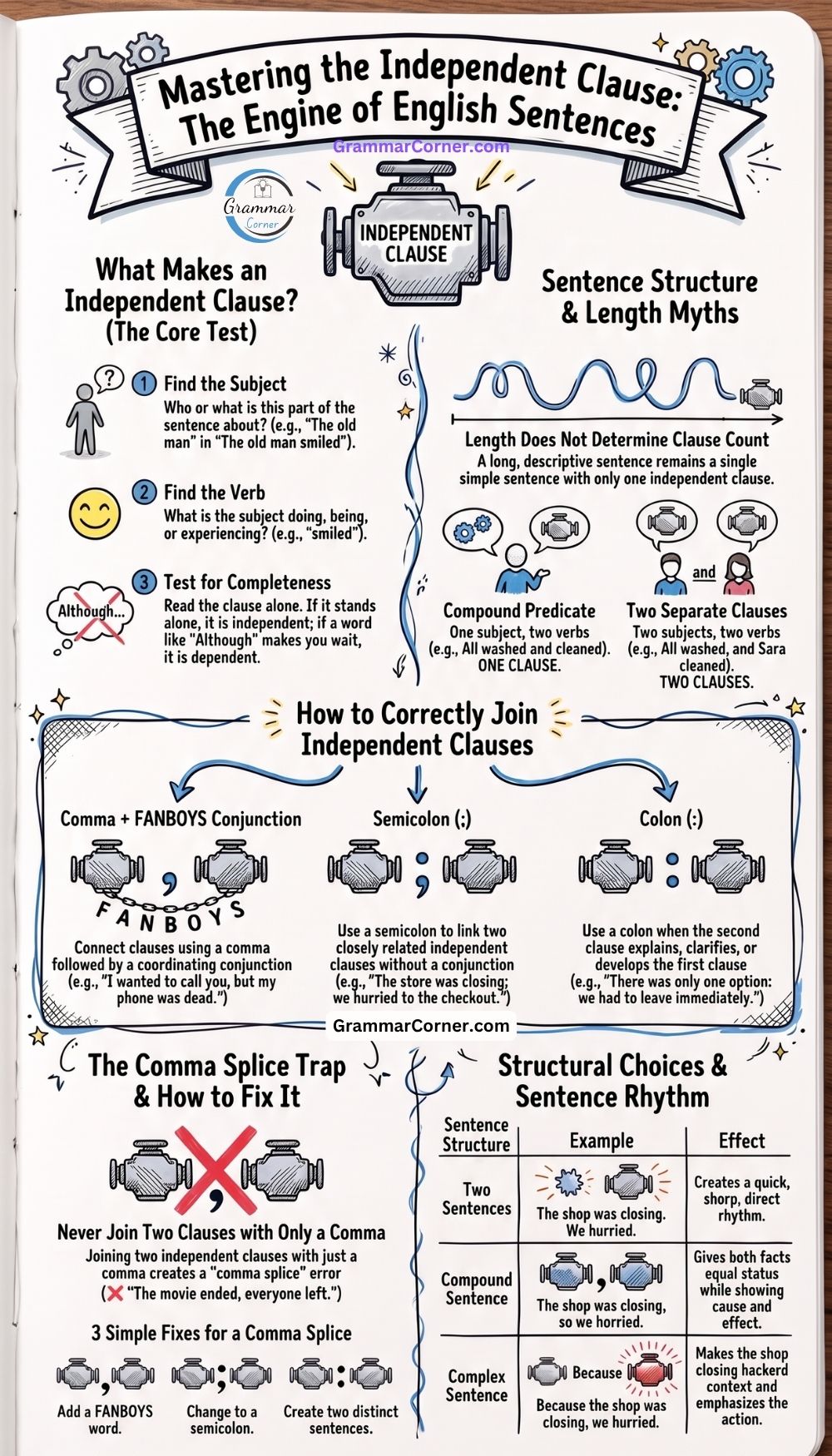
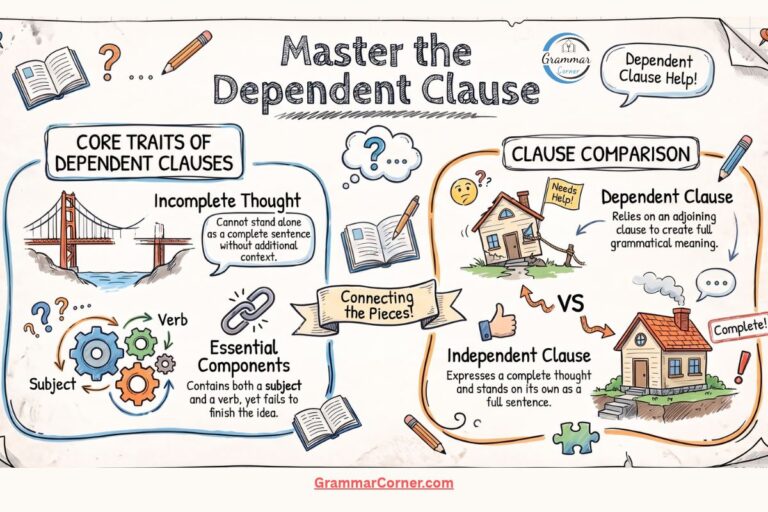
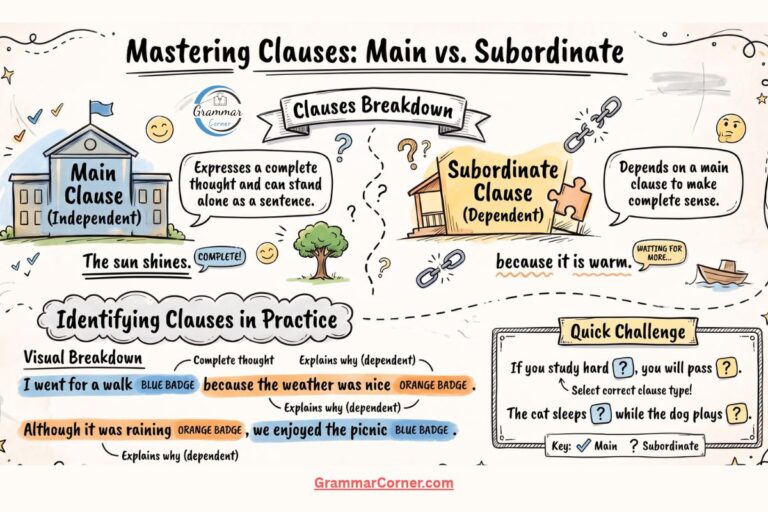
An independent clause is a group of words that contains a subject and a predicate and expresses a complete thought.
Look at this sentence:
“The children played in the garden.”
It is short, but it performs an important job. The sentence gives us a complete thought, and we do not need to wait for another part to understand it.
Now add another idea:
“The children played in the garden while their mother prepared dinner.”
The sentence is longer, but its basic structure is still easy to see. The children played in the garden can stand by itself. The other part, while their mother prepared dinner, cannot.
The first part is an independent clause.
Examples
Here are a few more:
Each one can function as a complete sentence because each expresses a complete idea.
The Three Things to Look For
When you want to identify an independent clause, do not begin by memorizing complicated terminology. Look for three things:
Try Another Comparison
It contains a subject and verb, but it does not feel complete. The word although makes us expect another idea.
• Independent: he looked worried
The Quick Test
| Question | If the answer is “yes” |
|---|---|
| Does it have a subject? | It may be a clause. |
| Does it have a verb? | It is likely a clause. |
| Can it stand alone with a complete meaning? | It is an independent clause. |
This test is simple enough for beginners.
✨ Quick Challenge
Three of these word groups are dependent (subordinate) clauses that leave the reader waiting. One is an independent clause that expresses a complete thought. Tap the one that can stand alone.
See the full answer
Answer: “Sara bought a new notebook”
An independent clause fulfills all three essential criteria:
- Subject: Sara
- Verb: bought
- Complete Thought: It makes full sense on its own without any subordinating conjunction (unlike while, because, or although).
One Independent Clause Can Make a Simple Sentence
A sentence containing one independent clause is generally a simple sentence.
- The baby is sleeping.
- My parents live nearby.
- The students completed their assignment.
These sentences may contain more than one word, but they have one independent clause. And a simple sentence does not necessarily have a short structure:
“The young students from our neighboring school won the regional science competition.”
It is still a simple sentence because it has one independent clause.
Simple Sentence Pattern
A simple sentence can contain:
-
Subject + Verb:
Birds fly. -
Subject + Verb + Object:
Sara opened the window. -
Subject + modifiers + Verb + Object + modifiers:
The students in our advanced English class completed the difficult assignment before lunch.
The length does not determine the number of clauses.
One Independent Clause Can Contain More Than One Verb
This is a common point of confusion. Consider:
“Ali washed the car and cleaned the windows.”
There are two verbs:
- washed
- cleaned
But there is only one subject, Ali, and the sentence can still be treated as one independent clause with a compound predicate.
Now compare:
“Ali washed the car, and Sara cleaned the windows.”
Here we have two subjects and two complete clause structures:
- Ali washed the car.
- Sara cleaned the windows.
The second sentence contains two independent clauses.
Compare the Structures
| Sentence | Clauses |
|---|---|
| Ali washed the car. | One independent clause |
| Ali washed the car and cleaned the windows. | One independent clause with a compound predicate |
| Ali washed the car, and Sara cleaned the windows. | Two independent clauses |
This distinction is important when deciding whether a comma is needed before and.
How to Join Two Independent Clauses
Independent clauses are strong enough to stand alone, but writers often want to connect related ideas. Suppose we have:
- The road was crowded.
- We arrived on time.
There are several ways to combine them:
The most familiar coordinating conjunctions are remembered by the word FANBOYS:
When one of these conjunctions joins two independent clauses, a comma normally comes before the conjunction.
• “She studied hard, so she passed the exam.”
• “We can leave now, or we can wait for the others.”
A semicolon can connect two closely related independent clauses.
Both sides could stand alone: The store was closing. / We hurried to the checkout. The semicolon shows that the two thoughts are closely connected.
• “I had forgotten my wallet; my friend paid for lunch.”
A colon has a different effect from a semicolon. A colon can introduce an explanation, clarification, result, or specific detail that follows naturally from the first clause.
✨ Quick Challenge
Three of these options correctly join two independent clauses. One contains a comma splice (joining two independent clauses with only a comma). Tap the incorrect sentence.
See the full answer
Answer: “The store was closing, we hurried inside.”
When connecting two independent clauses, a comma alone is insufficient (creating an error known as a comma splice). To fix it, you can:
- Add a coordinating conjunction: “The store was closing, so we hurried inside.”
- Use a semicolon: “The store was closing; we hurried inside.”
- Separate into two distinct sentences: “The store was closing. We hurried inside.”
A Simple Way to Break Apart a Difficult Sentence
When a sentence looks complicated, try reducing it to its basic clauses. Consider:
Ignore the extra details for a moment:
This method is useful when analyzing long sentences. Strip away the modifiers and subordinate material until the main statement becomes visible.
Can an Independent Clause Contain Another Clause?
Yes. Consider:
“I believe that she is right.”
• Noun clause: that she is right (completes the meaning of the verb believe)
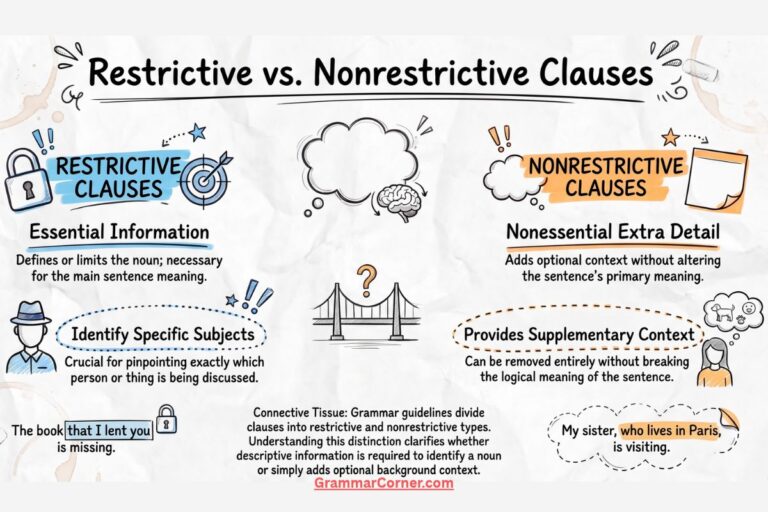
This shows why identifying clauses can sometimes require careful analysis. A sentence can have an independent clause as its main structure while containing a dependent clause inside it.
For learners, the practical question is usually: Which part can stand alone as the main statement? That part is the independent clause.
Independent Clauses and Sentence Rhythm
Independent clauses also influence the rhythm of writing. Compare:
This is one reason experienced writers pay attention to sentence structure. Clauses are not just grammatical pieces; they help control how information reaches the reader.
A Practical Comparison of Three Choices
Suppose you want to express these two facts:
- The shop was closing.
- We hurried.
You could write:
| Structure | Sentence | Effect |
|---|---|---|
| Two Sentences | The shop was closing. We hurried. | Clear and direct. |
| Compound Sentence | The shop was closing, so we hurried. | Shows the cause-and-result relationship while giving both clauses equal grammatical status. |
| Complex Sentence | Because the shop was closing, we hurried. | Makes the closing of the shop background information and emphasizes our action. |
The underlying ideas are almost identical, but the sentence structure changes the emphasis.
✨ Quick Challenge
In the complex sentence “When the rain stopped, the students who were waiting inside rushed to the playground,” what is the core independent clause that carries the main thought?
See the full answer
Answer: “the students rushed to the playground”
When breaking apart a layered sentence:
- When the rain stopped = Adverbial Dependent Clause (Time)
- who were waiting inside = Relative Clause (modifying students)
- the students rushed to the playground = Core Independent Clause (the complete thought that can stand alone as the main sentence)
A Quick Independent Clause Checklist
Before calling a clause independent, ask yourself:
If the answer to the central question is yes, it can stand alone, you are probably looking at an independent clause.
Practice Exercises
Practice: Find the Independent Clause
Identify the independent clause in each sentence:
- Although the weather was cold, we went for a walk.
- When the teacher entered, the students became quiet.
- I finished my work before the meeting started.
- The dog barked because someone was outside.
- If you arrive early, you can choose your seat.
- The woman who owns the store greeted us.
- We stayed at home because the roads were flooded.
- After the film ended, everyone left the theater.
| No. | Independent Clause |
|---|---|
| 1 | we went for a walk |
| 2 | the students became quiet |
| 3 | I finished my work |
| 4 | The dog barked |
| 5 | you can choose your seat |
| 6 | The woman greeted us |
| 7 | We stayed at home |
| 8 | everyone left the theater |
Notice that the independent clause does not have to come first.
Practice: Independent or Dependent?
Decide whether each group of words is an independent clause or a dependent clause:
- The baby fell asleep.
- Because the baby fell asleep
- We waited outside.
- While we waited outside
- She knows the answer.
- Although she knows the answer
- The players celebrated.
- When the players celebrated
| Expression | Answer | Reason |
|---|---|---|
| The baby fell asleep. | Independent | Complete thought |
| Because the baby fell asleep | Dependent | Begins with a subordinating word and needs another idea |
| We waited outside. | Independent | Complete thought |
| While we waited outside | Dependent | Incomplete meaning |
| She knows the answer. | Independent | Can stand alone |
| Although she knows the answer | Dependent | The word although makes it subordinate |
| The players celebrated. | Independent | Complete thought |
| When the players celebrated | Dependent | Needs a main clause |
Practice: Fix the Sentence
Correct each sentence below:
There can be more than one correct solution. The important thing is to recognize what the clauses are doing and connect them properly.
Independent Clause: A Quick Reference Table
| Feature | Independent Clause |
|---|---|
| Has a subject | Yes, or an understood subject in some constructions |
| Has a predicate | Yes |
| Gives a complete thought | Yes |
| Can stand alone | Yes |
| Can form a simple sentence | Yes |
| Can join another independent clause | Yes |
| Can join a dependent clause | Yes |
| Common role in a complex sentence | Main clause |
| Common role in a compound sentence | One of two or more main clauses |
Frequently Asked Questions
The subject is understood as (you).