Sentence Fragment (Types and Examples) | Complete Sentence vs Sentence Fragment
What Is a Sentence Fragment?
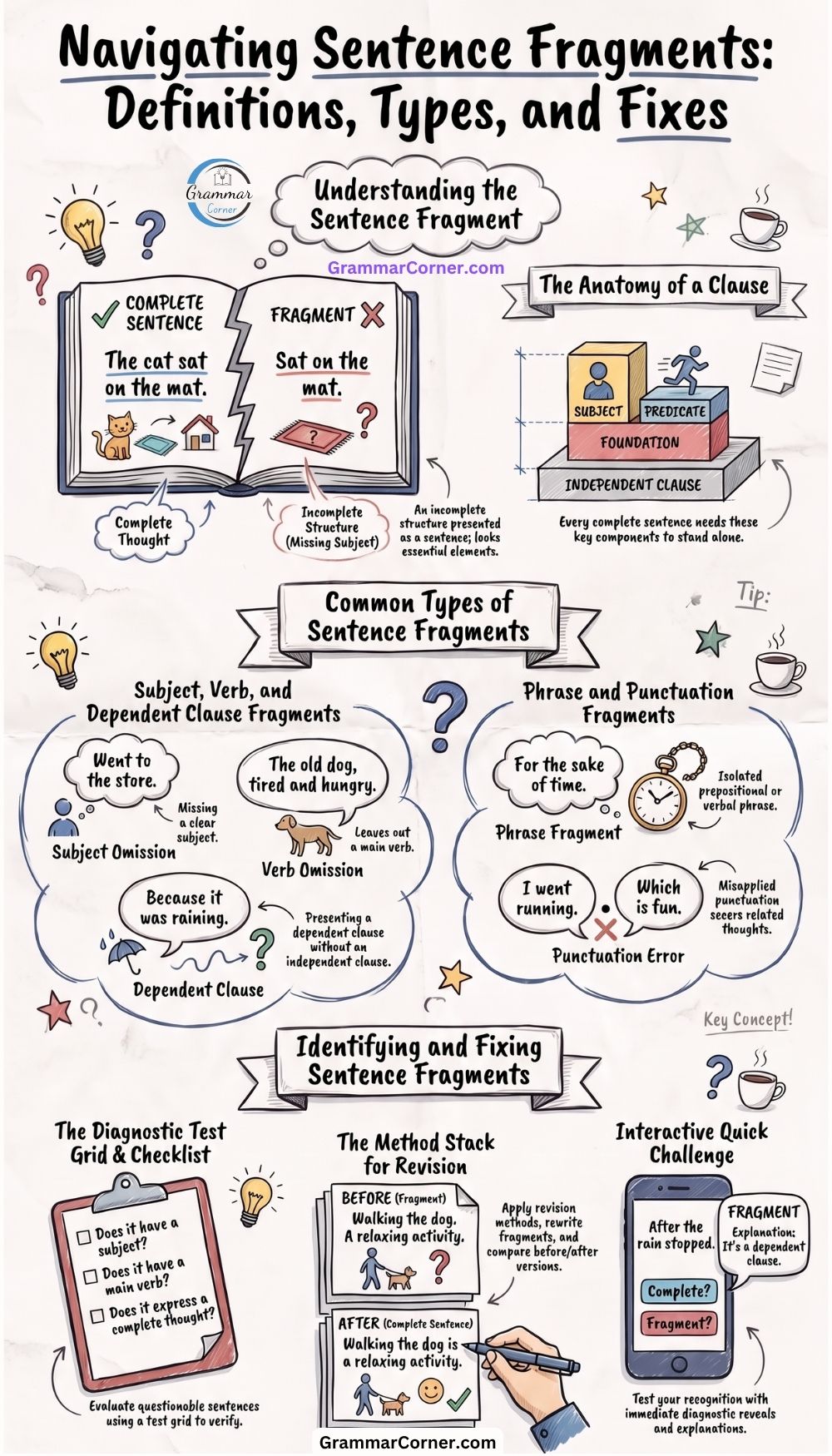
A sentence fragment is a group of words that looks like a sentence—beginning with a capital letter and ending with punctuation—but does not express a complete thought.
Examining the Missing Piece
Consider this example:
Even though it starts with a capital letter and ends with a period, something essential is missing. The reader is left waiting and naturally asks: “What happened after the long journey?”
Now compare it with a complete thought:
The second example provides the main clause to complete the thought, whereas the first remains disconnected as a sentence fragment.
Why Do Sentence Fragments Occur?
Sentence fragments are among the most frequent writing errors in English. They usually happen when writers:
- Accidentally detach a dependent clause or prepositional phrase from the main sentence it belongs to.
- Omit a key grammatical component, such as the subject.
- Leave out a complete finite verb or use only a partial verb form.
✨ Quick Challenge
Three of the options below are sentence fragments. Tap the only complete sentence that expresses a finished thought.
See the full answer
Answer: “The team completed the project on time.”
Breakdown of complete sentence criteria:
- Complete Sentence: “The team completed the project on time.” ➔ Subject (The team) + Finite Verb (completed) + Complete Standalone Thought.
- Fragments: Dependent clauses introduced by subordinators (Because…, Although…) and detached participle phrases (Walking through…) cannot stand alone as independent sentences.
What Does a Complete Sentence Need?
Before learning how to identify fragments, it is essential to understand what structural elements combine to form a complete, grammatically sound sentence.
| Element | What It Does | Example |
|---|---|---|
| Subject | Tells who or what the sentence is about | The students |
| Verb (Predicate) | Shows an action, occurrence, or state of being | studied |
| Complete Thought | Expresses a finished, standalone meaning | The students studied. |
| Independent Clause | Forms a grammatical unit that can stand alone | The students studied. |
A complete sentence does not need to be long or packed with descriptive modifiers. Even a two-word sentence can be 100% grammatically complete:
This is a complete sentence. It contains a subject (birds), a finite verb (fly), and delivers a complete, finished thought.
What Is an Independent Clause?
An independent clause is a group of words containing a subject and a verb that expresses a complete thought. Because it makes sense entirely on its own, it can stand as a full sentence.
Examples of Independent Clauses
Every complete sentence must contain at least one independent clause:
- The baby is sleeping.
- My brother plays cricket.
- We finished the project.
- The train arrived late.
- Julia opened the door.
Sentence Fragment vs. Complete Sentence
Fragments leave the reader waiting for additional information because an essential element—a subject, a verb, or the independent clause itself—is missing.
| ❌ Sentence Fragment (Incomplete) | ✅ Complete Sentence |
|---|---|
| After the meeting. | After the meeting, we went home. |
| Running through the park. | The children were running through the park. |
| The old house near the river. | The old house near the river looked abandoned. |
| Because she was tired. | Because she was tired, she went to bed early. |
| Finished the assignment. | Ali finished the assignment. |
What Are the Types of Sentence Fragments?
Sentence fragments occur for specific, identifiable grammatical reasons. The most common varieties include:
1. Sentence Fragments Missing a Subject
A complete sentence must clearly tell the reader who or what is performing the action. When the subject is omitted, the predicate is left hanging without an actor.
Question: Who went to the market? The subject is entirely missing.
More Missing Subject Examples
| ❌ Fragment (Missing Subject) | ✅ Corrected Sentence |
|---|---|
| Walked to school this morning. | My sister walked to school this morning. |
| Bought a new laptop yesterday. | Ahmed bought a new laptop yesterday. |
| Forgot to bring the books. | I forgot to bring the books. |
| Arrived late for the meeting. | The manager arrived late for the meeting. |
2. Sentence Fragments Missing a Verb
A group of words may establish a clear subject or noun phrase, but fail to provide a complete main verb (predicate) showing what the subject does or what happens to it.
We know who the subject is, but what did they do? What state are they in?
More Missing Verb Examples
| ❌ Fragment (Missing Verb) | ✅ Corrected Sentence |
|---|---|
| The new restaurant downtown. | The new restaurant downtown opens tomorrow. |
| My favorite book on the shelf. | My favorite book on the shelf belongs to my sister. |
| The students from our school. | The students from our school won the competition. |
| A beautiful garden behind the house. | A beautiful garden behind the house attracts many visitors. |
3. Dependent Clause Fragments
One of the most common sentence errors occurs when a dependent clause (subordinate clause) is punctuated as if it were a full sentence. A dependent clause contains both a subject and a verb, but it begins with a subordinating conjunction that prevents it from expressing a complete thought on its own.
The reader is left asking: “Because the weather was cold… what happened next?”
Words That Commonly Introduce Dependent Clauses
Subordinating words signal that a clause cannot stand alone without an accompanying independent clause:
| Subordinating Word | Example of an Incomplete Fragment |
|---|---|
| because | Because I was tired. |
| although | Although she tried. |
| when | When the teacher arrived. |
| while | While we were eating. |
| after | After the movie ended. |
| before | Before the guests arrived. |
| if | If the weather improves. |
| unless | Unless you call me. |
| since | Since he moved away. |
| until | Until the rain stops. |
Comparing Incomplete Dependent Clauses vs. Complete Sentences
4. Phrase Fragments
A phrase is a group of related words that lacks either a subject, a finite verb, or both. When a standalone phrase is punctuated with a capital letter and a period as if it were a complete sentence, it becomes a phrase fragment.
- Under the old bridge.
- After several hours of waiting.
- Running through the rain.
- The large house on the hill.
None of these phrases expresses a complete thought on its own.
Correcting Phrase Fragments
You can repair a phrase fragment either by adding the missing subject and verb or by attaching the phrase to an independent clause:
5. Participle Phrase Fragments
Participle phrases begin with words ending in -ing (present participles) or -ed / irregular forms (past participles). These are frequently mistaken for complete sentences because verbals look like true verbs, but they lack a subject and an auxiliary verb.
Question: Who was walking? The subject and helping verb are missing.
Question: Who was exhausted?
6. Infinitive Fragments
An infinitive consists of to + base verb (such as to run, to finish, to understand). Infinitives describe an action or purpose, but they cannot function as the main predicate of a standalone sentence.
Does not tell the reader what action occurred to fulfill that goal.
7. Fragments Caused by Incorrect Punctuation
Sometimes all the necessary words for a complete thought are already written, but an misplaced period cuts a dependent element off from its independent partner.
The period prematurely cuts off the dependent clause starting with Because.
How to Identify a Sentence Fragment
You can quickly diagnose whether a group of words is a complete sentence or an incomplete fragment using a simple four-question diagnostic test:
Ask: Who or what is the sentence about?
Ask: What is the subject doing or what happened to it?
Ask: Can this group of words stand alone?
Read aloud naturally:
A Quick Checklist for Sentence Fragments
Keep this checklist on hand when proofreading your writing:
How to Fix a Sentence Fragment
Because fragments occur for different reasons, the right fix depends directly on what is missing from the clause:
Supply the missing noun or pronoun that performs the action.
Add a main verb or complete predicate showing the action or state of being.
Attach the dependent clause or phrase directly to the main clause it modifies.
Drop the subordinating conjunction to convert the dependent clause into an independent sentence.
Rejoin introductory phrases or clauses that were mistakenly cut off by a period.
Sentence Fragment Examples and Corrections at a Glance
| ❌ Fragment | Why It Is a Fragment | ✅ Corrected Version |
|---|---|---|
| Walking along the beach. | No clear subject or auxiliary verb | We were walking along the beach. |
| The tall building near the station. | Missing main verb/predicate | The tall building near the station was empty. |
| Because she was late. | Standalone dependent clause | Because she was late, she missed the meeting. |
| Went home early. | Missing subject | I went home early. |
| After the storm ended. | Standalone dependent clause | After the storm ended, the workers returned. |
| To complete the assignment before Monday. | Infinitive phrase without a main clause | He stayed up late to complete the assignment before Monday. |
| Under the table. | Prepositional phrase without subject or verb | The cat was hiding under the table. |
Sentence Fragment vs. Complete Sentence
Examining direct side-by-side comparisons reveals exactly why a fragment fails and how adding an independent clause resolves it into a complete thought:
Notice that in every single corrected example, the sentence now contains at least one independent clause that can stand alone.
Sentence Fragment vs. Run-On Sentence
Sentence fragments and run-on sentences sit on opposite sides of sentence construction errors:
- Fragment: Contains not enough grammatical structure (an incomplete thought).
- Run-On: Contains too many complete thoughts jammed together without proper punctuation.
| Error Type | Example Sentence | Core Grammatical Problem |
|---|---|---|
| Fragment | Because it was raining. | Incomplete thought; leaves the idea unfinished. |
| Run-On (Fused) | It was raining we stayed inside. | Two complete clauses joined with zero punctuation. |
| Comma Splice | It was raining, we stayed inside. | Two independent clauses joined only by a comma. |
| Correct Sentence | Because it was raining, we stayed inside. | Complete, balanced, and properly connected. |
Sentence Fragment vs. Phrase
A phrase by itself is not an error—it is simply a natural grammatical building block (such as “in the morning” or “under the table”).
A phrase becomes an error only when a writer punctures and capitalizes it as if it were a standalone sentence (“In the morning.”). In formal writing, phrases must be embedded within a complete clause:
Are Sentence Fragments Always Wrong?
Not necessarily. Context and intent make all the difference:
- Formal Writing (Academic, Business, Professional): Fragments are considered serious errors and should be strictly avoided.
- Creative & Informal Writing (Headlines, Fiction, Dialogue): Writers frequently use intentional fragments to create punchy rhythm, emphasis, or casual realism.
Common conversational and stylistic fragments include:
Intentional Sentence Fragments in Creative Writing
Authors and creative writers often harness deliberate fragments to evoke specific artistic effects:
Gives an isolated statement immense dramatic weight and focus.
Mimics the natural pauses and second-guessing of a character’s thoughts.
Leaves the reader in suspense, actively wondering what lies ahead.
“Home.”
Reflects natural human speech, where full grammatical clauses are often dropped.
Common Causes of Sentence Fragments
Understanding why fragments occur during drafting makes identifying and eliminating them much easier. Most fragments stem from five typical errors:
Placing a period between a subordinating clause and the main clause.
Assuming the reader already knows who performed the action.
Providing a subject phrase without completing the action or predicate.
Treating a prepositional or descriptive phrase as a complete sentence.
Dropping a period before the core idea finishes unfolding.
How to Avoid Sentence Fragments
Incorporate these core proofreading habits into your writing routine to catch fragments early:
Ask: “Who or what is this about?” followed by “What did they do or what state are they in?”
Words like because, although, when, while, after, before, if, unless, since, and until introduce dependent clauses. Ensure the sentence finishes with a complete independent clause.
Short sentences aren’t automatically wrong, but isolated phrases like “After lunch.” or “Running quickly.” require extra attention.
Fragments often “sound” complete because your brain pulls context from the previous sentence. Cover the surrounding text and test if the sentence makes sense completely on its own.
How to Proofread for Sentence Fragments
Use this systematic 3-step evaluation technique on any sentence you suspect might be incomplete:
• Meaning Check: The word because signals a reason, but the sentence stops before explaining what happened as a result!
A Useful Trick: The “What Happened?” Test
One of the fastest ways to expose a hidden fragment is to read the phrase and immediately ask: “What happened?”
✨ Quick Challenge
Apply the proofreading checklist and “What Happened?” test: Which option is a sentence fragment caused by a detached dependent clause? Tap your answer.
See the full answer
Answer: “Since the manager approved the revised project budget.”
Applying the 3-step proofreading evaluation:
- Step 1 (Subject): the manager
- Step 2 (Verb): approved
- Step 3 (Complete Thought Test): The subordinating conjunction Since makes the entire statement a dependent clause. Reading it in isolation fails the “What Happened?” test because the consequence is missing.
- Correction: Connect it to an independent clause: “Since the manager approved the revised project budget, we purchased the new equipment.“
Common Mistakes When Correcting Fragments
Fixing a fragment requires restoring structural elements rather than merely adjusting surface mechanics. Watch out for these four frequent correction pitfalls:
Capitalizing the first letter does not transform an incomplete thought into a full sentence.
Placing a period at the end of a phrase does not supply the missing main clause.
Inserting a noun or pronoun awkwardly before a subordinating clause leaves it ungrammatical.
Simply dropping punctuation without using standard comma placement creates poorly formatted clauses.
Sentence Fragment Examples for Students
Here are common fragment patterns alongside their complete grammatical revisions:
| ❌ Fragment | ✅ Complete Sentence |
|---|---|
| Because I was sick. | Because I was sick, I stayed home. |
| Running through the field. | The children were running through the field. |
| The boy with the red backpack. | The boy with the red backpack is my brother. |
| Went to the library after school. | I went to the library after school. |
| Before the sun came up. | We left before the sun came up. |
| To finish the assignment. | She stayed late to finish the assignment. |
| Although it was difficult. | Although it was difficult, he completed the task. |
| Near the old railway station. | We found a small café near the old railway station. |
Practice Exercises
Exercise 1: Is It a Fragment?
Determine whether each example is a complete sentence or a sentence fragment:
- The children played in the garden.
- After the children finished lunch.
- My father repaired the bicycle.
- Running across the field.
- Because the store was closed.
- We returned home early.
- The large house on the corner.
- She finished her homework before dinner.
- Went to the market yesterday.
- Although he was tired, he continued working.
| No. | Classification |
|---|---|
| 1 | Complete sentence |
| 2 | Fragment (Dependent clause) |
| 3 | Complete sentence |
| 4 | Fragment (Participle phrase) |
| 5 | Fragment (Dependent clause) |
| 6 | Complete sentence |
| 7 | Fragment (Noun phrase lacking a verb) |
| 8 | Complete sentence |
| 9 | Fragment (Missing subject) |
| 10 | Complete sentence |
Exercise 2: Correct the Fragments
Rewrite each fragment as a complete sentence:
- After the rain stopped. → After the rain stopped, we went outside.
- Walking to school. → I was walking to school.
- The old man near the gate. → The old man near the gate was waiting for someone.
- Because she missed the bus. → Because she missed the bus, she arrived late.
- Forgot to lock the door. → I forgot to lock the door.
- Under the large tree. → The children were sitting under the large tree.
Exercise 3: Find the Missing Element
Identify what is structurally missing from each fragment:
| Fragment | Missing Component |
|---|---|
| Went to the doctor yesterday. | Subject |
| The tall building near the river. | Main verb / Predicate |
| Because the children were tired. | Independent clause / Completion of thought |
| Running through the rain. | Subject and complete main clause |
| After several hours of waiting. | Independent clause / Completion of thought |
Exercise 4: Join the Fragment to the Correct Sentence
Combine each pair into a unified complete sentence:
- Because the weather was cold. / We stayed indoors.
→ Because the weather was cold, we stayed indoors. - After the movie ended. / We went to a restaurant.
→ After the movie ended, we went to a restaurant. - Although she was nervous. / She gave an excellent speech.
→ Although she was nervous, she gave an excellent speech.
Quick Reference: Sentence Fragments at a Glance
| Fragment Type | Fragment Example | Corrected Version |
|---|---|---|
| Missing Subject | Went home early. | I went home early. |
| Missing Verb | The old house near the river. | The old house near the river was abandoned. |
| Dependent Clause | Because I was tired. | Because I was tired, I went to bed. |
| Prepositional Phrase | Under the table. | The cat was hiding under the table. |
| Participle Phrase | Running through the park. | The children were running through the park. |
| Infinitive Phrase | To finish the work. | She stayed late to finish the work. |
| Incorrectly Separated Clause | When the bell rang. The students left. | When the bell rang, the students left. |
Frequently Asked Questions About Sentence Fragments
• Subject: she | Verb: was
• Fragment reason: “Although” makes the clause dependent, leaving the reader waiting for the final outcome.
- Fragment: Has too little information (lacks an independent clause or complete thought).
- Run-on: Has too many independent clauses jammed together without correct punctuation or conjunctions.
- Add the missing subject or main verb.
- Connect the dependent fragment to an adjacent independent clause.
- Remove the subordinating word to make the clause independent.
- Completely rewrite and restructure the thought into a complete sentence.