Interrogative Sentences (Structure, Types & Examples)
What Is an Interrogative Sentence?
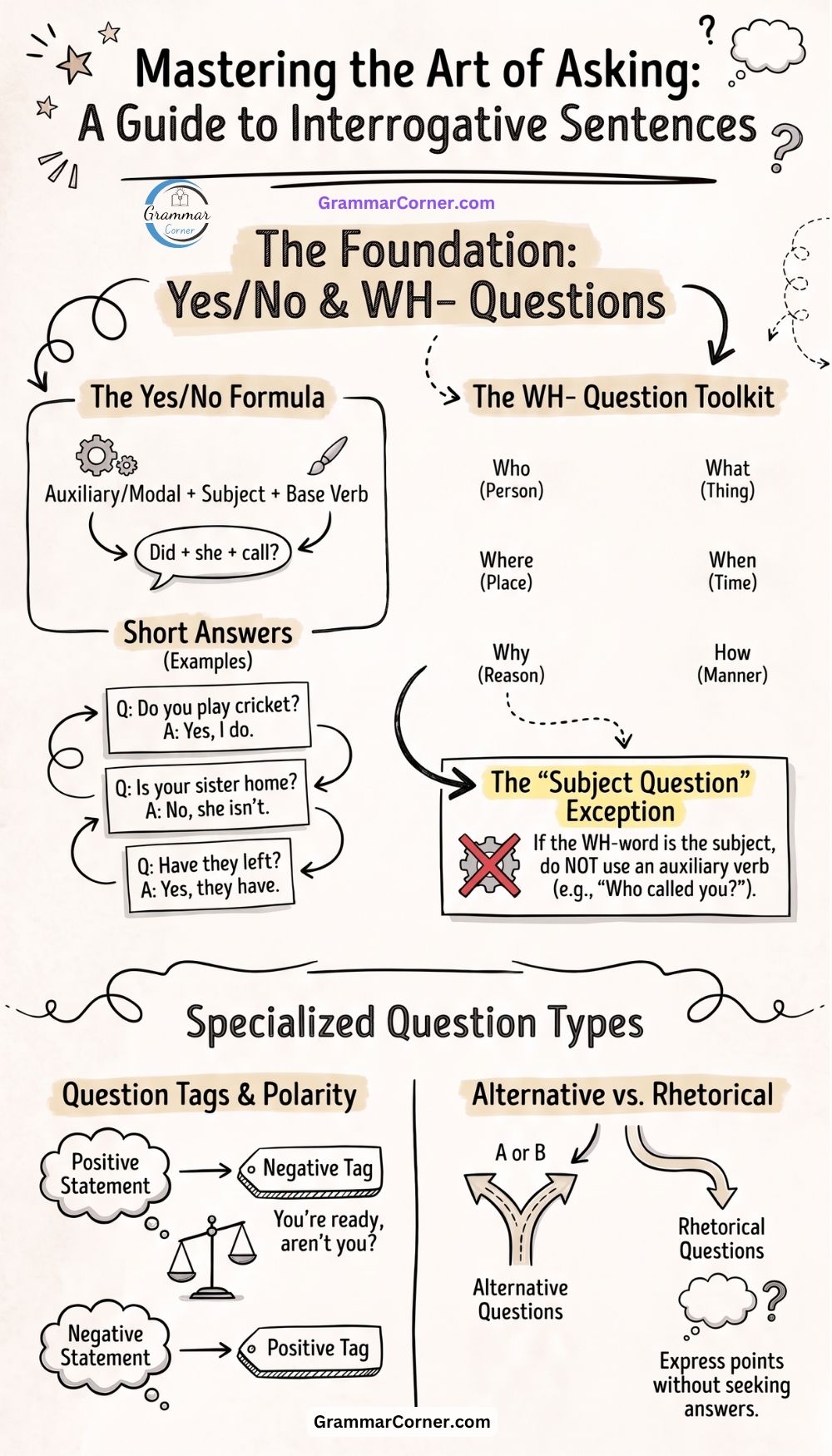
An interrogative sentence is a sentence that asks a question. It is usually used when the speaker or writer wants an answer, information, confirmation, or clarification. Interrogative sentences standardly end with a question mark (?).
From a simple question such as “Are you ready?” to a more detailed query like “Why did the meeting start late?”, interrogative sentences are an essential part of everyday English communication.
To master the proper use of interrogative sentences, it is important to understand their basic word patterns. In this comprehensive guide, you will learn how interrogative sentences are structured, the primary types of questions, how to form questions across different tenses, and common errors to avoid.
Common Examples of Interrogative Sentences
- Where do you live?
- Are you ready for the test?
- Why did Anna leave early?
- Have they arrived?
- Which dress do you prefer?
How Answers to Interrogative Sentences Function
The response to an interrogative sentence may vary depending on the depth of information requested. Answers can range from a single word or phrase to a complete sentence or detailed explanation:
✨ Quick Challenge
Which of the following sentences functions as a direct interrogative sentence asking for information or confirmation? Tap your answer.
See the full answer
Answer: “Did the manager approve the updated project schedule?”
Distinguishing direct interrogative sentences:
- Direct Interrogative Sentence: Inverts the auxiliary verb and subject (“Did the manager approve…”) to ask a direct question and ends with a question mark (?).
- Indirect Questions & Declaratives: Sentences starting with “I wonder…” or “Please let me know…” are declarative or imperative structures that embed question content without forming a direct interrogative clause.
What Does “Interrogative” Mean?
The word interrogative relates directly to asking questions. In English grammar, it describes a specific category of sentence, clause, or word used to inquire about something.
Interrogative = Related to asking a question.
An interrogative sentence is simply a question expressed as a complete grammatical structure.
Why Do We Use Interrogative Sentences?
Asking questions is not limited to gathering facts. We use interrogative sentences for a wide variety of communicative purposes in everyday spoken and written English:
The most common reason for asking a question.
- Where does your brother work?
- When does the course begin?
- Who opened the door?
Used to clear up uncertainty or misunderstanding.
- What do you mean by that?
- Could you explain this part again?
- Which document are you talking about?
Used to double-check something suspected or believed.
- Is this your notebook?
- Did you send the email?
- Are we meeting at five?
Phrased as polite questions instead of direct commands.
- Could you open the window?
- Would you help me with this box?
- Can you send me the file?
Presents two or more alternatives to the listener.
- Would you like tea or coffee?
- Are you traveling by bus or train?
- Should we meet today or tomorrow?
Helps initiate or maintain friendly dialogue.
- How was your weekend?
- What did you think of the movie?
- Where are you planning to go next?
What Is the Structure of an Interrogative Sentence?
The grammatical structure of an interrogative sentence shifts based on the question type and the specific verb form being used.
A standard interrogative pattern relies on subject-auxiliary inversion:
When asking for specific information, question words (what, where, when, why, who, which, whose, how) lead the sentence:
Quick Structural Breakdown Table
| Question Pattern | Structure | Example |
|---|---|---|
| Yes/No question | Auxiliary + subject + main verb + …? | Did you call him? |
| WH-question | WH-word + auxiliary + subject + main verb + …? | Where did you go? |
| Verb be question | Be + subject + …? | Are they ready? |
| WH-question with be | WH-word + be + subject + …? | Where are they? |
| Modal question | Modal + subject + main verb + …? | Can you drive? |
| Choice question | Auxiliary + subject + verb + choice A or choice B? | Do you want tea or coffee? |
Why Does the Word Order Change in Questions?
One of the most defining features of English questions is the shift in word order between a statement and a query. This shift is known grammatically as subject-auxiliary inversion.
Subject-auxiliary inversion is one of the most critical structural rules to master when learning to build natural English questions.
What Are the Types of Interrogative Sentences?
Interrogative sentences are classified primarily by their grammatical structures and the type of answer they solicit. The three primary question categories are Yes/No questions, WH-questions, and Choice questions, alongside special forms like Tag questions and Rhetorical questions.
A yes/no question is a query that can normally be answered with a simple affirmative or negative response. These questions consistently begin with an auxiliary verb, a modal verb, or a form of be.
- Do you like music?
- Is the door locked?
- Did they arrive safely?
- Have you finished the report?
- Can she speak Spanish?
- Will you attend the meeting?
Structure of Yes/No Questions
| Verb Type | Basic Pattern | Example |
|---|---|---|
| Do/Does | Do/Does + subject + base verb…? | Does he work here? |
| Did | Did + subject + base verb…? | Did she call you? |
| Be | Am/Is/Are/Was/Were + subject + …? | Were they late? |
| Have/Has/Had | Have/Has/Had + subject + past participle…? | Has he finished? |
| Modal | Modal + subject + base verb…? | Could you help me? |
Examples With Short Answers
Short answers usually repeat the auxiliary or modal verb used in the question.
WH-questions request specific details rather than a simple yes-or-no response.
| Question Word | Usually Asks About | Example |
|---|---|---|
| Who | Person | Who called you? |
| What | Thing or information | What happened? |
| Where | Place | Where do they live? |
| When | Time | When will the class begin? |
| Why | Reason | Why are you laughing? |
| Which | Choice from a limited group | Which book do you want? |
| Whose | Possession | Whose bag is this? |
| How | Manner, condition, degree, or amount | How did you solve it? |
WH-Question Structure
- Why + did + she + leave + early?
- Where + are + the students + going?
What Is a Subject Question?
When the question word itself (like who or what) functions as the subject of the sentence, do not insert auxiliary verbs like do, does, or did.
| Type | Structure | Example |
|---|---|---|
| Question word as object | WH-word + auxiliary + subject + verb | Who did you invite? |
| Question word as subject | WH-word + verb + rest | Who invited you? |
✅ Correct: Who called you?
A choice question presents two or more options to the listener, joined by the coordinating conjunction or.
- Would you like coffee or tea?
- Are you staying here or going home?
- Did Maria buy the red shirt or the blue one?
- Should we leave now or wait?
Structure Breakdown
| Part | Example Element |
|---|---|
| Auxiliary | Did |
| Subject | Ahmed |
| Main Verb | choose |
| Choice A | the morning flight |
| Connector | or |
| Choice B | the evening flight |
| Complete Question | Did Ahmed choose the morning flight or the evening flight? |
A tag question is a short question appended to the end of a statement, primarily used to confirm information or invite agreement.
- You finished the assignment, didn’t you?
- She is coming with us, isn’t she?
- They haven’t left yet, have they?
- He can drive, can’t he?
A rhetorical question is asked to emphasize a point, express emotion, persuade, or provoke thought, without expecting a literal answer.
- Who doesn’t want to succeed?
- How could anyone forget such a day?
- What could be more important than your health?
Information vs. Rhetorical Questions
Interrogative Sentences in Different Tenses
Questions can be formed in almost every English tense. The key to mastering tenses in questions is locating the specific auxiliary verb required by the tense, moving it before the subject, and keeping the main verb in its correct form.
| Tense | Question Pattern | Example |
|---|---|---|
| Simple Present | Do/Does + subject + base verb…? | Does she work here? |
| Present Continuous | Am/Is/Are + subject + verb-ing…? | Are they waiting? |
| Present Perfect | Have/Has + subject + past participle…? | Have you finished? |
| Present Perfect Continuous | Have/Has + subject + been + verb-ing…? | Has he been studying? |
| Simple Past | Did + subject + base verb…? | Did you see him? |
| Past Continuous | Was/Were + subject + verb-ing…? | Were they sleeping? |
| Past Perfect | Had + subject + past participle…? | Had she left? |
| Past Perfect Continuous | Had + subject + been + verb-ing…? | Had they been waiting? |
| Simple Future | Will + subject + base verb…? | Will you come? |
| Future Continuous | Will + subject + be + verb-ing…? | Will she be working? |
| Future Perfect | Will + subject + have + past participle…? | Will they have arrived? |
| Future Perfect Continuous | Will + subject + have been + verb-ing…? | Will he have been working? |
How to Form Questions With “Be”
The verb be behaves differently from ordinary main verbs. When am, is, are, was, or were serves as the verb, it shifts directly before the subject without adding dummy auxiliaries.
No do, does, or did is needed when converting “be” statements into questions.
| Statement Form | Interrogative Form |
|---|---|
| He is ready. | Is he ready? |
| They are happy. | Are they happy? |
| She was absent. | Was she absent? |
| We were late. | Were we late? |
How to Form Questions With “Do,” “Does,” and “Did”
When a simple present or simple past sentence relies on an ordinary main verb, English requires do, does, or did to construct the question form.
1. Simple Present Questions
• Use do with I, you, we, and they (e.g., “Do they live here?”).
• Use does with he, she, and it (e.g., “Does she live here?”).
✅ Correct: Does she live here? (Main verb reverts to base form)
2. Simple Past Questions
Use did across all subjects (e.g., “Did you visit Lahore?”).
✅ Correct: Did he go home? (Main verb reverts to base form)
How to Form Negative Interrogative Sentences
Negative questions incorporate a negative contraction or particle (such as not, isn’t, don’t, doesn’t, didn’t, haven’t, or can’t). They are often used to express surprise, expectation, disagreement, or request confirmation.
- Don’t you like this song?
- Isn’t she your teacher?
- Didn’t they receive the message?
- Haven’t you completed the work?
- Can’t we solve this problem?
Direct Questions vs. Indirect Questions
Understanding this distinction is crucial for natural word order in complex sentences:
• Direct Question: Asks something directly and uses standard interrogative word order (“Where does she live?”).
• Indirect Question: Reports or embeds a question inside another clause (“Do you know where she lives?”).
✅ Correct Word Order: Do you know where she lives?
Notice that the embedded section of the indirect question adopts statement-like word order (subject before verb).
Direct and Indirect Questions Compared
| Direct Question | Indirect Question |
|---|---|
| Where is the station? | Could you tell me where the station is? |
| What does he want? | Do you know what he wants? |
| When will they arrive? | I wonder when they will arrive. |
| Why did she leave? | Can you explain why she left? |
Does an Indirect Question Always Need a Question Mark?
No. The punctuation depends on whether the outer introductory clause is a question or a statement:
Interrogative Sentences and Question Marks
A standard direct interrogative sentence always ends with a question mark (?).
- Where are you going?
- Did you lock the door?
- Who is responsible for this?
- Can we start now?
However, a question mark should not be added simply because a sentence contains an indirect question embedded within it.
The sentence above is functionally a statement, not a direct question, so it requires a period.
Can an Interrogative Sentence Be Positive or Negative?
Yes. Interrogative sentences can take either a positive or negative grammatical form.
- Do you understand the lesson?
- Are they coming tonight?
- Did she finish the project?
- Don’t you understand the lesson?
- Aren’t they coming tonight?
- Didn’t she finish the project?
The distinction goes beyond grammar: negative questions often carry strong expectation, surprise, or emotion.
How Interrogative Sentences Are Used in Everyday English
Questions form the backbone of interactive communication across almost every social and professional context:
- Have you completed the exercise?
- What does this word mean?
- Who can answer the question?
- Why did you choose this answer?
- When is the meeting scheduled?
- Have you sent the report?
- Could you explain this figure?
- Which proposal should we discuss first?
- How was your day?
- Where are you going?
- What are you cooking?
- Do you need any help?
- Where is the nearest bank?
- How can I get to the bus station?
- Which road leads to the airport?
- Could you pass me the salt?
- Would you please wait here?
- Can you help me carry this?
Common Mistakes in Interrogative Sentences
Even after learning the core rules, English learners often encounter pitfalls with word order or auxiliary verbs when forming questions.
✅ Correct: Where are you going?
In standard WH-questions, the auxiliary or form of be must come before the subject.
✅ Correct: Did she go to school?
Because did already carries past tense, the main verb must remain in its base form.
✅ Correct: Does he like football?
After does, always revert the main verb to its base form without -s.
✅ Correct: Are you tired?
The verb be forms questions independently by inverting before the subject without dummy auxiliaries.
✅ Correct: Can you tell me where the bank is?
Embedded questions inside indirect requests require statement word order (subject before verb).
✅ Correct: Where are you going?
Direct interrogative sentences must end with a question mark.
✅ Correct: I don’t know where she lives.
Outer statement clauses containing indirect questions terminate with a period, not a question mark.
Interrogative vs. Declarative, Imperative, and Exclamatory Sentences
English categorizes sentences into four primary types based on their fundamental communicative purpose:
| Sentence Type | Main Purpose | Example |
|---|---|---|
| Declarative | Makes a statement | She works at a bank. |
| Interrogative | Asks a question | Does she work at a bank? |
| Imperative | Gives a command or instruction | Open the door. |
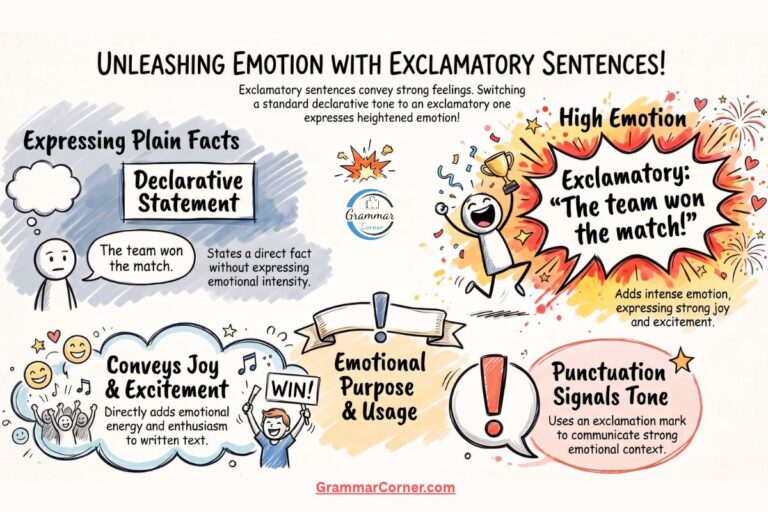
| Exclamatory | Expresses strong feeling | What a beautiful view! |
• Statement? → Declarative
• Question? → Interrogative
• Command or instruction? → Imperative
• Strong emotion? → Exclamatory
How to Identify an Interrogative Sentence
You can quickly confirm whether a sentence is interrogative by running these checks:
- 🔹 Does the sentence ask something?
- 🔹 Is it looking for information, confirmation, or a response?
- 🔹 Does it use question word order or another recognized question structure?
- 🔹 Does it standardly end with a question mark?
Example: “Where did you put my keys?”
It requests specific information, follows inverted WH-question word order, and ends with a question mark. Therefore, it is definitely an interrogative sentence.
Quick Comparison: Question Types
| Type | Main Purpose | Typical Answer | Example |
|---|---|---|---|
| Yes/No | Check whether something is true | Yes / No | Are you ready? |
| WH-question | Obtain specific information | Details / Explanation | Where do you live? |
| Choice question | Select between alternatives | One of the choices | Tea or coffee? |
| Tag question | Confirm information | Short confirmation | You’re coming, aren’t you? |
| Rhetorical question | Make a point or express an idea | None expected | Who would believe that? |
How to Change a Statement Into an Interrogative Sentence
Transforming a declarative statement into a question depends primarily on the verb type and tense:
A Simple Method for Forming Interrogative Sentences
Whenever you need to convert a statement into an interrogative sentence, follow these six straightforward steps:
Interrogative Sentence Examples
Here is a categorized collection of interrogative sentences illustrating various question structures:
- Are you feeling better?
- Did Mark call this morning?
- Have they finished the project?
- Can your brother drive?
- Will you attend the ceremony?
- What are you reading?
- Where did they go?
- Why is the machine not working?
- When will the results be announced?
- Who prepared this report?
- Which route should we take?
- Whose phone is ringing?
- How did you solve the problem?
- Do you want rice or noodles?
- Should we leave now or later?
- Is the meeting on Monday or Tuesday?
- Would you rather walk or take a taxi?
- Don’t you need a pen?
- Isn’t this your seat?
- Didn’t they tell you about the change?
- Haven’t you seen this movie?
- You know him, don’t you?
- She isn’t coming, is she?
- They have finished, haven’t they?
- He can help us, can’t he?
✨ Quick Challenge
Which of the following correctly transforms the statement “Marcus submitted the final report yesterday” into an interrogative sentence? Tap your answer.
See the full answer
Answer: “Did Marcus submit the final report yesterday?”
Transformation breakdown using the 6-step method:
- Step 1 & 2 (Verb & Tense): The verb is submitted (Simple Past).
- Step 3 (Auxiliary Inversion): Introduce the past auxiliary Did before the subject (Marcus).
- Step 5 (Base Verb Check): Revert submitted back to its base form: submit.
- Step 6 (Punctuation): End with a question mark (?).
Interrogative Sentence Practice
Test your skills! Practice converting declarative statements into correct interrogative sentences.
- She works in a hospital.
- They were waiting outside.
- He finished the assignment.
- You have seen this film.
- Sarah can speak German.
- The children are sleeping.
- We will meet tomorrow.
- Ahmed bought a new laptop.
- She has completed the project.
- They live near the school.
Answer Key
| No. | Declarative Statement | Interrogative Transformation |
|---|---|---|
| 1 | She works in a hospital. | Does she work in a hospital? |
| 2 | They were waiting outside. | Were they waiting outside? |
| 3 | He finished the assignment. | Did he finish the assignment? |
| 4 | You have seen this film. | Have you seen this film? |
| 5 | Sarah can speak German. | Can Sarah speak German? |
| 6 | The children are sleeping. | Are the children sleeping? |
| 7 | We will meet tomorrow. | Will we meet tomorrow? |
| 8 | Ahmed bought a new laptop. | Did Ahmed buy a new laptop? |
| 9 | She has completed the project. | Has she completed the project? |
| 10 | They live near the school. | Do they live near the school? |
Choose the Correct Interrogative Sentence
Frequently Asked Questions About Interrogative Sentences
Auxiliary + subject + main verb + rest?For a WH-question, the pattern is:
WH-word + auxiliary + subject + main verb + rest?The exact structure shifts based on tense and question type.
• Isn’t she coming with us?
• Haven’t they finished yet?