Active Sentences (Structure & Examples)
Understanding Active Voice
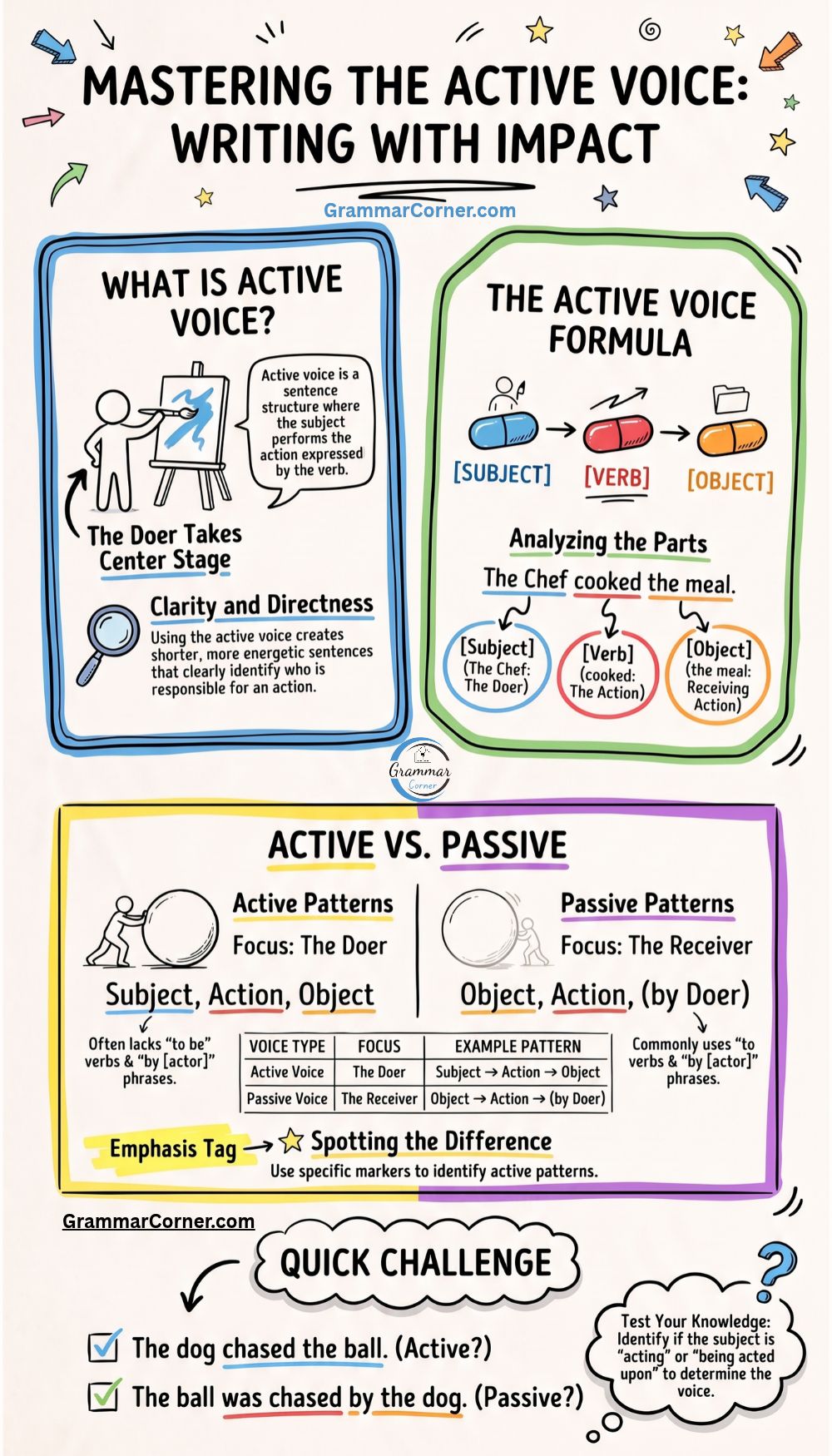
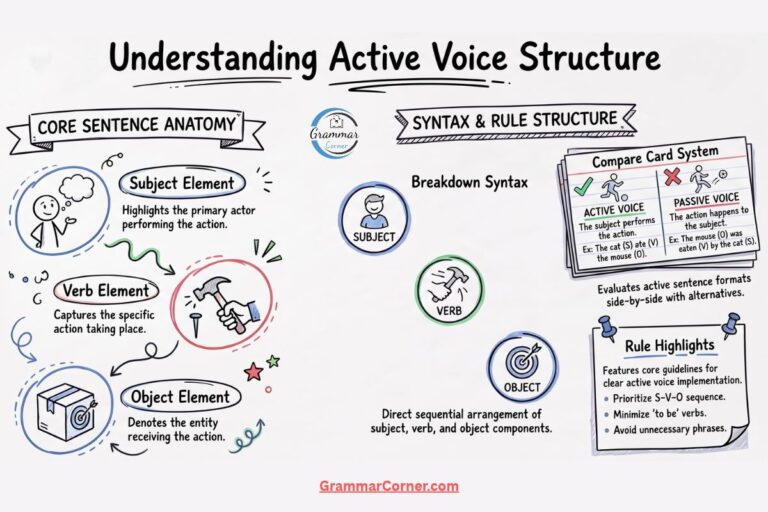
An active sentence is built on a direct relationship between the actor and the action. It informs the reader exactly who or what is performing the task.
In an active sentence, the person, thing, or idea doing the action functions as the subject, and the verb clearly tells us what that subject does.
Example:
• Explained is the action being performed.
This direct arrangement—where the subject acts upon the object—is the signature feature of the active voice.
Why Use Active Voice?
Active sentences are the standard in everyday English. They are generally preferred because they make your writing:
- Clear: The reader immediately knows who is responsible for the action.
- Direct: Sentences are usually shorter and punchier.
- Easy to Follow: The logical flow helps readers process information quickly.
✨ Quick Challenge
Which of the following sentences is written in the active voice (where the subject directly performs the action)? Tap your answer.
See the full answer
Answer: “The research team prepared the final report.”
In active voice sentences, the grammatical subject is the entity performing the action:
- Subject (Actor): The research team
- Verb (Action): prepared
- Object (Receiver): the final report
What Is an Active Sentence?
In an active sentence, the subject is the “doer”—it performs the action expressed by the verb. This creates a direct, punchy flow that helps the reader instantly understand who is responsible for the action.
Consider this sentence:
- The boy: Subject (The actor)
- Opened: Verb (The action)
- The window: Object (The receiver)
Since the boy is performing the action, the sentence is active. Compare this to the passive version: “The window was opened by the boy.” Here, the focus shifts to the object, making the sentence passive.
A Simple Way to Recognize Active Voice
You don’t need complex grammatical analysis to identify the voice. Just ask one question:
“Who or what is doing the action?”
If the subject of your sentence is the one answering that question, your sentence is active.
| Sentence | Who performs the action? | Voice |
|---|---|---|
| The chef prepared the meal. | The chef | Active |
| Sara answered the question. | Sara | Active |
| The dog chased the cat. | The dog | Active |
| The meal was prepared by the chef. | The chef | Passive |
| The question was answered by Sara. | Sara | Passive |
Active Sentence Structure
The most recognizable pattern in English is the Subject + Verb + Object (SVO) pattern. This direct arrangement clearly maps out who is doing what to whom.
“The student completed the assignment.”
Common Active Sentence Patterns
| Pattern | Example |
|---|---|
| Subject + Verb | Birds fly. |
| Subject + Verb + Object | Ali opened the door. |
| Subject + Verb + Complement | Maria is happy. |
| Subject + Verb + Indirect Obj + Direct Obj | Dad gave me a gift. |
| Subject + Verb + Object + Complement | The committee elected Sara president. |
Note: Not every active sentence requires an object. In the sentence “The baby slept,” the subject performs the action, but there is no receiver. The essential rule remains: The subject must be the doer of the verb.
The Three Main Parts of an Active Sentence
When using a transitive verb (an action directed toward someone or something), you can break the sentence down into three functional roles:
“The mechanic repaired the car.”
- Subject (The Doer): The mechanic — The person performing the action.
- Active Verb (The Action): Repaired — What the subject did.
- Object (The Receiver): The car — The thing receiving the action.
Active Sentences Across Tenses
The relationship between the subject and the verb remains constant regardless of the timeframe. The nurse is always the one performing the action:
| Tense | Example |
|---|---|
| Simple Present | The nurse checks the temperature. |
| Simple Past | The nurse checked the temperature. |
| Simple Future | The nurse will check the temperature. |
| Present Continuous | The nurse is checking the temperature. |
| Present Perfect | The nurse has checked the temperature. |
Active Sentences With Different Sentence Patterns
Active voice is dynamic and flexible. It is not restricted to simple Subject + Verb + Object arrangements, but instead spans multiple underlying structural patterns.
In the example “The students are ready,” the verb are does not describe a physical action performed on an object, but the sentence is still grammatically active. Active voice is defined by the structural relationship between the subject and the verb, not whether a physical movement occurs. Active voice seamlessly applies to verbs expressing states of being or existence.
Active Sentences vs. Passive Sentences
The clearest way to master active voice is by contrasting it directly against the passive voice. The central difference lies in which element takes center stage as the subject:
- In an active sentence, the doer (actor) functions as the subject.
- In a passive sentence, the receiver (target) of the action becomes the subject.
| Active Sentence (Doer = Subject) | Passive Sentence (Receiver = Subject) |
|---|---|
| The chef cooked the meal. | The meal was cooked by the chef. |
| The police arrested the suspect. | The suspect was arrested by the police. |
| The company launched the product. | The product was launched by the company. |
| Maria cleaned the room. | The room was cleaned by Maria. |
| The storm damaged several houses. | Several houses were damaged by the storm. |
Analyzing the Shift
Notice how grammatical responsibility shifts between the two forms:
The subject is the chef, and the subject actively performs the action (cooked).
The subject is now the meal, which passively receives the action.
Active vs. Passive at a Glance
| Feature | Active Voice | Passive Voice |
|---|---|---|
| Main focus | Doer of the action | Receiver of the action |
| Subject role | Performs the action | Receives the action |
| Common pattern | Subject + Verb + Object | Object + be + Past Participle |
| Agent (Doer) | Usually clear & explicit | May be included or omitted |
| Typical effect | Direct and straightforward | Shifts emphasis or conceals doer |
Note: Active voice is not strictly “better” in every situation. Passive voice remains useful when the receiver of the action is the most important element, when the actor is unknown, or when a writer purposefully omits the doer.
Why Are Active Sentences Important?
Active sentences are fundamental to effective communication because they establish an immediate, clear relationship between the subject and the action. Rather than forcing the reader to decode who is doing what, active constructions place the actor directly at the forefront.
Both are grammatically correct. However, the first version immediately highlights the decision-maker and their action, while the second shifts focus to the request itself.
3 Key Advantages of Active Voice
1. Active Sentences Are More Direct
They tell the reader instantly who made a decision or performed an action without dynamic delay.
2. Active Sentences Are More Concise
Active voice eliminates unnecessary wordiness, keeping sentences crisp and easier to parse.
Passive (7 words) “The computer was repaired by the technician.”
3. Active Sentences Make Responsibility Clear
When accountability matters, active constructions explicitly identify the responsible party.
Omitted Responsibility “The policy was changed.” (Who changed it?)
When Should You Use Active Sentences?
Active constructions are best applied whenever clarity, directness, and explicitly assigning responsibility are critical to the message.
| Context | Example | Why It Works |
|---|---|---|
| Instructions | “Open the file and select the correct option.” | Tells the reader exactly what steps to execute. |
| Academic & Educational | “The researchers analyzed the results.” | Clearly credits the people behind the study. |
| Business Writing | “The manager approved the request.” | Establishes authority and decision-making clarity. |
| Storytelling | “The horse jumped over the fence.” | Keeps narrative action moving naturally. |
| Everyday Communication | “I sent the document yesterday.” | Removes ambiguity about who performed the task. |
When Is Passive Voice Better?
While active voice is generally preferred for clarity, treat “use active voice” as a guideline rather than an absolute rule. There are specific strategic situations where passive voice is the superior choice.
| Scenario | Example | Why Use Passive? |
|---|---|---|
| When the Doer Is Unknown | “The window was broken during the night.” | There is no known subject to perform the action. |
| When the Doer Is Unimportant | “The road was repaired last month.” | The completion of the repair matters more than the workers who did it. |
| When the Receiver Is More Important | “Three people were injured in the accident.” | Places immediate focus on the individuals affected. |
| To Avoid Naming the Doer | “Several mistakes were made during the process.” | Diplomatically avoids pointing fingers or assigning direct blame. |
| Impersonal / Scientific Contexts | “The compound was heated to 100°C.” | Maintains a neutral tone where the objective process outweighs the actor. |
How to Change a Passive Sentence Into an Active Sentence
Converting a passive sentence into an active one is a straightforward process. It requires identifying the real actor behind the action and elevating them to the subject position.
The Structural Shift
Compare how the grammatical core moves between the two forms:
“The window was broken by the child.”
“The child broke the window.”
Passive to Active Sentence Conversion Table
Here are clear examples of how passive sentences transform into active constructions when a clear agent (doer) is present:
| Passive Voice | Active Voice |
|---|---|
| The letter was written by Sara. | Sara wrote the letter. |
| The car was repaired by the mechanic. | The mechanic repaired the car. |
| The cake was baked by my sister. | My sister baked the cake. |
| The decision was announced by the director. | The director announced the decision. |
| The students were praised by the teacher. | The teacher praised the students. |
Consider the sentence: “The documents were lost.”
We know what happened, but we do not know who lost them because there is no stated agent. In cases like this, forcing an active conversion requires inventing information that wasn’t in the original text (e.g., guessing who lost them).
Special Active Voice Structures
1. Active Sentences Without an Object
A common misconception is that every active sentence must strictly follow the Subject + Verb + Object (SVO) formula. However, active sentences can feature intransitive verbs where no object receives the action:
“The children laughed.”
The subject (the children) performs the action (laughed), but nothing receives that action. It is still 100% active.
• The birds flew away.
• The audience applauded.
2. Active Sentences With Helping Verbs
The inclusion of auxiliary or helping verbs (like is, are, has, have, will) does not make a sentence passive. What matters is still who is doing the work.
The students are actively performing the action (completing).
The assignment becomes the grammatical subject receiving the action.
3. Active Sentences With Questions
Active voice also occurs in questions. In interrogative sentences, an auxiliary verb often comes first, meaning the subject will not always be the very first word in the sentence.
- “Did Sarah write the report?”
- “Who opened the door?”
- “Will the team finish the project?”
This proves why “the subject always comes first” is an unreliable rule. Always evaluate the grammatical relationship between the subject and the verb rather than word position.
Active Sentences With Imperatives
Commands and instructions often seem to break the rule because they don’t have an explicit subject written out. However, imperative sentences have an understood subject: “You.”
The implied structure is actually: [You] close the door.
Because the understood subject (you) performs the action, commands are grammatically active!
More Imperative Examples:
- “Open the window.” → ([You] open…)
- “Complete the form.” → ([You] complete…)
- “Turn off the lights.” → ([You] turn off…)
- “Check your answers.” → ([You] check…)
How to Identify an Active Sentence: Step-by-Step
Whenever you are unsure whether a sentence is active or passive, follow this 4-step checklist:
Quick Identification Table
| Sentence | Voice | Why? |
|---|---|---|
| The dog chased the cat. | Active | The dog performs the action. |
| The cat was chased by the dog. | Passive | The cat receives the action. |
| Sarah completed the form. | Active | Sarah performs the action. |
| The form was completed by Sarah. | Passive | The form receives the action. |
| The baby slept peacefully. | Active | The subject performs the action expressed by the verb. |
Common Mistakes With Active Sentences
Mistake 1: Thinking the Subject Must Always Be First
“Today, Maria completed the assignment.”
The first word is Today, but the sentence is still active because Maria is the subject performing the action.
Mistake 2: Thinking Every Sentence With “Was” Is Passive
“The room was quiet.” — Here, was acts as a linking verb showing state of being (Active).
“The room was cleaned by staff.” — Here, was cleaned is a passive construction (Passive).
The word was alone does not make a sentence passive!
Mistake 3: Thinking Every Sentence With an Object Is Active
“The report was written by Sara.”
Even though an object or agent appears, the grammatical subject (the report) receives the action, making it passive.
Mistake 4: Removing Every Helping Verb
“The workers are repairing the road.”
This is completely active. Do not remove auxiliary verbs like are assuming active sentences cannot contain them.
Mistake 5: Changing a Sentence Without Checking Its Meaning
When converting passive to active voice, ensure the original meaning is preserved. If the passive sentence lacks an agent (e.g., “The documents were lost”), do not invent one unless context dictates it.
✨ Quick Challenge
Apply the identification checklist: Which of the following sentences is passive (where the subject receives the action instead of performing it)? Tap your answer.
See the full answer
Answer: “The new bridge was built by local engineers.”
Using the 4-step checklist:
- Step 1 (Verb): was built (a form of be + past participle).
- Step 2 (Subject): The new bridge.
- Step 3 & 4 (Relationship): The bridge did not build anything; it received the action performed by the engineers (by local engineers). Therefore, it is passive.
- Other options: Imperatives (“Submit…”), state-of-being linking verbs (“was cold”), and fronted time adverbs (“Yesterday, the team…”) are all active structures.
Active Sentences and Strong Verbs
Active writing is at its most powerful when you pair the subject directly with a specific, punchy verb. Avoid “hidden verbs” inside wordy phrases—let the verb do the heavy lifting.
Pro-tip: The goal isn’t to be brief at all costs, but to choose the verb that describes exactly what happened.
Active Sentences Across Writing Styles
Active voice is a universal tool, but its impact changes depending on your goals:
| Context | Example | Effect |
|---|---|---|
| Essays | The author develops this idea… | Clearly identifies the critic or writer. |
| News | The government announced… | Places the source of truth front-and-center. |
| Instructions | Click the button to continue. | Creates immediate, actionable clarity. |
| Business | We have approved your request. | Humanizes the organization’s actions. |
| Creative | The wind shook the windows. | Keeps the narrative pace energetic. |
Strategic Voice: Why “Active” Isn’t Always “Better”
A common misconception is that active voice is “correct” and passive voice is “wrong.” In reality, they are just different tools for different jobs. Good writing uses voice deliberately, not mechanically.
Compare these two focuses:
- “The surgeon performed the operation.”
Focus: The professional who did the work. - “The operation was performed successfully.”
Focus: The patient and the outcome of the procedure.
Neither is automatically superior. If you want to highlight the outcome rather than the actor, passive voice is often the more appropriate, professional choice. Always ask yourself: What do I want the reader to notice first?
Active Sentence Practice
Read each sentence below and decide whether it is written in the active or passive voice before checking your answers.
- The teacher explained the grammar rule.
- The grammar rule was explained by the teacher.
- The children played in the garden.
- The garden was cleaned by the workers.
- Maria has completed the project.
- The project has been completed by Maria.
- The manager approved the request.
- The request was approved yesterday.
- The dog suddenly barked.
- The window was broken during the storm.
Click here to reveal the Answer Key & Explanations
| No. | Answer | Reason |
|---|---|---|
| 1 | Active | The teacher performs the action. |
| 2 | Passive | The grammar rule receives the action. |
| 3 | Active | The children perform the action. |
| 4 | Passive | The garden receives the action. |
| 5 | Active | Maria performs the action. |
| 6 | Passive | The project receives the action. |
| 7 | Active | The manager performs the action. |
| 8 | Passive | The request receives the action. |
| 9 | Active | The dog performs the action. |
| 10 | Passive | The window receives the action. |
Frequently Asked Questions About Active Sentences
• Passive: The letter was written by Ali.
• Active: Ali wrote the letter.