Present Continuous Conversation Questions With Answers
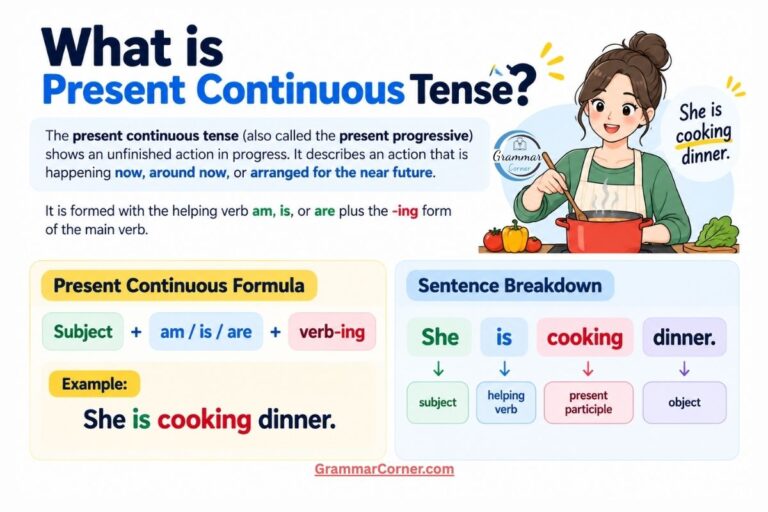
The easiest way to learn grammar is to use it in real conversations instead of simply memorizing rules. While learning grammar rules is important, using them in everyday speaking helps you understand and remember them much more effectively. Among the English tenses, the present continuous tense is one of the most useful because it allows you to describe actions happening right now, temporary situations, ongoing changes, and even planned future arrangements.
I am reading this page.
She is staying with her aunt.
Prices are rising again.
We are leaving on Friday.
What You Will Find in this Article?
- 150+ conversation questions with answersOrganized from beginner to advanced levels.
- Classroom activitiesReady to run with pairs, groups, or a whole class.
- Speaking tipsPractical advice for sounding natural, not scripted.
- Common mistakesThe errors learners repeat most, with the fix for each.
What Are Present Continuous Conversation Questions?
Present continuous conversation questions are speaking prompts that encourage learners to answer using the be verb + verb-ing structure.
For example:
What are you doing right now?
I am studying English.
These questions help learners develop:
Two mistakes to watch for from the very first question
Almost every error in a spoken present continuous answer is one of these two, and both are worth correcting on day one before they harden into habits.
The first drops the be verb. The second drops the -ing. Both halves are compulsory, every single time.
Speaking tip: use contractions out loud
On paper, I am studying English is perfect. Out loud, most speakers say I’m studying English. The same goes for he’s, she’s, we’re and they’re. Practising the contracted forms is the quickest way to stop sounding like a textbook.
One exception worth knowing early: in a short answer, the positive form never contracts. Yes, I am is correct; Yes, I’m is not.
Why speaking beats memorising
A learner who can recite the rule subject + am/is/are + verb-ing still freezes when someone asks what they are doing. The rule lives in one part of the brain; the answer has to come from another. Conversation questions close that gap by making you produce the structure under mild pressure, which is the only condition under which it becomes automatic.
Warm-up: answer these four
Before the main question lists, check that the basic shape is solid.
Correct so far: 0 of 41. What are you doing?
2. Is your brother sleeping? — he is.
3. What are your friends doing?
4. Are you listening to me? — you are not.
Before you start the question lists
- Every answer needs both halves: am/is/are and a verb ending in -ing.
- Match the be verb to your own subject, not to the one in the question.
- Say the contracted forms out loud — I’m, he’s, they’re.
- Positive short answers stay uncontracted: Yes, I am.
- Answer in a full sentence at least once per question. Fluency comes from producing the structure, not recognising it.
Beginner Present Continuous Conversation Questions with Answers
These beginner-friendly questions help learners practice talking about actions happening right now. Encourage students to answer in complete sentences and add extra details whenever possible.
Everyday Activities Present Continuous Conversation Questions with Answers
These questions focus on daily routines and activities that people may be doing at the moment or around the present time.
Family and Friends Present Continuous Conversation Questions with Answers
These questions help learners talk about what their family members and friends are doing right now or around the present time.
What is your mother doing right now?
My mother is preparing lunch in the kitchen. She’s also listening to her favorite songs while she cooks.
What is your father doing at the moment?
My father is working in his office. He’s finishing an important project today.
Are your brothers or sisters studying right now?
Yes, they are studying for their exams. They’re working very hard this week.
What are your best friends doing today?
My best friends are attending their college classes. They’re also preparing for a group presentation.
Is anyone in your family watching TV now?
Yes, my younger brother is watching a cartoon. He watches it every afternoon after school.
Who is helping your family at home today?
Everyone is helping at home today. My parents are cooking, and I’m cleaning the living room.
Are your grandparents visiting you this week?
Yes, they are visiting us this weekend. We’re planning to spend some quality time together.
What is your best friend learning these days?
My best friend is learning graphic design. He’s taking an online course to improve his skills.
Are your cousins traveling anywhere this month?
Yes, they’re traveling to the northern areas for their vacation. They’re really excited about the trip.
What are you and your family doing this evening?
We’re having dinner together this evening. After dinner, we’re watching a movie as a family.
School and College Present Continuous Conversation Questions with Answers
These questions encourage learners to discuss activities happening in school, college, or university.
What subjects are you studying this semester?
I’m studying English, mathematics, and computer science this semester. I’m enjoying English the most.
Are your teachers giving you homework this week?
Yes, they’re giving us homework almost every day. It keeps us busy after school.
What is your teacher explaining right now?
My teacher is explaining the present continuous tense. She’s giving us many examples to help us understand it.
Are your classmates paying attention in class?
Yes, most of them are paying attention. They’re asking questions whenever they don’t understand something.
Who is sitting beside you in class?
My close friend is sitting beside me. We often help each other with difficult lessons.
Are you preparing for any exams these days?
Yes, I’m preparing for my final exams. I’m studying for several hours every day.
What project are you working on?
I’m working on a science project with my classmates. We’re collecting information from different sources.
Are you participating in any school activities?
Yes, I’m participating in the school’s English speech competition. I’m practicing my speech every evening.
What are your classmates discussing during the break?
They’re discussing tomorrow’s class presentation. Everyone is sharing ideas and suggestions.
Are you enjoying your classes this year?
Yes, I’m enjoying my classes a lot. I’m learning many new things and making good friends.
Work and Office Present Continuous Conversation Questions with Answers
These questions are ideal for adult learners and professionals who want to practice workplace English.
1What are you working on these days?
Sample answerI’m working on a new project for my company. It’s challenging, but I’m learning a lot.
It’s challenging is simple present, not continuous. A quality is not an action in progress, so it is being challenging would be wrong here.
2Are you attending any meetings today?
Sample answerYes, I’m attending two meetings today. One is in the morning, and the other is after lunch.
The second sentence states facts about a schedule, so it stays in the simple present.
3What is your manager doing right now?
Sample answerMy manager is talking with a client. They’re discussing the details of a new business deal.
4Are your coworkers helping you with your project?
Sample answerYes, they are helping me whenever I need support. We work well as a team.
Two reasons for the simple present here: need is a stative verb, and we work well as a team is a general truth, not something happening this minute.
5What skills are you improving at work?
Sample answerI’m improving my communication and leadership skills. They’re helping me become more confident at work.
6Are you learning any new software?
Sample answerYes, I’m learning a new project management tool. It’s making my work more organized.
7What are your colleagues discussing?
Sample answerThey’re discussing next month’s marketing campaign. Everyone is sharing creative ideas.
8Are you working from home or from the office?
Sample answerI’m working from the office this week. I enjoy meeting my coworkers in person.
A general feeling, so simple present. Compare question 10, where enjoying is correct because it describes a temporary stretch of time.
9What are you doing during your lunch break?
Sample answerI’m eating lunch with my colleagues. We’re also talking about our weekend plans.
10Are you enjoying your current job?
Sample answerYes, I’m enjoying my current job. I’m gaining valuable experience and working with supportive people.
One verb, two tenses, eight questions apart
Look at enjoy in questions 8 and 10. Both answers are correct, and the difference is worth stopping for.
A permanent feeling. True last year, true next year.
A temporary stretch. This job, this period, and it may change.
Verbs of liking usually sit in the simple present, but they move into the continuous when you attach them to a limited period. That is why I’m enjoying this book sounds natural while I’m liking chocolate does not.
Hobbies and Free Time Present Continuous Conversation Questions with Answers
These questions encourage learners to talk about their hobbies, interests, and leisure activities using the present continuous tense.
1What hobby are you enjoying these days?
Sample answerI’m enjoying photography these days. I’m learning how to take better pictures with my phone.
2Are you reading any interesting books at the moment?
Sample answerYes, I’m reading a historical novel. The story is becoming more exciting with every chapter.
3What game are you playing these days?
Sample answerI’m playing a strategy game on my computer. It’s helping me improve my problem-solving skills.
4Are you learning a musical instrument?
Sample answerYes, I’m learning to play the guitar. I’m practicing for about thirty minutes every evening.
5What are you watching on TV or online these days?
Sample answerI’m watching a travel documentary series. It’s teaching me about different countries and cultures.
6Are you collecting anything these days?
Sample answerYes, I’m collecting old coins from different countries. It’s becoming one of my favorite hobbies.
7What are you practicing these days?
Sample answerI’m practicing my English speaking skills. I’m also learning a few new expressions every day.
8Are you spending more time outdoors these days?
Sample answerYes, I’m spending more time in the park. I’m trying to stay active and enjoy the fresh air.
9What new skill are you developing?
Sample answerI’m developing my cooking skills. I’m trying a new recipe almost every weekend.
10Are you trying any new hobbies this year?
Sample answerYes, I’m trying gardening for the first time. I’m learning how to grow flowers and vegetables at home.
Shopping and Food Present Continuous Conversation Questions with Answers
These questions help learners discuss shopping habits, meals, and food-related activities using the present continuous tense.
Travel and Transportation Present Continuous Conversation Questions with Answers
These questions allow learners to talk about travel plans, transportation, and journeys using the present continuous tense.
Weather and Nature Present Continuous Conversation Questions with Answers
These questions help learners describe the weather, seasons, and natural surroundings using the present continuous tense.
What is the weather doing right now?
It’s raining lightly outside. The streets are becoming wet, so people are carrying umbrellas.
Is the sun shining today?
Yes, the sun is shining brightly today. The weather is perfect for spending time outdoors.
Are the clouds moving quickly?
Yes, they’re moving across the sky quite fast. It looks like the weather is changing.
What are the birds doing outside?
The birds are singing in the trees. Some of them are flying from one branch to another.
Is the wind blowing strongly?
No, it isn’t blowing very strongly. There’s only a gentle breeze this afternoon.
What are the children doing in the park?
They’re playing football and riding their bicycles. Everyone seems to be having a great time.
Are the flowers blooming in your garden?
Yes, they’re blooming beautifully. Their bright colors make the garden look wonderful.
What are the leaves doing?
The leaves are falling from the trees because autumn is beginning. The ground is becoming colorful.
Is it snowing where you are?
No, it isn’t snowing here. The weather is warm and sunny today.
How is the weather changing today?
The temperature is rising, and the sky is becoming clearer. It looks like we’re going to have a pleasant evening.
Future Arrangement Present Continuous Conversation Questions with Answers
The present continuous tense is often used to talk about planned future events and arrangements. These questions help learners practice this important use.
What are you doing this evening?
I’m having dinner with my family this evening. After that, I’m watching a movie with my brother.
Are you meeting anyone tomorrow?
Yes, I’m meeting one of my old friends tomorrow afternoon. We’re having coffee together.
Where are you going this weekend?
I’m going to the beach with my cousins this weekend. We’re planning to spend the whole day there.
Are you visiting your grandparents soon?
Yes, I’m visiting my grandparents next Sunday. They always enjoy spending time with us.
What are you doing after school today?
I’m attending my English class after school. Then I’m finishing my homework at home.
Are you traveling anywhere next month?
Yes, I’m traveling to Islamabad next month. I’m going there for a family gathering.
Who are you having lunch with tomorrow?
I’m having lunch with my classmates tomorrow. We’re celebrating a friend’s birthday.
What are you doing during your next vacation?
I’m visiting some beautiful tourist attractions. I’m also taking lots of photographs.
Are you joining any classes next week?
Yes, I’m joining a computer programming course. I’m excited to learn something new.
What are you planning for this weekend?
I’m cleaning my room, finishing my homework, and spending time with my family. It’s going to be a busy but enjoyable weekend.
Temporary Situation Present Continuous Conversation Questions with Answers
The present continuous tense is also used to describe temporary situations that are happening around the present time but won’t last forever.
Changing Situations Present Continuous Conversation Questions with Answers
We also use the present continuous tense to talk about changes and developments that are happening over time.
Picture Description Present Continuous Conversation Questions with Answers
Picture description activities encourage learners to observe a scene and describe what people, animals, or objects are doing. These questions improve speaking skills, vocabulary, and confidence.
Imagination and Creative Present Continuous Conversation Questions with Answers
These questions encourage learners to use their imagination while practicing the present continuous tense. There are no right or wrong answers, making them excellent for developing speaking confidence.
Imagine you’re on a beach. What are you doing?
I’m sitting under a large umbrella and reading a book. My friends are swimming in the sea nearby.
Imagine you’re in a zoo. What are the animals doing?
The monkeys are climbing trees, and the elephants are drinking water. The lions are resting in the shade.
Imagine you’re at a birthday party. What is everyone doing?
Everyone is singing, dancing, and enjoying the music. The children are opening presents and playing games.
Imagine you’re flying in a helicopter. What are you looking at?
I’m looking at mountains, rivers, and forests below. Everything is looking beautiful from above.
Imagine you’re visiting another country. What are you doing there?
I’m exploring famous places, tasting local food, and meeting friendly people. I’m taking lots of pictures as well.
Imagine you’re in a library. What are people doing?
People are reading quietly, studying for exams, and borrowing books. Everyone is respecting the peaceful environment.
Imagine you’re camping in a forest. What are you doing?
I’m setting up a tent and preparing dinner over a campfire. My friends are collecting firewood nearby.
Imagine you’re on a spaceship. What are you doing?
I’m looking through the window at the Earth. The astronauts are checking the equipment and conducting experiments.
Imagine you’re at a music festival. What are people doing?
People are dancing, singing, and cheering for their favorite bands. Everyone is having an amazing time.
Imagine you’re in a large shopping mall. What are you doing?
I’m visiting different stores and buying a few things. I’m also enjoying a meal at the food court.
Pair Work Present Continuous Conversation Questions with Answers
These questions are perfect for classroom pair activities. Students can ask and answer the questions with a partner to improve their speaking fluency.
What are you doing after this class?
I’m going home and finishing my homework. After that, I’m relaxing for a while.
Are you learning anything new this month?
Yes, I’m learning how to create websites. It’s interesting and very useful.
What are you trying to achieve this year?
I’m trying to improve my English speaking skills. I’m practicing every day to become more confident.
Are you spending enough time with your family these days?
Yes, I’m spending more time with them in the evenings. We usually have dinner together.
What are you doing to stay healthy?
I’m exercising regularly and eating healthy food. I’m also drinking more water every day.
Are you saving money for something special?
Yes, I’m saving money for a new laptop. I hope to buy it soon.
What are you improving in your life right now?
I’m improving my communication skills. They’re becoming better through regular practice.
Are you helping anyone these days?
Yes, I’m helping my younger brother with his homework. We study together every evening.
What are you looking forward to this month?
I’m looking forward to my family vacation. We’re planning to visit some beautiful places.
Are you enjoying learning English?
Yes, I’m enjoying it very much. I’m becoming more confident every time I practice speaking.
Classroom Activities for Practicing Present Continuous Conversation Questions
These engaging classroom activities help students use the present continuous tense in meaningful conversations. They encourage speaking, listening, teamwork, and confidence.
Activity 1: Find Someone Who Is…
Objective
Instructions
- Give each student the list below.
- Students walk around the classroom and ask different classmates questions.
- When they find someone who answers “Yes,” they write that person’s name.
- Encourage students to ask follow-up questions to keep the conversation going.
The step students always miss
The list is written in the third person — someone who is studying — but nobody can be asked a question in that form. Students have to flip it to Are you studying…? to ask, then flip it back to Ayesha is studying… to report it. Three forms of one sentence, and the be verb changes every time while the -ing word never moves.
Tap any prompt below to see all three.
Find Someone Who Is…
- studying for an exam
- reading an interesting book
- learning a new skill
- wearing something blue
- planning a trip
- practicing English every day
- watching a new TV series
- exercising regularly
- saving money for something special
- trying a new hobby
Example Conversation
Are you studying for an exam these days?
Yes, I am. I’m preparing for my English exam next week.
Great! I’ll write your name here.
Activity 2: Guess the Action
Objective
Instructions
- One student silently acts out an action.
- The other students ask present continuous questions or make guesses.
- The first student who guesses correctly performs the next action.
Example Actions
Example Conversation
Are you cooking something?
No, I’m not.
Are you washing clothes?
Yes, I am!
Why this activity teaches short answers better than a worksheet
Look at what Student B says: No, I’m not and Yes, I am. The negative is contracted and the positive is not — which is exactly the rule, arriving by itself because those are the forms that feel natural to say out loud.
If a student says Yes, I’m, the game itself makes it sound wrong before you have to explain anything.
Speaking Tips for Answering Present Continuous Conversation Questions
Following these simple tips will help learners sound more natural and confident when answering present continuous questions.
Answer in Complete Sentences
Instead of giving one-word answers, use complete sentences.
Add Extra Information
After answering the question, include one or two more details to continue the conversation.
Example
What are you reading?
I’m reading a science fiction novel. It’s full of exciting adventures, and I’m really enjoying it.
Use Time Expressions
Time expressions make your answers sound more natural. Examples include:
Example
I’m learning Spanish these days.
Not all eight point at the same time
Six of them describe now or a period around now. But tonight usually points forward: I’m meeting my cousin tonight is a plan, not something happening as you speak. Same tense, different job — and the time expression is what tells your listener which one you mean.
Use Contractions in Conversations
Native English speakers often use contractions in everyday speech. Examples:
Example
Instead of saying I am studying, say I’m studying.
Two places where contractions do not work
There is no contraction for am not. The only option is I’m not — amn’t does not exist in standard English.
And a positive short answer never contracts. Yes, I am is correct; Yes, I’m is not a sentence. The negative one does contract, which is why No, I’m not is fine.
Ask a Follow-up Question
Good conversations don’t end after one answer.
Example
What are you doing this weekend?
I’m visiting my grandparents. What are you doing?
Notice that neither speaker is describing this moment. Both are using the present continuous for an arranged plan, and this weekend is the word doing that work.
Speak Naturally
Don’t worry about speaking too fast. Focus on speaking clearly and naturally. It’s perfectly fine to pause briefly while thinking about your answer.
Practice with Different Topics
Practice talking about school, work, hobbies, family, travel, food, and daily activities. The more topics you practice, the more confident you’ll become.
Drill: put the tips into practice
Five quick checks on the seven tips above.
Correct so far: 0 of 51. Are you studying for an exam? — which answer follows tips 1 and 2?
2. Which time expression usually points to a plan rather than this moment?
3. How do you contract I am not watching TV?
4. Your partner says I’m visiting my grandparents. What keeps the conversation alive?
5. In Activity 1, Sara says Yes, I am. I’m learning to code. How do you write it on your sheet?
Key takeaways from this section
- Activity 1 makes students move one sentence through three forms: is studying → Are you studying? → Ayesha is studying. Only the be verb changes.
- Activity 2 teaches short answers by ear: Yes, I am stays full, No, I’m not contracts.
- Answer in a full sentence, then add one more detail.
- Time expressions do real work — tonight turns the same tense into a plan.
- Contract everywhere except a positive short answer, and remember amn’t does not exist.
Common Mistakes When Answering Present Continuous Conversation Questions
Many English learners make similar mistakes when using the present continuous tense. Learning these common errors will help you speak more accurately.
Forgetting the Verb Be
The present continuous always requires a form of the verb be (am, is, or are) before the -ing verb.
Using the Base Verb Instead of the -ing Form
After am, is, or are, the main verb must end in -ing.
Using the Wrong Form of Be
Match the correct helping verb with the subject.
- I → am
- He/She/It → is
- You/We/They → are
Using the Present Continuous with Stative Verbs
Some verbs, such as know, believe, understand, love, and need, are usually not used in the present continuous.
Forgetting the Subject
Every complete sentence needs a subject unless it’s an imperative.
Answering with Only One Word
Complete answers help improve your grammar, vocabulary, and speaking confidence.
Using the Present Continuous for Habits
The present continuous describes actions happening now or temporary situations, while the simple present describes routines and habits.
See also
Similar Posts
Present Perfect Conversation Questions with Answers
When Do We Use the Present Perfect in Conversations? The present perfect tense is common in everyday English conversations because it connects the past with the present. We use it when the exact time of an action is unknown, unimportant, or still connected to the present moment. Whether you’re talking about experiences, recent activities, or…
Simple Present Tense Chart (All Rules Explained With Examples)
The simple present tense (also called the present simple tense) describes actions and situations that are generally true. It talks about facts or situations that are true in general, not just what is happening right now. Look at the simple present examples: I drink tea every morning. What does this one describe? A habit —…
Present Simple Conversation Questions with Answers
The present simple tense is one of the most commonly used tenses in everyday English. Practicing conversation questions is one of the best ways to become comfortable using this tense in real-life situations. Habits I get up at six. Routines She works every day. Facts Water boils at 100°C. Permanent situations They live in Faisalabad….
Present Perfect Tense Chart, Rules, Structure & Examples
Two sentences, one small difference: I lost my keys. A closed story — it happened, it ended. I have lost my keys. A problem you still have right now. The first one is a closed story. It happened, it ended, and you may well have found the keys an hour later. The second one is…
Present Continuous Tense (Formula, Chart, Examples)
What is Present Continuous Tense? The present continuous tense (also called the present progressive) shows an unfinished action in progress. It describes an action that is happening now, around now, or arranged for the near future. It is formed with the helping verb am, is, or are plus the -ing form of the main verb….